From LinkedIn Comparison Panic to Steadier Focus: A Small-Action Reset

Finding Clarity on the TTC: The 8:14 a.m. Scroll
You open LinkedIn “just to stay informed,” and 40 minutes later you’ve saved five internships, stalked three profiles, and somehow still haven’t taken one real step—classic LinkedIn comparison spiral.
Jordan said that to me like it was a confession, but their tone was almost flat—like they’d repeated it so many times it had turned into background noise.
I could picture it before they even finished the sentence. 8:14 AM on a Monday, Line 1 heading south. One hand on the pole, coffee cooling in a paper cup. The TTC announcement crackling overhead while the screen glow turns their face into a little blue-lit island. Then it happens: “Incoming Intern @ [Big Name].”
Jordan’s jaw tightens—so hard they actually notice it—and their chest does that quick, sharp squeeze that doesn’t feel like a feeling so much as a physical alarm. And their mind starts inventorying like it’s scanning barcodes: logos, dates, schools, titles. They want to feel happy for their friends. They also feel like their own timeline just got put on trial in public.
“LinkedIn makes it feel like everyone is graduating into success and I’m graduating into confusion,” they told me. “I don’t even know if I want that internship. I just want to stop feeling behind.”
I watched their fingers pick at the corner of their sleeve—small, restless, like their body was trying to edit something invisible.
The insecurity wasn’t abstract. It was like standing in front of a scoreboard that keeps updating without your consent—numbers flickering faster than your nervous system can keep up—and every refresh lands as, Here’s who you are today.
“Okay,” I said softly, keeping my voice steady. “We’re not going to shame you for having a human brain in an algorithmic environment. But we are going to name the pattern, and then we’ll build you one clear, repeatable next step. Let’s draw a map through the fog—something that leads to actual clarity, not just more scrolling.”

Choosing the Compass: The Celtic Cross · Context Edition
I asked Jordan to take one slow breath—nothing mystical, just a nervous-system gear shift. While I shuffled, I had them hold the question in a plain sentence: “When I see my friends’ internships on LinkedIn, what self-worth pattern fires?”
“Today,” I said, “we’ll use the Celtic Cross · Context Edition.”
For readers who’ve heard of the Celtic Cross but never used it: it’s built for situations like this because it doesn’t stop at the surface trigger. It traces the whole chain—what hits you first, what blocks you next, what story you consciously tell yourself, what habit has been feeding it, the deeper root underneath… and then it shows the stabilizer: the approach that actually interrupts the loop.
This version is a Context Edition because it makes space for the modern environment—Position 8 is tuned specifically to social-media visibility and peer comparison dynamics. And the “outcome” isn’t a prediction like a fortune cookie; it’s an integration trajectory: the stance you can embody moving forward.
I pointed to the shape I’d make on the table: “The center cross shows the collision point—your immediate reaction and what crosses it. The lower position touches the root. The right-hand card in the cross shows what’s approaching if nothing changes. Then the side ladder—self, environment, hopes/fears, integration—shows how to climb out.”
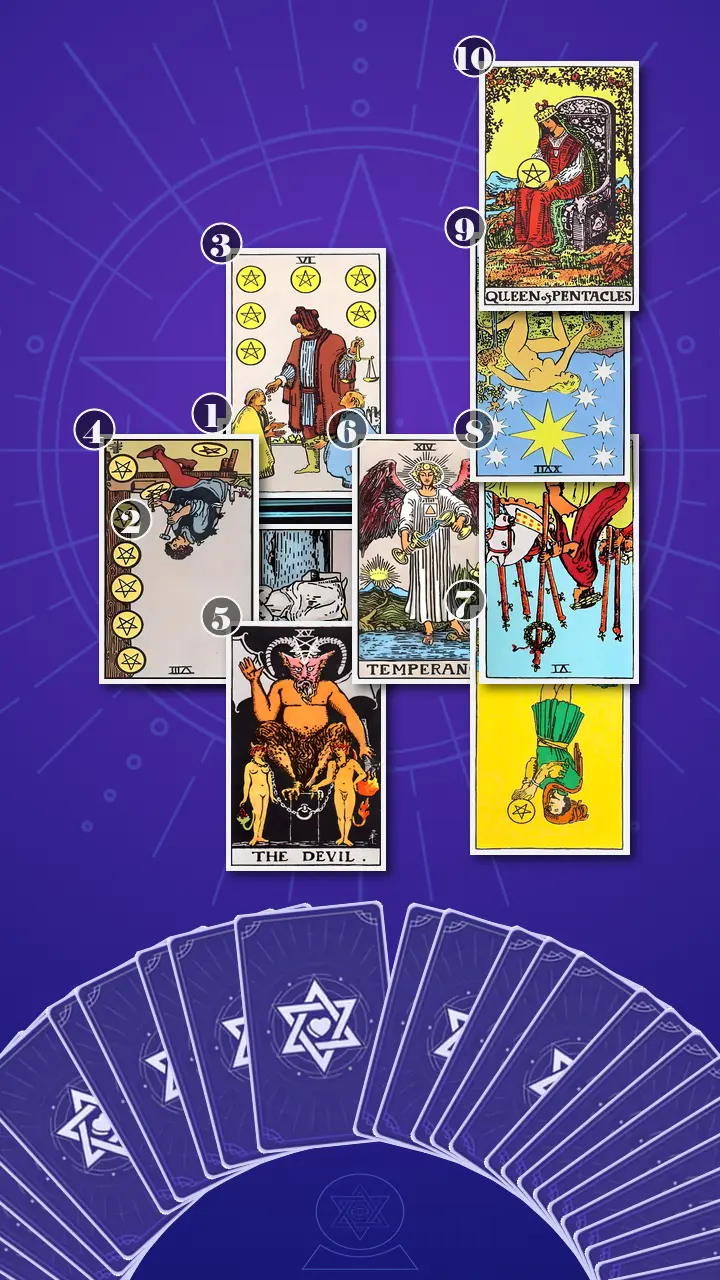
Reading the Map: When the Feed Became a Courtroom
Position 1: The Immediate Reaction Pattern
“Now flipped over,” I said, “is the card that represents the immediate reaction pattern when seeing friends’ internship posts—what shows up in mind and body right away.”
Nine of Swords, upright.
Even before I spoke, Jordan let out a quick, sharp breath through their nose—like the card had already done the explaining.
“This,” I said, “is the night-brain card. The one that turns thoughts into threats.” I tapped the image lightly: a figure sitting up in bed, swords lined up on the wall like accusations, a dark enclosed room. “Your feed becomes a private courtroom.”
And I used the most modern translation I could, because Jordan wasn’t living in medieval symbolism; they were living in a phone. “This is like when you close the laptop but your brain keeps replaying company logos like a screensaver you can’t exit.”
I mirrored the scene the way it actually happens: “11:48 PM, laptop closed. But in your head it’s: If they got it, then… / If I don’t have it by now, then… / If someone looks at my resume, then…”
“Saying it out loud sounds… dramatic,” Jordan said, then gave a short laugh that wasn’t funny. “But it’s true. It’s like—brutally accurate.”
“It’s accurate,” I said, “and it’s also not a verdict. LinkedIn didn’t ruin your confidence—your brain turned the feed into a courtroom.”
Energetically, this is Air in excess—thinking that won’t stop, analysis that doesn’t lead to movement. It keeps you in a loop where you feel busy, but you’re not actually safer.
Position 2: The Crossing Snag That Freezes Motion
“Now we’re looking at what blocks motion in the moment—the specific self-trust snag that keeps comparison looping.”
Two of Swords, reversed.
I didn’t need to invent a metaphor; the card already looked like one: blindfold, crossed swords, a calm sea with rocks you can’t quite see.
“Reversed,” I said, “this is the blindfold slipping. You can’t stay neutral anymore. The ‘I’m fine, I’m just gathering information’ stance starts straining.”
Then I named the micro-snag as precisely as I could: “Not lack of ambition. Not laziness. It’s decision-as-risk.”
I described the tab-switching visual Jordan had basically narrated earlier: “LinkedIn → job posting → friend’s profile → resume doc → back to LinkedIn. Your brain keeps you moving around the decision so you don’t have to be seen making one.”
Jordan’s shoulders lifted for half a second—like a flinch—then dropped. Relief and discomfort at the same time. “That’s… painfully true,” they said. “I keep saying I’m ‘still figuring it out,’ but it’s really… I’m avoiding being seen trying.”
“Exactly,” I said. “The blindfold feels like safety. But clarity requires one small, imperfect choice.”
Position 3: The Conscious Worth Story
“Now flipped over is the conscious story you tell yourself about worth, fairness, and what you ‘should’ have by now.”
Six of Pentacles, upright.
The scales in the giver’s hand stood out immediately. “This is your internal scholarship committee,” I said—gentle, not mocking. “You’re measuring whether you ‘deserve’ opportunities. LinkedIn makes it look like career progress is a public distribution of worth—who gets the coin and who doesn’t.”
I grounded it in Jordan’s reality: “Right after a rejection, you open the app and see a big-name logo. Your stomach drops and your brain goes straight to a ledger: GPA, dates, titles, like you’re building a case against yourself.”
Energetically, this is Earth in balance, but used as a weapon: measurement can be practical—until it becomes moral. The card isn’t saying you’re wrong to want support. It’s showing you how quickly ‘evidence’ turns into ‘identity.’
Jordan’s eyes stayed on the scales. “It really does feel like a ranking,” they said quietly. “Like silence equals… not picked.”
“Silence equals silence,” I said. “Your brain is adding a whole story.”
Position 4: The Habit Pattern That Set This Up
“Now we’re looking at the recent habit pattern that set this up—how your effort and focus have been deployed lately.”
Eight of Pentacles, reversed.
I exhaled a little, because this one is so common in early-career spirals. “This is apprenticeship energy—but blocked. It’s work that doesn’t convert into confidence.”
“Modern translation?” I asked, then answered: “Pixel-pushing. Endless formatting. Canva resume redesign spirals. Google Docs template rabbit holes. Tweaking bullet points like they’re life support.”
Jordan groaned. “I did that last night. Like… exactly that.”
“And the trap,” I said, “is that it feels like control. It feels like preparing. But preparation isn’t progress if it never touches the real world.”
Reversed, this is Earth energy misdirected—effort without output, repetition without learning feedback. It keeps you safe from rejection, and it also keeps you from opportunity.
Position 5: The Root Mechanism Under the Spiral
“Now we’re at the root self-worth mechanism that gets activated by LinkedIn—the deeper attachment underneath the spiral.”
The Devil, upright.
I watched Jordan’s face change—not shame, but that “called out” heat. Their lips pressed together; their eyes blinked a little slower.
“This is the algorithmic status ladder,” I said, keeping my tone clean and non-accusatory. “The feed becomes the judge, and you become the defendant.”
I pointed to the chain around the figures’ necks. “The detail most people miss is that the chains are loose. You could close the app. But something in you reaches for it anyway. Not because you’re shallow—because your brain is trying to borrow authority from prestige.”
Values vs prestige. Self-definition vs externalized power. That’s the conflict frame here.
Jordan swallowed. “It’s like… I know it’s curated. I know people only post wins. And still…”
“Still it lands like truth,” I finished. “That’s Devil energy: pressure that masquerades as fact.”
Position 6: The Near-Term Stabilizer (Key Card)
I slowed my hands before turning the next card. The room got quieter in that way it does when you can feel the reading pivot from diagnosis to exit route.
“Now flipped over,” I said, “is the card that represents the near-term stabilizer—what kind of approach helps you shift from comparison to grounded action.”
Temperance, upright.
Jordan leaned in, like their body recognized this might be something they could actually do.
Setup: “You know that moment on the TTC ride home when you see ‘Incoming Intern’ and your jaw locks—then you get home, open your laptop, and somehow an hour disappears into bullet points without one real submission. You’re stuck between ‘I need proof’ and ‘I need relief.’”
Delivery:
Stop treating the feed like a verdict and start treating your week like a blend—Temperance’s two cups remind you to mix outreach, practice, and rest into a pace you can actually sustain.
I let it hang for a beat, like a line of dialogue in an old film where the entire plot shifts on a single sentence.
Reinforcement: Jordan’s breath caught—just a tiny freeze—then their gaze went unfocused, like they were replaying a week of evenings in fast-forward. Their jaw unclenched on its own. Their shoulders lowered in increments, not all at once, like a tight strap being loosened notch by notch. Then, unexpectedly, their eyes flashed with a quick irritation.
“But that sounds so… boring,” they said, and there was real heat under it. “Like, if the answer is a routine, does that mean I’ve been doing it wrong the whole time?”
I nodded, because that reaction makes sense. “It doesn’t mean you were wrong,” I said. “It means you were using intensity to try to buy certainty. Temperance doesn’t shame intensity—it just replaces it with structure.”
This is where my own brain always reaches for Einstein. In my studio, I do it with paint; in readings, I do it with patterns. “Think of this as a thought experiment,” I told them. “In physics, Einstein would change one variable and watch what happens. We’re doing the same. Not a life overhaul. One variable: after a trigger, you blend one action you can control.”
“Here’s the experiment,” I continued, using the exact practical sequence Temperance wanted from us: “Set a 10-minute timer. Step 1 (2 min): write the exact post-scroll sentence in your head (word-for-word). Step 2 (6 min): do ONE ‘two-cups’ action—either (A) send one low-stakes message (3 sentences, no perfecting) or (B) submit one application after a single review pass. Step 3 (2 min): close LinkedIn and put your phone face-down. If your chest tightens or you feel panicky, pause and scale it down: draft the message without sending, or open the application and fill only contact info. You’re allowed to stop anytime—this is practice, not a test.”
I watched Jordan’s hands—tight, then loosening, then resting flat. “Now,” I asked, “use this new lens and look back at last week. Was there a moment when you could’ve swapped one scroll for one two-cups action—and felt different in your body?”
Jordan’s voice dropped. “Wednesday. Kitchen. Microwave humming. I did the whole profile-stalk thing. If I’d sent one message instead… I would’ve gone to bed like… a person. Not a defendant.”
And that was the shift in real time: from comparison spike and urgency toward cautious self-trust through one grounded action. That’s what finding clarity actually looks like—small, specific, and a little tender.
Position 7: How You’re Relating to Your Own Readiness
“Now we’re looking at your role in the cycle—how you’re relating to your skills, readiness, and ‘beginner’ identity.”
Page of Pentacles, reversed.
“This is waiting for a permission slip,” I said. “A title. A logo. A perfect resume line. Something that proves you’re allowed to be in the room.”
I kept it grounded: “Reversed, the Page can get tunnel vision on one symbol of worth. Internship title as the only proof you belong.”
Energetically, this is Earth in deficiency—learning energy stalled by fear of being publicly seen as a beginner. And here’s the truth: internships are literally designed for beginners. The card is reminding you that ‘not finished’ is not the same as ‘not worthy.’
Jordan’s mouth twisted into a half-smile, half-wince. “I hate how accurate that is.”
“Good,” I said. “Accuracy gives us leverage.”
Position 8: The Platform as an Environment (Not a Neutral Space)
“Now we’re looking at the social-media environment factor—how public wins, visibility, and algorithmic highlights shape your perception.”
Six of Wands, reversed.
“This is announcement culture,” I said. “The wreath, the crowd, the raised wand—it’s the stage.”
Reversed, the energy tilts into feeling overlooked, or interpreting quiet progress as failure because it isn’t applauded. “The feed is loud,” I told Jordan, “and your growth is allowed to be quiet.”
Jordan nodded, slowly. “It really does feel like… if it’s not posted, it didn’t happen.”
“And that’s the algorithm doing its job,” I said. “Not the universe declaring your worth.”
Position 9: The Hope/Fear Pulse About the Long Game
“Now we’re looking at your hope and fear about the long game—what you’re afraid it means, and what you’re longing to feel instead.”
The Star, reversed.
This card always changes the air in the room. Less adrenaline, more ache.
“This is the feed as sky going dark,” I said. “Refreshing for a sign you’re okay, and getting nothing that sticks.”
Reversed Star energy is hope in deficit—not because you’re hopeless, but because you’ve been trying to force reassurance through external signs. “Loud proof vs quiet evidence,” I said. “Your nervous system wants a guarantee, and the internet is happy to sell you the feeling of being behind.”
Jordan’s eyes went shiny, then they blinked it away like they were embarrassed by their own humanity.
“Don’t fight that,” I told them. “The spiral isn’t just stress. It’s a dimming of guidance. And the fix isn’t a bigger motivational speech. It’s rebuilding trust with receipts.”
Position 10: Integration—The Self-Worth Stance That Holds
“Now flipped over,” I said, “is integrated direction for self-worth—the grounded stance and practical boundary/action style to embody moving forward.”
Queen of Pentacles, upright.
I loved seeing this here. Not because it promised Jordan a specific company logo, but because it promised a way of holding themselves.
“Look at her posture,” I said. “She holds the pentacle securely. Worth is held, not chased.”
“This is self-worth as stewardship,” I added. “Not as a scoreboard.”
In modern life, the Queen is budgeting attention like money: protect it, invest it, let it grow. A career as a garden, not an emergency room.
Jordan’s face softened. “That… feels like a person I could become,” they said. “Not overnight. But… yeah.”
From Comparison to Actionable Advice: The One-Week Temperance Blend
Here’s the story your spread told, start to finish: the trigger hits (Nine of Swords) and your mind instantly turns a feed into a courtroom. The thing that freezes you isn’t a lack of work ethic—it’s decision-as-risk (Two of Swords reversed). Consciously, you keep trying to make career progress “fair” by treating it like a public allocation of worth (Six of Pentacles), and your recent coping habit has been polishing instead of shipping (Eight of Pentacles reversed). Underneath it all is the real engine: you’ve been handing authority to status symbols and algorithms (The Devil). The way out isn’t more information—it’s regulation through rhythm (Temperance), reclaiming beginner identity (Page of Pentacles reversed), changing the “stage” effect of the platform (Six of Wands reversed), and rebuilding hope with quiet evidence (Star reversed), until you’re living the Queen of Pentacles stance: grounded, steady, self-respecting.
The cognitive blind spot I want to name gently is this: you’ve been treating feeling behind as if it’s the same thing as being not good enough. And you’ve been trying to fix that feeling by collecting more proof, when what your nervous system actually trusts is consistency.
The transformation direction is simple and very doable: shift from using other people’s milestones as a verdict to using them as neutral information—while committing to one small, repeatable action you can control.
Here are your next steps—small on purpose:
- The 3-Sentence Message (Visibility Cup)Once this week, write and send one 3-sentence informational message to one person (alumni, a friend-of-a-friend, or someone in a role you’re curious about): 1) why you’re reaching out, 2) what you’re curious about, 3) a low-pressure ask (10 minutes on Zoom, or one question by text).Expect the urge to over-explain. Don’t. Lower the bar: kind, clear, no cleverness. If anxiety spikes, draft it today and send it tomorrow—the win is the habit, not the adrenaline.
- The 20-Minute Good-Enough Submission (Action That Touches Reality)Pick one internship listing. Set a 20-minute timer. Do a single review pass, attach your resume, and hit submit—no redesigning the whole document, no “just one more template.”When your brain says “too small to matter,” that’s the Devil trying to renegotiate control. Submit anyway. Good-enough action builds self-trust faster than perfect materials.
- The Evidence Log (Hope Cup)Three times this week, add one line to a one-page note on your phone with three headings: Skill practiced / Action taken / Support noticed. Keep it factual (e.g., “20 min mock interview,” “sent one message,” “friend replied kindly”).If it turns into self-judgment, you’re doing it too emotionally. Make it boring. Receipts rebuild Star-energy better than inspiration.
And because Temperance is about blending, I gave Jordan a structure that feels like my own artist brain: I asked them to treat the next week like a Beethoven symphony—not in the “be perfect” way, but in the “themes repeat until they become you” way. One small motif for visibility (message/apply), one for ability (practice/build), one for recovery (walk, food, sleep). Same three movements, on repeat. No grand finale required.
For focus, I also offered one of my studio tricks—my Manuscript Mindmaps strategy: if they got stuck in tab-switching freeze, they’d grab paper and do 60 seconds of “mirror writing” (writing a sentence backward, messy and private) to interrupt the perfection brain and drop into the body. It’s weird. It works. It’s a hard reset without needing willpower.

A Week Later: The Quiet Proof
A week later, Jordan messaged me from a rainy Thursday café downtown. Just a short update: “Did the 20-minute submission. I wanted to tweak fonts. Didn’t. Hit submit. Then I put my phone face-down like you said and my shoulders actually dropped.”
They added, almost like they were surprised: “It didn’t magically make me confident. But I felt… less haunted. Like I moved from defendant to person-who-did-a-thing.”
That’s the Journey to Clarity I trust: not fireworks, but a small loosening. The feed stayed loud. Jordan got steadier anyway—because their worth moved from public approval to private consistency.
When other people’s internship titles hit your feed like a verdict, it’s not that you don’t want success—you’re just tired of feeling like your worth has to be approved in public and on a deadline.
If you stopped treating the feed as a judge for one week, what’s the smallest, most repeatable thing you’d want to do—just to prove consistency to yourself, not to anyone watching?
Every reading at AceTarot is designed to connect you with your inner wisdom and empower your next step.
Learn more about our Journey to Clarity.