From Card-Decline Humiliation to One Calm Next Step: Rewriting Money Shame

The Money-Shame Spiral After a Declined Card
If you’ve ever had your card declined at a Toronto checkout and immediately felt the full-body “I need to disappear” wave—hello, money shame spiral.
Jordan (name changed for privacy) slid into the chair across from me with the careful posture of someone trying not to take up space. They’re 28, a junior product designer—smart, sharp, the kind of person who can untangle a messy user flow at work but somehow feels personally indicted by a payment terminal.
They described it like a scene they couldn’t stop rewatching: 8:12 a.m., a Monday rush at a coffee shop near the PATH. Tap. Beep. Tap again. Beep again. The line behind them did that polite-but-not-polite shuffle. The espresso machine hissed like it was judging. Jordan’s phone felt hot in their palm, while the air near the door had that early-winter bite.
“I said ‘Sorry—one sec, sorry!’ like five times,” they told me, voice tight. “And then I stepped aside like I forgot something. It’s not the money, it’s the humiliation.”
On the TTC ride home later, their body kept acting like the spotlight was still on. Hot face. Tight throat. That drop-in-the-stomach that makes you want to shrink into your coat. Their brain went into courtroom mode—replaying the beep like evidence—until they were home at 11:58 p.m. with three tabs open: banking app, a Notion budget template, and an r/personalfinance thread they were reading instead of doing the one neutral thing that might actually help.
What they wanted—what most people want in that moment—was simple: to feel financially capable and dignified. What they feared was brutal: that a small money moment proved they were irresponsible and not “adult enough.”
The shame wasn’t an abstract feeling. It was like their nervous system had turned into a smoke alarm that wouldn’t shut off—loud, insistent, and completely unhelpful for actual problem-solving.
I leaned in a little, letting my voice stay warm and city-real. “We’re going to treat this as what it is: a logistics problem plus a shame surge. Not a moral verdict. Let’s take a Journey to Clarity—one that ends with a single kind step you can actually do.”

Choosing the Compass: The Four-Layer Insight Ladder
I asked Jordan to take one slow inhale, one longer exhale—nothing mystical, just giving the body a chance to come back online. While I shuffled, I had them hold the question in plain language: “Card declined—what money-shame script is running, and what’s one kind next step?”
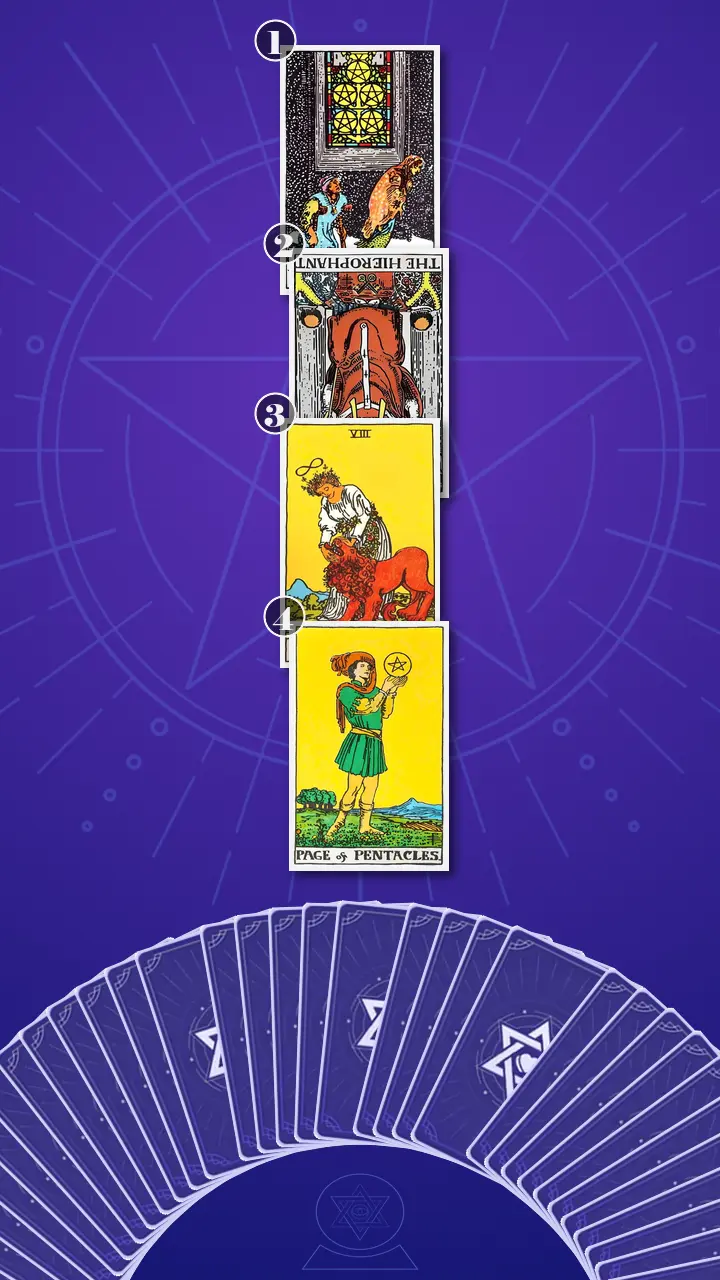
Today, I told them, we’d use a simple four-card spread: the Four-Layer Insight Ladder · Context Edition.
If you’ve ever wondered how tarot works in real life, this is one of the most practical ways: not prediction, but pattern recognition. This spread is designed for a single triggering moment—like a card decline embarrassment—when emotions spike and the mind starts narrating a whole identity story. The ladder format keeps the reading focused: present moment → root script → compassionate pivot → one grounded action.
I previewed the map before we turned anything over. “The first card shows the moment your card declined—what happens in your body in the first 30 seconds. The second card is the money-shame script underneath—the inner rulebook. The third is our pivot: the inner quality that interrupts the spiral. The fourth is the smallest practical next step that restores agency.”
Reading the Ladder: From Exposure to a Kind Step
Position 1: The moment of the decline
“Now I’m turning over the card that represents the moment of the decline: the concrete lived experience and immediate shame response in the body,” I said.
Five of Pentacles, upright.
This card always hits like cold air. And it fit Jordan’s story exactly: Jordan’s card declines at a busy checkout. They do the quick, desperate sequence—tap again, fumble a second card, over-apologize—then escape into the cold with a hot face and a tight throat. The practical problem could be a hold, a wrong account, or a timing issue, but it instantly feels like social exile: “Everyone just saw I don’t belong in the competent-adult club.”
Energetically, the Five of Pentacles is contraction. Not just “money stress”—it’s the body’s reflex to hunch, to hide, to assume you have to limp through it alone. The stained-glass window in the card is the detail I always point to: warmth and support exist, but shame makes you walk past them like you’re not allowed inside.
As Jordan listened, I watched their shoulders creep toward their ears. In my work—Jungian psychology in the mind, and energy flow in the body—I call this an Energy Flow Diagnosis: when shame spikes, it often locks into the neck and shoulders first, like your body is trying to protect your throat from being “seen.” (Not a medical claim—just an energy lens that helps us notice patterns.)
Jordan let out a small, bitter laugh. “That’s… honestly kind of mean. Like, it’s too accurate.”
I nodded. “It’s not mean. It’s honest. And honesty is how we stop the spiral. The Five of Pentacles doesn’t say you’re failing—it shows the exact moment your system decides, ‘I’m excluded,’ when the reality is: you’re standing near a lit window of options.”
Position 2: The money-shame script (the inner rulebook)
“Now I’m turning over the card that represents the money-shame script: the inherited rule or belief that turns a logistics issue into self-judgment,” I said.
The Hierophant, reversed.
Here’s the voiceover. The inner Terms & Conditions you never agreed to—but somehow you’re following.
In modern life, it looks like this: After the decline, Jordan hears an internal lecture: rules about what a ‘proper adult’ would never let happen. They start policing themselves—no more fun, no more meals out, no more asking for help—because money becomes morality. The result is secrecy and paralysis: they’d rather replay the moment a hundred times than make one neutral call that might expose them.
Reversed, the Hierophant’s energy is a blockage: structure turns into shame. Guidance turns into a judge. The crossed keys in the image—meant to open doors—start feeling like locked gates.
I staged the inner rulebook the way it tends to sound for people who grew up around “responsible adult” messaging, or who’ve absorbed too much finance-influencer content at 2 a.m.:
“Adults don’t let this happen.”
“You should have checked.”
“If you were competent, you wouldn’t be here.”
Then I offered the contrast, clean and un-moralized: “Responsible isn’t the same as respectable. Logistics isn’t morality. A declined card is an event—not a character assessment.”
Jordan’s jaw worked once, like they were chewing on the idea. Their gaze dropped to the edge of the table. “It sounds like my dad,” they said, quiet. “And also… like me.”
“That’s the point,” I said gently. “It’s a borrowed authority voice. You can thank it for trying to keep you safe—and then you can stop letting it run your whole nervous system.”
Position 3 (Key Card): The compassionate pivot
“Now I’m turning over the card that represents the compassionate pivot: what inner quality helps you stay present and interrupt the spiral without bypassing reality,” I said. And as I did, the room got noticeably quieter—the kind of quiet you get on a ship at night, when the engine hum becomes background and you can finally hear your own thoughts.
Strength, upright.
Strength isn’t hype. It’s not ‘manifest abundance.’ It’s the calm face and the gentle hands that keep the lion from taking over the room. In modern terms: Jordan catches the moment the spiral starts—hot face, tight throat, stomach drop—and tries something radically simple: they slow their breath and tell the truth without drama: “My card declined.” No extra story. No self-insults. Strength here is staying present long enough to regain choice, so the next step comes from steadiness, not humiliation.
Setup: Jordan was stuck in that specific Toronto-kind-of-shame—walking out of the checkout with their face burning, then replaying it on the TTC like it was proof they weren’t adult enough. The mind wanted one thing: a verdict. Guilty or not guilty. The body wanted one thing: to vanish.
Delivery:
Stop treating the decline as a verdict and start taming the surge with gentle strength—like calming the lion—so you can take one grounded step.
I let it hang there for a beat, the way I used to pause with travelers on transoceanic voyages when they finally admitted what they were afraid to say out loud. Not because I was being dramatic—because the nervous system needs a second to register new information.
Reinforcement: Jordan’s reaction came in layers. First, a tiny freeze: their breath stopped mid-inhale, fingers hovering above their mug. Then the cognition landed—eyes unfocusing like they were replaying the checkout beep, but this time with different subtitles. And then the release: a long exhale that looked like someone setting down a heavy backpack they’d forgotten they were wearing.
“So you’re saying… I don’t have to punish myself into responsibility,” they said, voice a little thinner now, like the armor had loosened.
“Exactly,” I replied. “You don’t need a bigger budget to be worthy—you need a steadier nervous system to make one clear move. Your nervous system deserves a say in your budget.”
I noticed again that neck-and-shoulder clamp, and I brought in my most practical tool—what I teach as a Quick Recovery Technique. “Let’s try 90 seconds,” I said. “Hand on your chest. Three slow breaths. And name it plainly: ‘My card declined.’”
I added a metaphor that always feels like home to me, from the Venetian canals: “In Venice, water has to move. When it stagnates, things get heavy fast. Shame does the same—it stops circulation. Strength is you letting the energy move again, through breath and gentleness, so your mind can do what it’s good at: calm debugging.”
Jordan nodded, and their shoulders dropped a fraction—like a lock turning.
I anchored the shift in words they could carry into the next trigger: “This is the pivot you’re practicing. Move from ‘a declined card is proof I’m failing’ to ‘a declined card is a data point I can respond to with one clear, kind step.’”
Then I asked the question that makes the insight real: “Now, with that perspective—can you think of one moment last week when you felt the shame surge start, and this could have changed how you treated yourself?”
Jordan swallowed, softer now. “At my desk. The ‘payment failed—update billing info’ email. I literally alt-tabbed to my budget sheet to… pretend I was doing something. I could’ve just… breathed and looked at the actual numbers.”
“That’s it,” I said. “That’s Strength. Not pretending it’s fine—staying present long enough to choose.”
Position 4: One kind next step
“Now I’m turning over the card that represents one kind next step: the smallest practical action that restores agency and builds trust,” I said.
Page of Pentacles, upright.
The Page of Pentacles is my favorite antidote to spiraling. It’s the beginner who doesn’t need to win—just needs to finish one clean task. In Jordan’s life, it looks like this: Jordan chooses one beginner-friendly fix and finishes it: they check available balance + pending charges, then do one action—update the subscription payment method, move a small buffer, or message the bank. The win isn’t a perfect budget; it’s proof to their nervous system: “I can handle money moments with calm, practical attention.”
This card’s energy is balance—earthy, grounded, focused. The Page holds the coin at eye level like it’s saying: don’t evaluate your whole life. Just look at one concrete thing. One screen. One number. One next step.
Jordan’s eyes lifted. “That sounds… embarrassingly doable,” they said.
“Good,” I replied. “Embarrassingly doable is exactly what breaks a shame script.”
Actionable Advice: The 10-Minute Money-Shame Reset
I pulled the four cards into one storyline. “Here’s what I see,” I said. “The Five of Pentacles is the public sting—your body reading a decline like exile. The Hierophant reversed is the inner rulebook turning logistics into morality. Strength is the pivot: regulating the surge so you can stay present. And the Page of Pentacles is the exit door: a tiny, finished action that rebuilds self-trust.”
The cognitive blind spot was simple and brutal: Jordan was treating clarity like something they had to earn through self-judgment. But clarity doesn’t come from punishment. It comes from information plus steadiness.
“Your transformation direction,” I told them, “is replacing borrowed rules with earned self-trust. You’re not ‘behind’—you’re mid-debug.”
Then I gave them a small plan—low drama, high follow-through:
- The Strength Reset (90 seconds)Wherever you are (bathroom stall at work counts), put one hand on your chest, take three slow breaths, and say quietly: “My card declined. That’s data, not identity.”If your shoulders are up by your ears, drop them on the exhale—think of Venetian water starting to circulate again.
- The Two-Number Check (2 minutes)Open your banking app and look only at: (1) available balance and (2) pending transactions. No scrolling. No “investigation.” Stop there.Set a timer. When it ends, close the app—even if you want to keep refreshing. That urge is the shame loop, not the task.
- One Fix, Finished (6 minutes)Choose one: update the payment method for the failed subscription OR transfer a small buffer (even $20) OR draft a 2-sentence message to your bank: “Hi—my card was declined at a merchant today. Can you confirm if there’s a block or hold?”Expect the thought “This is so basic.” That’s the Hierophant-reversed script. Your win today is completion, not perfection.
I added one boundary line for their social life—because money shame loves to isolate: “If dinner plans come up, try: ‘I’m keeping it low-key this week—can we do a walk or a coffee at mine?’ You don’t owe Splitwise receipts or a TED Talk about your budget.”
And because Jordan lived at a screen, I offered my most modern, non-mystical kit: desk posture correction plus a “commute meditation” moment. “On Line 1,” I said, “let the train be your metronome. Every stop, unclench your jaw once. That’s not spiritual fluff—that’s giving Strength somewhere to live in your body.”

A Week Later: The Quiet Proof
A week later, Jordan messaged me: “Did the two-number thing. Saw a pending hold. Updated the subscription. No spiral. I literally said ‘data, not identity’ like a dork.”
Their win wasn’t a brand-new life. It was smaller—and more real. They told me they still felt a flicker of heat in their face when they tapped their card again, but this time they didn’t vanish. They stepped aside calmly, tried chip, and kept their dignity.
That’s the whole Journey to Clarity: not certainty, but ownership. Not a perfect budget, but a nervous system that can stay steady long enough to take one grounded step—using tools as simple as this Four-Layer Insight Ladder · Context Edition tarot spread for money shame after a card decline.
When your card declines, it can feel like your whole adulthood gets questioned in public—like one beep at a terminal turns into a heat-flush, a tight throat, and a private verdict that you’re not trustworthy.
If you treated the decline as a data point—not a moral score—what’s the one kind, concrete step you’d let yourself take in the next 10 minutes?