Burnout After a Job Offer: Treating Rest as Input, Not a Reward

The 11:34 p.m. Offer-PDF Glow (and Why “Good News” Can Feel Like Bad Stress)
If you read a new job offer at night and immediately open salary comparison threads, benefits PDFs, and LinkedIn to make sure you’re not making a mistake—welcome to offer letter anxiety.
Taylor (name changed for privacy) sat across from me with their phone face-down, like it was still buzzing even when it wasn’t. They were 29, a mid-level product/marketing professional in New York, and their whole body looked like it had been asked to stay “available” for too long—jaw set, shoulders lifted, eyes doing that tired-bright thing that comes from caffeine meeting dread.
They described 11:34 p.m. in a dim NYC bedroom: the radiator clicking like a metronome, blue light smeared across the pillow, their leg bouncing on its own. “I open the offer PDF for one last look,” they said, “and then I’m in a salary comparison thread, then LinkedIn, and suddenly it’s 2 a.m. and my eyes burn but my brain won’t power down.”
The question wasn’t “Should I take it?” Not really. It was: “New job offer—why is my burnout hitting everything at once? Work, sleep, money, friends. I don’t even know why I’m tired because technically nothing has changed yet.”
I watched them swallow like their throat had gone dry. It felt—viscerally—like carrying a stack of boxes up a narrow walk-up while trying to read a text at the same time: you can do it for a minute, but your body starts negotiating with gravity.
And underneath it, I could hear the contradiction that makes this kind of burnout so sharp: they wanted to level up and prove they could handle it… and they were terrified that stepping up would expose them as someone who couldn’t—someone who would lose control over health, finances, and relationships.
“You’re not falling apart,” I told them, keeping my voice steady on purpose. “You’re running a transition in the background of your whole life. Let’s make a map of that system—so we can find clarity without asking your nervous system to pay the whole price.”

Choosing the Compass: How Tarot Works as an Energy Diagnostic Map
I invited Taylor to take one slow breath in—nothing mystical, just a clean switch from “performing competence” to “noticing reality.” I shuffled while they held the question in mind: why is this offer making everything unravel?
“Today I’m using a spread I call the Energy Diagnostic Map (7) · Context Edition,” I said.
For anyone reading along: this is exactly the kind of situation this spread is built for. When someone asks a multi-domain “why”—why burnout is hitting work, sleep, money, and friendships all at once—you don’t need a simple timeline or a yes/no. You need a system scan: surface symptoms, inner dynamics, outside amplifiers, the core blockage, then the resource, the key shift, and one grounded next step.
I pointed to the layout as I set the cards down—top row like a pressure report, center like the engine room, then a lower row that becomes the recovery path. “The first card shows what’s most obvious day-to-day. The center card names the knot that keeps the loop running. And the last card gives us something you can actually put on a calendar.”
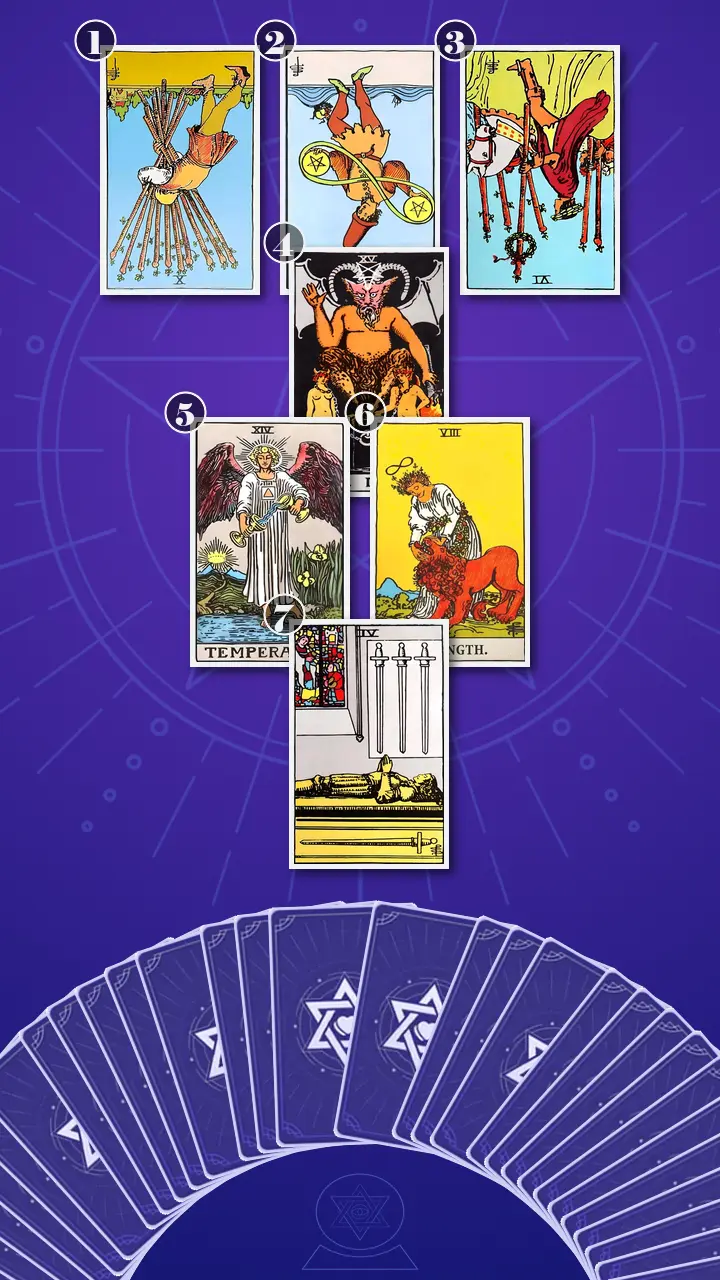
Reading the Pressure Funnel: Burnout After Getting a Job Offer
Position 1 — Surface symptom snapshot: what burnout is doing to daily functioning
“Now we turn over the card representing the surface symptom snapshot—the most visible burnout behaviors impacting your work output and daily functioning right now.”
Ten of Wands, reversed.
The first thing I noticed was the posture in the image: a figure bent forward under an oversized bundle, so overloaded they can’t see where they’re going. Reversed, it isn’t just “a lot.” It’s “a lot that’s tipping into resentment, exhaustion, and a quiet fantasy of dropping everything just to breathe.”
“This is you doing your current job like nothing’s changed,” I said, “but your brain has added a second invisible job: running the transition. Deliverables, Slack responsiveness, plus late-night offer analysis—until sleep, spending, and friendships become collateral damage.”
I kept it plain, because shame thrives on vagueness. “Some of this is work. Some of this is fear wearing a ‘responsible’ costume.”
Taylor let out a short laugh—bitter at the edges. Not a nod, not agreement. More like: called out. “That’s… yeah. That’s me,” they said. “It’s almost mean how accurate that is.”
“It’s not mean,” I answered gently. “It’s useful. The card is showing you the load—not your character.”
Position 2 — Inner tug-of-war: the juggling that destabilizes sleep and bandwidth
“Now we turn over the card representing the inner tug-of-war—where you’re overcompensating or juggling priorities in a way that destabilizes sleep and bandwidth.”
Two of Pentacles, reversed.
In the classic imagery, the infinity loop ribbon wraps around two pentacles as someone tries to keep them moving. Reversed, that infinity loop becomes a trap: constant switching that feels like management, but never becomes stability.
“This looks like your attention bouncing between work tasks, budgeting, negotiation research, and texts,” I said, “like you’re keeping plates spinning. Busy all day, but nothing ever feels resolved. Then at night, your nervous system stays in ‘on call’ mode, because you never gave it a clear ‘we’re done for today’ signal.”
I could see it land in their face—a soft frown and a tiny shake of the head, like they were watching their own browser history in their mind. “I have a Notion dashboard for this,” they admitted. “It’s… absurd. Twelve trackers. I feel productive and still completely unstable.”
Position 3 — External pressure: the visibility that turns this into a performance
“Now we turn over the card representing external pressure—what social comparison, expectations, or visibility is amplifying the burnout across money and friendships.”
Six of Wands, reversed.
Upright, this card is applause and recognition. Reversed, it’s the fear underneath applause: the sense that you’re being watched and evaluated, even when no one is explicitly judging you.
“You’re not just deciding,” I said. “You’re performing the decision. You rehearse how you’ll tell people, how you’ll negotiate, how you’ll look confident—especially after you see a ‘Thrilled to announce…’ post.”
That pressure spreads like dye in water: money becomes “I need to optimize harder,” sleep becomes “I need to rehearse every conversation,” and friends become “I need to show up as thriving—or I should vanish until I can.”
Taylor’s mouth tightened, then loosened. “Congrats texts feel like… a demand,” they said quietly. “Like: be happy correctly, right now.”
Position 4 — Core blockage: the belief-chain keeping the burnout cycle running
“Now we turn over the card representing the core blockage—the attachment or belief that keeps the burnout cycle running during the job-offer transition.”
The Devil, upright.
I’ve never read The Devil as a moral lecture. In modern life, it’s more like a subscription you can’t cancel: autopay on “prove you deserve it.” It’s the moment anxiety convinces you control is the same thing as safety.
“The imagery that matters here is the loose chains,” I told them. “Not because it’s easy to step out—because you can step out, but your system doesn’t trust it yet.”
I described the scene I could practically see: Taylor’s hand automatically reopening the offer PDF like muscle memory. The mind insisting, I’m not addicted to the PDF. I’m addicted to the feeling of certainty it promises.
“You want safety,” I said, “but you keep reaching for control because it feels faster.”
Taylor’s reaction came in a small, sharp sequence: their breath paused; their eyes unfocused like they were replaying last night at 1:32 a.m.; then a quiet exhale slipped out. “Oh,” they said. “That’s what this is.”
And I named it in the simplest words I could: “Certainty is the bedtime story your anxiety keeps asking for.”
Position 5 — Available resource: the stabilizer that’s realistic right now
“Now we turn over the card representing your available resource—the most realistic stabilizer you can use to rebalance across work, sleep, money, and friends.”
Temperance, upright.
There’s an angel calmly pouring water between two cups—no drama, no whiplash, no overnight reinvention. One foot on land, one in water: grounded and feeling, structure and softness.
“Temperance isn’t a vibe,” I said. “It’s a rhythm.”
“This is the part of you that can stop trying to fix work, sleep, money, and friendships all at once,” I explained, “and instead create one gentle, repeatable stabilizer that supports all four.”
I watched Taylor’s shoulders drop a fraction—ten percent, maybe. The urgency in their face didn’t disappear, but it stopped sprinting.
“So not a perfect routine?” they asked, almost suspicious.
“Not a new identity,” I said. “Just a 10% calmer week. One steady anchor that stops the swinging.”
When Strength Held the Lion: Finding Clarity Without Self-Abandonment
Position 6 — Key transformation: the inner skill that changes the whole system
I let my hand hover for a beat before turning this card. “We’re about to flip the turning point,” I said. “The one that changes the system, not just the offer details.”
Strength, upright.
The image is always quieter than people expect: a calm figure with a lion, not wrestling it, not dominating it—guiding it. Influence without force. Courage that looks like regulation.
“In your life,” I said, “the lion is adrenaline: the jaw clench, the doom-scroll thumb, the restless leg, the urge to check the offer at 1 a.m. Strength isn’t ‘push through.’ It’s self-leadership.”
I leaned in a little. “Strength is boundaries you can keep, even when you’re keyed up.”
And because I’m an artist who thinks in scenes, I offered Taylor the metaphor that lives in my bones: jazz.
“One of my go-to frameworks is what I call Jazz Improvisation,” I said. “Louis Armstrong didn’t play like he was trying to win a fight with the song. He listened, he paced, he left space between notes. That space wasn’t weakness—it was what made the music hold.”
“Right now, you’re treating this career crossroads like it’s a constant solo with no breathing. Strength is learning you can take a bigger role without a bigger self-abandonment.”
The Aha Moment (Setup → Delivery → Reinforcement)
For a moment, I could almost feel Taylor’s exact loop: they’re in bed in NYC at 11:30 p.m. telling themselves “one last look” at the offer PDF—then it’s spreadsheets, negotiation threads, LinkedIn, and suddenly their eyes are burning but their brain won’t power down. They’re trying to earn rest by solving the whole future tonight.
Capacity isn’t something you prove by pushing harder—it’s something you protect by leading yourself gently enough to recover and stay consistent.
I let the sentence hang in the air for a clean beat—like the room itself needed time to catch up.
Taylor’s reaction didn’t look like instant relief. It looked like a three-part unraveling: first, a physical freeze—their fingers stopped tapping their knee mid-bounce. Second, a cognitive slip—their gaze went distant, as if they were watching last week’s nights from outside their own body. Third, emotion arrived—not tears exactly, but a kind of hot-eyed recognition. Their shoulders sank, and they exhaled like they’d been holding a breath all month.
Then the unexpected pushback came, sharp and honest: “But if that’s true… doesn’t that mean I’ve been doing it wrong? Like—this whole time?”
I kept my voice calm. “It means you’ve been doing what works fast,” I said. “Control gives a quick hit of relief. But it costs you sleep, money steadiness, and closeness. Strength isn’t a verdict on your past. It’s a new skill you can practice without punishing yourself.”
“Let’s make it practical,” I added, and I guided them through a 10-minute ‘Strength check’—not a life overhaul:
1) Set a timer for 10 minutes. Sit or lie down.
2) Write two lines only:
— “The lion voice right now says: ____”
— “The self-leader voice says: ____”
3) Choose one gentle limit for tonight that you can keep without drama: “No offer/LinkedIn/budget tabs after 11:15.”
4) Put your phone to charge across the room (or at least out of arm’s reach).
“And here’s the boundary note,” I said, because this part builds trust: “If your anxiety spikes, you’re allowed to stop early—this is practice, not a test. If you break the limit, you haven’t failed. You just learned what your nervous system does under pressure.”
I watched Taylor nod—small, but real.
“Now,” I asked them softly, “use this new lens and rewind. Last week—was there a moment where the ‘one last check’ stole your sleep? What would have changed if you’d trusted the self-leader voice for ten minutes?”
Their answer came immediately. “Tuesday,” they said. “12:48 a.m. I opened the PDF. I didn’t even read it. I just… checked. And then I bought stuff I didn’t need the next day because I felt like garbage.”
“That’s the system,” I said. “And this—right here—is the first move from wired overwhelm toward steadier self-trust.”
Position 7 — Next step grounding: the calendar-able pause that turns insight into recovery
“Now we turn over the card representing your next step grounding—one concrete action that turns insight into recovery and sustainable decision-making.”
Four of Swords, upright.
This card is a deliberate pause after strain. Not quitting. Not hiding. Stepping out of mental battle mode long enough to restore your clarity.
“I want you to hear this,” I told Taylor. “This isn’t giving up; it’s stepping out of the mental fight long enough to think clearly.”
They looked skeptical—relief fighting with the belief that rest is irresponsible. And that skepticism was honest data, not a flaw.
From Insight to Action: A Boundary-First Transition You Can Actually Start
I pulled the whole story together for them, because this is what a good tarot reading does: it turns scattered symptoms into a coherent chain.
“Here’s what your cards say in plain English,” I said. “You’re overloaded (Ten of Wands reversed) and juggling in a way that never lands (Two of Pentacles reversed). LinkedIn-and-life visibility turns the offer into a performance (Six of Wands reversed). Underneath, The Devil is the belief-chain: ‘If I don’t optimize and control this perfectly, I won’t be safe.’ Temperance offers a rhythm—a single stabilizer. Strength is the real upgrade: calm self-leadership. And Four of Swords is how you prove it in real life: a protected pause.”
“Your cognitive blind spot,” I added, “is that you’re treating rest like a reward you earn after proving yourself. But your key shift—the one that changes work, sleep, money, and friendships together—is treating rest as a non-negotiable input that protects your competence.”
Then I gave Taylor next steps that were intentionally small—because small is what you can keep when you’re burned out after getting a job offer.
- The 15-Minute Decision WindowPick one time each day (same time) for 15 minutes of offer research/negotiation thoughts. Outside that window, if a thought hits at night, write it in one line and save it for tomorrow—no tabs.Expect your brain to call this “irresponsible.” That’s The Devil talking. You’re not banning thinking—you’re giving it a container so it stops taking your sleep hostage.
- The One-Person Processing Boundary (Plus an “Oscars Speech” Script)Choose one trusted person to process the decision with. Everyone else gets a two-minute, repeatable line: “I’m excited and taking my time. I’ll share when it’s final.”This is my Oscars Speech Training in real life: rehearse it once, then stop re-writing your life story in group chats. Less explaining = less performance pressure = more actual energy.
- One Low-Stim Reset Night (On the Calendar)Schedule one evening this week (e.g., Thu 7:30–10:30) labeled “Low-stim reset” like it’s a meeting. During the block: no offer PDF, no LinkedIn, no budget deep-dives. Choose one low-input activity (walk, laundry, simple show, reading).If you slip and open a tab, close it once without spiraling into self-criticism. No one gets access to you 24/7—not even your own anxiety.

Ownership, Not Certainty: The Quiet Proof a Week Later
A week later, Taylor messaged me a screenshot: a calendar block that read LOW-STIM RESET in all caps, like they were finally willing to take themselves seriously. Under it they’d written, “No offer/LinkedIn/budget tabs after 11:15.”
“I slept,” they added. “Not perfectly. I still woke up once and thought ‘what if I’m choosing wrong?’ But I didn’t check. I just… went back to sleep.”
That’s what I mean when I say this work is a Journey to Clarity. Not certainty. Not a personality transplant. Just the first real evidence of a new pattern: from compulsive control to grounded calm—one boundary kept, one nervous system protected, one life returned to them in small pieces.
When a “good” offer lands, it can feel like you’re carrying your whole future in your chest—so you keep tightening your grip at night, not because you’re lazy, but because you’re scared that letting go for one hour will prove you can’t stay in control.
If you let rest be an input (not a reward) for the next seven days, what’s one tiny boundary you’d be curious to try—just to see how your sleep and decision-making change?