From Quiet-Night Rumination to Steadier Self-Trust: Breaking the Loop

Finding Clarity in the 11:12 p.m. Scroll
You tell yourself you’re not spiraling—you’re just “processing”—but somehow you’re toggling between iMessage, Notes drafts, and the same Spotify playlist title you swore you’d retire.
Jordan (name changed for privacy) said that line to me with a kind of tired precision that made my chest ache in recognition. Twenty-seven. Non-binary. A UX designer who could ship clean work all day, then get quietly ambushed by night.
They were on video from their Toronto condo bedroom at 11:12 p.m., streetlight leaking through half-closed blinds like a thin, stubborn ribbon. The air looked dry—heat kicking on—and the city’s low transit hum seeped through the window like a sub-bass. Jordan lay on top of the covers with headphones in, phone warm in their palm, thumb flipping between a message thread, Spotify, and a Notes draft titled “final text.”
“I’m not even spiraling,” they said. “I’m just stuck.”
I watched their body tell the truth before their words did: jaw set like they were biting down on something they couldn’t swallow, shoulders creeping toward their ears, fingers twitching in that restless pre-scroll hover. Sadness, yes—but threaded with self-doubt, the particular kind that tries to earn relief by proving it deserves it.
Underneath everything, the contradiction was clean and brutal: wanting emotional relief and forward motion… while fearing that letting go means losing proof that what happened mattered.
“I hear you,” I said, keeping my voice steady and human. “And I’m going to say something that might be a relief: your feelings don’t need receipts to be real. Tonight, let’s make this less like a courtroom and more like a map. We’re not trying to erase what happened—only to find clarity about the one step that breaks the loop.”

Choosing the Compass: The Four-Layer Insight Ladder
I asked Jordan to take one slow breath with me—nothing mystical, just a nervous system handoff from the day into the moment. While they inhaled, I shuffled my deck the way I always do: not as a performance, but as a focusing tool, like turning down background tabs so one true window can load.
“For this question,” I told them, “I’m using a spread I call the Four-Layer Insight Ladder · Context Edition.”
For you reading this: it’s the smallest tarot spread I know that still covers the whole arc of a rumination loop without turning it into a lecture. It’s built for deep inner work—especially the kind of “Why do I keep rereading old texts at night?” or “How do I stop replaying the same conversation in my head?” question that doesn’t need prediction, it needs a pattern interrupt.
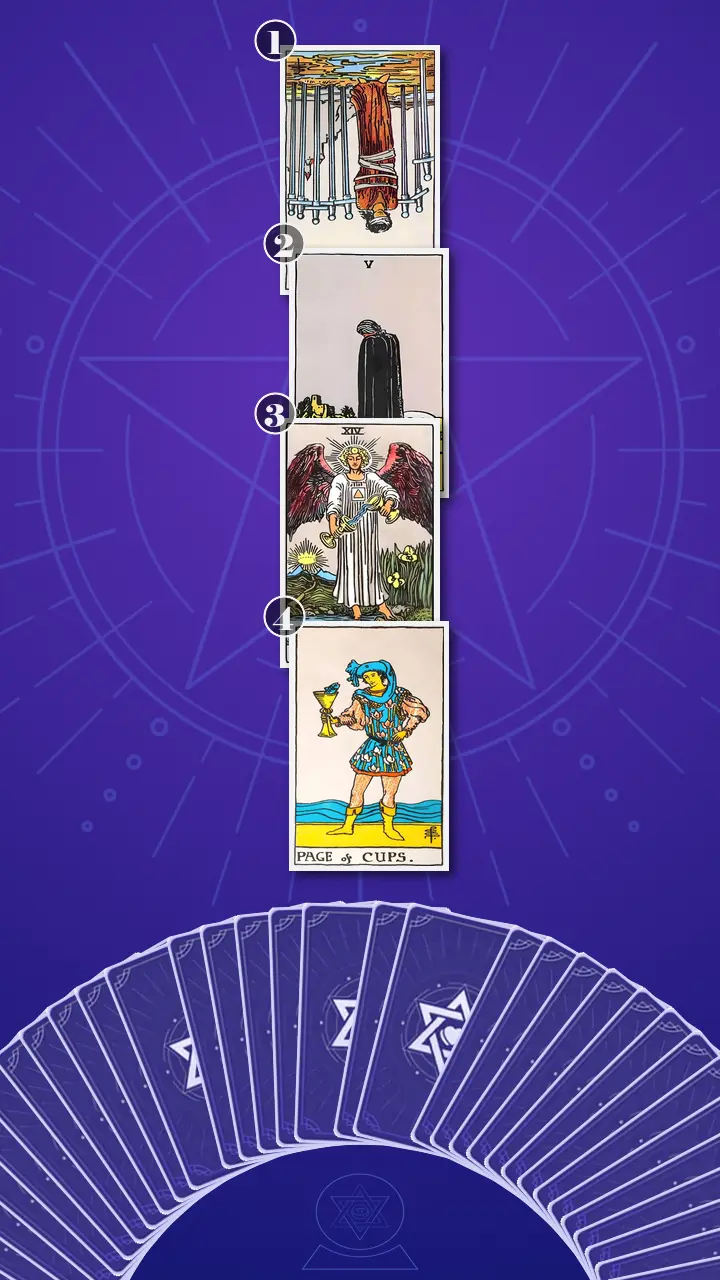
The ladder has four positions, laid in a simple vertical line—like walking down stairs from mental noise into emotional truth, then landing on one practical next step:
Position 1 names the observable loop—the on-repeat behavior you can catch in real life.
Position 2 reveals the emotional root—what hurts underneath the replay.
Position 3 is the medicine—the integrative shift that turns looping into learning.
Position 4 is the one step—small, doable, real.
Reading the Map: The Loop and the Fuel
Position 1 — The loop you can catch on camera
“Now flipped open,” I said, “is the card that represents The on-repeat emotional pattern as it shows up in daily, observable behavior—the loop itself.”
Eight of Swords, reversed.
Even through a screen, I could feel Jordan’s recognition land. This card is the classic image of self-restriction—swords forming a perimeter, a blindfold, bindings. Reversed, it’s rarely about a locked door. It’s about a door that’s already cracked… and a body still moving like it isn’t.
“This is you after dinner,” I said, using the plainest translation I could. “You’re not even upset on the surface—then a quiet second hits and your thumb opens the same thread like a reflex. Timestamps, rereads, Notes draft edits. Technically, you’re free to stop. But your body moves like you’re not, because certainty feels like safety for two seconds.”
Jordan let out a tight laugh—half bitter, half relieved. “Okay,” they said, eyes narrowing at the accuracy. “That’s… honestly kind of mean.”
“It’s precise,” I corrected gently. “Not mean.” I leaned closer to the camera. “And here’s the reframe I want you to hold: the loop isn’t proof you’re broken—it’s proof you’re trying to feel safe.”
The energy of this reversed Eight is a blockage-by-habit. Freedom is available, but the nervous system hasn’t updated its autopilot yet. Like refreshing the same app over and over expecting a different notification to appear—your nervous system calls it “research.”
“Let me ask you something,” I said. “In that moment—right before you open the thread—what do you hope it will give you?”
Jordan’s gaze slid off-screen toward their phone. “A… final answer,” they said quietly. “Like if I look one more time, I’ll finally know what it meant. And then I can move.”
I nodded. “That’s the blindfold talking. Not you.”
Position 2 — What hurts underneath the replay
“Now flipped open,” I said, “is the card that represents The emotional root that keeps feeding the loop—what hurts underneath the replay.”
Five of Cups, upright.
This card is grief without editing. It’s the figure staring at what spilled, so focused it forgets to turn around and see what still stands behind them.
“This is the fuel,” I told Jordan. “Not a lack of intelligence. Not you being ‘bad at moving on.’ It’s disappointment and grief—especially the kind that comes from an ending that was emotionally ambiguous. No explosion. No clean conversation. Just enough uncertainty for your mind to keep negotiating.”
I let the silence do some work, then added, “And social media doesn’t help. You scroll someone else’s highlight reel—new dates, clean breakups, soft-launch rooftop drinks—and it lands like proof you weren’t chosen. The mind goes, ‘See? We should’ve known. We should re-check.’”
Jordan’s face shifted in a small, involuntary sequence: first a pause—breath catching high in the chest—then their eyes unfocused as if replaying a memory, then a long exhale that softened their mouth.
“I hate that my feelings want receipts,” they whispered.
“Of course they do,” I said. “Because receipts feel like control. And grief is the place where control doesn’t work.”
In my own practice—what my family calls my Nature Empathy Technique—I watch for where a person is trying to force a season that can’t be forced. Five of Cups is late autumn energy: not the Instagram version with cute scarves, but the real one—bare branches, early dark, the honest accounting of what’s fallen.
“This card isn’t asking you to silver-line it,” I told them. “It’s asking you to mourn it without making mourning your whole identity.”
When Temperance Poured Between Two Cups
Position 3 — The medicine: how the loop transforms
I held the deck still for a beat before turning the next card. “Now flipped open,” I said, “is the card that represents The key integrative shift that transforms the loop into learning and forward motion.”
Temperance, upright.
The room seemed to quiet. Even through the call, I felt Jordan’s attention drop lower in their body, like something finally had weight and shape.
“Temperance is emotional integration,” I said. “Not forced closure. Not ‘I’m fine.’ Not deleting every thread and pretending you’re cured. This is the skill of mixing extremes into something livable.”
I tapped the image lightly. “See the angel pouring between two cups? One foot on land, one foot in water. Thought and feeling. Past and present. You don’t delete the track—you adjust the levels so it stops clipping your speakers.”
Then I brought in the tool that has saved more people than any pep talk: my Elemental Balance lens. “Your spread started in Air—Eight of Swords—thoughts looping, constricting. Then it dropped into Water—Five of Cups—grief concentrating your attention. Temperance is the channel between them. It regulates. It lets Water move without flooding the whole system.”
Jordan swallowed. Their hand went to their jaw again.
“And this,” I added softly, “is where my Body Signal Interpretation comes in. That jaw clench? That’s your nervous system trying to manufacture certainty. Tight shoulders? Bracing for impact from ambiguity. Restless hands? A search pattern—like your body is scanning for the missing piece.”
“So what do I do?” Jordan asked, and there was a flash of impatience in it—an honest one. “Because if the answer is ‘be patient,’ I’ll lose my mind.”
I appreciated that. Temperance doesn’t work without practicality.
I said, “We’re not doing ‘patient’ as a personality trait. We’re doing it as a repeatable micro-practice. And here’s the pivot.”
Not by forcing instant closure, but by blending what you feel with what’s true—like the angel who keeps pouring between two cups until the mixture becomes livable.
Jordan’s reaction came in waves—three clear steps. First, a freeze: their breath stopped, and their thumb—mid-hover—went still. Then the meaning seeped in: their eyes went glassy, not with drama but with recognition, like they were watching their own last month in fast-forward. Finally, the release: shoulders sank a fraction, jaw unclenched, and a shaky exhale left their mouth as if they’d been holding it for days.
“But… if I do that,” they said, voice suddenly sharper, defensive, “doesn’t that mean I was wrong? Like I wasted all this time obsessing?”
There it was—an unexpected flare of anger, not at me, but at the idea of losing the only strategy that had ever made them feel safe.
“No,” I said, firm and kind. “It means you were using the best tool you had. Analysis was a life raft. It kept you afloat. Temperance isn’t calling you foolish—it’s offering you a boat that actually moves.”
I paused, then guided them into the practice right then, because Temperance is a verb.
“Set a 6-minute timer,” I said. “For 3 minutes, write two lines: (1) ‘What I feel right now is…’—name the feeling, no story. (2) ‘What’s true today is…’—one grounded fact. The date. What you ate. One thing you finished. Then for the next 3 minutes, do one tiny body anchor: drink water slowly, or stand and feel both feet on the floor while you breathe out longer than you breathe in.”
I watched their face as they did it—eyes down, blinking slower. Their shoulders weren’t cured. But they weren’t climbing toward their ears either.
“If it spikes anxiety,” I added, “stop early. This is practice, not a test. You can scale it down to 60 seconds and it still counts as ‘the pour.’”
Then I asked the question that turns insight into lived memory: “Now, with this new lens—mixing feeling with reality—think back. Was there a moment last week when this would’ve changed your night, even by five percent?”
Jordan’s eyes lifted. “Tuesday,” they said. “I saw their name in my search history on the TTC. I… could’ve just named it. ‘I’m looping because I want control.’ Instead I spiraled for two hours.”
“That’s the shift,” I said. “From rumination-driven certainty-seeking to steady integration. Not perfect closure—self-trust.”
And because I’ve watched enough winters to know what’s real: “Consistency beats intensity when you’re trying to get unstuck.”
The Page’s “New Note”
Position 4 — One small, sincere move this week
“Now flipped open,” I said, “is the card that represents One concrete next step that creates a new emotional note this week—small, doable, real.”
Page of Cups, upright.
This is the Tender Beginner. A cup at chest level. A fish showing up where you didn’t expect it—new feelings arriving when you stop forcing a scripted ending.
“This card doesn’t want a grand closure speech,” I told them. “It wants an MVP. Minimum viable processing.”
Jordan gave a small, uncertain smile. “I can do MVP,” they said. “That’s literally my job.”
“Exactly,” I said. “So here’s the ‘tiny new note’ scene: instead of drafting the perfect paragraph for two hours, you send one simple text to a trusted friend—‘Can I talk for 10 minutes?’ Or you voice-note one honest sentence: ‘I’m sad, and I keep looping.’ It’s not optimized. And that’s why it works. It gives your heart fresh data instead of recycled analysis.”
I watched them imagine it—their eyes flicking to the side, fingers loosening as if they’d set something down.
“What would the kindest, honest version of you do in the next 24 hours?” I asked. “Not the version that wins the case. The version that wants to live.”
Jordan nodded once, small but real. “Text my friend Sam,” they said. “No explanation. Just… ten minutes.”
The One-Week Container: Replay Window + Two-Cup Mix
I gathered the four cards into one story—because tarot works best when the narrative is coherent enough to carry into real life.
“Here’s what I see,” I told Jordan. “Eight of Swords reversed says the door is already cracked open, but your thumb still behaves like it’s locked. Five of Cups says the loop is powered by grief—not drama—and grief keeps staring at what spilled because turning away feels like betrayal. Temperance says the way out isn’t a perfect explanation; it’s a steady mixing practice—feeling plus fact—until your body believes you’re safe again. Page of Cups says you seal it with one small, sincere emotional move: a new note.”
Then I named the blind spot that keeps smart people stuck: “Your cognitive blind spot is thinking that certainty is the price of movement. But the transformation direction is the opposite: movement—small, kind movement—rebuilds self-trust, and self-trust makes uncertainty survivable.”
“So what do I actually do,” Jordan asked, practical again, “when it hits at night?”
I nodded. “We’ll make it unglamorous and doable.”
- The 10-minute Replay WindowPick one daily time for a week (same cue if possible—after dinner, or right after you brush your teeth). For exactly 10 minutes, you’re allowed to reread, analyze, journal, listen to the playlist—on purpose. When the urge hits outside the window, write one line: ‘I’m looping because I want control,’ then do one grounding action.Expect resistance: the certainty-seeking part will say, “This is too small to matter.” That’s the point—small is harder to negotiate. If you miss a day, you don’t start over; you just pour again tomorrow.
- The Two-Cup Mix (5 minutes)On paper or in Notes: write one feeling (“sad,” “resentful,” “numb”). Then write one grounded fact about today (“I ate dinner,” “It’s Wednesday and I’m safe,” “I finished one task”). Then choose one next action that doesn’t require clarity (shower, bed, reply to one email, put on a different playlist).Keep it ridiculously simple. Temperance doesn’t want a breakthrough; it wants a repeatable mix. If you feel flooded, do a 60-second version and count it as success.
- Water-Pour Reset (my shower technique)If the loop spikes at night, stand in the shower for 2 minutes. Let the water hit your shoulders (where you brace). On each exhale, imagine you’re pouring from “what I feel” into “what’s true”—like Temperance. Then step out and do one small next action (bed, tea, one text, lights out).This is not a spa moment. It’s a nervous-system cue. If showering feels like too much, wash your hands slowly and do the same exhale-pour visualization for 30 seconds.
Because Jordan lived in a city where weather is a whole emotional ecosystem, I added one more practical layer from my own toolkit: “If you need help choosing the grounding action, use the weather like a menu. If it’s icy Toronto wind, do an indoor reset—shower or warm water. If it’s clear enough, do a five-minute walk to the end of the block. Don’t debate it. Let the sky choose for you.”

A Week Later, the Playlist Still Exists—But It Doesn’t Own the Night
A week later, Jordan sent me a message that made me smile in that quiet way you do when you see a nervous system finally unclench.
“Did the Replay Window,” they wrote. “Renamed the playlist to ‘Grief Is Here (10 min).’ Texted Sam: ‘Can I talk for 10 minutes?’ We didn’t solve anything. But I didn’t check the thread after. Also—I slept.”
They added, almost as an afterthought: “Woke up and my first thought was still ‘what if I misread it?’ But… I didn’t grab my phone. I just laid there and did the Two-Cup thing in my head. Feeling: scared. Fact: it’s Thursday and I’m safe. Then I got up.”
That’s the journey to clarity I trust: not a dramatic personality transplant, but a steadier emotional flow—proof that the past can be remembered without hijacking the whole night.
When you’re stuck on the same moment, it’s not because you’re dramatic—it’s because part of you believes the only way to honor what happened is to keep replaying it until you can prove you understood it perfectly.
If you didn’t need 100% certainty to take one tiny step, what would a gentle, curious version of you try in the next 24 hours—just to create one new note?