From Midnight Diary Spirals to Self-Trust: Stop Using the Past as Proof

The “Just One Entry” Lie at 12:41 a.m.
If you’re a late-20s London professional who tells yourself you’ll read “just one old diary entry” and somehow ends up cross-checking old iMessages like it’s a relationship cold case, this is for you.
Taylor (name changed for privacy) didn’t say it like a confession. She said it like she’d finally caught herself doing something so specific it was almost funny—if it didn’t leave her wrecked the next day.
“It’s always late,” she told me, wrapping both hands around her takeaway coffee like it was a heat pack. “Zone 2. Streetlight through the blinds. I’m on the sofa with the diary on my lap, laptop open… phone in my hand. And the kitchen light does this little hum that makes everything feel… too awake.”
She swallowed, and I saw the swallow—tight, careful, like her throat had become a narrow doorway she didn’t trust anyone to walk through. “I’ll read one sentence I underlined years ago and it’s like I’m back there. Then I’m in the iMessage search bar, typing a name I shouldn’t be typing. I need to get the timeline straight. I need to know what was real.”
The way she said real wasn’t about facts. It was about reassurance. The kind that comes with closeness. The kind she wanted—and then immediately judged herself for wanting.
In my studio, the rain had started that soft London tapping against the window—steady, almost metronomic. Inside, the air smelled faintly of warm electronics and peppermint tea. Taylor’s leg bounced like it had its own agenda.
“I hate that I still care,” she added, and her mouth did that half-smile that isn’t happiness—it’s self-defense. “I don’t want to be the person who needs reassurance.”
Longing can be so physical. In her, it looked like a chest trying to expand while an invisible hand pressed it back down—like breathing through a scarf pulled too tight.
I leaned forward, keeping my voice gentle but grounded—the way I speak on-air when someone calls in with a story they’ve never said out loud. “You’re not doing anything ‘wrong’ by being affected by your own past. But if reading those pages is turning into a loop that steals your night, then our job today is to turn that loop into a map.”
“A map to what?” she asked, almost wary.
“To clarity,” I said. “Not the kind that erases what happened—more like the kind that helps you stay in today while you look at then.”

Choosing the Compass: The Transformation Path Grid (6)
I invited Taylor to take one slow breath with me—not as a ritual for mystique, but as a nervous-system handoff. A tiny signal that we were leaving the midnight spiral and entering a room where we could look at it with the lights on.
As I shuffled, I asked, “Before we pull cards—quick check-in, music-therapy style. What have you been playing lately? Like… your actual ‘Recently Played.’”
She blinked, surprised, then unlocked her phone and scrolled. “Um. A ‘sad girl’ playlist on Spotify. Some Phoebe Bridgers. And then… weirdly, white noise. Like an eight-hour track. And then—don’t judge me—a ‘Fleabag soundtrack’ mix someone made.”
I nodded. “No judgment. That’s data. I call it a Music Pulse Diagnosis. Your playlist is often your nervous system trying to self-medicate: lyrics for meaning, noise for containment, and something like Fleabag for a mirror that feels sharp enough to be true.”
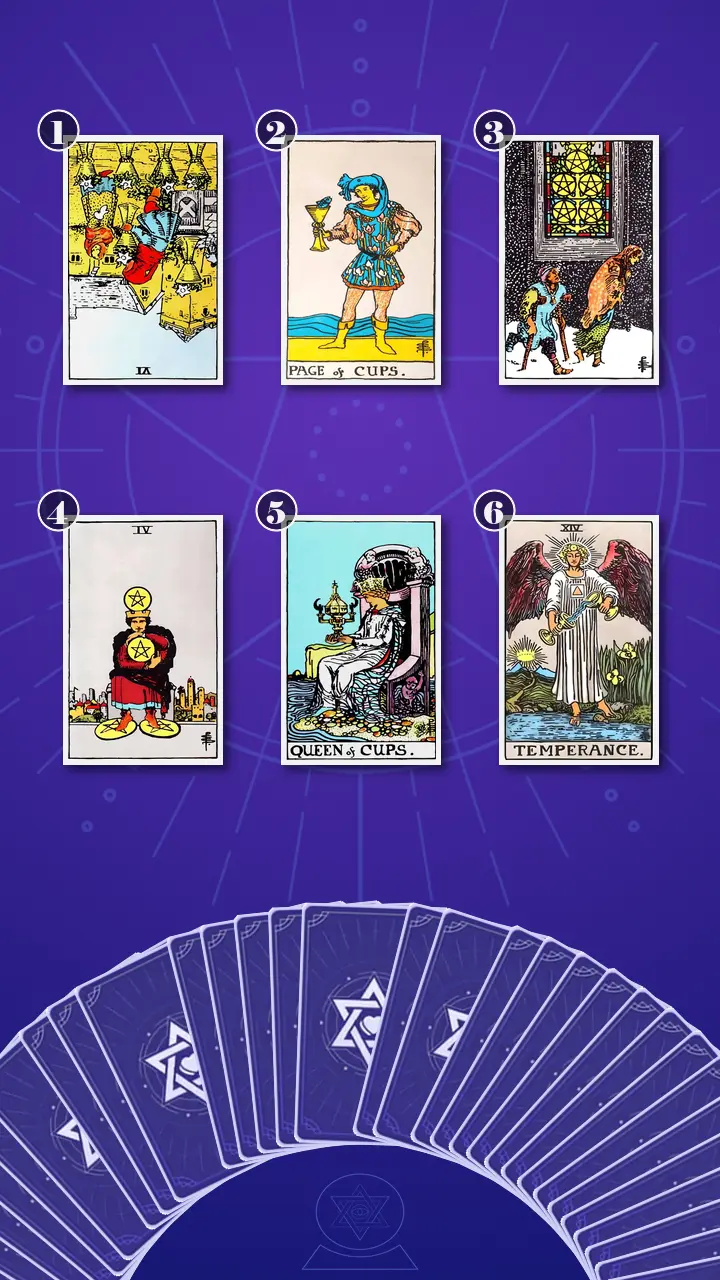
Today, I told her—and you—I was using a spread I built for moments exactly like this: the Transformation Path Grid (6) · Context Edition.
Here’s why it works so well when you’re asking, “What does rereading old journals mean emotionally—and why do I reread my old diary and spiral at night?” Because the goal isn’t prediction. It’s pattern-mapping. This spread tracks a repeating inner loop—trigger → message → wound → protection → resource → integration—without giving you so many cards that you end up with more “evidence” to prosecute yourself with.
I laid the cards in a 2x3 grid, like two shelves. “Top row is the past calling for attention,” I explained. “Bottom row is the present building a new response. We’ll start with what activates you, then what your younger self is trying to say, then the deeper attachment wound. After that, we’ll name your protection strategy, find the secure resource inside you, and finish with a one-week integration step.”
Reading the Map: Card Meanings in Context
Position 1 — Surface trigger: Six of Cups (reversed)
“Now flipping,” I said, “is the card that represents Surface trigger: what specifically gets activated when you re-read the diary and how it shows up in present-day behavior.”
The Six of Cups, reversed.
I watched Taylor’s eyes go straight to the image like it could speak. In a way, it could—just not in the courtroom language she’d been using on herself.
“This is that midnight moment,” I said, keeping it simple and specific. “It’s midnight and you open your diary for comfort, but you end up rereading the same year like it’s a locked playlist you can’t stop replaying. You highlight sentences as if they’re clues, then your hand moves to your phone to cross-check old chats—because the past feels like the only place you can get emotional certainty.”
Reversed, I explained, the Six of Cups isn’t gentle nostalgia. It’s nostalgia with a sticky underside—comfort that turns into a trap door. The energy here is blocked: sweetness that doesn’t circulate, it clings.
As I spoke, I could almost see the montage in her body: diary → Notes app “receipts” → old iMessage thread → Instagram search bar → back to diary. The warm phone. The lamp buzz. The “one more page” hook that feels like research but behaves like a compulsion.
Taylor let out a small laugh—quick, bitter, like a pinprick. “That’s… yeah,” she said. “It’s so accurate it’s kind of brutal.”
I didn’t flinch. “Brutal accuracy can be a doorway,” I told her. “And there’s no shame in the loop. It’s a coping strategy that once worked. We’re just updating it.”
Position 2 — The diary’s message: Page of Cups (upright)
“Now flipping,” I said, “is the card that represents The diary’s message: what your younger self is trying to communicate beneath the words.”
The Page of Cups, upright.
Something in Taylor’s face softened—like her eyes remembered how to be kind before her brain jumped in with commentary.
“This card is a message, not a mystery,” I said. “You read one line and a feeling rises instantly—like a notification you didn’t ask for. Instead of building a theory, you treat it as a message: ‘I was scared.’ ‘I wanted someone to stay.’ You respond to that feeling the way you’d respond to a friend’s vulnerable text: simple, kind, and not performative.”
Upright, the Page is balanced Water energy—fresh emotion, clean communication. Not a flood. Not a drought. A ping.
“Longing isn’t a flaw—it’s information,” I added, and I saw Taylor’s shoulders drop a millimetre, like her body had been waiting for permission to stop arguing with itself.
I asked her, “If that entry was a voice note from someone you love—emoji-free, honest—what would you text back?”
She looked down at her hands, then up at me, eyes shiny but steady. “I’d say… ‘I get why you felt like that. You weren’t crazy.’”
“Good,” I said. “That’s the Page. Not ‘solve it.’ Just ‘I hear you.’”
Position 3 — Core attachment wound: Five of Pentacles (upright)
“Now flipping,” I said, “is the card that represents Core attachment wound: the underlying abandonment/scarcity story being re-opened.”
The Five of Pentacles, upright.
The room felt colder for a second—not literally, but emotionally, like someone had opened a door to a winter street. The card’s image does that: warmth behind glass, bodies outside it.
“This is the old template,” I told her. “A diary entry about being left on read hits, and your body reacts like you’re back outside a warm room, pretending you don’t mind the cold. You don’t just remember the event—you re-feel the belief: ‘Closeness is for other people, and I’m always one mistake away from being shut out.’”
The energy here is deficiency—not because you’re deficient, but because the story inside you says love is scarce. It says you have to earn entry. It says belonging is conditional.
Taylor went still. Her hand tightened around the coffee cup, knuckles pale. The tight throat she’d described showed up in real time; her breath got smaller.
“I hate that it’s still in me,” she whispered. “Like… I can be competent all day. I can run meetings. But in this… it’s like I’m outside again.”
I nodded. “That’s not immaturity. That’s a wound doing what wounds do: protecting itself from happening twice.”
Position 4 — Protection strategy: Four of Pentacles (upright)
“Now flipping,” I said, “is the card that represents Protection strategy: how you currently guard yourself when closeness feels uncertain.”
The Four of Pentacles, upright.
“After the diary spiral,” I said, “you go into controlled mode in real life: you keep texts short, act unbothered, don’t ask for reassurance, and convince yourself you’re fine. Then, alone, you privately seek certainty by rereading, checking, and rehearsing—because control feels safer than asking for warmth.”
The energy here is excess Earth—gripping, holding, clamping down. It stabilizes you short-term, but it also blocks circulation. No warmth gets in; no warmth gets out.
In my head, the sound metaphor was immediate. When I’m editing audio for radio, over-compression makes a voice “stable,” but it also makes it lifeless. You lose the breath between words—the humanity. This card felt like emotional over-compression: nothing spikes, nothing moves, but you can’t feel held either.
“Control can feel like safety, until it becomes a cage,” I said.
Taylor nodded once, sharp. I saw the “window vs grip” film in her: the cold street outside the stained-glass warmth, then the adult strategy—jaw clenched, phone face-down, feelings held like a secret. Intimacy vs boundary. Closeness vs safety. And right in the middle of it, her hand—still gripping.
“So what now?” she asked, and there was something in the question that wasn’t just curiosity. It was exhaustion.
When the Queen of Cups Took the Stand
Position 5 — Secure resource: Queen of Cups (upright)
I paused before turning the next card. The rain outside had shifted into a steadier pattern, and the studio felt suddenly quieter—as if the room itself knew we were about to touch the antidote.
“Now flipping,” I said, “is the card that represents Secure resource: what ‘earned security’ can look like inside you right now.”
The Queen of Cups, upright.
Setup: I could feel Taylor’s mind gearing up the usual script—past midnight, one line hooks her throat, and she starts hunting for proof like the right sentence will finally explain why she was left. In her body, the old logic is simple: if she can prove what went wrong, she can prevent it from happening again.
Stop treating the diary like evidence and start treating it like a lidded cup you can hold with care, because the Queen of Cups asks for emotional containment, not emotional prosecution.
For a beat, we just let that sit there.
Reinforcement: Taylor’s breath stopped—like her lungs hit a speed bump. Her eyes unfocused for a second, as if her brain replayed every highlighted sentence she’d ever used as Exhibit A. Then her jaw unclenched in slow motion. I saw her shoulders sink, not dramatically—just enough to change the geometry of her whole posture. Her fingers loosened around the coffee cup, and the tiniest sound escaped her, a quiet “oh,” like a door opening somewhere inside her chest. Then came the complexity: a flicker of embarrassment (for needing), followed by relief (for being allowed to need), followed by a new kind of vulnerability—because if she stopped prosecuting herself, she’d have to actually care for the part of her that hurt.
I used the contrast frame the Queen demands. “Right now, your internal scene is a courtroom,” I said. “Exhibit A: that diary line. Exhibit B: the message timestamp. And your anxious voice is the prosecutor: ‘Don’t be needy. Don’t be too much.’”
“Yeah,” she whispered, almost smiling through it.
“The Queen changes the role,” I continued. “She’s not here to win the case. She’s here to hold the cup.”
I gave her the two-line pivot, simple enough to remember at 1 a.m.:
Anxious voice: “Don’t be needy.”
Queen voice: “Needing care isn’t a crime.”
Then I asked, gently but directly, “Now, with this new lens—can you think of one moment last week, right after you read an entry, when this would’ve changed what you did next? Even by five percent?”
Taylor stared at a spot on the rug like it was a timeline marker. “Tuesday,” she said. “I read the line where I wrote, ‘I’m trying not to be needy.’ And I went straight to iMessage. If I’d heard this… I think I would’ve closed the diary. I would’ve… put my hand on my chest. I would’ve stopped trying to prove I deserved warmth.”
“That’s it,” I said. “That’s the shift—from evidence-seeking midnight longing to self-compassionate steadiness. Not deleting the past. Not pretending you don’t want closeness. Just becoming the steady witness and gentle responder your younger self didn’t reliably get.”
The Slow Pour: Temperance and a One-Week Integration
Position 6 — Integration step: Temperance (upright)
“Now flipping,” I said, “is the card that represents Integration step: a grounded, one-week practice to metabolize the insight without spiraling.”
Temperance, upright.
“This is the steady pour,” I said. “You create a simple ritual you can repeat: 10 minutes of reading, one short response from present-you, then a grounding action—tea, shower, stepping outside. You keep one foot in today while touching yesterday—so memory becomes information and compassion, not a trap door into spiraling.”
The energy here is balance. Measured blending. Not extremes—neither “drown in it” nor “shut it down.”
And this is where my soundwork comes in most practically. “Temperance is basically a nervous system mix,” I told her. “We’re not trying to mute the track called ‘Past Hurt.’ We’re turning down the harsh frequencies and bringing up a steady baseline.”
I offered her a tool I use with callers who can’t stop looping at night: a Breath Soundtrack. “Four counts in, six counts out,” I said. “Like a slow tempo that tells your body, ‘We’re safe enough to be here.’ If you want, you can pair it with white noise or brown noise—my White Noise First Aid—not to erase feelings, but to stop your brain from turning silence into an interrogation room.”
Taylor nodded, and for the first time in the session, her leg stopped bouncing. Just… stopped. Like her body had received an instruction it trusted.
From Insight to Action: The Read-Once Ritual (and a Sound-Based Reset)
I gathered the story the cards had told in plain language, the way I’d sum up a segment before the ad break—clear, connected, usable.
“Here’s the arc,” I said. “The Six of Cups reversed shows the surface loop: you use the diary for comfort, and it turns into a compulsion to prove what happened. The Page of Cups says the diary isn’t trying to convict you—it’s trying to deliver a feeling-message. The Five of Pentacles names the wound underneath: ‘Warmth exists, but I’m outside it.’ The Four of Pentacles shows your adult protection: ‘Then I’ll grip—be low-need, be controlled.’ And the Queen of Cups is the antidote: you become the safe container. Temperance turns it into a repeatable one-week practice.”
“The blind spot,” I added gently, “is that you’ve been treating reassurance as something you’re allowed to have only if you can prove you deserved it. That’s the old scarcity story running the show. The transformation direction is the opposite: from ‘the past must certify my worth’ to ‘I can give my younger self the care she didn’t get—and that changes how I attach now.’”
Then I gave her next steps that were small enough to do on a random Tuesday, not just in a perfect self-help montage.
- The Read-Once Boundary (10 minutes)Pick one diary entry this week. Set a 10-minute timer. Read it once only. When the timer ends, close the diary even if you feel mid-thought. No “just one more page.”Expect resistance (“This won’t change anything”). Treat that as a cue to stop anyway. Stopping on purpose is the win.
- The Two-Sentence Queen Response (2 minutes)Immediately write two sentences as present-you: (1) “Of course you felt ___.” (2) “What you deserved was ___.” Keep it human, not poetic.If warmth feels inaccessible, borrow neutrality: “It makes sense this hurts.” Shorten the sentence until your body can agree.
- A Present Anchor + White Noise First Aid (5 minutes)Do one five-minute present-tense action right after: rinse one mug, step to the window, or stand with both feet on the floor and name 3 sounds you can hear. If the urge to open old chats spikes, play 60 seconds of white/brown noise and do a 4-in/6-out breath cycle for three rounds.Boundary: no opening old iMessages/Instagram profiles afterward. If you slip, pause and restart the anchor—no shame, just repetition.
Before she left, I also offered my BGM Prescription—three “tracks” she could use like emotional training wheels (not a cure, not a diagnosis, just support):
1) A lyric-free track around 60–75 BPM for containment (so your brain can’t turn words into arguments).
2) Brown noise for the “I’m about to fact-check my heartbreak” moment.
3) One steady, warm song you associate with being chosen—by a friend, by a community, by yourself.

A Week Later: The Quiet Proof
A week later, Taylor texted me at 7:12 a.m.—commute hour, Central line energy. “Did the timer thing,” she wrote. “Closed it while I still wanted to keep reading. Hated it. Then I did the two sentences. Then I washed a mug. I didn’t check the thread.”
Under that, a second message: “I slept. Like… properly.”
It wasn’t a Hollywood ending. It was better: a small, repeatable proof that she could stop the spiral on purpose.
She told me later that the next morning, the first thought still arrived—What if I’m wrong about what happened?—but this time she caught it, exhaled, and said, quietly, “I’m here.” Then she got dressed and left the flat anyway.
That’s the Journey to Clarity I trust: not certainty, but ownership. Not erasing the past, but refusing to abandon yourself while you remember it.
When you want closeness so badly but feel ashamed of needing it, it’s easy to reread your own past like a verdict—hoping one perfect sentence will prove you were always worthy of being chosen.
If you let your diary be a mirror instead of evidence, what’s one small, kind response your present self could give your younger self tonight—just enough to help you stay here, in today?