Old Boss Offer, Cold Tea, and the Move From Relief to Future Fit

Old Boss Wants Me Back, and the Tea Has Gone Cold Again
If you’re a late-20s product marketing manager in Toronto staring at a message from your old boss after a brutal week, and suddenly your Sunday Scaries turns into a full career referendum, I know how fast the room can shrink. When Jordan (name changed for privacy) sat down with me, I recognized the pattern immediately: career paralysis caused by over-comparing a familiar job offer with a harder but more growth-oriented current role.
She described 8:42 p.m. in her condo kitchen near St. Clair West: Slack finally closed, blue laptop light stretched across the counter, the fridge humming, half a mug of tea gone cold. She would open her old manager’s message, jump to a PMM salary tab, click over to her current org chart, then back to a Notes page labeled return vs stay, like toggling between Slack, LinkedIn, Glassdoor, and her banking app might finally tell her how to feel.
“I keep telling myself I just need one more piece of information,” she said, pressing her thumb into the side of the mug. “But really I’m scared to choose. Going back would be easier, and that’s exactly why I don’t trust my answer yet.”
Her body had already told me the rest. Her chest was tight, her breathing shallow, her stomach pulled in as if the decision had laced a drawstring around her ribs. This was the real contradiction: long-term growth and self-directed progress on one side, the safety of familiar validation and lower uncertainty on the other.
I told her, gently, “You’re not failing this decision. You’re carrying it in your body like it’s a verdict. Let’s turn the fog into a map and see if we can find clarity without pretending uncertainty has to disappear first.”

Choosing the Compass: A Decision Cross for a Safe Job Versus Growth Job
I asked her to put both feet on the floor, take one breath out longer than the inhale, and hold the question as plainly as she could: return, or keep growing where she was? Then I shuffled slowly and had her cut the deck. For me, that pause is not theater. It is simply the moment where we step out of doom-scrolling brain and into actual attention.
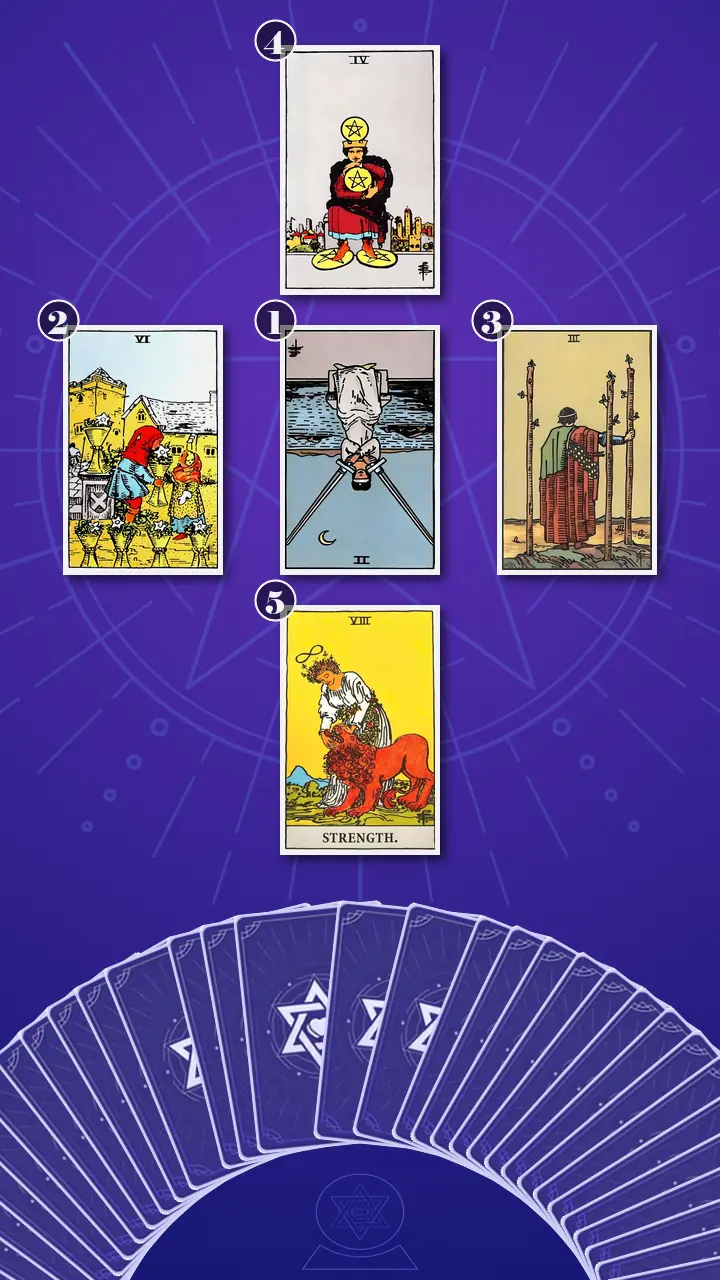
For this reading, I used the Decision Cross · Context Edition, a tarot spread for a career crossroads between returning to a former boss and continuing in a stretch role. This is how tarot works when I use it well: not as prediction, but as a structured way to separate what is visible, what is emotional, what is fear-based, and what is genuinely aligned.
The center card would show the decision knot itself. The left card would explore the pull of going back. The right card would explore the growth path in staying. The top card would name the hidden fear lens shaping the comparison. And the bottom card—the most important position in this reading—would show how to choose from self-trust instead of panic.
Reading the Crossroads Sign
At the Center: The Loop That Calls Itself Research
When I turned over the first card, I said, “This position presents the immediate decision knot—the stalling, the overthinking, the part of you trying not to close either door.” The card was the Two of Swords, reversed.
I pointed to the blindfold and the crossed blades over the chest. In real life, this looked exactly like her evenings after work: Slack closed, old boss’s message open, salary bands on one tab, performance notes on another, a Notes app comparison table quietly turning into a way to keep deciding without deciding. Nothing crucial was missing at a practical level. What was missing was her willingness to let one option become real and the other unavailable.
Reversed, the energy here is blockage, not lack. Too much Air, too little peace. Like keeping fourteen browser tabs open because you want a feeling of certainty from a tool that can only hand you more inputs. Or like refreshing the same dashboard and calling it strategy when it’s really avoidance in a smarter outfit. I told her, “Not every hard decision is asking for more data. Some are asking for more self-trust.”
She let out a quick, sharp laugh and looked at me over the rim of the mug. “Wow,” she said. “That’s accurate enough to be rude.”
I smiled. “Good. Then we’re looking at the right knot.” Her fingers kept tracing the ceramic anyway, but the laugh had done something useful: it named the trap without shaming her for being in it.
The Left Pull: The Courtyard of Being Known
I turned the second card and said, “This position explores the emotional and practical pull of returning to your former boss—the part of the offer that feels like relief.” The card was the Six of Cups, upright.
The offered cup of flowers and the enclosed courtyard told the story immediately. I read it as the old manager’s message itself: not just a job possibility, but a gesture of welcome back into a place where she had once been understood quickly. It was like reopening a show in its comfort season because you remember exactly how it made you feel before life got more complicated.
Upright, this is balanced Water. The support is real. The goodwill is real. The memory of being backed in meetings is real. But water can blur as easily as it soothes when memory becomes a filter. I told her, “Familiar is not automatically aligned. This card isn’t mocking your longing. It’s asking whether you’re drawn to the role, or to the version of you who didn’t have to earn credibility from scratch every week.”
Her shoulders dropped for a second. Then I watched her stomach tighten again beneath the table edge. “That’s the part,” she said quietly. “It felt so easy to speak there.”
The Right Pull: What the Horizon Builds
I turned the third card to the right. “This position explores the developmental pull of staying where you are—the part that feels harder now, but may be building more than you can see week to week.” The card was the Three of Wands, upright.
The figure on high ground, watching the ships, is one of my favorite career images in the whole deck. In Jordan’s life, it looked like staying in a demanding product marketing role long enough for ambiguity to turn into range: more visibility, better judgment, more strategic stretch, the kind of confidence that is earned through discomfort instead of handed over through familiarity.
Upright, this is balanced Fire. Not chaos. Not hustle-post nonsense. Expansion with perspective. I asked her to picture not tonight’s discomfort, but the next calendar year. “This isn’t just harder,” I said. “It might also be larger.” Outside the window, a streetcar bell cut through the dusk, and the sound felt strangely perfect—movement, even if slow.
She looked past the cards for a moment, as if she were staring out a TTC window instead of at my table. Then I saw it: her shoulders eased down an inch, and her next breath landed deeper. The future stopped looking like one giant threat and became a horizon again.
Above the Center: The Grip Mistaken for Prudence
I turned the fourth card above the center. “This position reveals the hidden factor distorting the whole comparison—the fear lens, the control lens, the part of you trying to protect yourself so hard that it narrows the criteria.” The card was the Four of Pentacles, upright.
The symbolism could not have been clearer: one pentacle on the head, one pinned to the chest, two trapped under the feet. Thought gripped. Feeling gripped. Movement gripped. In real life, this was rent math, benefit-plan comparisons, rereading old praise, checking the banking app, tightening the list of criteria every time her body spiked. “I say I want the best long-term move,” I told her, “but right now I’m hearing a quieter sentence underneath it: I want the option that will calm me down fastest next week.”
That is Earth in excess—security turning rigid, control dressing itself up as wisdom. My artist brain always sees this card like a canvas overruled with black lines: everything boxed, nothing breathing. The practical concerns matter. Rent matters. Manager fit matters. But when safety becomes the only metric left in the room, growth starts to look reckless by default.
She went very still. First her jaw stopped moving. Then her eyes lost focus, as if some private replay had started—the Line 1 ride home, the rent alert, the old message glowing warmer after a bad meeting. Then she exhaled hard enough to cloud the surface of her tea and turned her phone face-down beside her. We had named the real fear: not just choosing wrong, but letting one choice become evidence that she couldn’t control her future.
When Strength Placed a Calm Hand on the Lion
Below the Knot: The Advice That Changed the Question
By the time I reached the final card, the whole spread had the shape of a crossroads sign with a ceiling and a floor: the frozen center, the known courtyard on the left, the horizon on the right, fear above. What I needed now was not another argument. It was an antidote. I turned the fifth card from the bottom position—the place of grounding advice and wise action. It was Strength, upright.
The room seemed to settle around the card. Even the fridge quieted into the background. Strength never reads to me like brute force. It reads like jazz improvisation—the Louis Armstrong kind, where the gift is not in controlling every note before it arrives, but in staying grounded enough to answer the moment truthfully. You do not wait for stage fright to vanish. You breathe, hear the band, and play the next honest note. That is the energy this card was invoking: regulated courage and compassionate self-command.
Jordan was still caught in that familiar late-night trap I see so often: the tea cold, the message open, the whole body acting like one reply could decide her entire adult life. She was trying to think her way into a risk-free future before she would allow herself a choice.
The answer is not hiding inside a tighter grip on certainty; it appears when you place a calm hand on the lion of fear and choose from self-trust.
She froze first. Her breath stalled halfway in, and her thumb hovered above the mug handle without touching it. Then I watched the sentence sink deeper. Her gaze drifted toward the dark window, unfocused, like she was replaying last Thursday’s kitchen loop frame by frame—the cold tea, the salary tabs, the unsent message, the part of her that called it research because panic in a blazer sounded more respectable. When she looked back at me, her eyes were wetter. “But if that’s true,” she said, and there was a flash of resistance in it, almost anger, “then I’ve been asking this decision to do way too much. I’ve been making it prove I can handle adulthood.”
“Yes,” I said. “And that doesn’t make you foolish. It makes you scared. Those are not the same thing. The panic isn’t proof the answer is wrong; it’s proof the choice matters. But fear does not get to be the admin account.”
Her shoulders finally dropped. Not dramatically—more like a jacket slipping off a chair back. Then came the softer part I always watch for in real readings: the slight disorientation after clarity, the almost dizzy feeling of no longer being propped up by the old loop. I asked her, “Now, using this new lens, think back to last week. Was there a moment when this question would have changed how the whole decision felt?”
She nodded slowly. “After that awful meeting,” she said. “I didn’t want the old job. I wanted the feeling of not having to prove myself for twenty-four hours.”
That was the hinge. Not just a clever insight, but a real shift—from tight decision anxiety and outsourced certainty to grounded self-trust and values-based commitment. Or, in plainer language: from relief-seeking to future-fit thinking. “Pick the path you can still respect after the adrenaline leaves,” I told her. “That’s what Strength is asking.”
The Self-Respect Filter: Practical Next Steps
When I looked back over the whole spread, the story was clean. At the center, the Two of Swords reversed showed a mind keeping both doors open so no grief had to be felt yet. On the left, the Six of Cups showed why the old boss’s message hit so hard: it offered recognition, ease, and a return to a version of Jordan that once felt more fluent. On the right, the Three of Wands showed the longer arc her current role might be building if she judged it by the next year instead of the next bad week. Above, the Four of Pentacles revealed the blind spot: she was secretly grading both paths by how quickly they would lower her anxiety, not by which environment best supported the person she was becoming. Below, Strength gave the transformation direction—choose from steadiness, not from nostalgia or panic.
I told her the key shift as directly as I could: “Stop asking which option feels safest today. Start asking which environment best supports the person you’re becoming over the next year.” Clarity is not the same thing as relief. That is exactly what the Decision Cross · Context Edition is built to show: not which path is magically risk-free, but which criteria fear has been quietly hijacking.
So I gave her a one-year environment lens, three clear criteria, and regulated self-reflection—the practical structure the reading had been asking for all along. She did not owe uncertainty a nightly performance review.
- The 30-Minute Mondrian Grid This week, block one 30-minute calendar slot titled ‘Career choice only once.’ On a single sheet of paper or one Notes page, draw three clean boxes—learning, support, and future stretch—and score both options once. No extra tabs, no new categories. If 30 minutes feels too sharp, start with 15. Put your phone on Do Not Disturb, close LinkedIn, Glassdoor, and salary tabs before you begin, and give yourself a no-night-reopen rule until morning once the timer ends.
- The One-Year Window Walk Take a 10-minute walk without your phone after work and ask only one question: ‘Which environment is more likely to grow my judgment by next year?’ If it helps, write two five-line snapshots dated 12 months from now—one if you return, one if you stay. Keep the focus on how you would work and grow, not on how impressive either option sounds. If writing makes you spiral, switch to bullet points and stop at five lines.
- The Two-Minute Oscars Pitch Before replying to your old boss or polling friends again, record a two-minute voice note finishing this sentence: ‘The option I can respect myself in most is...’ If you still need context, ask your old boss one concrete growth question: ‘What would this role stretch in me over the next year that it didn’t before?’ This is not for performance. It is to hear your own edit before you hit send. If your body spikes, pause, unclench your jaw, take three slower breaths, and continue only if it still feels useful.

A Week Later, the Quiet Proof
A week later, I got a voice note from Jordan while she was walking home. She had done the grid, taken the phone-free walk, and asked her old boss the growth question. “The answer was kind,” she said, “but it wasn’t actually bigger.” Then she laughed, softer than before. “I think I missed being known more than I missed that job.”
She chose to stay. She told me she slept through the night after sending the reply, then woke with the old flicker—what if I picked wrong?—and noticed, almost with surprise, that she didn’t reach for LinkedIn, Glassdoor, or the notes app. She just made coffee and went to work.
From my side of the table, that is what a real Journey to Clarity looks like. Not total certainty. Not a cinematic swell and instant peace. Just the quiet move from panic-driven comparison to calm commitment, from outsourced reassurance to self-trust, from a clenched jaw to a steadier hand.
Sometimes the hardest part is not choosing between two jobs—it’s feeling your chest lock up because one path seems to risk your future, and the other seems to risk the version of you you were finally trying to become.
If your own cold-tea tab loop starts up again tonight, what would change if you stopped asking which option would calm you down fastest and asked instead which environment would let you respect yourself a year from now, with one steady hand on the lion?