From Good-Morning Text Anxiety to Calm Replies: Practicing Paced Attention
Finding Clarity in the 8:09 a.m. Ping
If you’ve ever smiled at “good morning” and then immediately checked the thread again (and again) while making coffee because the vibe felt like a verdict, you’re not alone.
Taylor told me this on a video call from her Toronto condo, camera angled just enough that I could see a slice of her kitchen: pale morning light, a kettle clicking off, the soft hum of the fridge doing that constant, almost irritating little job of being alive. Her phone was in her hand like it belonged there, already warm from being gripped too tightly.
“It’s just a good-morning text,” she said, and the way she emphasized just sounded like she was trying to convince her own nervous system. “But my brain treats it like a test.”
She walked me through her usual two-minute montage: the text arrives, she smiles—genuinely, sweetly—then her thumb opens the thread again while she’s still in socks. She rereads. She checks if the emoji is the same. She starts doing timing math: reply too fast and she’ll look needy, reply too slow and she’ll look cold. She drafts a response in her Notes app “just to see,” then deletes it, rewrites it, and suddenly twenty minutes are gone and her coffee is cooling on the counter like an abandoned ally.
And the feeling underneath all that thinking wasn’t abstract. It was physical. A tight chest and restless hands—like her body couldn’t fully settle into the day until she knew where she stood.
As Luca Moreau—Paris-trained perfumer turned intuitive consultant—I’ve learned to take those body signals seriously. Scent and attachment sit closer together than people think. One small cue can flood the whole system.
“We can work with this,” I told her. “Not by forcing yourself to be chill, or by following rigid texting rules. We’re going to figure out what old pattern gets triggered right after that good-morning text—and then we’ll build a small, realistic pivot. Think of it as a Journey to Clarity: we’re not here to judge you. We’re here to map the loop.”

Choosing the Compass: The Celtic Cross · Context Edition
I asked Taylor to put the phone down for ten seconds—just ten—and take one slow breath that she could actually feel in her ribs. Not as a ritual for the universe, but as a clean transition for her attention. Then I shuffled.
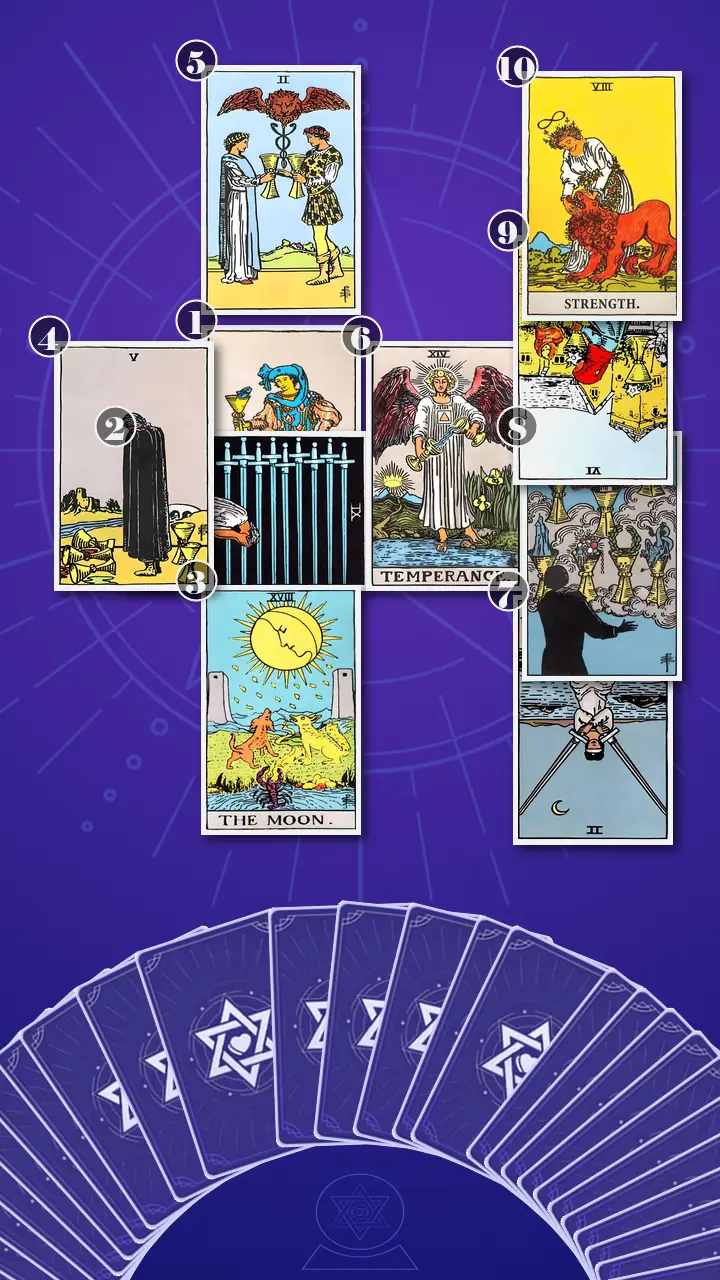
“Today we’ll use the Celtic Cross · Context Edition,” I said. “It’s a classic spread, but I like it for this question because it doesn’t just name the trigger. It shows the chain: what’s happening in the moment, what complicates it, what’s underneath it, what old memory is feeding it, and where the practical leverage point is for this week.”
For anyone reading who’s ever wondered how tarot works in a real-life situation like texting anxiety: this is why a full structure matters. A yes/no pull might tell you “you’re anxious” (which you already know). A Celtic Cross shows you the mechanics—so you can change something on purpose, not just react.
“I’ll call out a few positions as we go,” I told Taylor. “We’ll start with the present situation—what that text represents in your body. Then the immediate challenge—what kicks in right after. We’ll also look at the old pattern position, because that’s your exact question. And we’ll anchor it with a near-future leverage point: the most realistic shift you can practice this week.”
Reading the Map: What Happens After ‘Good Morning’
Position 1: When Sweetness Becomes Weather — Page of Cups (upright)
“Now we’re turning over the card that represents the present situation: what the daily good-morning text represents emotionally right now and how it lands in the body.”
Page of Cups, upright.
The image always gets me—this young messenger holding out a cup, and inside it, a fish pops up like a surprise feeling that refuses to stay contained.
“This is like when you get the good-morning text and, for a moment, it feels playful and sincere—until the ‘fish in the cup’ moment turns into ‘Wait, what does this imply about us?’” I said.
Energetically, the Page of Cups is open and tender—a balanced invitation to connection. But it’s also young energy: it can feel fragile if you treat it like a guarantee. A sweet message becomes the center of the day’s emotional weather, not because it’s manipulative, but because your nervous system is asking it to prove something bigger: warmth, certainty, belonging.
Taylor gave a half-laugh that had a little bitterness in it. “That’s… rude. Accurate, but rude.”
I smiled—not because it was funny, but because that laugh was a tiny release. “I know,” I said. “The Page isn’t blaming you. It’s telling the truth: you’re receiving something sweet, and immediately asking it to carry the whole relationship.”
Position 2: The Browser Tabs on the Wall — Nine of Swords (upright)
“Now we’re turning over the card that represents the immediate challenge: the specific mental/emotional reaction that kicks in right after the text and disrupts stability.”
Nine of Swords, upright.
I didn’t even have to reach for a mystical explanation. The scene on the card is basically modern life: a person sitting up in bed with hands over their face, and nine swords lined up like thoughts you can’t close out of.
“This is like having 27 browser tabs open called ‘What did they mean by that?’ and expecting your nervous system to run smoothly,” I said. “You open the thread. Then you reopen it. You check last active. You write three endings before 9 a.m.”
I mirrored the internal monologue I could practically hear in her: “If the emoji is gone, it’s distance. If it’s short, it’s fading. If I reply wrong, I’ll cause it.”
Energetically, this is excess Air: thinking as a substitute for relating. Not because you’re dramatic—because worry creates the illusion of control. For a second, monitoring feels like you’re preventing loss. Long-term, it spends your self-trust.
Taylor’s face changed in that small, involuntary way people have when something lands too precisely: a quiet wince, then an exhale she didn’t plan. Her fingers, which had been tapping her mug, went still.
“I do it in broad daylight,” she said, almost embarrassed. “Like I’m running late-night thoughts at 8:15 a.m.”
“Exactly,” I told her. “And the trigger isn’t the text. The trigger is what your mind does right after.”
Position 3: Fog + Projection — The Moon (upright)
“Now we’re turning over the card that represents the underlying root: the unconscious fear and projection that makes the text feel high-stakes.”
The Moon, upright.
The Moon doesn’t show danger as a fact. It shows uncertainty as a force—tides, shadows, the path between two towers that looks straightforward until you actually try to walk it.
“This is like when you can’t tolerate ‘undefined,’ so you start interpreting every micro-signal—response time, punctuation, emoji—as if it were a hidden warning,” I said.
Energetically, The Moon is blockage through ambiguity. It’s not that your intuition is wrong. It’s that fear borrows intuition’s voice when the situation has gaps. The Moon supplies the fog; the Nine of Swords tries to control it by thinking harder.
I watched Taylor’s eyes drift slightly off-screen—like her mind had opened a file folder labeled previous experiences.
“When you feel compelled to decode the text,” I asked her gently, “what worst-case are you trying to outrun?”
She swallowed. “That it’ll fade. That I’ll be the last one trying.”
“That makes sense,” I said. “Moon energy isn’t crazy. It’s your system trying to protect you when it doesn’t have clear ground.”
Position 4: Scanning for What’s Missing — Five of Cups (upright)
“Now we’re turning over the card that represents the recent past: the emotional memory trace that still shapes how closeness and consistency are interpreted.”
Five of Cups, upright.
This card is grief’s attention pattern: three cups spilled in front, two still standing behind, and a bridge out that’s easy to miss when you’re locked on what’s already gone.
“This is like reading a perfectly friendly text, but immediately searching for what’s absent—extra warmth, reassurance, a plan—then feeling the familiar drop in your stomach,” I said.
Energetically, it’s deficiency—not of love, but of attention toward what’s steady. The Five of Cups trains the nervous system to scan for the missing ingredient, even when the recipe in front of you isn’t broken.
Taylor nodded once, very small. “I hate that I do that,” she said. “Even when nothing bad is happening.”
“Notice the word ‘even,’” I replied. “That’s the point. This is an old reflex, not a verdict about your current partner.”
Position 5: What You’re Actually Trying to Secure — Two of Cups (upright)
“Now we’re turning over the card that represents your conscious aim: what you think you’re trying to secure through the ritual.”
Two of Cups, upright.
Two people, mirrored posture, cups held at equal height—mutuality in daylight.
“This is like… you’re not actually asking for constant texting,” I said. “You’re asking for a felt sense of ‘we’re on the same page.’ You want it to be real, not guessed.”
Energetically, the Two of Cups is balance. It’s the part of you that wants to choose each other without games. It’s why that simple good-morning text feels meaningful: it represents partnership energy to you, not just chatter.
Taylor’s shoulders dropped a fraction, like her body recognized itself in that. “Yes,” she said. “Mutual. That word.”
“Good,” I told her. “Because when we know what you want, we stop asking the text to do a job it can’t do.”
When Temperance Spoke: Blending Honesty and Pacing
Position 6 (Key Card): The Leverage Point You Can Practice This Week — Temperance (upright)
As I reached for the next card, the room felt quieter—not in a spooky way, but in the way it gets quiet when someone finally stops arguing with themselves long enough to listen.
“Now we’re turning over the card that represents the near-future leverage point: the most realistic shift you can practice this week to change the trigger-response loop.”
Temperance, upright.
An angel pours between two cups, one foot in water, one foot on land—emotion and steadiness, blended instead of battled.
Setup (the moment you’re stuck in): I said, “You know that split-second after you smile at the good-morning text—then your thumb goes back to the thread while your coffee machine hisses, like you can’t start your day until you’ve decoded what this means about you.”
I let that sit, then added the practical truth: “If one text feels like a verdict, you’ll keep reading it like evidence. Temperance is a reminder: safety isn’t hidden in the message—it's built by how you pace your attention and stay connected to yourself while you stay connected to them.”
Delivery (the sentence that shifts the frame):
Stop treating one message like a verdict; start blending honesty and pacing like Temperance pouring between the cups.
Reinforcement (what happens in the body when it lands): Taylor’s breath caught—just for a beat—like her ribs forgot what to do. Her eyes went unfocused, not because she checked out, but because something inside her replayed a hundred mornings at once: the kettle, the phone, the thread, the quiet panic dressed up as “being intentional.” Her jaw unclenched, then clenched again, like her body was negotiating whether to trust this new idea.
Then the three-step micro-reaction happened so clearly I could almost hear it: first, a physical freeze—her fingers stopped fidgeting. Second, the thought sinking in—her gaze lowered to the table as if she were reading the sentence on a page. Third, a soft release—her shoulders dropped and she exhaled through her nose, shaky but real.
“That’s… doable,” she said, and her voice sounded surprised by its own relief. “Like, it’s not ‘fix your attachment style forever.’ It’s… a timer.”
“Yes,” I said. “Temperance is a timer, not a personality change.”
And this is where my perfumer’s brain always joins the tarot: “Temperance is also what we do in a fragrance lab. If you pour everything in at once—too much sweetness, too much intensity—you don’t get romance. You get distortion. But when you titrate? When you let top notes sparkle without demanding they prove the whole dry-down? You get something you can actually live in.”
I leaned in. “Now—use this new lens and tell me: last week, was there a morning when the text was fine, but you still spiraled?”
Taylor nodded immediately. “Thursday. It said ‘Morning’ instead of ‘Good morninggg’ and my brain was like, ‘We’re done.’”
“Right,” I said. “Temperance doesn’t ask you to pretend that didn’t sting. It asks you to pace your attention so that sting doesn’t take the steering wheel.”
And I named the shift out loud so she could feel it as a direction, not a vibe: “This is the move from hyper-vigilance and negative forecasting toward steadier calm—responding from self-trust and directness instead of trying to pre-empt abandonment through perfect messaging.”
The Time Machine Pattern You Didn’t Consent To
Position 7: Freeze-as-Control — Two of Swords (reversed)
“Now we’re turning over the card that represents your self-position: your habitual role in the loop—how you protect yourself in the moment the trigger hits.”
Two of Swords, reversed.
Blindfold, crossed swords over the chest—trying to keep emotion contained by holding perfectly still.
“This is like being stuck on a subway platform watching two trains arrive—warm vs guarded—and refusing to get on either,” I said. “So you hover. You type, delete. You choose a delayed reply to look unbothered.”
I framed it as the two options she keeps toggling between: “Warm and real” versus “safe and neutral.” And the body cue that always comes with it: shoulders lifting, jaw tight, eyes flicking between the message and the clock.
Energetically, this is blockage. The reversal says the stalemate can’t hold. The longer you freeze, the more the mind spins to compensate—Nine of Swords fuel.
Taylor did the exact half-laugh the card predicted. “Oh no,” she said, dragging the words out. “The ‘cool delay’ strategy. I hate it. I do it anyway.”
“Of course you do,” I replied. “It’s a protection. But it’s not neutral. It creates distance, and then your nervous system panics and monitors harder.”
Position 8: The Feed as a Meaning Factory — Seven of Cups (upright)
“Now we’re turning over the card that represents your environment: external factors that amplify interpretation.”
Seven of Cups, upright.
Seven floating options—like pop-up windows—each one a different storyline. Commitment. Fading interest. Mixed signals. Testing you. You being “too much.” You being “not enough.”
“This is the modern situation,” I said. “You read the text, then your brain offers you five narratives like a menu. And TikTok relationship advice doesn’t help. Instagram Stories of matching coffees don’t help. It becomes a relationship KPI you never agreed to.”
Energetically, it’s excess—too many possible meanings competing for your attention. The Seven of Cups makes The Moon foggier and the Nine of Swords louder.
“It’s like my brain has a dating podcast running in the background,” Taylor admitted. “Even when I’m not watching anything.”
“That’s the environment,” I said softly. “The culture gives you infinite interpretations. Your work is to choose one reality-based interpretation unless you have direct evidence otherwise.”
Position 9: Naming the Old Script — Six of Cups (reversed)
“Now we’re turning over the card that represents the old pattern being triggered: the familiar script that reactivates after the morning text and what it’s trying to protect.”
Six of Cups, reversed.
I pointed at the simple offering in the image—the little cup of flowers—and then named the reversal: sweetness that becomes a time machine.
“This is like realizing your phone is a time machine,” I said. “One notification and suddenly you’re 19 again, trying to earn safety.”
And I did the split-screen for her: on one side, her current partner’s perfectly normal good-morning text; on the other, an older relationship memory where warmth slowly faded, where she learned—quietly—that consistency meant safety and any shift meant abandonment.
“You’re not decoding them,” I told her. “You’re trying to stabilize you.”
Energetically, Six of Cups reversed is imbalance: past-based relating, nostalgia that isn’t harmless. It pulls you into a younger version of yourself who thinks monitoring is what love requires.
Taylor went very still. Her expression softened, like something old had been named without being weaponized. “I always thought I was just… being careful,” she said. “But it’s like I’m replying to ghosts.”
“Exactly,” I said. “And your body thinks it’s protecting you from a slow fade by controlling the interaction now.”
Position 10: Integration Without Prediction — Strength (upright)
“Now we’re turning over the card that represents integration: what it looks like to respond from self-trust instead of monitoring.”
Strength, upright.
The woman doesn’t fight the lion. She holds it—tenderly, steadily—like she understands it’s loud because it cares about survival.
“This is the urge to check again,” I said. “The lion. Not bad—just loud.”
Energetically, Strength is balance with courage. Not dominance. Guidance. It’s the moment you can say, “I can handle uncertainty without monitoring,” and mean it enough to do one supportive action.
I gave her a concrete image to replace the spiral: “Phone face-down while you tie your shoes and step outside. The relationship doesn’t get to be your entire morning altar.”
Taylor nodded, and I saw a different kind of determination—quieter, less desperate. The kind that doesn’t need to win, just needs to lead.
The One-Week Reset: Actionable Advice for Texting Anxiety
I gathered the spread into a single story, so it would feel like a map instead of ten separate insights.
“Here’s the pattern,” I said. “The Page of Cups shows the text is genuinely sweet—it sparks real connection. Then Nine of Swords crosses it: your mind treats that sweetness like evidence you must interpret perfectly. The Moon underneath explains why: ambiguity activates projection, and your system tries to outrun uncertainty. Five of Cups shows the emotional memory—your attention defaults to what might be missing. Two of Cups tells the truth about what you want: mutuality, not a performance. Temperance is the bridge: a balanced response ritual that keeps you connected to yourself as much as to them. Two of Swords reversed shows your protective move—freeze and delay—keeps the loop running. Seven of Cups shows the environment: too many narratives, too much feed-driven meaning. Six of Cups reversed names the old pattern: the phone as a time machine. And Strength is the integration: guide the urge with dignity.”
Then I named the cognitive blind spot I see constantly in this specific modern dating loop: “You’ve been treating monitoring as if it’s the same thing as caring. But monitoring isn’t intimacy. It’s surveillance. And surveillance erodes self-trust.”
“Your transformation direction,” I continued, “is to shift from using the texting ritual as reassurance to using it as a moment of genuine presence—with one clear boundary for how much you will monitor and interpret.”
She frowned a little, practical brain kicking in. “But I’m in a hybrid job. My mornings are chaotic. I can’t just… do a twenty-minute mindfulness thing.”
I loved that she said it. Real obstacles mean we’re in real life.
“Perfect,” I said. “We’re not doing a personality transplant. We’re doing micro-actions. Five minutes counts.”
- 60-Second SendWhen the good-morning text arrives, reply in one pass within 60 seconds using your natural voice—no drafting in Notes, no group chat screenshots. Pick a simple line you can stand behind (e.g., “Morning—hope your day starts easy. I’ve got meetings till noon.”).If you feel the urge to perfect it, whisper: “Respond like me. Then return to my life.” Send anyway.
- Thread Timeout (Temperance Timer)Immediately set a timer for 5–20 minutes. Put your phone face-down or in another room, and do one physical, ordinary task—shower, unload the dishwasher, step onto the balcony, pack your bag—without reopening the thread.Expect pushback like “This is dumb” or “But what if I miss something.” That’s the monitoring system trying to stay in charge. Start with 5 minutes if 20 feels impossible.
- Fact vs Story SplitOpen Notes and write two lines: Fact (the exact words + timing) and Story (what your mind is adding). Then say out loud: “This is an old feeling, not a current fact.” Decide one self-respecting micro-ask you can save for later (on a call or date), not inside the morning thread.Keep the “Fact” line brutally literal. If you can’t prove it, it belongs in “Story.”
Then I offered my signature twist—because I’m not only reading cards; I’m reading the sensory system that gets hijacked.
“Taylor,” I said, “I want to use one piece of my Attraction Analysis. Tell me: what kind of fragrance do you default to on days you want to feel safe?”
She blinked. “Clean. Like… skin scents. Laundry but expensive.”
“Of course,” I said, gently. “Clean musks and ‘fresh’ notes are often an emotional strategy: ‘If I’m effortless and easy to be around, I’ll be chosen.’ That’s not wrong. It’s just information.”
I suggested a tiny add-on using my First impression management with signature scents strategy—repurposed inward, not performative. “Pick one scent you already own that makes you feel grounded—something with a base note you can feel, like sandalwood, vanilla, amber, even a warm tea note. After you hit send, apply one small spritz to your wrist. During the Thread Timeout, bring your wrist close and take one slow breath. You’re giving your body a ‘present-time anchor’ that is not the message thread.”
“So I’m… blending attention,” she said.
“Exactly,” I replied. “Temperance, in scent form. We’re giving your nervous system another place to land.”

A Week Later: Ownership, Not Certainty
Eight days later, Taylor sent me a message that made me exhale in the way you do when something finally clicks into place.
“Did the 60-Second Send,” she wrote. “Then put my phone face-down and did a 7-minute ‘Thread Timeout’ while I made oatmeal. My chest still did the thing, but it didn’t run my morning. Also—sprayed that warm vanilla-sandalwood you mentioned. It helped. I didn’t reopen the thread until I was literally putting on my boots.”
She added, almost as an afterthought: “I still had the ‘what if the vibe changes’ thought when I woke up. But I smiled at it. Like—okay, lion. I’m driving.”
That’s what I mean when I say tarot can offer actionable advice. Not a fantasy of never feeling activated again—but a realistic practice that shifts the power back into your hands.
When a good-morning text lands and your chest tightens like you’re waiting for a verdict, it’s not that you want too much—it’s that one small signal is being asked to prove you belong.
If you treated tomorrow’s good-morning text as a moment of presence—not a test—what’s one tiny boundary you’d want around your own monitoring (even just for 10 minutes) so you can hear your real voice again?