From Deadline Panic to Values-Led Commitment: Choosing School vs Job

Finding Clarity in the 9:58 p.m. Two-Tabs Loop
If you keep reopening the payment portal like it’s a slot machine that might finally spit out certainty, while your jaw stays clenched and your brain runs catastrophic “what if I ruin my future?” simulations—yeah. I know exactly what kind of Sunday this is.
Jordan showed up on my screen from a Toronto condo kitchen at 9:58 p.m., the kind with a fridge hum that never fully fades and a faint streetcar bell slipping in through a cracked window. They had their laptop open like a command center: grad portal in one tab, job offer PDF in another, and a spreadsheet that kept sprouting new sheets—Prestige, Earning Potential, Network, like they were building a Notion dashboard for a life they hadn’t picked yet. The laptop fan whirred. Their phone looked warm from refreshing. When they swallowed, they noticed their jaw—because it was locked in place.
“The deposit’s due Monday,” they said, rubbing their thumb against their index finger like they were trying to erase a thought. “And the job wants a yes. I keep waiting for the option that makes me feel calm… and it’s not happening.”
I watched their eyes flick to the corner of the screen where the “Pay now” button lived, then away again. Anxiety wasn’t a vague cloud in the room—it was like trying to pick the “best” route on Google Maps without ever hitting Start, while the clock on your phone counts down in the corner.
“Okay,” I said, keeping my voice steady on purpose. “We’re not here to force a magical feeling of calm. We’re here to get you to clarity—clear enough to choose one next step, and stable enough to support yourself after you choose.”

Choosing the Compass: The Decision Cross Tarot Spread
I asked Jordan to take two slow breaths—not as a mystical thing, but as a nervous-system reset. Then I shuffled. My old trading-floor habit still shows up here: you don’t make a clean decision in a body that thinks it’s being chased. You regulate first, then you assess.
“Today I’m going to use a Decision Cross tarot spread,” I told them. “It’s built for exactly this: two good options, one hard deadline, and a brain that keeps trying to buy certainty with more inputs.”
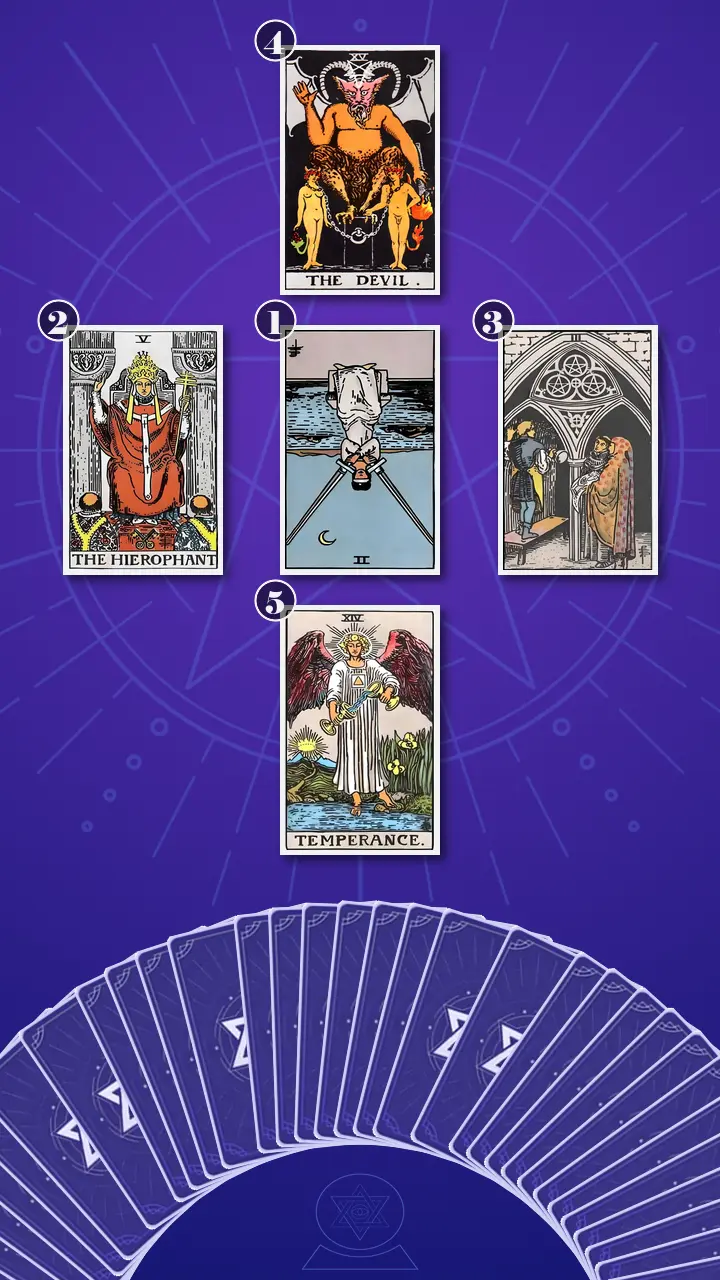
For you reading this: the rationale is simple. The Decision Cross gives us a center card that names the current loop, two side cards that show what each path actually develops (not just what it looks like on paper), a top card that reveals the hidden driver behind the intensity, and a bottom card that tells us how to integrate—how to make a decision without needing total certainty.
“Here’s the map,” I said. “Center is your stuck point. Left is grad school—what it supports and what it asks of you psychologically. Right is the job—what it builds in real-world terms. Top is what’s really running the show underneath. Bottom is the integration and next step.”
Reading the Map: The Loop, the Two Doors, and the Hook in the Ceiling
Position 1: The Stuck Point That Looks Like ‘Research’
“Now turning over is the card representing Current stuck point: the exact behavior and mental loop showing up as the deposit deadline approaches,” I said. “Two of Swords, reversed.”
The image hit the table like a screenshot of Jordan’s weekend. “It’s late Sunday night and you’re running a spreadsheet like it’s a courtroom case: salary calculator, tuition totals, LinkedIn salary reports, program FAQ. You keep reopening the deposit payment page and the job offer email, hovering over the buttons, then closing them—because choosing feels like stepping out from behind the blindfold and admitting you can’t have total certainty by Monday.”
Reversed, this card is Air energy in distress: not balanced logic—overheated logic. The mind swings like a pendulum and calls it “responsible,” but it’s actually a blockage. You’re using more data as a sedative.
I said it the way I’d want someone to say it to me: “More data isn’t always more clarity—sometimes it’s just a quieter way to avoid committing.”
Jordan let out a small laugh that was half breath, half flinch. “That’s… brutal,” they said. Then, softer: “But it’s literally my screen.”
“It’s not brutal,” I replied. “It’s accurate. And accuracy is kinder than shame, because accuracy gives us something we can work with.”
Position 2: The Grad School Door—Structure, Mentorship, and the Comfort of a Script
“Now turning over is the card representing Path A (Grad School): what accepting the program supports and what it asks of you psychologically,” I said. “The Hierophant, upright.”
I nodded toward the pillars in the image. “Grad school shows up like a pre-written playbook: orientation dates, syllabi, advisors, clear milestones, and a recognizable badge on your résumé. The pull is real—mentorship and depth—but so is the question: are you choosing it because you want that exact training, or because it feels like the socially validated way to stay ‘on track’ when you don’t want to risk being wrong?”
Upright, the Hierophant’s energy is structured and supportive—balanced when it matches your values. But it can tip into excess if it becomes an approval shelter: “If I pick the respectable thing, nobody can question me.”
I asked, “If you say yes to grad school, who teaches you—and what are you actually hoping they make you into?”
Jordan’s eyes lifted off the card as if they were seeing a hallway. “I keep picturing… office hours,” they admitted. “Like someone older and confident tells me I’m doing it right.”
That wasn’t wrong. It was just information.
Position 3: The Job Door—Paid Apprenticeship, Team Craft, Real Feedback
“Now turning over is the card representing Path B (Job): what taking the job supports and what it develops in real-world terms,” I said. “Three of Pentacles, upright.”
“The job looks like paid apprenticeship energy: you join a team, get real tasks, and learn through doing—weekly check-ins, project milestones, someone reviewing your work, and the confidence that comes from shipping something tangible. This isn’t just ‘income,’ it’s a craft environment where you build a reputation through consistency, not a single decision.”
Earth energy, upright, tends to be honest. Not flashy. Not a ‘destiny’ card. More like: show up, do the work, get better, get paid. Balanced, it builds self-trust through evidence.
I leaned into the side-by-side montage. “Syllabus and advisor office hours versus onboarding and weekly 1:1s. ‘Credentialed belonging’ versus ‘earned confidence.’ Neither is morally better. They’re just different learning ecosystems.”
Jordan’s shoulders shifted, almost like they’d been bracing for a verdict and realized they were allowed a comparison instead. “I do like feedback loops,” they said. “Like… being able to tell if I’m improving.”
Position 4: The Hidden Driver—The ‘Worth Contract’ You Didn’t Mean to Sign
“Now turning over is the card representing Hidden driver: the underlying fear, attachment, or identity story that’s making this choice feel heavier than logistics,” I said. “The Devil, upright.”
This is where the air in a reading changes. Even over video, I felt it: the quiet that arrives when someone is about to be seen too clearly.
“Under the deadline, the decision turns into a status-and-safety contract in your head: ‘If I pick the impressive option, I’ll be safe; if I pick the wrong one, I’ll be exposed.’ You start treating prestige or paycheck like emotional insurance. The trap isn’t school or the job—it’s the belief that your worth depends on picking the option other people can’t question.”
Devil energy isn’t “evil.” It’s attachment. Compulsion. The illusion that the chains are locked when, up close, they’re loose enough to slip off—if you’re willing to admit you’re wearing them.
I said it plain: “If the decision has to ‘prove’ you, it’ll never feel safe.”
Jordan went still. Then a three-part reaction rolled through them: first their breath caught—like a tiny freeze. Then their gaze unfocused, as if a memory was replaying behind their eyes. Then the exhale came out long and thin. “I hate that,” they said, voice small. “Because it’s true. I want the choice to be… un-arguable.”
“Right,” I replied, soft but firm. “That’s the two-layer operating system. Surface layer: ‘I’m being rational.’ Underneath: ‘I’m trying to buy certainty with a label.’ And that’s why the portal and the PDF keep pulling you back. It’s not about logistics anymore. It’s about control.”
When Temperance Spoke: Mixing What Matters into a Workable Plan
Position 5: Integration and Next Step—The Antidote to Deadline-Brain
“Now turning over is the card representing Integration and next step: the most empowering way to decide and move forward without needing certainty,” I said. “Temperance, upright.”
Temperance always feels like someone opening a window in a room that’s been running on stale air. An angel pouring between two cups. One foot on land, one in water. A path leading toward a sun that doesn’t rush you.
“This is the moment you stop trying to predict your whole life and instead build a ‘livable formula,’” I told Jordan. “You map the next 6–12 months in real terms—budget lines, weekly rhythm, support people, transition steps—so whichever choice you make, you’re not relying on perfect certainty. The calm comes from regulation and structure you create, not from a magically fear-free option.”
Not “I must find the flawless answer,” but “I will mix what matters most into a workable plan,” like Temperance steadily pouring between the cups.
I let it sit. In the pause, the fridge hum suddenly sounded louder, like the kitchen itself was eavesdropping. I thought of my old life on Wall Street—how people confuse urgency with importance, and how the biggest errors happen when you treat a deadline like a prophecy.
Then I brought in my signature lens—because Temperance isn’t just a vibe. It’s a method.
“Here’s what I want to do,” I said. “I’m going to run a Strategic Crossroads Analysis—the same way we’d look at two deals in M&A. Not because your life is a spreadsheet, but because your brain already went spreadsheet. We’re just going to make it stop lying to you.”
“We’ll use a simple three-scenario forecast for each option,” I continued. “Base case, upside case, stress case. Then we assign rough probability weights. Not to predict the future—just to stop your mind from catastrophizing one single storyline and calling it ‘reality.’”
Jordan’s face tightened for a second—resistance, the familiar reflex: if I don’t get certainty, what am I even doing?
“And,” I added, “we’re going to price in opportunity cost. Time and energy aren’t infinite. If you pick grad school, what are you not doing for twelve months? If you pick the job, what are you postponing? Temperance is literally portfolio theory in robe form: you’re balancing risk, reward, and sustainability—so your future isn’t dependent on one flawless decision.”
This time, Jordan’s reaction came in a different chain: first their fingers stopped fidgeting. Then their jaw loosened like they’d realized it could. Then their shoulders dropped—an inch, maybe two—but enough to change the whole frame.
“That feels… doable,” they said, and their voice sounded surprised by its own steadiness.
I nodded. “Good. Now—use this new lens and look back at last week. Was there a moment you could’ve made a smaller, values-led move instead of trying to solve your whole future?”
Jordan swallowed, but this time it wasn’t against a clenched jaw. “On Thursday,” they said. “I drafted an email to ask the program about deferrals. I deleted it because I didn’t want to look uncertain.” They paused. “But that was me trying to buy certainty by looking perfect.”
“Exactly,” I said. “This is the shift: from deadline-driven decision paralysis and self-worth pressure to values-led commitment with steadier self-trust under uncertainty. Not perfect confidence. Just steadier.”
The One-Page Ledger: Actionable Next Steps for a Job Offer vs Grad School Deadline
I summarized what the cards had told us in plain language: the Two of Swords reversed showed the loop—information as anesthesia. The Hierophant and Three of Pentacles showed two legitimate learning ecosystems—structure and credentialed mentorship versus craft, team feedback, and paid skill-building. The Devil named the real weight: the choice was being used as a worth test. Temperance offered the fix: integration—choose with values, then stabilize with a plan.
“Your cognitive blind spot,” I told Jordan, “is thinking that the right choice will feel calm before you commit. Temperance says the calm comes after—when you build support around your decision.”
“So here’s the transformation direction,” I continued. “Shift from ‘I must guarantee the perfect outcome’ to ‘I will choose based on my top values and build a reversible, learning-focused next step.’ A deadline doesn’t get to be your identity.”
I offered three actions—small, concrete, and designed to work even with shaky hands.
- 25-Minute Two Paragraphs TimerTonight, set a 25-minute timer. Write two short paragraphs: “If I choose grad school, I’m choosing it because…” and “If I choose the job, I’m choosing it because…”. Circle the three values that show up in both paragraphs (money, learning style, timeline, identity—whatever repeats). Decide using only those circled values.Expect your brain to call this “not objective enough.” That’s the point. If you start spiraling, shrink it: circle just ONE value and choose based on that.
- Two-Sided 6-Month Temperance Plan (Money / Time / Support)Make one page for each option with the same three headings: Money (a realistic monthly snapshot), Time (a weekly rhythm you can actually live with), Support (who/what keeps you steady). No optimizing. Just real numbers and real calendar blocks.If your jaw clenches or stomach flutters, pause for two slow breaths. The goal is clarity, not pushing through panic.
- One 5-Line Clarity MessageSend one low-stakes question today: ask the program one specific logistics question (funding, deferral policy, deposit terms) or ask the job one concrete mentorship/onboarding question (who your manager is, what the first 30 days looks like). Keep it to five lines.If sending feels terrifying, write it and save it as a draft first. You’re not being flaky—you’re negotiating clarity.
Before we ended, I used my pre-commitment ritual—a trading-floor focus technique dressed down for real life. “Pick a decision appointment,” I told Jordan. “Forty minutes on your calendar. No LinkedIn. No Reddit threads. Your only output is one sentence: ‘I choose ___, because my top values are ___.’ Then you act.”

A Week Later: The Quiet Proof
A week later, Jordan messaged me from the TTC—Line 1 southbound, fluorescent light glare, the usual Toronto winter gray pressed against the windows. “I did the Two Paragraphs thing,” they wrote. “Values were basically: financial stability, learning with feedback, and a weekly rhythm I can survive. I asked the program a specific deferral question—sent it in 4 lines. Then I said yes to the job and blocked off one night a week for a course so I’m still building toward the longer pivot.”
They added: “I woke up the next morning and my first thought was still ‘what if I’m wrong?’ But I didn’t spiral. I just… made coffee. It felt quieter.”
That’s the Journey to Clarity, as it actually happens: not a Hollywood certainty—more like a jaw unclenching in increments, and a plan that makes a random Tuesday feel livable.
When a deadline turns into an identity test, your brain will keep demanding “one more proof” until your jaw hurts—because committing feels less like choosing a path and more like risking regret.
If you stopped trying to guarantee the perfect outcome for a second, what’s one small support plan you’d want in place so your choice feels steady on a random Tuesday—not just impressive on Monday?