From RSVP Freeze to Bounded Yes: Rewriting the Family 'Should'

The RSVP Deadline That Turns Into a Jaw Clench
You see an RSVP deadline and instantly open your calendar three different ways… and still don’t answer (hello, decision paralysis).
Jordan (name changed for privacy) met me on a Wednesday lunchtime—downtown Toronto, office kitchen energy: the fluorescent lights doing that faint, unforgiving hum, the counter smelling like reheated leftovers and burnt espresso. She stood with a lukewarm coffee and a phone that had gone slightly warm in her palm from being gripped too long, flicking between Google Calendar, her work calendar, and Notes like one more tab would finally produce certainty.
Her thumb hovered over “Accept” the way people hover over a “Confirm Purchase” button when they’re not sure they can afford the consequence. Her jaw was set so tight I could almost hear teeth trying not to grind. Chest held. Fingers jittery, like they wanted to hit “send” and also throw the phone across the room.
“It’s not even a huge thing,” she said, and the way she said it made “huge” sound like a trapdoor. “But it’s family-adjacent. So if I say yes, it feels like… I’m signing away my whole night. And if I say no, it’s like I’m proving I don’t belong.”
That was the core contradiction in plain language: wanting to be reliable and connected vs fearing that saying yes will trap you in someone else’s expectations.
Her apprehension didn’t look dramatic. It looked like someone trying to breathe through a sweater pulled too tight at the collar—an invisible pressure that made every “simple” choice feel like a test.
I set my hands on the table, steady, the way I do on-air before a difficult segment. “You’re not broken for reacting like this,” I told her. “Let’s treat this like a map problem, not a personality flaw. We’re here for finding clarity—enough clarity to take one real step before the deadline turns into a verdict.”

Choosing the Compass: A Tarot Spread for RSVP Anxiety and Family Patterns
I’m Alison Melody—radio host by day, music-therapy nerd by training, tarot reader by calling. My readings are practical on purpose: less fog, more “what do you do at 12:34 PM when your thumb freezes over the button?”
I asked Jordan to take one slow inhale, one slow exhale—not as a ritual, just as a gear shift. Then I shuffled while she held the question in mind: “RSVP deadline—what family pattern feeds my commitment fear, and what’s one step?”
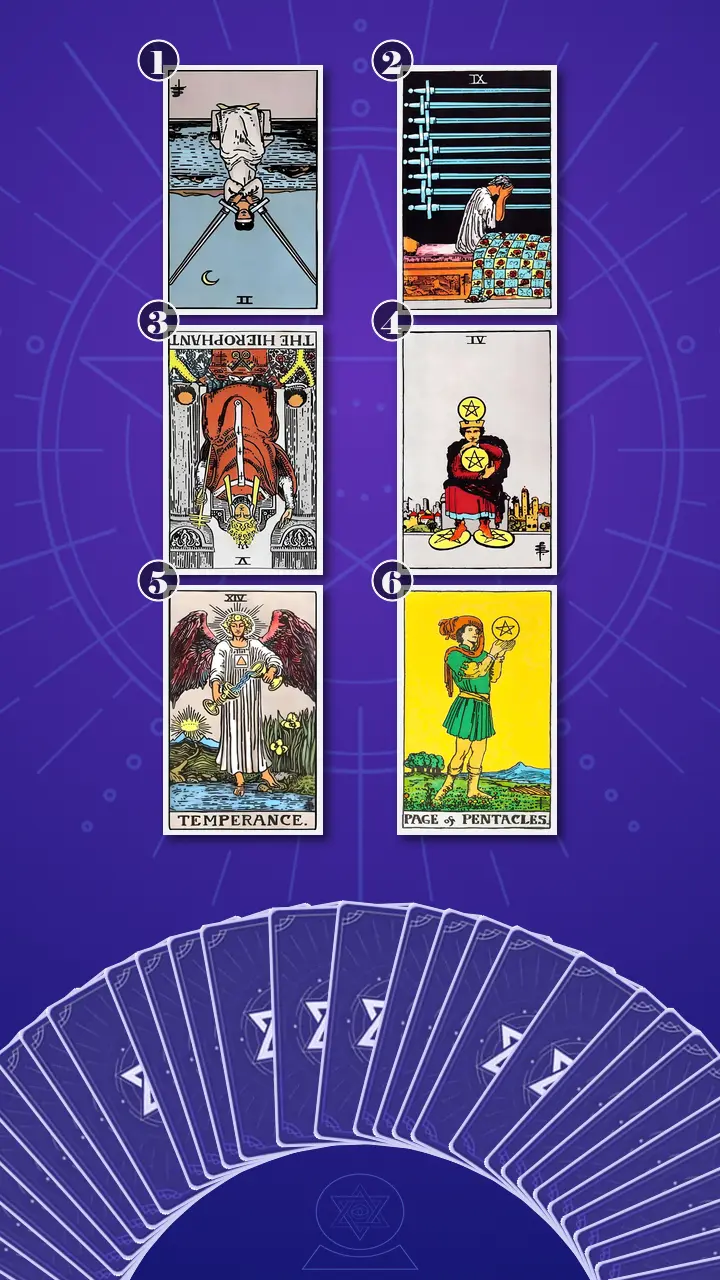
“For this,” I said, “I’m using a custom six-card layout called the Four-Layer Insight Ladder · Context Edition.”
For anyone wondering how tarot works in a situation like this: the point isn’t prediction. This spread is designed to separate what you’re doing (surface behavior), what it costs you (emotional climate), what trained you into the pattern (family script), what you’re protecting (core fear), and then—crucially—what reframe and next step make the decision workable. It’s a tarot spread for commitment fear and family patterns that stays psychologically honest and still gives actionable advice.
“We’ll start with the on-screen stall,” I added, “then the mental cost, then the inherited ‘should’ that makes this feel loaded. After that, we’ll name the fear underneath, and we’ll use one key card as a bridge into a single, grounded action you can do this week.”
Reading the Ladder: When Decision Paralysis Is Actually Control
Position 1: The Hover-Over-Send Loop (Surface symptom)
“Now we’re turning over the card that represents the surface symptom: the concrete RSVP-stalling behavior and decision paralysis happening right now.”
Two of Swords, reversed.
I didn’t need to reach for anything mystical; the image did the job: the blindfold, the crossed swords held tight to the chest, the posture of “neutral” that’s actually tension.
“This,” I said, “is you on your lunch break with the invite open, flipping between Google Calendar, your work calendar, and Notes. You type a cheerful ‘Yes, I’d love to!’ then delete it. Not because you don’t care—because not choosing feels like staying in control.”
In reversed position, the Two of Swords isn’t calm balance. It’s an Air blockage: thought trying to manage emotion by suspending the decision. The energy is contracted—like holding your breath so you don’t have to feel the wave of impact.
I leaned in a little. “Here’s the part people miss: the ‘neutral’ stance isn’t neutral. It’s tense. It’s a form of control.”
And because it mattered to name it without shame, I added one of my favorite pattern-spotter truths: “A deadline doesn’t create your decision—it just exposes your pattern.”
Jordan let out a small, almost amused sound—half laugh, half wince. “That’s… brutal,” she said. “But yeah. That’s literally me.”
Her reaction came in a tiny sequence I’ve learned to trust: first, a brief stillness (thumb stopped moving); then her eyes unfocused as if replaying a screen recording of herself; then a tight nod with a small exhale—recognized and a little called out, but in the useful way.
Position 2: The 2:13 A.M. Group Chat in Your Head (Immediate emotional/mental cost)
“Now we’re turning over the card that represents the immediate emotional cost: what the stalling is doing to your inner state day-to-day.”
Nine of Swords, upright.
“This is the part where the RSVP doesn’t stay in your phone,” I said softly. “It moves into your sleep.”
I used the translation exactly as it shows up in real life: at 2 AM, Jordan wakes up and checks how close the RSVP deadline is. Imaginary conversations line up—someone sounding hurt, her sounding defensive, her sounding ‘flaky.’ The guilt lands in the body as a tight chest and clenched jaw. The event isn’t happening yet, but the stress already is.
Energy-wise, this is Air excess—the mind spinning because the decision is suspended. And the Nine of Swords doesn’t mean “something terrible will happen.” It means the inner narration gets harsh when you delay.
“If you want a practical tool,” I told her, “write down the single sentence you’re most afraid will be true if you RSVP yes. Then write the single sentence you’re most afraid will be true if you RSVP no. Not a paragraph. One sentence each.”
Jordan pressed her lips together and gave a tiny shrug that wasn’t casual—it was defensive. “I hate that I do this,” she said. “Like, why can’t I make a simple decision like everyone else?”
“Because your nervous system thinks this is a loyalty audit,” I said, keeping my tone warm. “Not a plan.”
Position 3: The Inherited Rule You Never Agreed To (Family pattern)
“Now we’re turning over the card that represents the family pattern: the inherited rule or relational script that makes commitment feel loaded.”
The Hierophant, reversed.
“Okay,” I said, and I felt the room get quieter in that way it does right before a song hits its chorus. “This isn’t you being indecisive. This is you negotiating with an old ‘should.’”
Her eyes flicked up at me, then back to the card—like she didn’t want it to be that accurate.
Reversed, the Hierophant points to tradition as pressure: rules about what a “good” person does, and the private urge to resist being controlled by them. The keys in the card aren’t just symbolic—they’re gate imagery. Approval as a door that opens only if you say the right thing.
And I let it land as a micro flashback, because that’s how these scripts actually live in the body:
“You open an invite, and somewhere under the surface there’s an old line—half guilt, half threat,” I said. “Something like: ‘We don’t say no.’ Or ‘People will talk.’ Or ‘If you don’t show up, you don’t care.’”
Jordan went very still. Then she swallowed. “My aunt literally says, ‘Family shows up.’ Like it’s… a law.”
“Exactly,” I said. “So now your RSVP isn’t about the event. It’s about belonging. Yes feels like submission; no feels like exile.”
The energy dynamic here is a blockage in self-authorship: your adult values are present, but the inherited script still grabs the mic.
Jordan didn’t nod right away. She stared at the edge of the table, silent for a beat too long. Then she said, quieter, “I always thought I just had commitment anxiety. But this feels… older.”
Position 4: Calendar-as-Fortress (Core fear)
“Now we’re turning over the card that represents the core fear: what you believe you will lose if you commit.”
Four of Pentacles, upright.
“This is control as safety,” I said. “Not because you’re selfish. Because you learned that if you open your hands, you might not get to close them again.”
The modern translation is painfully specific: treating your schedule like a protected stash. One RSVP feels like it could crack the dam—once you say yes, people will ask for more, you’ll be overextended, and then you’ll have to disappoint someone anyway.
Energy-wise, this is Earth in excess: containment turned rigid. A fortress can keep you safe, and it can also keep you alone.
Jordan’s fingers tightened around her cup when I said, “It’s budgeting your time like rent money—every plan feels like an unexpected charge.”
She gave a small, frustrated breath. “I’m friendly. I show up. But I’m terrified of agreeing and then realizing I’m exhausted and can’t leave. Because then I’m ‘flaky.’”
“That’s the fear right there,” I said. “Not commitment. Commitment without terms.”
Position 5: When Temperance Poured Between Two Cups (Key shift)
“We’re turning over the card that represents the key shift: the reframe that transforms commitment from threat into a workable practice.”
The air in the kitchen felt like it paused—like the fluorescent hum dropped half a notch. This was the bridge card of the whole reading.
Temperance, upright.
Temperance is integration. Mixing. Calibration. Not dramatic leaps—measured pours.
Here’s the setup, because I could see Jordan caught in the familiar trap: she was waiting for certainty to appear before she could press send, like hovering at the edge of a diving board, hoping for a feeling that never arrives. In her mind, “yes” or “no” wasn’t a choice—it was a permanent identity verdict.
Not a lifelong contract—make a measured mix and RSVP from the middle, like Temperance pouring between two cups.
Silence. Then the three-part reaction chain hit her all at once: first, her breath snagged like she’d been caught trying to sneak out of a room; second, her eyes went glassy and unfocused, as if an entire playlist of past family gatherings started buffering behind them; third, her shoulders dropped—slowly, reluctantly—like her body had been waiting for permission to stop bracing.
“But—” she said, and the word came out sharper than she expected. Her brows pulled together. “If I do that… doesn’t it mean I was doing it wrong before? Like I wasted all this time?”
I nodded, because that anger is honest. “It means you were using the tools you had,” I said. “Freezing and stalling kept you from immediate conflict. It wasn’t ‘wrong.’ It was protective. Temperance just offers a better tool—one that doesn’t charge you interest at 2 AM.”
Then I brought in my signature lens—because as a music-therapy radio host, I don’t just listen to words; I listen to patterns.
“Can I do a quick Music Pulse Diagnosis with you?” I asked. “What have you been playing on repeat lately—especially on the commute or late at night?”
She blinked, surprised, then laughed once. “Honestly? A lot of sad-girl indie. And then, like, ‘lofi beats to focus’ when I’m spiraling.”
“That makes so much sense,” I said. “Sad-girl indie is emotional truth. Lofi is control—soft walls around the mind. Temperance is neither: it’s the mix. It’s the ‘middle track’ where you can feel connection and keep your limits.”
I tapped the card gently. “So here’s the experiment: set a 10-minute timer. In Notes, write two lines: (1) ‘Family rule voice:’ and finish the sentence. (2) ‘Adult values voice:’ and finish the sentence. Then draft the RSVP from line two plus one concrete term—arrival time or leave time.”
Her jaw tightened again for a split second, so I offered the most practical bridge I know: “If your chest spikes, we don’t push through it. We regulate. I’ll give you a Breath Soundtrack: three slow breaths with a 4-second inhale and a 6-second exhale—like a song with a longer outro than intro. It tells your body: we’re safe enough to choose.”
I watched her try it—subtle, almost invisible in a public kitchen. On the last exhale, she whispered, “Okay. ‘Yes with terms’ feels… possible.”
“Now,” I said, “with this new frame, think back to last week. Was there a moment—one invite, one group chat, one family text—where this would’ve changed how trapped you felt?”
Jordan’s eyes shifted to the side, memory searching. “My cousin’s thing,” she said. “If I’d just said, ‘I can come but I’m leaving by nine,’ I wouldn’t have spent three days researching TTC routes like it was a dissertation.”
That was the emotional transformation clicking into place: from deadline-driven spiraling and option-hoarding to self-trusting, bounded commitments with clear terms. Not perfect confidence—just a workable pivot.
Position 6: The Beginner’s Checklist That Calms Your Nervous System (One step)
“Now we’re turning over the card that represents the one step: the smallest practical action you can take within a week to resolve the RSVP and rebuild self-trust.”
Page of Pentacles, upright.
“This is such a relief card,” I said, and I meant it. “Because it doesn’t ask you to ‘become a different person.’ It asks you to do one small, grounded thing.”
The Page studies the pentacle like a simple object you can hold in your hands. In modern terms: you send the RSVP, then you externalize one tiny logistics plan so your nervous system doesn’t have to keep the entire decision in your body.
Energy-wise, this is Earth in balance: practical containment that supports you instead of trapping you.
Jordan nodded faster this time. “I can do a checklist,” she said. “Like… if it’s in Notes, it’s not in my brain.”
“Exactly,” I said. “Make it practical enough that your nervous system can believe you.”
From Insight to Action: The Yes-With-Terms Experiment (and a Sound-Based Reset)
I slid the six cards into a neat ladder again, because the story they told was coherent—and, honestly, kind.
The short version went like this: you stall (Two of Swords reversed) because you’re trying to maintain control through “neutrality,” but the delay taxes you with rumination and guilt (Nine of Swords). Under that is an inherited family script that turns invitations into a belonging gate—say the right thing or risk distance (Hierophant reversed). So your body clamps down and guards time like it’s scarce currency (Four of Pentacles). Temperance doesn’t demand you pick the “right” identity; it teaches you to create a balanced agreement with explicit terms. Then Page of Pentacles turns that agreement into one small follow-through action you can complete this week.
Your cognitive blind spot—the sneaky one—is thinking the problem is lack of information. More calendar checks, more transit research, more “let me see what others are doing.” But what you’re actually avoiding is the terms conversation. The transformation direction is clear: shift from commitment-as-verdict to commitment-as-bounded agreement.
So I gave Jordan three next steps. Not aspirational. Not moral. Just doable.
- The 10-Minute Send Button RuleSet a timer for 10 minutes on your lunch break. No new research tabs. Decide yes/no based on one priority (rest, connection, finances, work capacity). When the timer ends, send the RSVP immediately.If you feel yourself trying to “earn” the decision with perfect logic, pause and ask: “What are my terms?” One term is enough.
- A Yes-With-Terms (or No-With-Care) ScriptDraft one sentence you can stand behind: “Yes—I can make it, and I’ll likely head out around 9.” Or: “I can’t make it this time, but I’d love to catch you for coffee next week.” Read it once out loud before sending and check your body: does it feel self-respecting?A bounded yes is still a real yes. Terms aren’t excuses—they’re information.
- Page of Pentacles 3-Bullet Logistics PlanRight after you RSVP, open Notes and write three bullets: (1) how you’ll get there (TTC/drive/rideshare), (2) what time you’ll leave, (3) one thing you’ll bring/do (card, dish, outfit). Add one reminder: “Leave by 8:40 to make it easy.”If you start spiraling, return to one practical detail. Externalize the plan so it stops living in your nervous system.
And because my work is always a blend of tarot and sound, I added a simple, immediate “nervous system first aid” layer Jordan could use the same night—my White Noise First Aid plus a tiny BGM Prescription:
BGM Prescription (pick one, 15 minutes): (1) Brown noise at low volume for “city brain” decompression after a TTC commute. (2) 432 Hz soft piano or ambient strings for unclenching the jaw without forcing emotion. (3) A steady 60–70 BPM instrumental beat (anything that feels like a slow walk) while you write the two-line “Family rule voice vs Adult values voice” exercise.
“You’re not trying to become someone who never feels mixed,” I reminded her. “You’re becoming someone who can choose with honesty and keep the agreement you make.”

A Week Later: Quiet Proof in a Sent Message
Five days later, Jordan sent me a screenshot: the RSVP bubble, finally not in drafts. Her message was simple—“Yes, I’m in. I’ll head out around 9.” Under it, a Notes app list with three bullets: TTC route, leave time, and what she was bringing.
Her follow-up text was even smaller, and somehow bigger: “I didn’t wait to feel certain. I just… chose terms.”
The bittersweet part, the part that felt most real: she celebrated by sitting alone in a café after work, headphones in, staring out at Queen Street traffic for ten quiet minutes—relieved, a little shaky, proud, and still not 100% sure she’d feel like going when the day came.
That’s the Journey to Clarity I trust: not certainty as a prerequisite, but ownership as a practice. A decision that doesn’t require self-abandoning. A commitment that’s an agreement—with terms.
When an RSVP feels like a character test, your chest tightens not because you don’t care—but because you’re trying to stay connected without handing your autonomy over to someone else’s unspoken rules.
If you let commitment be a small, bounded agreement instead of a permanent verdict, what would your most honest “yes (with terms)” or “no (with care)” sound like today?