Choice paralysis under a flight deadline—And one clean boundary text

The 9 p.m. Google Flights Spiral
If your family group chat is already acting like you booked (“So what time do you land?”) while you’re still staring at an empty cart, feeling guilty for not being a “normal adult.”
Taylor (name changed for privacy) sat down across from me like she’d been running—except she’d only been pacing her tiny Toronto kitchen. The overhead light was too bright for how tired she looked. Her laptop was open to Google Flights, the fan hummed like it was trying to drown out her thoughts, and every few seconds her phone lit the dim counter with another notification.
She rubbed her jaw like she could massage a decision out of it. “Flight prices jump tonight,” she said, voice clipped. “And I keep… adding it to the cart and then closing the tab.”
A WhatsApp bubble popped up on her screen—So what time do you land?—and I watched her stomach visibly drop, like the fare had already surged. Her hands didn’t stop moving: swipe, tap, refresh, Notes app, delete, repeat.
“I want to go home,” she admitted, eyes still on the phone. “But I’m afraid I’ll lose my peace. Like… it’s not the flight that’s expensive, it’s the emotional hangover.”
The anxiety in her wasn’t abstract—it was mechanical. Tight jaw. Tight chest. Restless fingers. The feeling of being graded by a countdown banner.
I kept my voice warm and steady. “That makes so much sense. Tonight isn’t just a travel choice—it’s a boundary choice under a deadline. Let’s make a map through the fog and get you to clarity you can actually act on.”

Choosing the Compass: The Decision Cross Tarot Spread
I asked Taylor to take one slow breath and hold the question in mind—not as a spell, but as a focus shift: from scrolling to listening. While I shuffled, I noticed how her shoulders stayed lifted, like she was bracing for a verdict.
“For a time-sensitive choice like ‘go home or protect my peace,’ I use a five-card layout called the Decision Cross,” I told her.
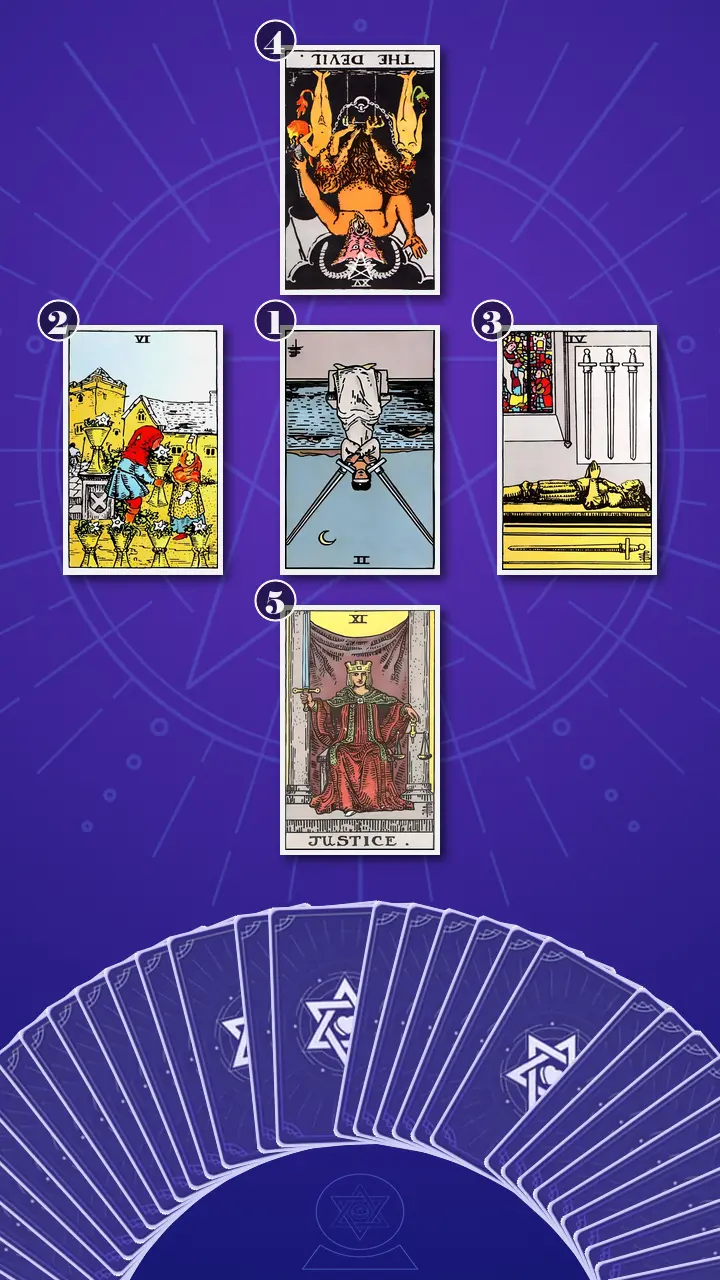
For you reading this: the rationale is simple and practical. This tarot spread is built for two-option decisions under pressure. It keeps the reading from turning into more mental noise. The center shows the stuck behavior (why you can’t click ‘buy’). Left and right compare the lived energy of each option (Option A vs Option B). The top names the hidden driver (what’s secretly making it feel like a character test). The bottom lands on advice you can do tonight—especially a clean way to communicate.
“We’ll start in the center with what’s looping,” I said, “then look at what ‘going home’ really gives you, what ‘protecting your peace’ really protects, and finally what’s pulling the strings underneath it all.”
Reading the Map: Five Cards for a Deadline-Heavy Choice
Position 1 — The current stuck point: the concrete decision paralysis under the price deadline
“Now we’re turning over the card that represents the current stuck point,” I said.
Two of Swords, reversed.
“This is the classic ‘I can’t decide’ card—but reversed, it stops being quiet stalemate and starts becoming overwhelm,” I explained. “It’s 9 PM and you’re running a full product-manager decision loop on your own life: five tabs open—Google Flights, Hopper, airline points, alternate dates, weather back home—a ticket in your cart, then you close it again. You tell yourself you’re being responsible because you’re ‘doing research,’ but your body is braced like you’re about to get in trouble. The deadline turns every refresh into an emergency, so you keep thinking instead of choosing.”
In my mind, I saw a split screen: her flight tab like a treadmill, her Notes drafts like an endless QA cycle. Movement without arrival.
“Energy-wise, this is Air overload,” I said. “Too much thinking, not enough truth. It’s not deficiency—it’s excess. Logic is crossed over your heart like armor.”
Taylor let out a small laugh that sounded more like a wince. “That’s… brutal,” she said. “Like, too accurate.” Her eyes flicked back to the flight tab, then away, as if the screen might scold her.
I nodded. “You can’t optimize your way out of a boundary. The mind is trying to buy certainty so you don’t risk being seen as uncaring.”
Position 2 — Option A (go home): what this choice emotionally provides
“Now we’re turning over the card that represents Option A: going home—what it really provides beneath the logistics,” I said.
Six of Cups, upright.
“This is the pull,” I told her. “Like getting a ‘memory’ notification and suddenly you’re back in the good version of home—the familiar laugh, the hallway light, the smell of a childhood dish. The pull isn’t just the place. It’s permission to feel like you still belong without having to prove it.”
I watched her face soften and then tighten again, almost immediately—like warmth followed by a brace. “My brain plays the highlight reel,” she whispered. “One good dinner. One good joke. And then I remember the comment that stuck to me for days.”
“Exactly,” I said gently. “This card is Water—real longing. But under deadline pressure, nostalgia can edit out the recovery time. The question isn’t ‘Do you love them?’ It’s ‘What are you actually going back for—people, place, repair, or proof you’re still good in their eyes?’”
Her fingers paused on her phone for the first time. A quiet, honest pause—the kind that means the truth is starting to come into view.
Position 3 — Option B (protect my peace): what this choice protects and what it requires
“Now we’re turning over the card that represents Option B: protecting your peace—what it safeguards and what it asks you to tolerate,” I said.
Four of Swords, upright.
“This looks like a quiet weekend in Toronto: phone face-down, notifications off, no bracing for sideways comments, no 2 a.m. emotional debrief in your head,” I said. “This isn’t punishment. It’s maintenance—like updating your OS before it crashes.”
“That sounds like heaven,” Taylor said, and I watched her shoulders drop half an inch, as if her body recognized the room it wanted to live in.
“Energy-wise, this is still Air,” I added, “but regulated Air. The mental load gets set down on purpose. The cost is that you may have to tolerate guilt without trying to fix it with a last-minute flight.”
She swallowed. “Rest guilt is so real,” she said. “Even imagining it makes me feel like I’m doing something wrong.”
“That’s not a moral signal,” I told her. “It’s a conditioning signal. And we’re about to see what’s hooked into it.”
Position 4 — The hidden driver: what makes this decision feel higher-stakes than airfare
“Now we’re turning over the card that represents the hidden driver—the underlying fear or attachment making this feel like a character test,” I said.
The Devil, reversed.
“The real pressure isn’t the fare,” I said. “It’s the invisible contract in your head: If I comply, I belong. And the chain tightens the moment the group chat gets confident.”
Reversed, this wasn’t doom. It was a hinge. A loosening.
“Here’s a grounding exercise,” I offered. “Finish this sentence privately: ‘The sentence I’m afraid to say is…’ And then underline the word that’s really about belonging—‘selfish,’ ‘uncaring,’ ‘disappoint.’”
Taylor stared at the card. Her breathing paused for a beat, then came back shallow. “The sentence I’m afraid to say is: ‘I’m not coming,’” she said. “Because then… I’m the bad daughter.”
“There it is,” I said, calm and clear. “Not villainizing anyone. Just naming the hook. Guilt isn’t proof you’re wrong. It’s proof you’re choosing differently than your old rules.”
She nodded once—sharp, like something inside her clicked into place, even if it stung.
When Justice Spoke: Fair Beats Perfect on a Deadline
Position 5 — Integration and next step: the decision standard and the clean message for tonight
I slowed down before turning the final card. The room felt quieter—not because the city noise stopped, but because Taylor’s constant motion did. Like we’d reached the center of the spiral.
“Now we’re turning over the card that represents integration and next step—your decision standard, and the clearest way to communicate it tonight,” I said.
Justice, upright.
“Justice doesn’t ask you to be perfect,” I told her. “It asks you to be fair. Fair to you: your bandwidth, money, recovery time. Fair to them: clarity and respect—no mixed signals.”
My old life on transoceanic voyages flashed through me: docking windows, port fees, weather shifts. On a cruise, you can’t negotiate with the tide by refreshing an app. You pick a safe window, accept the cost, and dock cleanly. This card felt like that: a clean landing.
I leaned in and used my Choice X-Ray—my way of reading a dilemma in multiple dimensions, not just “what’s easiest tonight.” “Let’s X-ray the hidden costs and benefits,” I said. “Not just airfare. Emotional hangover. Recovery time. The likelihood you’ll overextend and resent it. The cost of delaying: higher prices, more pressure, and a messier message.”
Her eyes went glassy for a second, not with tears yet—more like the brain replaying a pattern it finally recognizes.
Setup: Taylor had been refreshing Google Flights like it’s a slot machine—price up, price down—while the family group chat talked like she already booked. She was trapped in the idea that she needed the perfect choice so nobody would be disappointed, and so she wouldn’t have to feel guilty in her body.
Stop bargaining with guilt and start weighing what’s fair—then let Justice’s sword turn your boundary into one clean sentence.
Reinforcement: She froze—breath held, thumb hovering over her phone like it was suspended mid-air. Then her gaze unfocused, as if she’d scrolled back through the last three family trips in her head: the warmth, the tension, the recovery days afterward. Her shoulders slowly sank, not in defeat, but in relief. When she finally exhaled, it came out shaky and real. “So… I don’t have to make guilt disappear,” she said. “I just have to make a decision I can stand behind.”
“Yes,” I said. “And then communicate it cleanly.” I paused, letting the sword-and-scales image do its quiet work. “Now—use this new lens. Think about last week. Was there a moment where you reopened the flight tab, and if you’d asked ‘What’s fair?’ instead of ‘What’s perfect?’ your body would’ve felt different?”
She nodded, slow this time. “Tuesday,” she said. “I was exhausted. I didn’t want to go. But I kept trying to find a deal like it would make it… morally okay.”
“That’s the shift,” I said. “From deadline-driven guilt spirals and option-paralysis to values-led boundaries and a clean, self-respecting decision. Not zero discomfort—just integrity you can live with.”
The One-Text Landing: Actionable Advice for Tonight
I gathered the five cards into one story for her—simple, linear, usable.
“Two of Swords reversed shows the loop: researching to avoid the feeling. Six of Cups shows the real sweetness you want—belonging, being known. Four of Swords shows the truth your nervous system is asking for—rest and space. The Devil reversed names the hook: the old rule that says compliance equals belonging. And Justice gives you the adult standard: a fair decision, then one clean sentence.”
“Your blind spot,” I added, “is treating guilt like a push notification you must clear immediately. The transformation direction is the opposite: tolerate the discomfort long enough to choose what matches your limits and values—then say it plainly.”
Because you asked for something you can do now, I shifted into my Port Decision Model—a strategy I learned training people to make calm calls under real docking deadlines. “We pick a docking time,” I told her, “and we stop circling the harbor.”
- 10-minute Fairness CheckSet a timer for 10 minutes. On paper (not your Notes app), write three lines: (1) “What’s fair to me tonight is ___.” (2) “What’s fair to them is ___.” (3) “The cost I’m actually willing to pay is ___ (money + energy).”If your chest tightens, pause for 3 slow breaths. Discomfort is allowed—debate is optional.
- One-clean-sentence boundary textDraft ONE text under 240 characters that includes: (1) care statement, (2) limit statement, (3) next step (optional). Send it to the one person who will actually act on it (not the whole group chat). Example: “I love you and I miss you. I’m not coming this weekend—I don’t have the bandwidth. Can we do a video call Sunday afternoon instead?”No defending. No five-paragraph essay. One clean sentence is a kindness to your nervous system.
- No-extra-justification experiment (30 minutes)After you send it, don’t add follow-up paragraphs for 30 minutes. If someone reacts, repeat your limit once—then step away from the screen.If you start spiraling, physically leave the flight app for 5 minutes—water, stretch, look out the window—then return.
A Week Later: The Quiet Proof
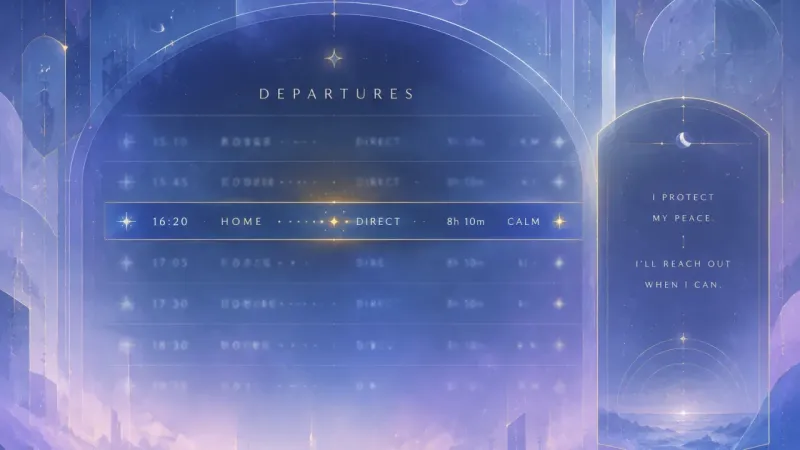
A few days later, I got a message from Taylor. Not a long update—just a screenshot of her sent text and a short line: “I did it. I sent one message. I didn’t over-explain.”
She told me she’d stayed in Toronto that weekend, ordered takeout, and put her phone on Do Not Disturb for two hours. It wasn’t fireworks. It was something rarer: her jaw unclenched while the world kept spinning. The next morning her first thought was still, What if I’m wrong?—but this time, she noticed it and didn’t renegotiate her boundary.
That’s what a Journey to Clarity often looks like in real life: not the absence of guilt, but the presence of self-respect. Justice doesn’t erase feelings; it helps you stop letting them write the contract.
When the flight price feels like a countdown clock on your worth, you start trying to buy a version of this where nobody’s disappointed—and you don’t have to admit what your body already knows you can’t carry.
If you didn’t need the perfect choice tonight—only a fair one—what would your one clean sentence sound like?