Two Drafts, Zero Sends on a Co-Author Invite—And a Terms-First Reply

Sunday Scaries, a Co-Author Invite, and the Gmail Drafts Graveyard
You have a co-author invite sitting in your inbox, and somehow it’s louder than every other deadline—classic Sunday Scaries meets “career growth” pressure.
Taylor (name changed for privacy) said it like a confession, but their laptop already told me the story: Gmail open, subject line starred, and two tabs pinned like they were keeping each other hostage.
It was 8:47 p.m. on a Tuesday in their Toronto condo kitchen. The kettle had just clicked off. The overhead light gave off that faint electrical hum that makes silence feel even sharper. Their phone was warm from being held too long, thumb hovering over the same email they’d already read five times. When they glanced at Google Calendar, their shoulders climbed—almost like the calendar itself was a threat.
“I want to say yes,” they told me, eyes flicking between the invite and a draft reply. “But I don’t want to pay for it with my nervous system.”
They described the loop in the most painfully searchable way: drafting two opposite replies—one bright, enthusiastic yes; one careful boundary essay—and sending neither. The second they imagined their name on the byline, ambition sparked. The second they imagined deadlines and back-and-forth messages, their chest went heavy. Scope creep anxiety wasn’t a concept to them; it was a physical weight.
The overwhelm wasn’t abstract. It had the texture of a high-priority Slack ping you can’t mark as “done,” so it keeps stealing RAM in the background—tight jaw, tight shoulders, and that restless midnight energy that turns “I’ll just reply tomorrow” into a 10:58 p.m. Notion outline you never agreed to build.
“If I say yes, I lose my life,” they said. “If I set limits, I lose the opportunity.”
I let that land, then softened my voice the way I do when someone’s body is already braced for impact. “We’re not here to force a yes or a no tonight,” I said. “We’re here to get you out of the drafts loop—and into clarity. Let’s draw a map you can actually use.”

Choosing the Compass: The Transformation Path Grid (6) for Decision Paralysis
I asked Taylor to take one slow inhale, then an even slower exhale—the kind that tells your nervous system, we’re not running from a bear. While they did that, I shuffled. Not as a theatrical ritual—more like a clean handoff from spiraling to focusing.
“For this,” I said, “I’m using a spread I call the Transformation Path Grid (6) · Context Edition. It’s a 2x3 grid—basically a practical worksheet in card form.”
For anyone reading who’s ever Googled how tarot works in the middle of a career crossroads: I chose this spread because the real issue isn’t predicting whether the collaboration will ‘work.’ The issue is turning a high-stakes yes/no into a sustainable structure—scope, pace, responsibilities—so you can respond without burning out.
“Top row,” I explained, tapping the table lightly as if outlining a project plan, “shows the pressure: your present load, what’s blocking your decision, and the root pattern behind it. Bottom row shows the path out: the catalyst shift, the action conversation, and what healthy collaboration looks like next.”
Taylor nodded, but their jaw was still doing that tiny clench people get when they’re trying to be ‘easy to work with’ at the expense of being honest.
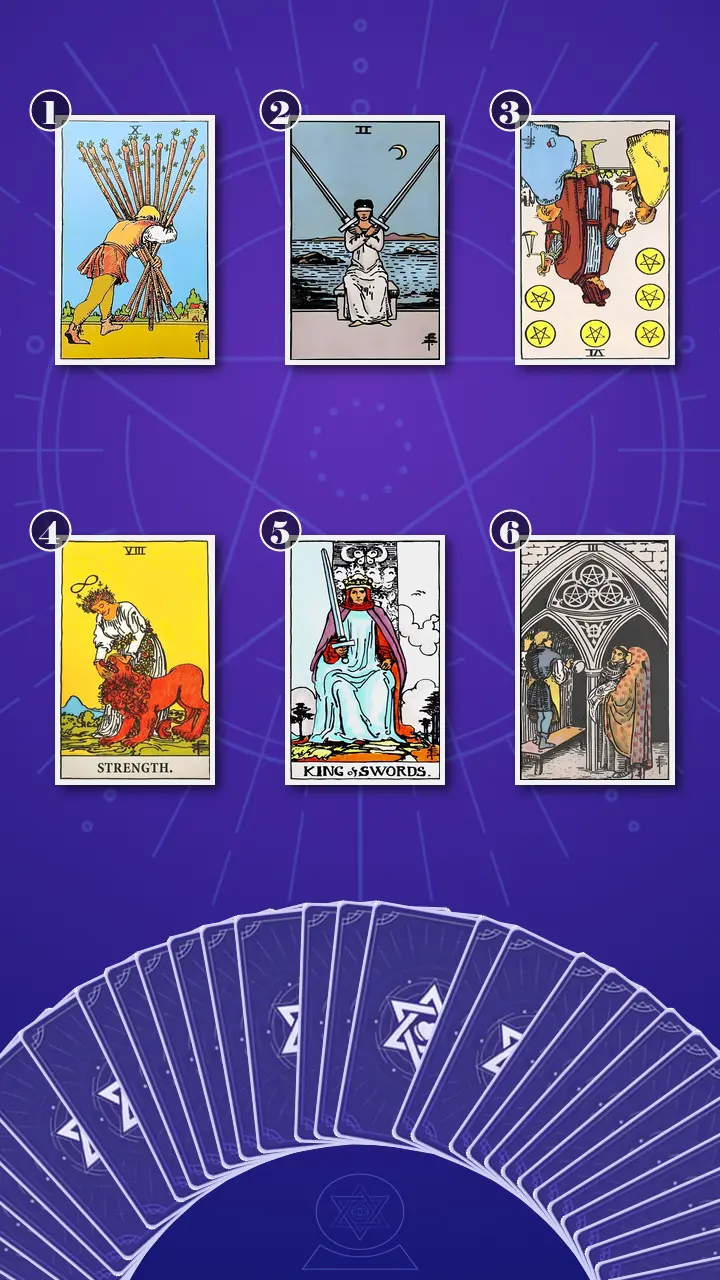
Reading the Map: Card Meanings in Context
Position 1 — Present load: what you’re already carrying
“Now flipped over,” I said, “is the card representing Present load: the concrete ways you’re already overextended and how the invite lands in your body and schedule.”
Ten of Wands, upright.
I didn’t need to reach for mysticism. The image did the work: a figure bent forward, arms full, vision blocked by what they’re carrying.
“This is that moment,” I told Taylor, “when you say ‘That sounds amazing’ out loud, and then immediately open Google Calendar and start stacking tentative writing blocks on top of client deadlines. By the third block you’re already bargaining with sleep—‘I can just do two late nights’—and you realize you’re mentally committing to the whole collaboration before a single responsibility has been defined.”
In energy terms, the Ten of Wands is excess: responsibility creep, but self-assigned. Not because you’re irresponsible—because you’re reliable.
Taylor let out an unexpected little laugh that had a bitter edge. “That’s… actually kind of brutal,” they said. “Like, are you in my Google Calendar?”
“Not brutal,” I said, steady. “Specific. The card isn’t judging you. It’s showing you what’s already on your back before you add one more thing.”
Position 2 — Main blockage: what keeps you stuck in the drafts loop
“Now we’re looking at the card representing Main blockage: what keeps you toggling between ‘yes’ and ‘boundaries’ without sending a reply.”
Two of Swords, upright.
“This,” I said, “is decision freeze. Not because you don’t care—because clarity would require a relational risk.”
I pointed to the crossed swords and the blindfold. “In real life, it looks like this: your inbox stays open in a background tab all day. You draft a bright, enthusiastic yes—then switch to drafting a boundary message that’s three paragraphs long because a short limit feels too risky. You keep toggling between the two drafts, convincing yourself you’re being careful, while the real effect is you’re stuck and braced.”
The Two of Swords is blockage: Air energy frozen into buffering. A part of you thinks, If I don’t decide, I can’t be rejected for the decision.
Taylor did the uncomfortable recognition-laugh—short, sharp, almost embarrassed. Their shoulders rose, then dropped half an inch, like their body had been waiting for permission to admit the truth. “Yeah,” they said. “Two tabs, two selves.”
“Exactly,” I replied. “Ambition vs safety. And you’re trying to protect both at once by not moving.”
Position 3 — Root pattern: the giving/receiving dynamic behind burnout
“Now flipped over,” I said, “is the card representing Root pattern: the deeper giving/receiving dynamic that has historically led to burnout in collaborative work.”
Six of Pentacles, reversed.
The tipped scales were the first thing I noticed. My mind flashed—briefly, involuntarily—to my old life in finance: term sheets, contracts, the way ‘fair’ isn’t a feeling on a trading floor. It’s a structure. A clause. A number. A responsibility matrix.
“Here’s the root,” I told them. “When the ‘terms’ are fuzzy, you end up paying with time, flexibility, and emotional labor.”
I made it modern and concrete, because that’s where trust lives: “You accept a collaboration framed as ‘we’ll figure it out as we go,’ and you become the person who fills every gap: you schedule the calls, synthesize the notes, polish the shared doc, smooth the tone in messages. No one asked you to do all of it, but the lack of structure quietly pushes it onto you—until resentment shows up and your energy drops.”
This reversed Six is imbalance. And it comes with a tell: every time you add “I can also…” the scope creep meter tilts further. Fairness isn’t a feeling; it’s a set of terms.
Taylor’s eyes went slightly unfocused—like they were replaying a highlight reel of being the unofficial PM with no title. Their fingers tightened around their mug, then loosened. “Scheduling,” they said quietly. “I always end up doing scheduling and follow-ups. Even when it’s ‘collaborative.’”
“That’s the coin you keep handing over,” I said gently. “Not because you’re weak. Because you’re trying to be chosen.”
When Strength Spoke: Holding the Lion of Ambition Without Self-Betrayal
I turned the next card more slowly. The condo felt extra quiet for a second—the kind of quiet you notice when a fridge clicks on and suddenly sounds loud.
“Now flipped over,” I said, “is the card representing Catalyst shift: the inner capacity or mindset that helps you move from self-protection into grounded self-leadership.”
Strength, upright.
Setup. I could practically see the moment the spread was describing: Taylor at 11:42 p.m., calendar open on one screen, reply draft open on the other, feeling like their whole career is riding on one perfectly worded sentence. In their head, the only two options were overcommitment or sabotage.
Stop treating boundaries as weakness; start using gentle strength to ‘hold the lion’ of ambition without letting it eat your life.
I let silence do its job.
Reinforcement. Taylor’s reaction came in layers—three small shifts that told me the message didn’t just make sense; it landed in the body. First, a freeze: their breath paused mid-inhale, and their eyes widened a fraction as if the card had named something they hadn’t dared to say out loud. Then the mental reframe: their gaze drifted away from the table toward the dark window, streetcar noise washing up faintly from below, like their brain was replaying every “sure, I can handle it” they’d ever typed. Finally, the release: a slow exhale that softened their mouth and let their shoulders drop, not dramatically—just enough to change the shape of their whole posture.
“But if I’m ‘firm,’” they said, and there was real anger under it for a moment, “doesn’t that mean I’ve been doing it wrong this whole time? Like… I’ve been the problem?”
I shook my head once. “No. It means you’ve been using endurance as your only tool. Strength is different. Strength is leadership.”
This is where my Potential Mapping System always clicks into place. “Taylor,” I said, “your energy reads like a Deep Thinker—you try to pre-solve risk through planning. That’s a brilliant talent, until it turns into midnight scope-planning to avoid the vulnerability of negotiating terms. Strength doesn’t ask you to kill your ambition. It asks you to hold it safely—steady grip, calm posture, no yanking, no pretending the lion isn’t strong.”
“Warm doesn’t mean available. Firm doesn’t mean harsh,” I added, watching their jaw unclench by maybe five percent.
Then I asked the question that turns insight into lived clarity: “Now, using this new lens—last week, was there a moment where a single warm-and-firm sentence would’ve changed how you felt?”
Taylor blinked, swallowed, and nodded once. “Yesterday,” they admitted. “I started writing ‘So excited!’ and then it turned into… like, three apology paragraphs.”
“Right,” I said. “That’s the bridge. This is you moving—from guilt-driven overcommitment and decision-freeze to boundary-led clarity and steady self-trust. Not overnight. But measurably.”
Position 5 — Action step: the clean terms conversation
“Now flipped over,” I said, “is the card representing Action step: the most constructive way to communicate terms, boundaries, and scope so your decision becomes real and workable.”
King of Swords, upright.
“This is the opposite of the boundary essay,” I told them. “It’s not cold—it’s precise.”
I gave them the modern translation straight: “You send a proposal-style reply with bullet points: scope, timeline, division of labor, and one open question. You stop overexplaining and let the terms do the work, because you’re no longer trying to earn the collaboration through flexibility.”
King of Swords energy is balance in Air: clean language, directness, and respect for reality. In my old Wall Street brain, this is the moment we stop treating feelings like the contract and start treating the contract like the contract.
Taylor’s face tightened again. “Okay, but—real question—what if they think I’m high-maintenance?”
“That fear makes sense,” I said. “And here’s the reframe: Clarity is not conflict. It’s collaboration infrastructure. If someone only wants you when you’re endlessly flexible, that wasn’t a collaboration offer. It was an invisible labor trap.”
Position 6 — What’s next: the shape of healthy collaboration
“Now flipped over,” I said, “is the card representing What’s next: what healthy collaboration or outcome looks like when boundaries and roles are clear.”
Three of Pentacles, upright.
The image felt like relief in architectural form: people aligned around a plan in an actual workspace.
“This is the outcome that doesn’t cost your health,” I said. “It’s a shared build. Defined roles. Agreed standards.”
I painted the montage the way modern work actually looks: “A shared doc with headings. A simple timeline. ‘Owner’ labels next to tasks. Decisions about drafts and edits made before you’re tired and resentful. The quiet relief of closing your laptop at a normal hour.”
Taylor’s shoulders eased again, and this time their voice got softer. “That… sounds like something I’d actually want to do,” they said. “Not something I’d survive.”
The Terms-Then-Decision Method: Actionable Next Steps for a Boundary-First Yes
I leaned back and stitched the whole story of the grid together for them—because clarity isn’t just insight, it’s coherence.
“Here’s why you’re stuck,” I said. “The Ten of Wands shows you’re already overloaded, and you’re treating the invite like an emergency sprint. The Two of Swords shows the freeze: you keep drafting because choosing would require the risk of being clear. The reversed Six of Pentacles is the root—uneven exchange, where vague collaborations turn into hidden labor. Strength is the turn: regulated courage, not more endurance. The King of Swords makes it real through terms. And the Three of Pentacles is the healthy version: a defined collaboration, not a solo carry disguised as teamwork.”
The cognitive blind spot was now obvious: Taylor had been trying to use the email to solve the entire future of the project. That’s why every sentence felt high-stakes. “Your mind keeps treating this invite like a test of worth,” I said. “But the transformation direction is different: define scope, pace, and responsibilities first—then decide. Boundaries aren’t a brake. They’re the steering wheel.”
When Taylor said, “I don’t even know if I can find five minutes for this,” I didn’t argue. I used my own toolset—the one I built for people who are smart, ambitious, and stretched.
“We’ll keep it small,” I said. “This is where my 5-Minute Decision Tools help: a tri-axis check—Advantage, Risk, Breakthrough—so you don’t confuse adrenaline with alignment. But first: you need a sendable draft.”
- The 3-Bullet Terms Check (King of Swords)Open the invite email and draft a reply with exactly 3 bullets: Scope (what you will do), Timeline (by when), and Process/Roles (who drafts/edits what). End with one clean question: “Does this match what you had in mind?”If it starts turning into an apology paragraph, replace it with one neutral line: “Here’s what I can commit to realistically.” Keep the whole thing to six lines max.
- The Calm Courage Draft (Strength)Open a notes app and write a 3-line “Calm Courage Draft” you can send today: (1) one sentence of enthusiasm, (2) two non-negotiables (scope + timeline OR pay + deadline), (3) one question. Set a 7-minute timer. When it goes off, stop—don’t polish.If your chest tightens and you feel yourself sliding into a long justification, pause and come back later. You’re allowed to send nothing until you feel steady enough to send something clean.
- The 2-Minute Out-Loud CutRecord a voice memo reading your reply once. Listen back one time and cut it in half if it sounds like an essay. No more edits after that pass.Direct doesn’t mean harsh. You’re aiming for “meeting agenda” energy: scope, timeline, division of labor.

A Week Later: Quiet Proof, Not Perfect Confidence
A week later, Taylor messaged me a screenshot—just the middle of the email, no names. Three bullets. One question. No apology spiral. Under it, they wrote: “Sent it. Hands were shaking a little. But I sent it.”
The bittersweet part was in the next line: “I celebrated by sitting alone at a coffee shop for an hour. Not because I was sad. Just… decompressing.” The clarity hadn’t erased vulnerability. It had simply made room for it.
This is what I mean when I talk about a Journey to Clarity: not certainty, not a dramatic reinvention—just the moment you stop treating the invite like a worth-test and start treating it like a contract draft you’re allowed to shape.
When an opportunity lands, your body tightens like it’s bracing for impact—because part of you wants the byline, and part of you is terrified that saying ‘I have limits’ will make you disposable.
If you trusted that clarity is what makes you a good collaborator (not endless flexibility), what’s the smallest limit you’d be willing to name first—just to see what kind of “yes” becomes possible?