Resume-Driven Overcommitment—And How to Reply Without Burning Out

Finding Clarity in the 11:47 p.m. Inbox Spiral
I hear it in your voice before you even say the word honors: you get the “Congratulations, you’ve been invited…” email right when midterms are stacking, your job schedule is packed, and the only thing louder than your ambition is your burnout radar.
Jordan (name changed for privacy) sat down across from me in my little reading space—Toronto rain still clinging to their jacket sleeves—and pulled out their laptop like the email might jump out and bite. They didn’t open it. They just hovered over the trackpad, like the subject line alone could raise their heart rate.
They described an iconic kind of weeknight: 11:47 PM at a tiny desk, half-cold iced coffee sweating onto a coaster, the laptop fan doing that strained little whine. Outside: a streetcar bell, distant traffic, someone’s laughter in the hallway. Inside: a tight chest that wouldn’t fully let go.
“It’s literally one reply,” Jordan said, and their laugh came out sharp. “But it feels like… if I hit send, I’m locking in a whole version of my life.”
The dilemma was clean on paper and brutal in the body: wanting to join for credibility and future options, while fearing that one more commitment will push them into burnout. Resume anxiety on one side, nervous-system reality on the other. Two doors held open at once until your arms shake.
I leaned forward a little and kept my voice steady. “Let’s not force a heroic answer tonight. Let’s find clarity. We’ll turn this from a worthiness test into a decision you can actually live inside.”

Choosing the Compass: The Decision Cross Tarot Spread
I asked Jordan to take one slow breath—not as a mystical ritual, just a gear-shift. When you’re stuck in decision fatigue, your mind acts like it’s doing research while your body is quietly bracing for impact. A breath gives us a cleaner signal.
I shuffled while they held the question in one sentence: “Honors program email—join for the resume or avoid burnout: what’s my next step?”
“For this,” I told them, “I want something structured and practical. We’re using the Decision Cross.”
If you’ve ever Googled tarot spread for decision paralysis with a deadline, this is one of the most useful setups because it does three things fast: it names what loop you’re stuck in (so you stop blaming your personality), it separates the energy of ‘yes’ vs ‘no’ (so you’re not arguing with fog), and it reveals the hidden driver underneath (often workload, fear, or social comparison). Then it gives a grounded next step—because insight without action is just another tab open.
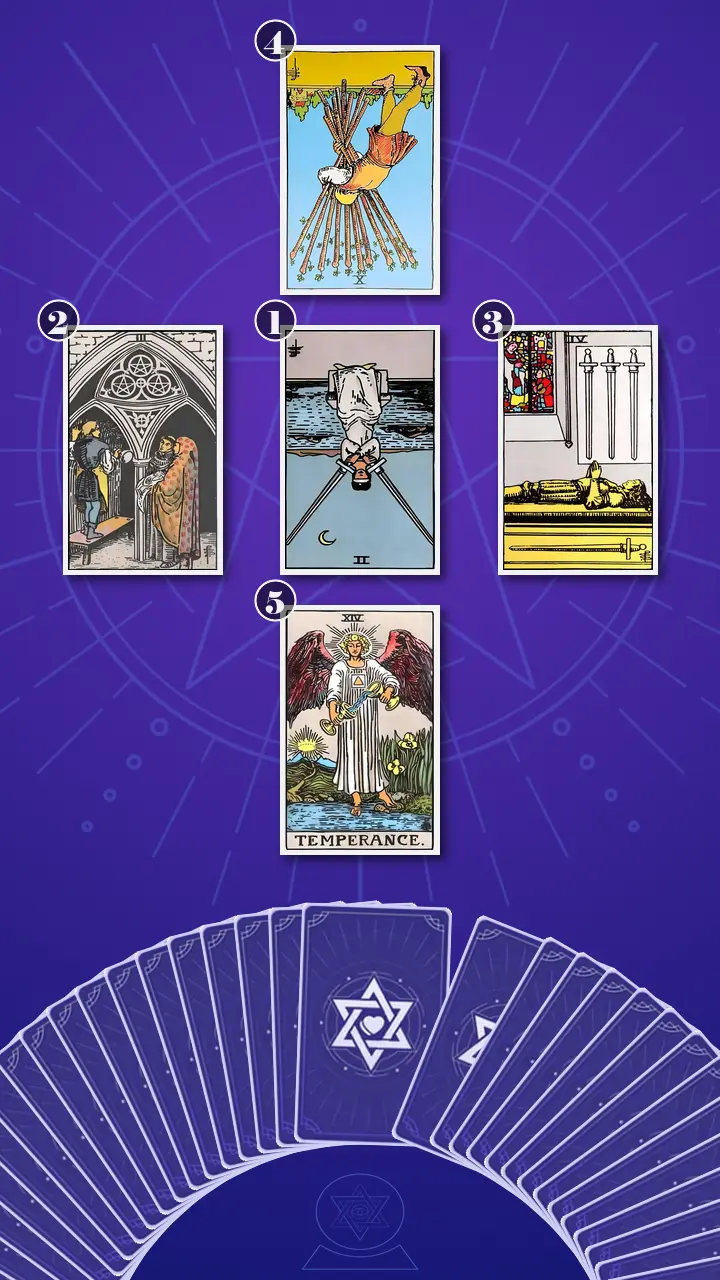
I previewed the map for them: the center card would show the exact stuck behavior; left is the ‘yes’ path; right is the ‘no’ path; above is what they need to know (the hidden influence); below is guidance—the best way forward and the next step.
Reading the Map: Card Meanings in Context at a Career Crossroads
Position 1: The current stuck point—what keeps the email unanswered
“Now turning over is the card that represents the current stuck point and the exact behavior keeping the email unanswered,” I said.
Two of Swords, reversed.
I didn’t need to dramatize it. The image itself is basically modern life: keeping something in limbo so you don’t have to feel what choosing would bring up.
“This is you at night,” I told Jordan, keeping it concrete. “Toronto bedroom, laptop open, rereading the honors invite like it’s a final exam prompt. Requirements tab. Testimonials tab. ‘Does honors matter’ tab. Reddit. LinkedIn. Draft reply. Delete. Rewrite. Close the laptop like ‘tomorrow me’ will be calmer.”
Energetically, reversed Two of Swords is Air in blockage: too much mental motion with no decision-output. It’s hyper-analysis with deadline pressure—trying to think your way into a risk-free answer.
Jordan’s mouth twitched, and then they let out a small, bitter laugh. “That’s… kind of mean,” they said. “But also exactly true.”
I nodded. “Limbo has a workload. You’re already doing the work—just not the kind that moves you forward.”
And here’s the part I wanted them to really feel: “This email isn’t neutral while it sits. It’s a background app draining your battery every day.”
Position 2: The ‘yes’ path—what joining gives you beyond the resume fantasy
“Now turning over is the card that represents what joining gives you—and what it asks of you—beyond the resume fantasy.”
Three of Pentacles, upright.
“If you say yes,” I said, “this card wants you to treat the honors program like a structured studio or lab: clear deliverables, mentor feedback, collaboration with capable peers. Not a forever proving ground.”
Three of Pentacles is Earth in balance: practical structure, craftsmanship, and shared standards. It’s not ‘be impressive 24/7.’ It’s ‘do consistent, visible work in a container that has a rubric.’
Jordan’s shoulders lowered by maybe a centimeter—barely noticeable, but real.
“Don’t answer the invite with your ego,” I added. “Answer it with your calendar.”
Position 3: The ‘no’ path—what declining protects (and what it risks)
“Now turning over is the card that represents what declining protects in terms of energy and recovery—and what it might stir up emotionally.”
Four of Swords, upright.
I watched Jordan swallow before I even spoke, like their body already knew what was coming.
“This is the clean version of ‘no,’” I said. “Not ghosting. Not collapsing. A real recovery container: laptop closed, Do Not Disturb on, sleep treated like a priority, and your brain not running performance audits at 1 AM.”
Four of Swords is still Air in balance. It’s strategic pause. It says: rest isn’t what you earn after proving yourself—it’s what keeps your work coherent.
Jordan stared at the card and then looked away, like the idea of rest was both comforting and suspicious. “If I say no,” they said quietly, “I’m scared I’ll regret it for years.”
“That fear makes sense,” I said. “But we’re going to make sure ‘no’ means something specific. Not a vague retreat.”
Position 4: The hidden influence—what’s driving the burnout mechanism underneath
“Now turning over is the card that represents the underlying burnout mechanism and hidden workload dynamic driving the fear.”
Ten of Wands, reversed.
My stomach did that familiar drop I used to get on the trading desk when the numbers were saying what nobody wanted to say out loud: the system is already over-leveraged.
“This email didn’t create the burden,” I told Jordan. “It just landed on top of it.”
I listed the invisible bundle the way they’d described it: job shifts, readings, group projects, family texts, club obligations, networking pressure, Canvas/Quercus notifications, and the constant mental effort of staying ‘reliable and impressive.’
Ten of Wands reversed is Fire in overload—not motivation, but weight. It’s the point where you’re carrying so much you can’t see the path ahead. And that’s why even a good opportunity feels like a threat.
Jordan nodded once, fast, almost annoyed at how accurate it was. “So the problem isn’t honors,” they said. “It’s that I have no margin.”
“Exactly,” I said. “And that changes the next step.”
When Temperance Poured Between Two Cups
I let the room get quieter on purpose before the last card. The street outside sounded farther away, like someone turned down the volume. “We’re turning over the guidance card now,” I said, “the one that tells you what to do next in a way that builds self-trust.”
Position 5: Guidance—the practical integration and next step
Temperance, upright.
“This is the middle path,” I said. “Not all-in ambition, not total withdrawal. It’s designing a sustainable version of your choice.”
Then I gave them the real-world translation: “A measured response. A boundary-led reply. You ask for clarity before you commit. You name your capacity. You don’t treat the invite like an identity test.”
Jordan’s eyes flicked down to the card. Their breathing stalled for half a beat.
They were right back in that loop—reopening the email at 11:43 PM, scrolling, checking how it “looks” for internships, then closing the laptop like they’d decide tomorrow. The limbo was already taking up space.
Stop treating this as an all-or-nothing test of your worth and start mixing your ambition and your limits like Temperance pouring water between two cups.
They froze—physically. That subtle, full-body pause where even the hands stop fidgeting.
Then the second micro-shift: their eyes unfocused, like they were replaying the last two weeks in fast-forward—every tab-hop, every half-draft, every “I’ll do it tomorrow.”
Then the release: a long exhale from somewhere low in the chest, shoulders dropping in a way that looked almost unfamiliar on them. Their jaw unclenched, and they blinked hard once as if the room had gotten brighter.
“But if I do that,” Jordan said, voice tighter again for a moment, “doesn’t it mean I’ve been doing it wrong? Like… I’ve been making this so dramatic.” There was a flash of anger in it—at themselves, at the whole game.
I didn’t flinch. “It doesn’t mean you were wrong,” I said. “It means you were trying to control an emotional risk with information. That’s a very intelligent coping strategy—until it starts costing you sleep.”
And this is where my Potential Mapping System clicked in—not as jargon, but as a lens. “Jordan, your energy profile reads like a Deep Thinker under stress,” I said. “You default to analysis, optimization, perfect wording. A Deep Thinker can build brilliant strategies—but when you’re running at capacity, that same strength turns into paralysis. Temperance isn’t telling you to stop thinking. It’s telling you to blend: a little structure, a little recovery, and a bounded decision you can actually follow through on.”
I pointed at the angel’s two cups. “Your next step isn’t ‘yes’ or ‘no.’ It’s a container. A boundary. A sustainable dosage.”
“Now,” I asked, “with this new frame—design, not worthiness—can you think of one moment last week when this would’ve changed how you felt?”
Jordan’s eyes went up and left, searching memory. “Sunday night,” they said. “Google Calendar. I was hunting for a blank square like it was… proof I deserved to say yes.”
“That’s the shift,” I said gently. “From resume-driven pressure and choice paralysis to boundary-led self-trust and sustainable pacing. You don’t need certainty. You need a choice you can support with your real life.”
I slid the card a little closer. “Temperance says: make it sustainable, or don’t make it yours.”
From Insight to Action: The Boundary-First Reply That Ends the Mental Tax
I pulled the whole spread into one sentence for them: Two of Swords reversed shows the mental stalemate that’s draining you; Three of Pentacles shows the ‘yes’ path works only with structure and defined expectations; Four of Swords shows ‘no’ can be a strategic recovery decision; Ten of Wands reversed reveals the hidden truth—your week is already overloaded; and Temperance ties it together: you don’t need a perfect answer, you need a sustainable design.
The blind spot I named directly was this: you’ve been treating the honors invite as a verdict on your future, so you’re trying to eliminate risk before acting. But the real leverage point isn’t more information—it’s capacity and boundaries.
I offered Jordan something I use with clients who are strong performers (and former-me, honestly): my 5-Minute Decision Tools. Not to rush them—but to stop paying the daily interest of limbo. We used a quick tri-axis: Advantage (what you gain), Risk (what it costs), Breakthrough (what boundary makes it workable).
- Renegotiate One Existing Commitment FirstBefore you reply to the honors email, renegotiate one thing this week: email for a deadline extension, swap one work shift, or reduce the scope on one group task. Do it within 24–48 hours.If your brain argues “I can’t,” do the smallest version: one sentence request. The goal is margin, not a life overhaul.
- Write Two Drafts in One 12-Minute ContainerSet a 12-minute timer. Write two complete replies: (A) “Yes, and here’s my capacity” and (B) “No, and here’s my honest reason.” Each must include one concrete boundary (hours/week, meeting frequency, or start date).When the timer ends, pick the one that makes your chest feel even 5% less tight. Paste it into the email draft and send—no extra polishing loop.
- Send a Temperance-Style Clarity QuestionIf you’re leaning yes, use a calm, specific line: “I’m excited about the program and can commit ~X hours/week. Can you confirm the expected meeting frequency and time window before I finalize?”If fear says “they’ll rescind it,” label that as nervous-system noise. Clarity-before-commitment is competence, not rudeness.
Finally, I added one non-negotiable, because Ten of Wands reversed won’t let us lie: “Block a real 60–90 minute recovery window within 48 hours of sending your reply. Walk by the waterfront. Gym. Phone-off café time. Make the rest part of the plan, not a reward you may never reach.”
“A ‘yes’ without boundaries is just preloaded resentment,” I said. “And a ‘no’ without intention turns into rumination. Temperance is your third option: a designed container.”

A Week Later: Calm Pride That Isn’t Fueled by Overextension
Six days later, Jordan messaged me a screenshot: an email sent at 12:06 PM between classes. Not at midnight. Not after twenty rewrites. It was short and clear—yes, with a capacity boundary and one question about meeting frequency.
Under the screenshot they wrote: “I thought I’d feel guilty. I just feel… lighter. Also I asked my manager to swap one shift and they said yes??”
That’s the kind of proof I trust: not a perfectly solved life, but a nervous system that stops bracing long enough to make one clean move.
And it wasn’t magically easy. Jordan told me they slept a full night—then woke up with the first thought still being, “What if I chose wrong?” Only this time, they said, they noticed the thought, exhaled, and got out of bed anyway.
When you’re already carrying too much, even a “good opportunity” can feel like a threat—because the real fear isn’t the program, it’s choosing wrong and watching your whole carefully-managed life tip over.
If you let this be a design problem instead of a worthiness test, what’s the smallest boundary you’d want in your reply so your future and your nervous system both get a vote?