From Late-Night Photo Spirals to Self-Trust: Choosing One Next Step

Finding Clarity in the 10:52 p.m. Camera Roll Spiral
If you can function at work all day, then get home and end up in bed “researching yourself” through old photos, Notes app essays, and half-written texts you never send, you’re not alone.
Jordan came to me from Toronto—28, non-binary, sharp, kind, the sort of person who can sound completely fine on a 3 p.m. Teams call and then feel their whole inner world tilt sideways by night.
On our video call, they told me about the exact moment it started: 10:52 p.m. in their shoebox apartment, perched on the edge of the bed, phone at 7% battery, lit by one stubborn bedside lamp. They’d found a childhood photo while doing a closet reset—just one picture, nothing cinematic—and then zoomed in until the pixels blurred. Radiator clicking. Screen warm in their palm. Throat tightening like words had gotten stuck there.
“It’s just a photo,” Jordan said, and their voice did that thing—trying to sound casual while the body is clearly not casual. “But it messed with me for days.”
What they wanted was simple: to understand what story that kid in the photo was carrying. What they feared was sharper: that the past still gets to steer the present. That one relic could quietly revoke their right to move forward—apply for the role, send the text, take up space—until they’d “solved” the origin story.
The feeling wasn’t loud panic. It was more like standing in a dim hallway holding a single photograph as if it’s a verdict—your chest turning into a locked drawer, your mind pacing outside it, jingling keys it can’t quite use.
I let that settle between us, the way I’ve learned to let weather settle over a loch—no rushing it into sunshine. “We’re not here to put your childhood on trial,” I told them gently. “We’re here to find clarity. We’ll make a map of what this photo activated… and what your next small step can be—without needing a perfect explanation first.”

Choosing the Compass: The Celtic Cross · Context Edition
I asked Jordan to take one slow breath and place a hand where they felt the tightness most—throat, chest, jaw. Not as a ritual for mystery, but as a switch: out of the phone-brain loop and back into the body that actually lives their life.
While I shuffled, I named what I was doing in plain terms. “Tarot works best as a mirror,” I said. “It doesn’t hand down a sentence. It shows patterns—what’s loud, what’s hidden, what keeps repeating—and then it helps us choose a next move.”
For this question, I chose the Celtic Cross · Context Edition.
Here’s why this spread fits a question like Found a childhood photo—what past story is steering me now? It’s not a yes/no. It’s layered: present emotional weather, a mental blockage, a deeper root bargain, a specific childhood imprint, and then—crucially—an integration pivot. The Context Edition simply gives childhood a dedicated position instead of forcing it to hide under “recent past.”
I also previewed the parts of the map we’d lean on the most: the center card for what’s activated right now, the crossing card for the main roadblock, the root for the old survival rule underneath it all… and the pivot card for how to metabolize the memory into something workable.
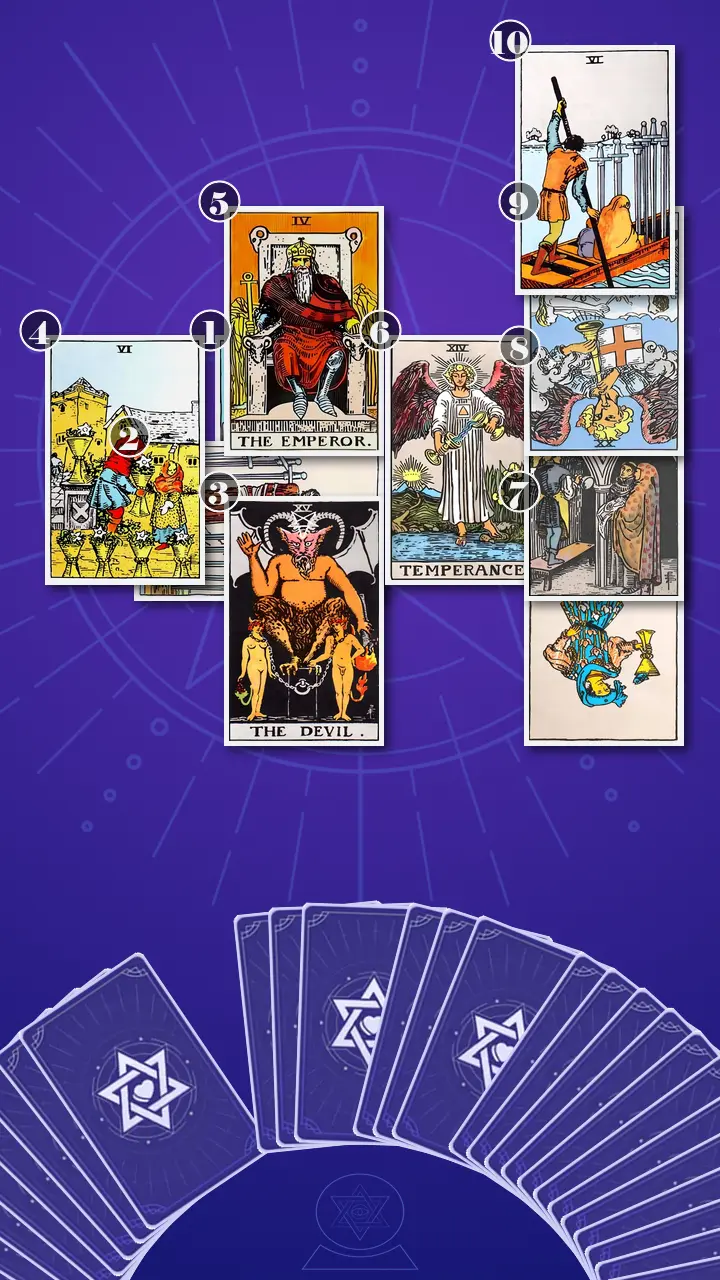
Reading the Map: Card Meanings in Context
Position 1: Present emotional weather after the photo-trigger
“Now we turn over the card that represents your present emotional weather and current self-story after the childhood-photo trigger—the felt sense right now,” I said.
The Moon, upright.
I watched Jordan’s eyes change first—like the screen brightness shifted inside them. The Moon is that landscape where feelings and memory are real, but the meaning keeps moving in the shadows. It’s the psyche speaking in symbols when your rational brain wants bullet points.
In modern life, it’s exactly this: seeing one childhood image and suddenly your mind treats it as a doorway to a whole hidden truth, even though the full context isn’t available.
“This card doesn’t say you’re making it up,” I told them. “It says you’re in fog. And in fog, the mind starts filling in gaps like it’s doing a 1 a.m. incident postmortem with missing data—then still expecting a perfect conclusion.”
Energetically, The Moon is Water in motion—emotion, intuition, memory—beautiful and true, but easily overwhelming when you try to force it into certainty. You can feel it in the body: that throat-tightening becomes a signal flare, not a problem to eliminate.
Jordan gave a small, surprised laugh. Not happy. More like bitter recognition. “That’s… kind of cruel,” they said, then immediately softened. “But yeah. Okay. Why does this one photo feel like it just rewrote my whole personality?”
“That question,” I said, “is The Moon talking.”
Position 2: The main mental/behavioral blockage
“Now we turn over the card that represents the main mental/behavioral blockage that keeps the past story steering present choices,” I said.
Eight of Swords, upright.
“You’re not stuck because you don’t understand. You’re stuck because you think understanding has to come first,” I said, and I felt Jordan go still in the way people go still when a sentence lands too cleanly.
The Eight of Swords is a mind-built cage. The bindings look tight, but they’re loose enough to slip out of—if you’re willing to take one step without a guarantee.
Its modern translation is painfully specific: drafting a message, deleting it, drafting it again, and deciding you ‘can’t’ reach out because you don’t have the perfect explanation of your feelings.
I described the loop the way I’d seen it in a hundred clients and in my own younger years: “It’s 12:38 a.m. You zoom into the photo like it’s evidence. Your chest tightens. You open Notes and type, ‘I think my childhood made me…’ then you delete it. You switch to an attachment-style explainer, then a podcast clip, then back to the photo. It feels like research. But it’s actually freezing.”
Energetically, this is Air in blockage—thought over-tightened into a noose. The bargain is quiet and seductive: If I stay stuck, I can’t be wrong.
Jordan nodded once—sharp, involuntary. Their hand went to their chest like they were checking the lock from the inside.
Position 3: The subconscious root bargain
“Now we turn over the card that represents the subconscious root—the older rule, attachment, or coping bargain formed long ago that still runs in the background,” I said.
The Devil, upright.
The Devil is not about doom. It’s about agreements you didn’t know you signed.
In this context, it’s this: you know intellectually you can change, but emotionally you keep returning to the same self-definition because it feels safer than stepping into a new one.
“The photo is the trigger,” I told Jordan. “But The Devil is the old subscription you keep paying for—the identity that costs you peace, but feels familiar. The rule might sound like: ‘I’m safe when I perform.’ Or ‘I’m chosen when I’m easy.’ Or ‘If I’m perfectly self-aware, no one can surprise-hurt me.’”
Energetically, this is Fire turned inward—desire and power trapped in a cave, feeding compulsion instead of forward motion. It reinforces why the Eight of Swords feels convincing: the mind doesn’t want freedom if freedom means risk.
Jordan swallowed, throat bobbing visibly. “If I name what I needed back then,” they said, very quiet, “I’m scared it’ll sound dramatic.”
I nodded. “And somewhere in you, that fear still equates ‘need’ with ‘unworthy.’ That’s the hook.”
Position 4: The childhood imprint activated by the photo
“Now we turn over the card that represents the childhood imprint activated by the photo—the emotional tone that got lit up,” I said.
Six of Cups, upright.
The room felt warmer just naming it. Six of Cups is tenderness—sweetness with an ache underneath.
Its modern translation is simple and intimate: staring at the photo and feeling both warmth and a sudden ache, as if the past is asking to be held with care rather than decoded.
“This is the kid with the school-picture-day outfit,” I said softly, “or the birthday candle, or the face trying to be good. And it’s not asking you to write a thesis. It’s asking: ‘Can you receive me?’ Comfort. Being cared for. Being taken seriously.”
Jordan let out a slow exhale—the kind that empties a little space in the chest. Their shoulders dropped a fraction.
“That’s it,” they whispered. “It’s warm… and it hurts.”
“Yes,” I said. “Both can be true.”
Position 5: The conscious narrative you try to live by now
“Now we turn over the card that represents the conscious narrative you try to live by now—what you think you should be in order to be okay,” I said.
The Emperor, upright.
The Emperor is structure. Competence. The part of you that wants to be unshakeable.
In modern life, it’s this: responding to tenderness with a strict inner voice saying, ‘Get it together, be rational, be impressive,’ even when what you actually need is gentleness.
Energetically, The Emperor is Fire in containment. It can be healthy leadership—boundaries, routines, steady self-respect. Or it can become armor that turns every feeling into a performance review.
I offered Jordan a small, dialogue-style mirror, because sometimes it’s easier to hear your own pattern when it’s scripted plainly:
Adult Manager: “Let’s be composed. Let’s write a reasonable explanation.”
Tender Messenger: “I just miss being held.”
Adult Manager: “Cringe. Rewrite it.”
Jordan snorted—one short laugh, half relief, half grief. “That is… literally me,” they said, rubbing their forehead. “I make everything sound so mature and then I delete it anyway.”
“If it has to be perfectly explained to be valid,” I said, “it will never get to be lived.”
When Temperance Started Pouring: Integration Over a Perfect Explanation
Position 6: The integration pivot
I slowed my hands before turning the next card. “Now we open the card that represents the integration pivot—how to metabolize the memory into a workable, present-day stance.”
Temperance, upright.
I felt the whole spread click into a single sentence: the fog (Moon), the freeze (Eight of Swords), the old bargain (Devil), the sweetness (Six of Cups), the armor (Emperor)… and then this—an angel pouring water between two cups, patient as seasons.
Jordan’s face tightened the way it does when someone is bracing for the “so what does it mean about me?” verdict.
For a moment, I watched their body the way I watch wind in heather: not the story, the signal. Their throat pulled tight; their chest rose high, shallow. That’s when I used my own method—the one my family in the Highlands called listening to nature, and what I now call Body Signal Interpretation. A tight throat is often Air getting stuck: unspoken truth. A tight chest is often Fire trying to control Water: the nervous system holding the lid down on feeling.
So I spoke to the energy, not the drama. “Temperance says you don’t need to solve your childhood to move forward. You need to mix what you remember into what you choose. A memory can be real without being a steering wheel.”
I let that hang long enough that it didn’t feel like advice—more like weather shifting.
Then I named the setup plainly, almost like reading their Notes app back to them: you’re in bed at 12:38 a.m., zooming in on a childhood photo like it’s evidence. Your chest goes tight, and your brain starts drafting a whole origin story—then deleting it—like if you just get it “right,” you’ll finally be allowed to move.
Stop treating the past like a verdict and start mixing it into wisdom—like Temperance, pour what you remember into what you choose until a steadier self emerges.
Jordan’s reaction came in layers—an honest three-beat chain. First, a tiny freeze: they stopped blinking, lips parting like they’d been interrupted mid-argument with themselves. Second, a soft unfocus in their eyes, like a memory replayed without narration. Third, the release: their shoulders lowered as if someone finally took a bag off their back, and a shaky breath left their mouth that sounded like, “Oh.”
Then the vulnerability arrived right on schedule. Jordan’s brow knit. “But… if that’s true,” they said, voice suddenly sharper, “doesn’t that mean I wasted all this time? Like I’ve been doing it wrong?”
I didn’t rush to comfort them out of their anger. “It means you used a strategy that once kept you safe,” I said. “And now you’re noticing the cost. That’s not failure. That’s awakening—without a verdict.”
“Okay,” they whispered. “So what do I actually do?”
“Ten minutes,” I said. “That’s the offer.”
I asked them to set a 10-minute timer. Open Notes. Make two columns:
‘Little me needed…’ and ‘Today I can offer…’
“Three bullets max,” I told them. “No backstory. No fixing. Then pick ONE offer you can do within 24 hours. If your throat or chest tightens and you feel the spiral start—pause. One breath. One sentence only. The goal is agency, not emotional intensity.”
I leaned in, gentle but direct. “Now, with this new lens—recipe mindset instead of verdict mindset—think back over last week. Was there a moment where the photo made you shrink? A message left unsent? An opportunity you delayed? What would ‘mixing’ look like there?”
Jordan’s eyes flicked up and left—searching. “I didn’t apply for an internal project,” they admitted. “I told myself I was being practical. But I think… I got scared of being seen.”
“That’s Temperance,” I said. “Not forcing certainty—choosing one small action anyway.”
Climbing the Staff: Support, Self-Position, and the Calmer Crossing
Position 7: Your self-position with feelings and inner child
“Now we turn over the card that represents how you’re relating to your feelings and inner child in daily behavior,” I said.
Page of Cups, reversed.
This is the Tender Messenger, interrupted. The feeling rises—like the fish in the cup—and the system goes, Nope. Too much. Too embarrassing. Too cringe.
Its modern translation is clear: sensing a real need for comfort or reassurance, but your adult persona insists on staying cool, articulate, and unaffected.
Energetically, this is Water in deficiency—not because you don’t have feelings, but because you don’t trust them long enough to let them be simple.
Jordan’s mouth twisted. “I literally recorded a voice note to a friend and then… didn’t send it. I told myself it was ‘too much.’”
“That’s the reversal,” I said, warmly. “Not too much. Just unedited.”
Position 8: External supports and mirrors
“Now we turn over the card that represents external supports and mirrors—who or what can help you hold the story safely without spiraling alone,” I said.
Three of Pentacles, upright.
This is Earth: structure that doesn’t shame you. Collaboration. A container with a time and a place.
Its modern translation: stopping the private perfection loop and talking it through with someone grounded—turning emotion into a workable next step.
I gave Jordan a practical scene: “A calendar invite. A therapist slot. Mentor coffee. A walk-and-talk with one friend where the only goal is: you say the story you’re telling yourself, and they reflect what they hear—no fixing.”
Jordan’s shoulders loosened again. “I can think of one person,” they said. “I just hate feeling perceived.”
“Then we use limits,” I said. “Two minutes. One sentence. The container is part of the care.”
Position 9: Hopes and fears about self-review
“Now we turn over the card that represents your hopes and fears about truly acknowledging this past story,” I said.
Judgement, reversed.
Judgement reversed is the fear that truth will sound like a courtroom sentence. That if you name it, it changes everything—and then you’ll judge yourself for having needed anything at all.
Its modern translation: worrying that acknowledging your younger self’s pain will ‘change everything,’ so you keep it intellectual and contained instead of honest and human.
Energetically, this is Air over-pressurized—self-evaluation turned harsh, so you hit snooze on your own awakening.
Jordan’s eyes went glossy for a second. They blinked hard and looked down. “I’m scared it proves I was never fully worth choosing,” they said.
I kept my voice steady. “That fear is common. And it’s also not a prophecy. It’s a protective story.”
Position 10: Integration outcome—forward motion
“Now we turn over the card that represents what forward motion looks like when the past becomes context rather than control,” I said.
Six of Swords, upright.
This is transition—calmer water ahead. Not forgetting. Not erasing. Carrying truth like cargo in a boat: carefully, not dramatically.
Its modern translation is the line I wanted Jordan to feel in their bones: ‘Yes, that happened, and it affected me,’ and still sending the email, taking the meeting, making the choice that aligns with who you’re becoming.
Energetically, this is Air in balance—clearer thinking after turbulence, guided by something steadier than panic.
“One small action is how you take the wheel back,” I reminded them.
From Insight to Action: The Temperance Micro-Mix for the Next 48 Hours
I leaned back and let the full story stitch together out loud, because this is where tarot earns trust: not by sounding mystical, but by making the pattern usable.
“Here’s the chain,” I said. “The photo dropped you into The Moon—fog and symbol-language. Your mind tried to force clarity by locking you into Eight of Swords—drafts, delays, perfectionism. Underneath, The Devil shows the old bargain: control and performance feel safer than uncertainty. But Six of Cups reveals what’s actually under the trigger: tenderness and a need to be cared for. The Emperor tries to manage it with competence. And then Temperance changes everything: integration, mixing, small repeatable actions. With support—Three of Pentacles—you stop doing it alone. You face Judgement reversed gently, without turning it into a verdict. And you move—Six of Swords—not perfectly, but forward.”
The cognitive blind spot underneath it all is subtle: you keep treating understanding as a prerequisite for action. The transformation direction is the key shift Temperance offered: from “I need a perfect explanation of the past” to “I can name the pattern, honor the need, and choose one present-day action that breaks the loop.”
Jordan surprised me with an exhausted little smile. “Okay,” they said. “But I’m going to be honest—I don’t even have five minutes some nights. I get home and I’m just… gone.”
“Thank you,” I said, genuinely. “That’s real. So we make it smaller and more sensory. This is where my Nature Empathy technique helps: we don’t fight the weather. We dress for it.”
Then I gave them a short list—clear, low-stakes, doable in a corporate-week reality:
- The 2-Column Temperance Note (10 minutes, once this week)In your Notes app, write two headers: “Little me needed…” and “Today I can offer…”. Add 1–3 bullets under each. No backstory. Then circle one “offer” you can do in the next 24 hours.If you feel your throat/chest tighten, stop at one bullet per column. You’re building agency, not writing a memoir.
- Put the Photo in a Container (2 minutes, tonight)Create a single album/folder on your phone called “Context, not a verdict”. Put the childhood photo in there. You choose when to open it—no more accidental trapdoor scrolling.If you catch yourself reopening it at midnight, use the rule: one look + one word for the mood (tender/lonely/proud/complicated), then close it.
- The 5-Minute Balcony Reset (or Window Version)When the spiral starts, step onto your balcony or stand at a window. Feel the air on your face. Name the weather out loud (“dry,” “cold,” “windy,” “soft rain”). Then take five slow breaths with one hand on your chest and say one sentence: “This is a memory, not instructions.”No balcony? Run a quick shower and do a water-flow meditation: follow the sensation of water for 60 seconds, then choose one tiny action (send the text, schedule the walk, press ‘submit’).
“And if you want an extra anchor,” I added, “use the moon as a reminder—not to get mystical, just to get rhythmic. Nighttime tends to be Moon-time for your nervous system. So we plan for it. We don’t moralize it.”

A Week Later: Ownership, Not Certainty
Eight days later, Jordan messaged me. Not a long essay. Not a perfectly edited explanation. Just a screenshot: an album on their phone titled Context, not a verdict. Under it, a calendar entry: Wednesday 7:20 p.m. — 12-minute walk to the corner store.
They wrote: “I did the two-column thing. It felt cheesy. I did it anyway. I texted my friend one sentence. I didn’t die. I slept… kind of okay.”
In my mind I saw the quieter proof—the bittersweet kind: they got a full night’s sleep, but woke up with the first thought still whispering, What if I’m wrong? And this time, instead of reopening the photo like evidence, they put a hand on their chest, breathed once, and let the thought pass like weather.
That’s the journey I trust: not certainty, but ownership. From a nostalgia-triggered spiral into a calmer forward motion—past as information, not instruction.
And if you’re reading this with a tight throat and a brain that wants to write a courtroom-grade backstory from one blurry photo, remember: When one childhood photo makes your throat tighten and your brain start writing a courtroom-grade backstory, it’s not because you’re broken—it’s because some part of you is terrified that naming what you needed back then will prove you were never fully worth choosing.
If you let that photo be context instead of a steering wheel, what’s one small, present-day move you’d try this week—just to prove to yourself you’re still the one holding the keys?