Empty Fridge, 50+ Unread: A Two-Step Reset That Stops the Ping-Pong

The 9:32 p.m. Fridge Light and the Unread Badge
You open your inbox “just to triage,” then bounce to Instacart, then to your Notes app—like if you keep switching fast enough, you’ll find the perfect first move.
Jordan (name changed for privacy) told me that sentence like it was a confession, not a habit. She was 28, a project coordinator in New York City, the kind of person who can keep three stakeholders aligned in a meeting—and then come home and get taken out by an empty fridge and an unread badge count.
She described a Tuesday at 9:32 p.m. in her Brooklyn walk-up: fridge door open, fluorescent light buzzing, cold air turning her forearms pink. The shelves were mostly condiments, an old lemon, a container of leftover rice she didn’t trust anymore. Her phone was warm from being held too long. She thumb-opened Gmail “just to check.” The 50+ badge hit like a scoreboard she was losing, and her hand started doing that restless flick—refresh, scroll, refresh.
When she spoke, I could see her jaw working like she was chewing something tough. Her shoulders hovered too close to her ears, and her breath stayed high in her chest—tight and quick, the way it gets right before a hard conversation.
“I want to feel in control,” she said, staring at the table between us like it was safer than my face. “But choosing the wrong first step—emails or food—feels like proof I’m… not handling adulthood. If I start with the fridge, I’m procrastinating work. If I start with email, I’m neglecting my life. And then I just… switch. All night.”
The overwhelm wasn’t an abstract emotion on her; it was a physical weather system. Like trying to hold a dozen slippery subway poles at once—hands busy, nothing steady. Like her brain was a browser with twenty tabs open, all playing audio.
I let her finish. Then I nodded, gently, the way I used to when I trained cruise staff to read a room fast without shaming anyone for being human.
“Okay,” I said. “We’re not here to judge your capacity. We’re here to find clarity. Let’s draw a map of what’s actually happening—so the next step stops feeling like a moral verdict and starts feeling like a sequence.”

Choosing the Compass: The Energy Diagnostic Map (7) Spread
I asked Jordan to put both feet on the floor and do one slow inhale that she didn’t have to “do right.” Not a ritual to impress the universe—just a nervous-system handoff from reacting to observing.
As I shuffled, I watched her body the way I do in my Jungian work: not as a diagnosis, and never as medical advice, but as a language. Tight jaw, elevated shoulders, restless hands—those are often the first places modern overwhelm lives, especially when screens and notifications keep the body braced like something is about to happen.
“Today,” I told her, “we’ll use a spread I call the Energy Diagnostic Map (7) · Context Edition.”
For you reading this: this issue isn’t a prediction problem. It’s a self-regulation and prioritization problem—internal conflict plus external pace. This spread works because it’s minimal-but-complete: it shows the visible loop (what you’re doing), the inner stalemate (why starting feels risky), the external pressure (what keeps accelerating), the root blockage (the deeper need/belief underneath), the support you already have, the key method shift, and one next step that you can actually complete.
“Card one,” I said, laying the center card down, “will name the observable overwhelm pattern—what the fridge and inbox look like as behavior.”
“Card four,” I continued, placing one below, “will show the core blockage under the mess—the thing that keeps the loop running.”
“And card six,” I said, leaving space at the upper-right, “will be our turning point: the method shift that answers your actual question—what reset comes first?”
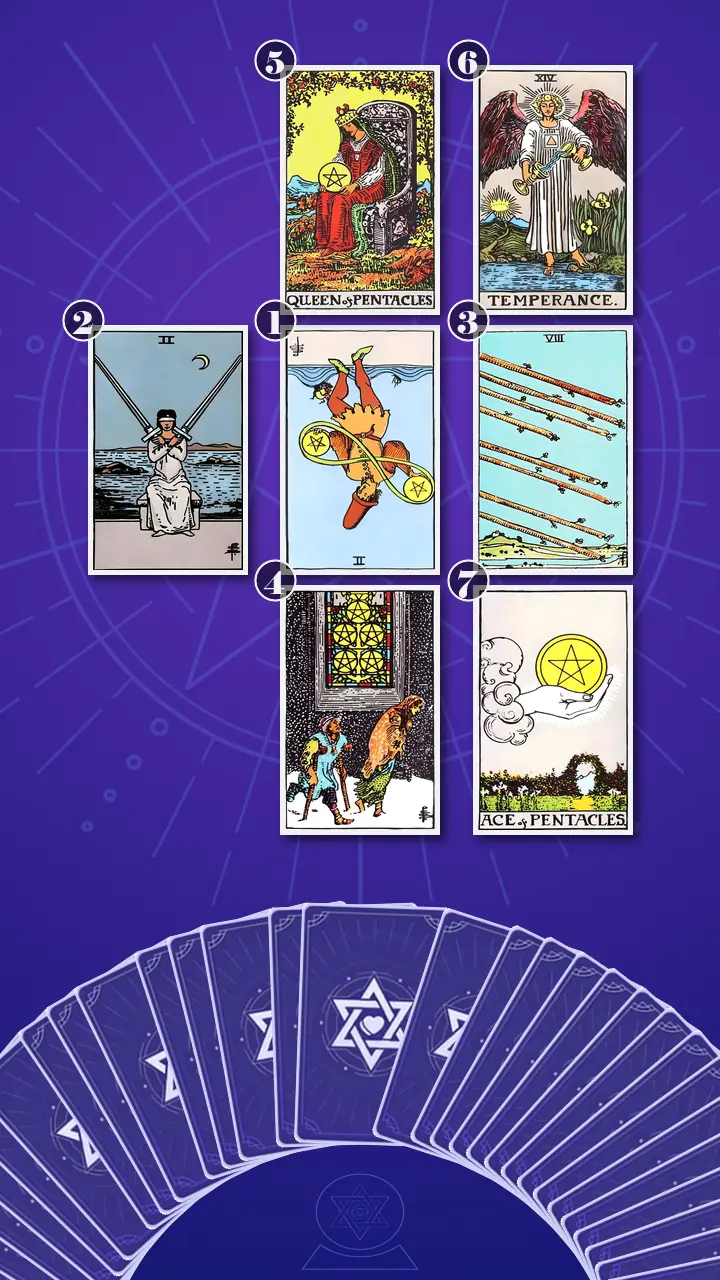
Reading the Tension Line: Juggling, Stalemate, and Speed
Position 1 — Surface Snapshot: Two of Pentacles (reversed)
“Now flipped open,” I said, “is the card that represents your surface snapshot: the specific, observable ‘overwhelm’ pattern linking the empty fridge and unread emails.”
Two of Pentacles, reversed.
I turned the card so Jordan could see it: the juggler, the infinity ribbon, the choppy water behind him. In reverse, the motion isn’t graceful anymore—it’s frantic. The stance wobbles.
“This is the exact scene you described,” I told her, and I used the translation as plainly as possible: “You’re standing in front of the fridge with the door open while your phone is in your other hand. You open email to check urgency, then jump to a grocery app to build a cart, then back to email to reread subject lines. Ten minutes later you’ve made ‘progress’ in three places—and completed nothing.”
Reversed, this isn’t ‘you can’t juggle.’ It’s that your system is trying to juggle two coins inside an infinity loop while waves keep hitting. The energy is blocked by instability: too much switching, not enough landing.
Jordan let out a short laugh—sharp at the edges, like it surprised her. “That’s… painfully accurate,” she said. “Like, rude.”
I smiled, because that reaction matters. “I know,” I said. “And also—this isn’t a character flaw. It’s a pattern. Patterns can be changed.”
Position 2 — Inner Tug-of-War: Two of Swords (upright)
“Now flipped open,” I said, “is the card that represents your inner tug-of-war: the mental/emotional stalemate that makes starting feel risky.”
Two of Swords, upright.
The blindfold. The crossed swords held at the chest. Not drama—protection.
“Here’s the modern translation,” I said, keeping my tone warm but direct: “You’re at your kitchen counter telling yourself you can’t do groceries until you know what’s urgent at work—but you can’t know what’s urgent until you read everything. So you reread subject lines, draft a perfect grocery list, then freeze, because committing to either feels like admitting failure in the other.”
This is avoidance-by-analysis. The energy is frozen: thinking as a barricade. And it makes sense—because if you choose, you have to tolerate the discomfort of leaving something imperfect.
“Planning can be a form of hiding,” I added softly. “Not because you’re dishonest. Because choosing feels like exposure.”
Jordan’s eyes flicked down to the card, then away. Her fingers tightened around her water glass, then loosened—like she’d caught herself mid-rationalization, exactly as this position tends to do. “I hate how true that is,” she murmured.
Position 3 — External Pressure: Eight of Wands (upright)
“Now flipped open,” I said, “is the card that represents your external pressure: what is accelerating the situation.”
Eight of Wands, upright.
I didn’t need to over-explain this one. Even the image looks like velocity.
“It’s a normal weekday and your inbox keeps refilling while you’re trying to catch up—new messages, follow-ups, FYIs. The pace makes you feel like you need to respond immediately, so starting feels pointless unless you can finish everything in one sit-down.”
Short sentences came naturally here, because that’s how it feels in the body. Ping. Slack. Calendar reminder. Another email arrives while you’re reading the last one. A subject line marked “urgent” like a flare. The energy is excess fire: speed without a container.
Jordan nodded fast, almost laughing again, but this time with relief. “This is exactly my inbox,” she said. “It’s like a group chat during a crisis. While you’re typing, there are five new messages.”
“Yes,” I said. “And notice what that means: the pressure is real. It’s not you being ‘dramatic.’ But real pressure still needs boundaries—otherwise your body stays braced, and your mind turns everything into an emergency.”
Position 4 — Core Blockage: Five of Pentacles (upright)
“Now flipped open,” I said, “is the card that represents your core blockage: the deeper belief/need underneath the mess that keeps the loop going.”
Five of Pentacles, upright.
Snow. Two figures moving forward like they’re not sure warmth is allowed for them. A lit window nearby that they somehow can’t enter.
“Here’s the part people miss,” I told her. “The fridge isn’t only logistics. The empty fridge is a message.”
And I used the exact lived scenario, because Jordan needed it reflected back without judgment: “The empty fridge isn’t just logistics—it’s you running on low fuel and treating care like a reward. You push through the day, come home depleted, and then every email feels heavier because you’re trying to think clearly while your body is asking for basics you keep postponing.”
The energy here is deficiency—not of character, but of resources. It’s like trying to do deep work on 3% battery with no charger. Everything becomes urgent because you’re under-resourced.
Jordan went still. A three-part reaction chain I’ve learned to respect: first the micro-freeze—her breath paused. Then the cognitive seep—her eyes unfocused for a second, like she was replaying last week’s nights in fast-forward. Then the release—a long exhale she seemed surprised to have.
“If I feed myself first, I’m irresponsible,” she said quietly, almost word-for-word from the inner monologue this card carries. “If I don’t, I’m proving I can’t handle basics. It’s… cold. It feels cold.”
“Exactly,” I said. “Five of Pentacles is that ‘cold scarcity’ feeling. And it’s why the inbox badge feels like a threat. You’re not just answering emails—you’re trying to prove you deserve warmth.”
Position 5 — Available Support: Queen of Pentacles (upright)
“Now flipped open,” I said, “is the card that represents your available support: the practical resource or inner capacity that can stabilize the reset.”
Queen of Pentacles, upright.
Her gaze is steady. Not performative. She holds care like it matters.
“Your support isn’t ‘try harder,’” I told Jordan. “It’s stewardship. Basics. A home base.”
And I gave her the modern translation plainly: “Instead of earning rest after productivity, you make a small ‘home base’ move: reorder staples, set up a simple breakfast, clear one counter space. You build reliability through small, tangible acts—so your brain stops treating the inbox like a threat to survival.”
This is balanced earth energy. It doesn’t care about the aesthetics of a TikTok ‘day in my life.’ It cares about whether tomorrow-you has protein and a plan.
Jordan’s shoulders lowered a fraction without her noticing. “I have the money for staples,” she admitted. “It’s not that. It’s like… I don’t let myself use it unless I’ve earned it.”
“That’s the window in the Five of Pentacles,” I said. “Support nearby. Not accessed.”
When Temperance Poured Between Two Cups
Position 6 — Key Transformation: Temperance (upright)
When I reached for the sixth card, the room quieted in that specific way it does right before something clicks—like the city outside is still loud, but our little circle goes suddenly focused.
“Now flipped open,” I said, “is the card that represents your key transformation: the most important method shift that changes how you approach ‘what comes first’.”
Temperance, upright.
The angel pours between two cups—measured, patient. One foot on land, one in water. A long path to a bright horizon that doesn’t demand you sprint.
“This is the turning point,” I told her. “Not a new app. Not inbox zero. A method.”
Setup (what you’re trapped in): At 9:30 p.m., you’re trying to do prioritization math like it’s an emergency—fridge, inbox, money guilt, health guilt, fear of missing something important. You keep switching apps because committing to one imperfect step feels like choosing which part of your life you’re failing first.
Not “fix everything tonight,” but “pour a little at a time”—Temperance turns your attention into a measured transfer so you don’t spill your energy across fridge and inbox.
Reinforcement (the click, in the body): Jordan stared at the card. Her thumb stopped moving—no scrolling, no phantom refresh. First, her lips parted like she’d been caught mid-sentence. Then her eyes went glossy, not in a dramatic way, but in the way someone’s nervous system recognizes relief before the mind can explain it. Her shoulders dropped all at once, like she’d been carrying two grocery bags in each hand for blocks and finally set them down. She swallowed, and her jaw unclenched enough that her face looked different—softer, more like herself.
“But if I pour a little… I’m not done,” she said, and there was a flash of resistance—almost anger. “Doesn’t that mean I’ve been doing it wrong this whole time?”
I held her gaze. “It means you’ve been trying to survive speed with intensity,” I said. “Temperance is not an indictment. It’s a rate limiter. The system doesn’t crash when the flow is regulated.”
This is where my Venetian brain always goes: water. In Venice, you don’t stop the tide. You work with circulation. If a channel is blocked, the water doesn’t become ‘bad.’ It just overflows somewhere else.
“Your attention is like water,” I told her. “If you try to pour into two cups at once, you spill yourself. And your body has been telling us that—tight chest, tight jaw, shoulders creeping up. That’s an energy-flow blockage, not a moral failure.”
“Now,” I asked, “with this new lens—can you think of one moment last week when feeding yourself first would’ve changed how threatening the inbox felt? Even 5%?”
Jordan blinked, slow. “Thursday,” she said. “I hadn’t eaten since… I don’t know. I was on the L train, checking Gmail, and I felt like I couldn’t breathe. If I’d just had a banana—like a literal banana—maybe the badge wouldn’t have felt like… the end of the world.”
“That,” I said, “is the shift from urgency-driven multitasking and shame-based avoidance to paced sequencing and quiet confidence built through completion. Not perfect. Just steadier.”
Position 7 — Next Step: Ace of Pentacles (upright)
“Now flipped open,” I said, “is the card that represents your next step: the smallest concrete action that anchors the reset in real life this week.”
Ace of Pentacles, upright.
The hand offers one coin. Not a whole financial plan. One tangible start.
“And here’s the translation,” I said, making it physical and finishable: “One real, finishable action tonight: place a staples order, prep one breakfast, or restock two basics (coffee + protein, or fruit + yogurt). It’s physical proof you can move forward—before you touch the inbox again.”
The energy here is grounded beginning. Completion energy. A win you can hold.
Jordan let out a small breathy laugh—this one warmer. “I can do that,” she said. Then she hesitated. “But I swear I don’t even have five minutes. I get home and I’m wrecked.”
“That’s real,” I said. “So we don’t ask for five heroic minutes. We ask for three honest ones.”
I taught her one of my quick recovery techniques—something I used to give crew members between meetings on long voyages:
“Drop your shoulders on an exhale. Unclench your teeth. Put one hand on your chest and one on your lower ribs. Three breaths—slow enough that your phone-brain gets bored. This isn’t woo. It’s telling your body the emergency is over so you can choose.”
From Insight to Action: The Minimum Viable Reset
When I looked at the whole spread together, the story was clear: your life has been running like fire without a container (Eight of Wands) hitting an already-wobbling juggling act (Two of Pentacles reversed), pushing you into a protective stalemate (Two of Swords). Underneath, the real choke point wasn’t time—it was scarcity: treating basic needs as optional until you’ve “earned” them (Five of Pentacles). The way out wasn’t a clean slate. It was grounded support (Queen of Pentacles) plus a method shift—measured pacing, two small pours (Temperance)—landing in one tangible action (Ace of Pentacles).
Your cognitive blind spot, Jordan, was this: you were treating “fridge vs inbox” like a character test. Like the first choice would prove whether you’re responsible or unreliable. But the cards framed it as a sequencing problem, not a morality play. The transformation direction was simple and surprisingly kind: stabilize your basics first, then contain communication with time-bounded triage.
I told her, “Your inbox isn’t a moral scoreboard. Done is the win. Not ‘clean.’ Feed the system, then message the world.”
Then I gave her a Minimum Viable Reset—something repeatable, not impressive. This is also how tarot works at its most practical: it takes vague dread and turns it into next steps you can do even on a Tuesday night with subway grime still on your hands.
- The 10-Minute “Pour a Little” ResetSet a timer for 10 minutes. For 6 minutes, open your grocery app and reorder only staples (6–10 items max: yogurt/eggs, bread/tortillas, one protein, one frozen veg, one fruit, one snack). For 4 minutes, open email and do sorting only—archive/delete obvious noise, then star at most 3 emails that truly need a response.If your chest tightens and your brain bargains (“but what if I miss something?”), take one slow breath and return to the timer. You stop when the timer ends—completion over endurance.
- The Laptop Sticky-Note RuleWrite: “Food first. Then timed triage. Done is the win.” Put it on your laptop where you’ll see it before you open Gmail at night.Expect resistance. That voice saying food-first is “procrastinating work” is the old rule. Treat the note like a script you follow for one week as an experiment.
- The Queen of Pentacles ShelfPick one fridge shelf or one counter corner as your default “baseline staples” zone. Keep it stocked with the same few items so you don’t re-decide every week.Make it embarrassingly easy—not a wellness overhaul. The goal is reducing decision fatigue so the inbox feels less threatening.
Before she left, I added one more piece of my own toolkit—something I call Venetian Aqua Wisdom. “When water circulation is healthy,” I said, “it moves in channels. Your evening needs channels too. A clear start and a clear stop.”

A Week Later: Ownership, Not Certainty
A week later, Jordan texted me a photo: a small grocery bag on her counter—eggs, yogurt, tortillas, frozen broccoli, bananas. Nothing Pinterest-worthy. Just enough.
Under it she wrote: “Did the 10-minute pour. Starred 3 emails. Didn’t reply. Didn’t die.”
And then, almost as an afterthought: “Inbox still not clean. But I ate before I opened it. It felt like… I had a home tab again.”
She wasn’t magically caught up. The city didn’t stop. Slack still pinged. But the proof was in her body: she said she slept a full night—then woke up and her first thought was still, What if I’m behind? Only this time, she paused, drank water, and made breakfast anyway. Clear, but still a little tender.
That’s the Journey to Clarity I trust: not certainty, but ownership. Not the fantasy of a clean slate, but the quiet confidence built through completion.
When the fridge is empty and the inbox is screaming, it’s not laziness—it’s that tight, jaw-clenched fear that picking the ‘wrong’ first step will prove you’re not actually in control.
If you didn’t have to earn being fed first, what would your smallest ‘tomorrow-you’ gesture look like tonight—one tiny pour, not a full reset?