From 'Hovering Over Send' to Self-Authorship: One Sentence Forward

Finding Clarity in the 8:47 PM ‘On Repeat’ Spell
If you’re the kind of early-career creative/tech person who replays one “old chapter” Spotify playlist while rewriting the same email draft for the fifth time—hello, Sunday Scaries meet nostalgia loop.
Jordan (name changed for privacy) told me that line like it was a confession and a joke at the same time. They were 28, downtown Toronto, the sort of competent-at-work person whose calendar looked clean and whose insides felt…buffering.
They described a Tuesday night I could practically see: 8:47 PM in their condo hallway, elevator ding still echoing, air faintly takeout-greasy. Keys halfway to the lock. Headphones already on. The playlist starts—soft, familiar—and their shoulders drop like someone finally lowered the volume on the day.
Then their hand tightens around their phone, because the unsent message is still there. Glowing on the screen like a dare.
“This playlist knows me better than my current life does,” they said. “And I can’t tell if I’m healing or just looping.”
I watched their fingers—restless, rubbing the edge of their case, drifting toward their earbuds like a reflex. The feeling they described wasn’t abstract. It was physical: a heavy chest-throat pressure, like a door that won’t quite open, paired with hands that want to do something—hit play, scroll, replay, anything but press send.
Underneath the music was the real contradiction: wanting to move forward into a new chapter vs fearing that leaving the old chapter behind means losing a truer version of yourself.
“Okay,” I said gently, the way I do when someone is bracing for judgment they don’t deserve. “Let’s not shame the nostalgia. Let’s understand it. We’ll try to turn this fog into a map—something that gives you clarity and an actual next step.”

Choosing the Compass: A Past–Present–Future Tarot Spread for a Nostalgia Loop
I own a small Italian café on College Street—twenty years of espresso steam and early-morning regulars. I’ve learned something practical about rituals: they’re not magic tricks. They’re transitions. A way to move your nervous system from “spinning” to “seeing.”
I asked Jordan to take one slow breath with me, shoulders down, jaw unclenched. While I shuffled, I kept it simple: focus on the question—Old Spotify playlist hits—what past chapter is shaping my next step?
For this, I chose a classic three-card layout: the Past–Present–Future spread. Readers sometimes ask how tarot works in a situation like this, when nothing is “mystical” on the surface—just a playlist and a draft you keep reopening. This spread works because it matches the mind’s timeline logic. It identifies the past chapter the music reopens, names the present loop that keeps you stuck, and then translates insight into a grounded next-step energy—without turning it into fate or a fixed prediction.
I told Jordan what each position would do for us:
“Card one: the past chapter your playlist is reopening—what you’re still emotionally loyal to, and what it originally gave you.”
“Card two: the current loop—what keeps you replaying rather than moving, and how it shows up behaviorally right now.”
“Card three: your next-step energy—one self-honoring move you can take now.”
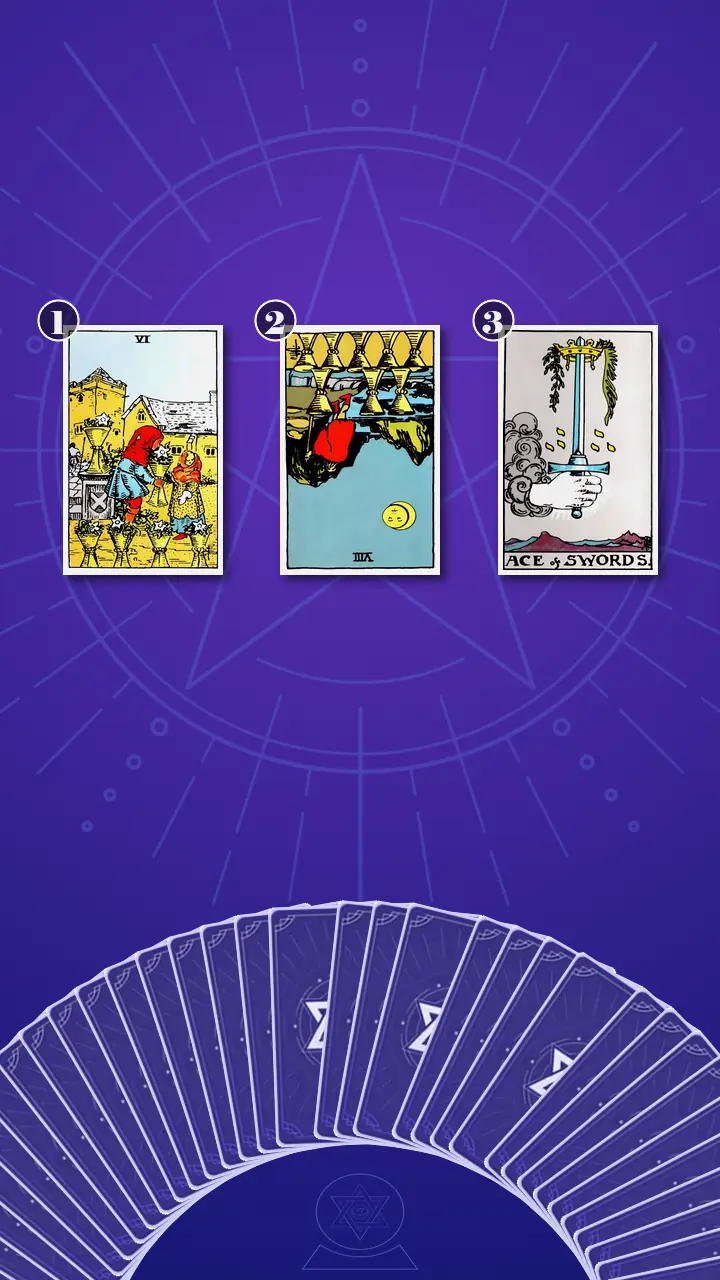
Then I laid the cards left to right, like a track progress bar: past, repeat, next.
The Warm Flashback—And the Beat Where It Gets Stuck
Position 1: The past chapter the playlist is reopening
Now flipped open is the card representing the past chapter the playlist is reopening: what you’re still emotionally loyal to and what it originally gave you.
Six of Cups, upright.
I didn’t go lofty with it. I went specific—because that’s where trust is built.
“This is like you’re on a late TTC ride or walking home past Queen West storefront lights, and one track from your old playlist makes your whole body soften,” I said. “For three minutes you remember a version of you that felt effortless—before everything started feeling like a strategy.”
The Six of Cups is Water energy in balance: sweetness, belonging, a safe emotional courtyard. Not “better times,” necessarily—just times that felt unselfconscious. In this card, the past self is offering a cup with a white flower: a gift. Not the whole era. The quality that era carried.
I leaned in a touch. “Here’s the pivot. Comfort isn’t the same as direction. The playlist isn’t evil. It’s a portal to a feeling you miss.”
I gave them a simple inner-monologue template, the kind that makes a messy emotion graspable: “I’m not missing the whole era—I’m missing ___.”
Jordan made a sound that was half laugh, half wince. “Oh my god,” they said, a little bitter. “That’s…too accurate. Like, rude.” But their shoulders lowered again—this time not because the song was on, but because they felt seen.
“So,” I asked, “when that old playlist hits, what exact feeling are you trying to get back—ease, belonging, being unguarded? And where did you last feel even a trace of that in your current life?”
They stared at the card, then past it. “I miss being…less curated,” they said quietly. “Like I didn’t have to turn everything into a plan.”
Position 2: The current loop that keeps you replaying
Now flipped open is the card representing the current loop: what keeps you replaying rather than moving, and how it shows up behaviorally right now.
Eight of Cups, reversed.
“This is the ‘almost leaving’ card,” I said. “Only reversed, it’s the ‘I keep almost leaving, then I don’t’ card.”
And because Jordan’s life had a rhythm to it, I described the loop in one repeated beat—like a chorus they knew too well:
Open draft → tweak one line → check socials → back to playlist → close app.
“It’s 9:30 PM,” I continued, using the exact modern-life scene this card loves to show. “Your draft is two sentences away from done. Then your hands get restless, your throat tightens, and you hit the old playlist ‘just to think.’ You replay the chorus and tell yourself you’re waiting for the right timing.”
In reversed position, the Eight of Cups is Water energy in blockage: emotion that should move becomes emotion that circles. It’s not a lack of willpower. It’s protection. Your body is trying to keep you inside what feels known, because the next step—send, submit, set a boundary—feels irreversible.
I pointed gently to the truth hiding under the habit. “If it only feels real when it’s on repeat, it’s not a plan—it’s a loop.”
Jordan nodded hard, then let out a tense laugh. Their fingers did the exact thing they’d described—hovering, twitching, as if reaching for headphones they weren’t even wearing. “Right before I hit play again,” they said, “it’s like my throat tightens and I get this thought: if I choose wrong now, I’ll ruin the story.”
“That’s the split-screen,” I said, keeping my voice steady and kind. “One side: ‘I want to move.’ Other side: ‘I’m scared that moving means I’m not me anymore.’”
And then I named the mechanics, plainly, the way you’d explain a notification loop on your phone: “A song triggers a past chapter. The mind turns it into a verdict—‘that was the real me.’ Replay becomes the coping behavior. It gives short-term relief. But the long-term cost is you never send the message. Pressure grows. And the belief gets louder.”
Jordan swallowed. “Yeah,” they said. “It’s like…my identity hasn’t caught up to my life on paper.”
I could feel the room do that quiet thing it does when someone has stopped arguing with reality—not in a defeated way. In a relieved way. Outside the café window, late-afternoon rain streaked the glass in slow lines, like Water itself was admitting, I’ve been keeping you here.
When the Ace of Swords Finally Hit “Next”
When I turned the third card, the atmosphere changed—not spooky, just unmistakably crisp, like someone cracked a window after too much steam.
Position 3: Your next-step energy
Now flipped open is the card representing your next step energy: the most grounded, self-honoring move you can take now.
Ace of Swords, upright.
I shifted my tone without even trying. This is what this card does. It makes language clean.
“Morning light,” I said. “Laptop open. No playlist yet. You write one line in your notes app—something you can’t argue with: ‘I’m applying this week even if it’s imperfect,’ or ‘I’m not doing maybes anymore.’ Your chest still feels tender, but your mind stops bargaining. Then you act from the sentence. Not dramatic. Just decisive.”
Here’s what I wanted Jordan to understand: the Ace of Swords isn’t about being emotionally over it. It’s Air energy—ventilation. It’s the moment you stop trying to earn readiness through more feeling.
And right there, I named the turning point exactly as it needed to be named:
Shift from “I need the perfect next chapter that honors the past” to “I can name the lesson, choose one clear action, and let the past be a reference—not a refuge.”
Jordan’s eyes narrowed, like they were testing whether they were allowed to believe that.
Stop treating nostalgia like a map back; use the Ace’s blade to cut a single sentence of truth that points forward.
I let it hang in the air. In my café, I’ve learned about timing the hard way—espresso has a peak flavor window. If you wait too long, the crema collapses. Not because the coffee is “bad,” but because the moment for it to be what it is…passes.
That’s one of my private tools, what I call Sacred Timing: noticing the clean windows when something is ready enough now, even if it doesn’t feel perfect. The Ace of Swords is that window in card form. A narrow, usable opening.
Setup: Jordan was still caught in the late-night equation: if I listen one more time, I’ll finally understand what that era meant—and then I’ll be ready. Their thumb hovered over “Send” like a crosswalk button they kept pressing, hoping the light would change without stepping forward.
Delivery (and I said it plainly, like an instruction you can actually use):
You don’t have to relive that chapter to prove it mattered; you just need one clean sentence that makes your next move obvious.
Reinforcement: Jordan’s body reacted before their voice did—three steps, like a little chain reaction. First, a freeze: their breathing stopped for a beat, mouth slightly open, as if their brain had gone quiet mid-scroll. Second, a kind of internal replay: their eyes unfocused, not on the card anymore, but on some memory of a TTC ride, a chorus, a draft screen, their thumb hovering. Third, the release: a long exhale that seemed to start in their sternum. Their shoulders dropped, but not with the soft collapse of nostalgia—with the heavier relief of truth.
Then, unexpectedly, their expression tightened. “But…if it’s that simple,” they said, and there was a flash of anger under the tenderness, “doesn’t that mean I’ve been wasting time? Like I made it a whole thing for no reason?”
I didn’t argue them out of it. I honored the protection. “No,” I said. “It means you’ve been taking care of yourself with the tools you had. The loop wasn’t pointless—it was comfort. But it’s not direction. And you’re allowed to upgrade the tool.”
I tapped the table lightly, once. “Now—use this new lens. Think about last week. Was there a moment when this sentence would’ve changed the way you felt? When the playlist started and the draft was open?”
Jordan blinked, eyes glossy but steady. “Wednesday,” they said. “I had the email. It was basically done. I hit the song first.”
“What would your one clean sentence have been?” I asked.
They swallowed again, then spoke like they were stepping onto a solid surface. “Today, what’s true is I’m scared—and I’m still applying. So my next step is…subject line. Just the subject line.”
That was it: not nostalgia-driven rumination and ‘hovering over Send’ paralysis, but truth-based self-authorship and clean next-step resolve—small, real, and entirely theirs.
The Reference-Not-Refuge Plan: Actionable Advice You Can Actually Do Tonight
I gathered the three cards into one story, the way I’d explain it to myself after a long shift behind the counter.
The Six of Cups said: the past is offering you a gift—ease, belonging, being uncurated. The Eight of Cups reversed said: you’ve been using that gift as a hiding place, returning to the same emotional courtyard whenever the present asks you to risk an irreversible choice. And the Ace of Swords said: the way out isn’t a bigger feeling. It’s a cleaner sentence. Water to Air. Feel it fully, then name it simply.
The cognitive blind spot I named for Jordan was this: they were treating the playlist like proof of identity—like the “real them” lived back there, and the present had to earn the right to feel true. That’s why every next step felt like it was “on trial.”
“Clarity is a form of self-respect,” I told them. “Not because it’s cold. Because it’s kind. It stops you from bargaining with your own life.”
Then I gave them the smallest possible moves—because big transformations are just tiny choices repeated on purpose.
- North Star Sentence (10 minutes)Put your phone on Do Not Disturb. Open Notes and write one line that starts: ‘Today, what’s true is ____, so my next step is ____.‘ Keep it blunt, not poetic.If your chest tightens, put a hand on your sternum and take three slow breaths—then downgrade the action to a 30-second version (e.g., open the email and fill only the subject line).
- The ‘Send First’ Rule (5 minutes)For one week, when you want to hit the old playlist, open the draft first and take one forward action before you press play: subject line, recipient added, paste the link, or a two-sentence truth text.This isn’t ‘quit your playlist.’ It’s a sequence change. After the micro-action, you can play exactly one song—one, not the whole loop.
- One-Song Journal Sprint (10 minutes)Pick one song from the old playlist. Write: ‘What did this era give me that I still want?’ (ease, playfulness, courage, closeness). Then choose one micro-way to bring that quality into this week.Keep it specific and non-sappy. You’re extracting a quality, not clinging to a timeline. If grief shows up, let it sit beside you while you write.
Jordan hesitated. “But I don’t even have five minutes some nights,” they said. “Work’s been…a lot. And then I’m just fried.”
“Then we make it café-small,” I said. “Here’s my Morning Espresso Ritual version: one breath, one sentence, one action—before anything else. Even if that action is literally opening the draft and typing one word. The win is choosing clarity once, not forcing a mood.”
I also offered a tiny sensory trick from my other toolkit, because bodies learn faster than brains: Aroma Anchoring. “When you do the micro-action,” I said, “pair it with one smell you like—coffee, orange peel, a candle—something that says ‘present day.’ You’re teaching your nervous system: this is what forward feels like.”

A Week Later: The Quiet Proof
Six days later, Jordan messaged me a screenshot. It wasn’t dramatic. Just a subject line filled in, a two-sentence email, and the little grey timestamp: Sent.
“I didn’t feel ready,” they wrote. “I felt tender. But I did the one-sentence thing. And then I hit send before my brain could open twenty tabs.”
They added one more line that made me smile: “I still played the song after. One song. It felt like a reference, not a refuge.”
They didn’t become a new person overnight. The bittersweet part was honest: they said they slept a full night, but in the morning the first thought was still, “What if I chose wrong?”—only this time they paused, took one breath, and wrote one sentence anyway.
That’s the whole Journey to Clarity, really. Not certainty. Ownership. A present-self you can trust because you keep showing up to the page.
When you’re trying to move forward but your chest tightens at the thought of leaving that era behind, it’s not because you’re broken—it’s because some part of you is still trying to prove that the ‘real you’ didn’t disappear.
If you let the past be a reference instead of a refuge, what’s one sentence you could write today that would make your next step feel simple?