A Ring Photo, a Three-App Spiral, and Learning the One-Lane Week

The Ring Photo and the Three-App Spiral
If you are a late-20s city professional with a real title, real rent, and a sibling's engagement announcement can still send you into a LinkedIn-bank app-Hinge audit before you've even left the family group chat, this is probably a timeline comparison spiral, not laziness.
When Jordan (name changed for privacy) sat down with me, she did what so many high-functioning people do first: she tried to make the story sound neat. Then I asked her to slow down and tell me what actually happened that night.
She gave me a scene so specific I could feel it in my own body: 9:18 p.m. on a Wednesday, in a shared apartment kitchen in downtown Toronto, leftover pasta turning in the microwave, the overhead bulb too white, the tomato-garlic smell hanging in warm air after the food had already lost its comfort. Her family group chat lit up with ring emojis, venue jokes, glossy engagement photos. She typed 'Congrats,' felt her phone go hot in her hand, and then opened LinkedIn, her banking app, and Hinge back-to-back while her chest tightened and her stomach dropped.
One update became a whole-life verdict.
'I know comparison is pointless,' she told me, looking down at her sleeve instead of at me, 'but I still do it. It feels like everyone else got the memo on adulthood and I missed it. I can handle one problem, but not all three showing up at once.'
I could see the shame in the way her shoulders kept trying to climb toward her ears. It did not feel abstract. It felt like trying to read road signs through sleet while holding twelve browser tabs open in your ribcage.
I answered her the way I wish more people were answered in that moment: 'Of course your body reacts. You're not broken, and you're not being dramatic. You're having a very specific shame response to a milestone trigger. Let's not argue with it tonight. Let's map it, and find the clarity underneath it.'
Choosing the Map for Finding Clarity
I asked Jordan to take one slow breath, not as a mystical performance, but as a way to stop the nervous system from driving the whole session. Then I shuffled slowly while she held the question in plain language: Why does my sibling getting engaged make job, money, and dating all feel behind at once?
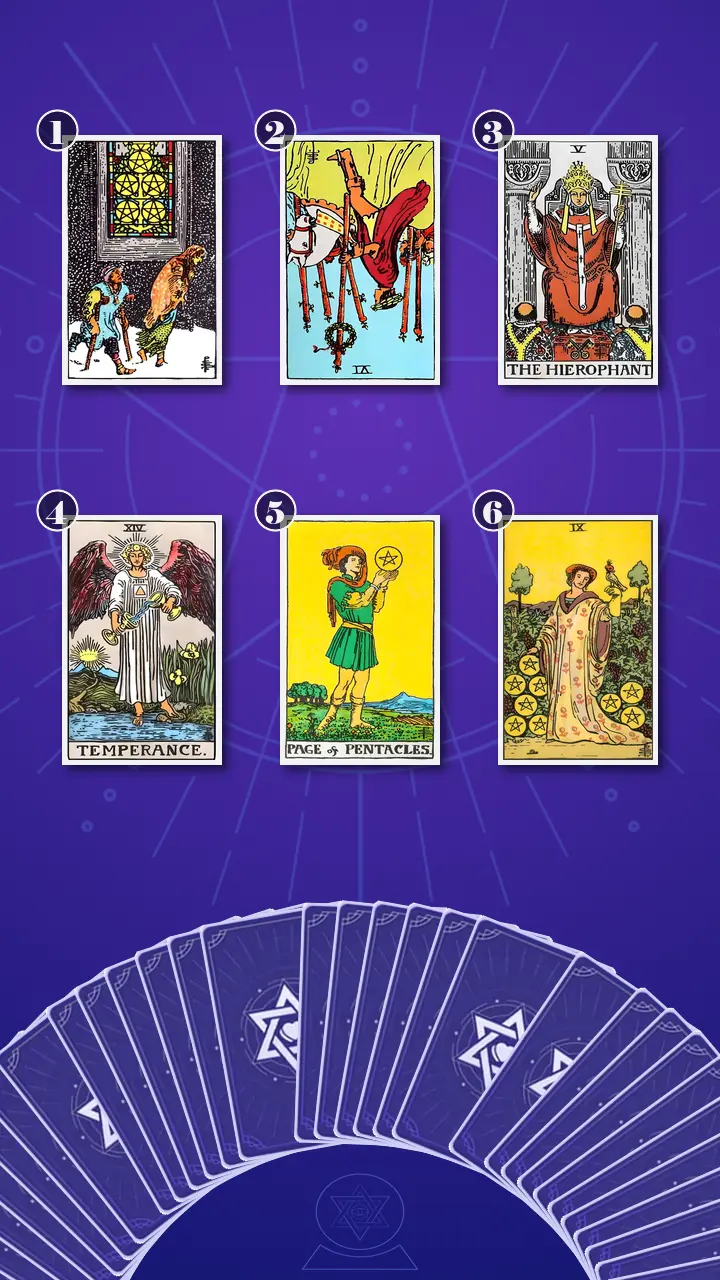
For her, I chose the Transformation Path Grid (6) · Context Edition. This is how tarot works best in my practice: not as a shortcut to prediction, but as a way to hold a pattern still long enough to understand its mechanics. Classic spreads can separate influences well, but Jordan's issue was more web-like than linear. One family milestone was recruiting three life areas into a single identity crisis. I needed a spread that could show the symptom, the blockage, the deeper script, the turning point, the action path, and the embodied outcome without drowning her in ten more things to think about.
I told her what mattered most in this six-card transformation spread. The first card would show the visible symptom cluster: what 'being behind' actually looks like in a real week. The middle root card would show the inherited rulebook under the spiral. The fourth card, sitting like a hinge between the old pattern and the new one, would reveal the essential shift. Then the fifth and sixth would translate that shift into actionable advice and a more grounded state of self-respect.
She nodded once, still tense, but more present. The top row of the spread felt like a diagnosis band. The lower row felt like a studio wall where a new structure could actually be built.
Reading the Diagnosis Band
Position 1: Outside the Warm Window
I turned over the first card. 'Now the card representing the visible symptom cluster is the Five of Pentacles, upright.'
I pointed to the image before translating it into her life. 'This is the moment right after your sibling's engagement announcement when you start acting as if warmth, stability, and belonging all live inside other people's lives. You're still in your own kitchen, holding your own phone, but emotionally it feels like everyone else got let into the adult version of life while you're outside checking proof on a screen.'
The energy here was cold earth in blockage. Not actual lack in every area of life, but the immediate sensation of lack spreading everywhere. A normal work week suddenly felt unstable. A rent payment looked like evidence of failure, not a routine expense in an expensive city. A slow patch on a dating app stopped being just an app experience and became a verdict on lovability. This card was naming the first injury clearly: she was treating uneven progress as proof she did not belong.
'It's like other people's milestones are behind glass,' I said. 'You can see the glow, but your body decides the glow means you were excluded.'
Jordan gave a short laugh that had no real humor in it. 'Wow,' she said. 'That's accurate and also kind of brutal.'
'Only because it's precise,' I told her gently. 'And precision is kinder than vagueness.'
Position 2: The Private Scoreboard
I turned to the next card. 'Now the card representing the defense strategy that keeps the spiral alive is the Six of Wands, reversed.'
'This,' I said, 'is the three-app scoreboard spiral. After family news, you mentally total who has the better title, bigger savings, or more serious relationship, and then you keep refreshing feeds and apps for more evidence. LinkedIn, your bank balance, Hinge notifications—they become one running leaderboard before you've even chosen your next move.'
The energy here was reversed fire: an excess of attention toward external recognition, and a deficiency of inner confirmation. In upright form, Six of Wands can enjoy being seen. Reversed, it turns visibility into worth-math. LinkedIn reactions start behaving like stock prices for your self-esteem. A sibling's applause sounds, and your own brain assumes your microphone just got cut.
I watched her eyes narrow slightly in the way people do when a truth lands somewhere inconvenient. 'Comparison loves a scoreboard because scoreboards let shame feel organized,' I said. 'It gives you numbers, tabs, metrics, and the temporary illusion that if you just collect enough data, you'll finally know how bad this is. But practical action would be one next step. This is ranking.'
Her hand stopped halfway to her tea. That tiny freeze told me more than a long explanation would have. Then she exhaled through her nose and said, quieter, 'I thought I was being practical.'
'I know,' I said. 'That's why this pattern is so seductive.'
Position 3: The Rulebook Under the Table
I turned over the third card. 'Now the card representing the inherited script beneath the comparison loop is The Hierophant, upright.'
'Under the spiral,' I told her, 'is a script about how adulthood is supposed to look: stable job, serious partner, cleaner finances, clearer plan. This is what gets activated when an engagement doesn't feel like just their news, but like an official reminder that there is a correct sequence to life and you might have missed it.'
The energy here was structure in excess. The Hierophant can give meaning, tradition, shared values. But in this position, it was showing me a default setting she never consciously chose. It was the public checklist masquerading as a personal map.
This was the moment I used one of my oldest lenses, something I call Generational Echo Mapping. I grew up in Venice, where sound can bounce off canal walls and return a second later, altered just enough to feel like a new voice. In family systems, the same thing happens. Nobody has to say, 'By now you should be engaged, more financially secure, more settled.' A sibling milestone can hit the old stone in you and send the message back as an echo: you should have figured this out by now.
I looked at Jordan and said, 'The engagement is the sound. The rulebook is the echo. And because echoes feel immediate, you think the pressure belongs to the present moment.'
She went very still. First her jaw tightened. Then her gaze unfocused as if replaying more than one family dinner at once. Finally she looked back at the card and said, almost annoyed at herself, 'Nobody actually says it. That's the worst part. I just... feel graded anyway.'
'Exactly,' I said. 'Which is why the problem isn't that you're weak. It's that you're obeying an invisible onboarding doc for adulthood that you never agreed to.'
When Temperance Closed Seventeen Tabs
Position 4: The Bridge Between Borrowed Timing and Your Own
When I turned the fourth card, the room changed. The radiator gave one soft hiss and fell quiet, and the late light against my window shifted into a pale reflection across the table. This was the hinge card of the whole reading.
'Now the card representing the essential transformation is Temperance, upright,' I said.
Temperance appeared exactly where I needed it to. 'This is the turning point,' I told her. 'The moment you stop asking how to catch up fastest and start asking what rhythm your actual nervous system, budget, work reality, and relationship values can sustain. In real life, this looks like closing two of the three apps, picking one lane for the week, and letting proportion matter more than panic.'
Its energy was balance, but not the fake balance of having every area solved at once. Real balance. Regulated flow. One foot on land and one in water: practical life and emotional life allowed to speak to each other instead of dragging each other underwater.
Because I come from a city built on reflections, I often read Temperance through what I call Water Mirror Dialogue. If the canal is chopped up by wake, every light looks broken. But the light is not broken; the surface is disturbed. We do not solve that by slapping the water harder. We let it settle enough to reflect what is actually there. Jordan had been reading her whole life through disturbed water.
The Sentence That Changed the Room
She was still in that Wednesday-night kitchen in her mind: phone hot in her hand, three apps open, body acting like one happy family update had somehow become evidence against her. The old question on her face was not, 'What do I want next?' It was, 'How fast do I have to catch up to stop feeling exposed?'
Your life needs calibration, not acceleration.
Not 'I have to catch up to count,' but 'I can pour my next right step where it belongs,' like Temperance steadily moving water between two cups until balance becomes real.
I let the words sit between us for a moment.
Her reaction came in three clear waves. First: physical freeze. Her breathing paused, and her fingers stayed curved around the mug without lifting it. Second: cognitive penetration. Her eyes went slightly distant, as if she were replaying the exact tab-switching sequence—LinkedIn, bank app, Hinge—and seeing that it had never once given her the clarity she claimed to be looking for. Third: emotional release. Her shoulders dropped all at once, then too far, the way they do when a person has been holding a weight so long that relief itself feels disorienting.
Then came the resistance, exactly where I expected it. She looked up at me, almost angry now. 'But if that's true,' she said, 'doesn't that mean I've been making myself miserable over a race I didn't even sign up for?'
'It means you built a survival strategy around borrowed timing,' I answered. 'That isn't stupidity. It's adaptation. But it's expensive now.'
I leaned in slightly. 'Use this new lens for one second. Last week, was there a moment when one small shift in pacing would have changed the entire night?'
She pressed her lips together, thought, then gave a breath that sounded half laugh, half grief. 'Wednesday,' she said. 'I could've just done the money thing. Set the transfer. Closed everything else.'
'Exactly,' I told her. 'That is the first bridge from shame-tightened comparison and urgency toward cautious self-trust and steadier confidence. Not solving your life. Choosing a truer pace.'
Position 5: The Respectable, Boring Next Move
I turned to the fifth card. 'Now the card representing the action pathway is the Page of Pentacles, upright.'
'This is where tarot becomes useful,' I said, tapping the card once. 'Instead of auditing your entire future, you choose one grounded task and do it this week: one application, one automated transfer, one honest reply, one spreadsheet line finished. This is the apprentice energy. Learning adulthood through one concrete move rather than proving you already know how to do it perfectly.'
The energy here was balanced earth: modest, focused, teachable. Not dramatic. Not glamorous. That was the medicine. When comparison fatigue is loud, the nervous system always wants a cinematic fix. Page of Pentacles says no. Move one card in the Notion board all the way to done. Reply to one message instead of auditing your entire romantic future. Set one transfer instead of redesigning your whole financial identity.
'Private consistency beats public proof,' I said.
For the first time all session, her face softened without collapsing. 'Okay,' she said. 'That I can actually picture.'
Position 6: The Garden That Doesn't Need an Audience
I turned the final card. 'Now the card representing the embodied outcome of the shift is the Nine of Pentacles, upright.'
'This is not a dramatic reveal,' I told her. 'It's quieter than that. Paying your bills, enjoying your own space, making choices from preference instead of panic, and not using a date, a salary number, or a family comparison to decide whether you count. It's being able to enjoy a decent Saturday without turning it into proof that you're finally catching up.'
The energy here was cultivated earth in balance. Five of Pentacles showed warmth imagined as something owned by others. Nine of Pentacles brought the warmth back inside her own boundaries. The walled garden said self-respect. The falcon said discernment. Enoughness was not being handed to her by romance or approval; it was being grown.
I felt that part land in the quieter way the deepest truths often do. Her posture changed almost invisibly. Less braced. Less auditioning. As if some part of her had stopped looking over its shoulder for the crowd.
'Being in a middle chapter is not the same as being behind,' I said.
From Scoreboard to One-Lane Week
When I looked across the whole spread, the story was clean. The Five of Pentacles showed the wound: one milestone trigger becoming a global story of lack. The reversed Six of Wands showed the maintaining pattern: a private scoreboard made of titles, balances, and dating signals. The Hierophant showed the deeper cause: an invisible adulthood rulebook that made someone else's visible milestone feel like a personal demotion. Temperance broke the spell by shifting the question from 'How do I catch up?' to 'What pace actually fits my life?' Then the Page of Pentacles translated that insight into one grounded action, and the Nine of Pentacles showed where it leads: self-respect, sufficiency, and progress measured by values instead of sibling milestones.
I named her blind spot plainly: 'You've been mistaking scattered checking for responsible adulthood. But the checking is mostly protecting you from one exposed choice. Your transformation direction is from borrowed timing to self-defined pacing. From ranking your life to authoring it.'
That was when Jordan gave me the practical pushback I was hoping for. 'But I get home fried,' she said. 'I don't always have twelve clean minutes in me.'
'Fair,' I said. 'Then we make the container smaller.'
I gave her one of my own boundary tools, the Bollard Marking Method. In Venice, when a boat needs steadiness, you do not tie it to the whole canal. You choose one bollard. One point of attachment. The water can keep moving, other boats can pass, but your vessel stops drifting. That was exactly what she needed with job, money, and dating: not total life mastery, just one clean place to tie off her attention for the week.
- The One-Lane Check-In.Before opening LinkedIn, your bank app, or Hinge after work, sit at your kitchen table or desk and write in your Notes app: 'This week's lane: job,' or 'money,' or 'dating.' Give only that lane 12 minutes of attention. Put the other two in a parking-lot note so your brain knows they are not being ignored, just not handled tonight.Tip: No switching apps until the timer ends. If 12 minutes feels impossible, make it 5. If all you do is name the lane, that still counts.
- The Friday Self-Respect Action.Choose one Page of Pentacles move that can be completed by Friday in one area only: send one application, automate one transfer, or send one clear dating reply. Put it on a sticky note, phone widget, or calendar block so it stays visible and concrete.Tip: Keep it boring on purpose. The point is follow-through, not reinvention.
- The Scoreboard Interrupt.Each time a family update, promotion post, or dating-app lull triggers comparison fatigue, say out loud, 'This is a scoreboard moment, not a truth moment.' Then write one private metric that actually matters to you—like 'I want less dread when I open my bank app' or 'I want one date that feels honest, not impressive'—and take one five-minute action toward it before checking another screen.Tip: If you feel silly doing this, do it privately. You do not have to believe in the interrupt for it to work.
These were her next steps. Small. Grounded. Actionable advice, not a new identity. Exactly the right scale for someone coming out of a three-app scoreboard spiral.

A Week Later, the Quiet Proof
Five days later, Jordan sent me a screenshot. At the top of her Notes app it said: 'This week's lane: money.' Underneath: 'Automate transfer.' Beneath that, one satisfying line: 'Done.'
Her message was short. 'I still wanted to open all three apps after my sister texted about venues,' she wrote, 'but I did the transfer first and closed the rest. Weirdly, I slept better.' The next morning, she said, her first thought was still, what if I'm behind? But this time she laughed, made coffee, and let the thought pass without turning it into a night-long audit.
That is the kind of proof I trust. Not a dramatic life overhaul. A quieter nervous system. One completed action. One less evening sacrificed to shame disguised as research.
This is why I reach for the Transformation Path Grid (6) · Context Edition when someone asks why job, money, and dating all feel behind after a sibling's engagement. It helps me separate the echo from the truth. And once that happens, the journey changes shape: from shame-tightened comparison and urgency toward cautious self-trust and steadier confidence.
Sometimes the hardest part is not the announcement itself, but that dropped-stomach, tight-chest moment when someone you love reaches a milestone and your whole body starts acting like your own life has just been exposed.
If you stopped using comparison as evidence for one moment, which small choice in job, money, or dating would you actually want to give your full attention to next—the one lane, the one tab, the one cup you can pour into tonight?