My 'Pride' Was Actually Scorekeeping: How I Stopped Counting Hearts

The Tuesday Night Applause Line
You can genuinely love your sibling and still feel your self-worth tank the second the family chat turns into a virtual applause line (reaction-count scoreboard and all).
Jordan (name changed for privacy) showed up on my screen from a cramped New York living room, half-slouched on a couch like their bones were trying to hide inside the cushions. It was 9:12 PM on a Tuesday in their world: laptop still open to a metrics dashboard from work, the dim lamp doing its best, and their phone throwing that cold blue light onto their hands like a tiny stage spotlight.
“They posted good news,” Jordan said, eyes flicking down to the chat thread, then away. “And it’s like… I can be happy for them and still feel like I’m disappearing.” Their swallow was visible—throat tight, chest tight, stomach doing that quiet drop like an elevator missing its expected floor.
I listened the way I listen to weather. Not the drama of it—just the truth of it. Shame doesn’t usually announce itself with words. It shows up as contraction. As the body trying to make itself smaller so it can’t be measured.
Jordan kept going, fast and precise, like they were giving me a report: they reread the same messages as if they were evidence, drafted a “perfect” supportive reply, deleted it three times, then went silent for hours. And after that silence—LinkedIn. Promotions. Titles. Timeline math. “My brain turns everything into a ranking,” they said, almost like an apology.
“None of this makes you a bad sibling,” I told them. “It makes you human inside a system that taught you attention equals safety.” I let my voice soften, the way you soften when you’re approaching a skittish animal. “Let’s try to give the fog a map. Not a verdict—clarity. Something you can actually use the next time the chat lights up.”

Choosing the Compass: The Four-Layer Insight Ladder Spread
I asked Jordan to put both feet on the floor, just for a moment, and take one slow breath they could actually feel in their ribs. Not because it’s mystical—because it marks a shift from being inside the trigger to looking at it.
While they breathed, I shuffled. The sound is always the same—paper against paper—but the effect is different each time: it gives the mind something steady to hold while the heart tells the truth.
“Today,” I said, “we’ll use a spread I call the Four-Layer Insight Ladder · Context Edition.”
For you reading this: this issue—‘Sibling praised in the family chat—why does my self-worth drop?’—isn’t really a two-option decision, and it isn’t a prediction problem. It’s an inner-worth problem tied to inherited beliefs. A short ladder spread is perfect here because it tracks a psychological sequence without overwhelming you: what happens in the exact moment, what script fires, what belief keeps it repeating, what resource helps you stay present, what reframe changes the authority, and what concrete practice anchors it for the next week.
I previewed the structure so Jordan wouldn’t feel ambushed by their own mind. “The first card will show the surface reaction—the moment your self-worth dips. The middle will reveal the mechanism underneath. And the last cards will show the pivot: how to unhook, and what to do next time.”
Reading the Map: Why Praise Feels Like a Verdict
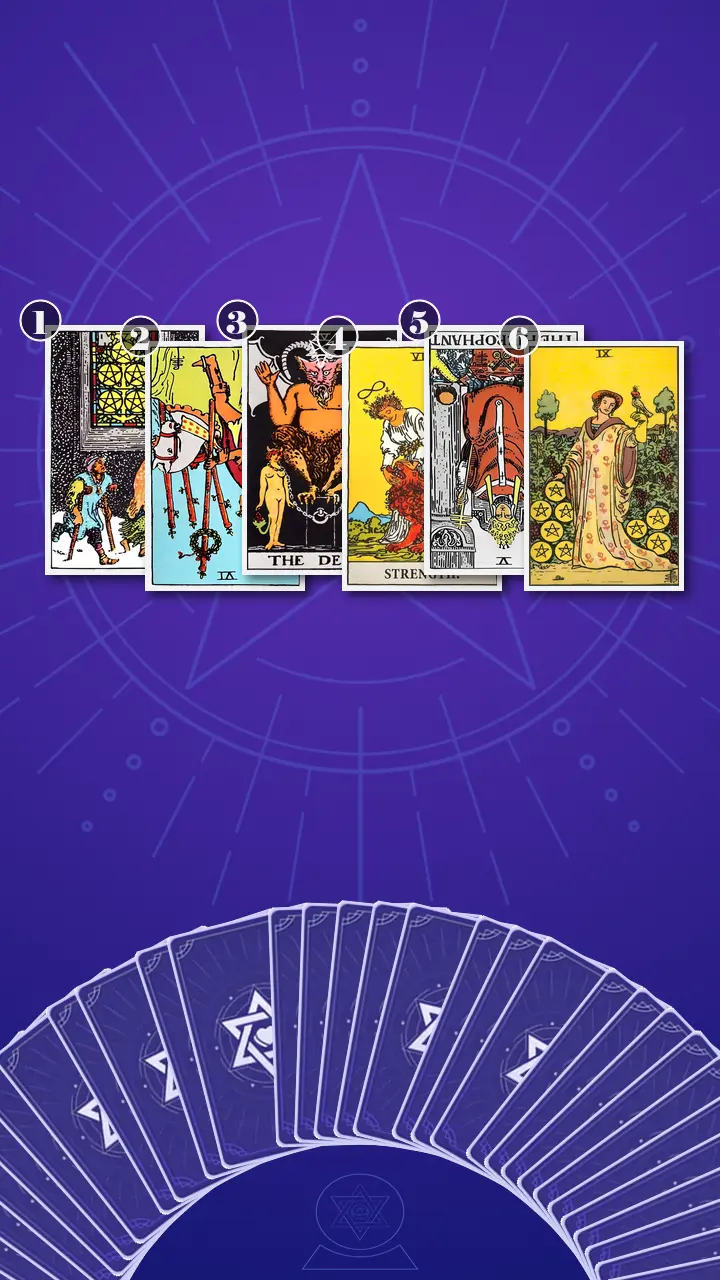
Position 1 — Surface reaction: the instant drop
“Now we’re turning over the card that represents the surface reaction: what happens in the exact moment your self-worth drops when the family chat praises your sibling,” I said.
Five of Pentacles, upright.
I didn’t rush. This card has a particular kind of cold in it—snow-cold, window-cold. “Here’s the scene,” I told Jordan, “and it’s painfully modern.”
I used the language their life already spoke: You’re on your NYC couch after work, phone in hand, and the family group chat is suddenly full of celebration for your sibling. The blue glow feels like a warm room you’re not invited into unless you have something equally shiny to present. Your throat tightens, you reread the messages, and you quietly exit the conversation without saying anything.
“That’s not jealousy first,” I added. “That’s exclusion first. Five of Pentacles is the nervous system reading a warm window as ‘inside’ and ‘outside.’ In this position, the energy isn’t balanced—it’s scarcity. A feeling that belonging is conditional, like there are bouncers at the door and you forgot your ID.”
Jordan let out a small laugh that didn’t match their face—sharp at the edges, tired in the middle. “That’s… brutal. And accurate,” they said. “Like, why am I rereading the same messages like they’re evidence in a case against me?”
“Because your body is trying to prove something it’s afraid of,” I said gently. “The card doesn’t shame you for that. It just shows the moment your mind misreads a celebration as a lock.”
Position 2 — Trigger script: the automatic comparison story
“Now we’re turning over the card that represents the trigger script: the automatic comparison story and meaning you assign to praise and attention,” I said.
Six of Wands, reversed.
“This is the victory parade card,” I told them, “but upside down.” In real life, it looks like this: In the family chat, your sibling’s news gets a flood of hearts and ‘AMAZING!!!’ replies. Your brain treats the reaction count like a leaderboard. You start drafting a reply that’s supportive but also subtly proves you’re doing well too—then you delete it because you hate how performative it feels.
Reversed, the energy here is blockage: recognition doesn’t feel steady or fair—it feels like it’s rationed. “A family chat reaction isn’t a ranking announcement—unless your brain turns it into one,” I said, and I watched Jordan’s eyes soften in that specific way that means, Oh. That’s exactly what I do.
“I don’t even want the spotlight,” they said. “I just… don’t want to feel erased.”
“Exactly,” I replied. “Six of Wands reversed turns visibility into a threat. The applause becomes less about them and more about what it ‘means’ about you.”
Position 3 — Root mechanism: the belief that keeps repeating
“Now we’re turning over the card that represents the root mechanism: the core attachment or limiting belief that keeps the self-worth drop repeating,” I said.
The Devil, upright.
People expect this card to be dramatic. In my experience, it’s usually mundane—like compulsively refreshing something you hate refreshing.
I anchored it in their real loop: You know, logically, that your sibling being praised doesn’t reduce your worth. But the second the chat lights up, you feel chained to an invisible audition: prove you’re impressive, or accept being forgotten. You escape into comparison—LinkedIn titles, salary guesses, milestone math—like it’s a reflex you can’t unclench.
“This is attachment energy,” I said. “Not moral failure. In this position it’s excess—too much authority given to external approval. Like your self-worth has a subscription you never meant to sign up for, and you keep paying the attention-tax anyway.”
Then I named the emotional precision without flinching: “You’re not jealous of them—you’re scared of being unloved without a headline.”
Jordan’s shoulders rose toward their ears as if the sentence had turned the room colder. Their hand went to their throat for a second—touch, release—like checking whether the tightness was visible.
I kept my voice steady. “The Devil card always shows one more thing people miss: the chains are loose. They feel like iron, but they’re learned. Which means they can be unlearned.”
Position 4 — Inner resource: the stabilizer that creates an exit
“Now we’re turning over the card that represents the inner resource: what strength helps you stay present with the discomfort without withdrawing or proving,” I said.
Strength, upright.
Strength is not loud. It’s not the confidence speech you give yourself in the mirror. It’s the moment between the notification and the meaning.
I described it the way it happens in a body: You feel the spike—tight chest, hot face, the urge to go silent. Instead of disappearing, you take one slow breath, unclench your jaw, and send a simple congrats without adding your own résumé. You stay connected while letting the discomfort exist in the background, not in the driver’s seat.
“In this position,” I said, “Strength is balance. Not suppressing the feeling. Not obeying it. Regulating it.”
I watched Jordan try it in real time: a breath that went low, a jaw that softened by a millimeter, shoulders dropping like a coat sliding off a hook.
“One breath before one sentence,” I reminded them. “That’s Strength in real life.”
And quietly, almost like they were surprised it worked, Jordan said, “That feels… possible.”
When The Hierophant Turned Over the Scoreboard
Position 5 — Key reframe: who gets to be the authority?
I held my thumb over the next card a beat longer than usual. “This is the turning point,” I told Jordan. “The one that changes how you read the whole situation.”
“Now we’re turning over the card that represents the key reframe: the belief or authority you need to question to unhook self-worth from family praise dynamics.”
The Hierophant, reversed.
In modern terms, this card is institution. Rubric. The ‘official’ way things are supposed to count. Reversed, it’s refusal—not rebellion for aesthetics, but opting out of a system that was never designed to hold your whole self.
I spoke it in Jordan’s language first: You notice how quickly you treat the family chat like a rule-setting institution: certain achievements get praised, certain paths get treated as ‘real,’ and you start shaping your life around what will be approved. This card is the moment you realize: you can respect your family and still refuse their scoreboard as your inner judge.
Then I brought in my own lens—my family’s lens. In the Scottish Highlands where I was raised, we watched patterns the way you watch tides. They don’t blame the shore for being wet; they ask what pulls the water back and forth. “In my work,” I said, “I call this Generational Pattern Reading. Not because your family is ‘toxic’ or because you’re doomed—because families pass down rules about love the way they pass down recipes. Quietly. Repeatedly. Until someone realizes they’re still cooking for a table that doesn’t exist anymore.”
I could almost feel Jordan’s mind trying to argue its way back into safety—like a junior marketer preparing a deck to justify a decision. And that’s when I used the contrast that always lands with people who live inside KPIs:
“Your family chat has become a dashboard,” I said. “Like a workplace KPI screen. If it’s green, you’re ‘good.’ If it’s red, you’re ‘failing.’ But here’s the question The Hierophant reversed asks: who built the dashboard? And why are you letting it run your identity?”
Jordan blinked hard—once, twice—like their eyes were trying to refocus on a different truth.
Here’s the moment we slowed down.
Setup: It’s 9:18 PM, you’re on your couch, and the family chat is blowing up with “SO PROUD!!!” for your sibling. Your chest tightens, your thumb hovers, and your brain starts calculating what you’ve done lately that would “deserve” that many reactions. You’re trapped in the logic of the scoreboard: if they’re up, you must be down.
Delivery:
Stop obeying the family scoreboard and start rewriting the rulebook—like The Hierophant reversed, you get to decide what counts and what doesn’t.
I let the sentence hang in the air. Even through a screen, you can feel when someone’s inner world goes quiet—like a subway car pulling into a station and the brakes finally stop screaming.
Reinforcement: Jordan’s reaction came in three waves. First, a physical freeze: their breath caught, and their fingers stopped mid-fidget on the hoodie string. Then, the cognitive seep-in: their gaze went unfocused, as if they were replaying a dozen old family moments—holidays, Zoom calls, comparisons disguised as pride. Finally, the emotion: a long exhale that sounded like they’d been holding something for years. Their shoulders sank, but their eyes went glossy, the way they do when relief arrives with grief attached.
“But if I stop using their rubric…” they said, voice small, “then what does that say about everything I’ve been chasing?” There was a flash of anger under it—quick, hot. “Like, does that mean I’ve been doing it wrong?”
“It doesn’t mean you were wrong,” I said. “It means you were surviving inside a borrowed authority. That’s different. And it’s common—especially when you’re the ‘reliable’ one. You learn to be measurable because being measurable feels safer than being fully known.”
I guided them into the practice the card was already asking for: “Now, with this new lens,” I said, “think back over the last week. Was there a moment—one tiny moment—when the family chat lit up and you could feel your body contract? What would have changed if you’d whispered to yourself, ‘That’s the scoreboard voice’ before you touched LinkedIn?”
Jordan nodded slowly, like the answer was arriving from somewhere below their thoughts. “Sunday night,” they said. “I was in bed. Radiator ticking. I did the whole scroll thing. If I had named it… I think I would’ve put the phone down sooner.”
That was the shift taking root: not from insecurity to perfection, but from shame and shrinking to the first layer of self-authored self-respect. Noticing the rule. Questioning the authority. Choosing something truer.
Position 6 — Integration step: the garden you can return to
“Now we’re turning over the card that represents the integration step: a concrete way to practice self-worth that doesn’t depend on applause, over the next week,” I said.
Nine of Pentacles, upright.
This card always makes me think of a garden that isn’t trying to impress anyone. It simply grows—patiently, privately, with enough boundary to keep it safe and enough openness to let in sun.
I translated it directly: You build one quiet proof of self-respect that doesn’t need to be announced: a savings auto-transfer, a skill you’re improving, a steady routine, or rest you don’t justify. When the chat praises someone else, it still stings sometimes—but you have your own ‘garden’ to return to, where your worth isn’t up for vote.
“In this position,” I said, “Nine of Pentacles is balance too—grounded self-worth. Not loud. Not fragile. The opposite of reaction-count anxiety. It’s ‘I can feel the evidence of my life in my own hands.’”
Jordan’s face eased—not into happiness, exactly, but into orientation. Like someone finding north again.
From Insight to Action: The Rulebook Swap and the One-Breath Reply
I looked back across the whole line of cards and threaded them into one story—because this is how tarot becomes practical instead of poetic.
The Five of Pentacles shows the body-level wound: the family chat feels like a warm room, and you feel outside it the second you’re not the one being celebrated. Six of Wands reversed shows the script that turns warmth into hierarchy: applause becomes proof of rank. The Devil reveals why the loop is so sticky: your nervous system has chained worth to being impressive—an always-on audition. Strength offers the exit hatch: regulation, gentleness as power, one breath before one sentence. And The Hierophant reversed names the real pivot: the cognitive blind spot is treating your family’s praise culture like an inner authority. The transformation is choosing your values as the measuring stick. Then Nine of Pentacles grounds it all: build private evidence, so applause becomes optional.
“Your blind spot,” I said to Jordan, “is not that you ‘overreact.’ It’s that you treat the scoreboard as if it’s objective truth. And if approval is your authority, peace will always feel conditional.”
I also added something from my Nature Empathy Technique: “We don’t fix this by forcing yourself to be happy on command. We fix it the way seasons change: tiny, repeated shifts that your body can actually tolerate.”
Then I gave Jordan actionable advice—small enough to do on a Tuesday night, specific enough to break the loop.
- The One-Breath Reply ProtocolNext time the family group chat praises your sibling, take one slow breath before typing anything. Then send one clean sentence: “Congrats—so happy for you.” No extra explanation, no humblebrag add-on, no ‘by the way I’m also…’Expect the urge to make it witty or impressive. That urge is the scoreboard trying to keep its job. Let it talk while you breathe.
- The 10-Minute No Reaction-Check TimerAfter you hit send, set a 10-minute timer. During those 10 minutes, do one grounding action that involves your hands: refill water, wash one dish, or step to the window and feel your feet.Physically put your phone face-down. The point is to interrupt “approval-checking,” not to win at self-control.
- Rulebook Swap (Family Rule → My Rule)Open Notes and write two lines: (1) “The family rule I’m obeying right now is ___.” (Example: “Only big wins deserve attention.”) (2) “My rule is ___.” (Example: “My life counts even when it’s quiet.”) Then, once this week, share one modest update in the chat without over-selling it.If shame spikes, write in a neutral tone—like product requirements. Clear, not poetic. Stop anytime if your body ramps up.
- My 3-Minute Family Energy Check (Houseplant Version)Right after a praise trigger, walk to the nearest houseplant. Look at it for 30 seconds: is it leaning, dry, reaching for light? Water it or rotate it a few inches. While you do, name one private “Nine of Pentacles” marker you’re cultivating this week (savings transfer, two gym visits, one focused work block, one creative session—something actually doable).This isn’t about plants being magical. It’s about giving your nervous system a “garden” action—quiet proof that you can care for what’s yours without an audience.
Jordan stared at the list on their screen and gave a small nod that looked more like relief than enthusiasm. “I can do three minutes,” they said, almost laughing. “I can water my plant and not refresh iMessage like it’s an engagement dashboard.”
“That’s the point,” I said. “We’re not trying to become immune. We’re trying to become free enough to stay connected without competing or disappearing.”

A Week Later: The Quiet Proof
A week later, Jordan sent me a message I could picture instantly. The family chat had lit up again—another wave of 🎉 for their sibling. Jordan wrote, “Did the one breath. Sent the clean congrats. Put my phone face-down. Watered my sad pothos. Ten minutes felt weirdly long… but I didn’t spiral.”
Then: “I still woke up the next morning with the first thought being, ‘What if I’m falling behind?’ But it didn’t grab my whole day. I literally said, ‘scoreboard voice,’ and got up anyway.”
That’s how a Journey to Clarity usually looks in real life: not a personality transplant—just a tiny new authority taking the wheel.
When someone else gets celebrated in the family chat and your throat tightens, it’s not that you’re a bad sibling—it’s that part of you still believes love is handed out like points, and you’re quietly terrified of being the one who doesn’t place.
If you didn’t have to win the family scoreboard tonight, what’s one value you’d let count as “enough” for you—just for the next 24 hours?
Every reading at AceTarot is a Journey to connect with inner wisdom and empower next step.
Learn more about our Journey to Clarity.