The Will Email Hit Like a Life Alarm—Then I Built One Stable Rule

Finding Clarity in the PDF That Felt Too Serious
You open a PDF attachment that feels way too serious for your age, and within five minutes you’re doomscrolling, tab-switching, and calling it “being responsible.”
Jordan (name changed for privacy) said that to me like it was a confession and a punchline at the same time, the kind you make when you’re trying to keep your face neutral while your body is doing something else entirely.
They were calling from Toronto, and even through the screen I could feel the particular city-hum in their story: the condo kitchen light that’s a little too white, the constant ping of Slack, the sense that adulthood is a moving target you’re supposed to hit while commuting on Line 1 and carrying groceries that somehow cost $70 even when you “barely bought anything.”
“It was 8:12 a.m., Monday,” they told me. “Kettle clicked off. Slack pinged. I opened the email. The will attachment loaded like… slow. Like the loading bar was dragging out a sentence.”
As Jordan spoke, I watched their hands. Restless, hovering near their phone like it was a hot mug they couldn’t put down. Their chest rose high and fast, then dropped, heavy—like trying to breathe with a book pressed against the ribs.
“I know it’s just a document,” they said, voice tight with forced logic. “But it hit me like a life alarm. And then it’s like everything started failing at once—work, my relationship, money. I keep checking my accounts like the numbers will explain my feelings.”
I let the silence land for a beat, the way I learned to on long voyages when someone finally admitted what they’d been holding through three time zones and two oceans. “A PDF can’t decide if you’re ready—only your habits can show you what you can hold,” I said gently. “And right now, your habits are trying to protect you by keeping ten tabs open.”
Jordan exhaled, but it wasn’t relief. It was the kind of breath you let out when you realize your nervous system has been running the show. “Exactly. I can’t tell if I’m being responsible or just… spinning.”
“Then let’s give the spinning a map,” I said. “Not a mystical one. A practical one. We’re here for clarity—and for a next step you can actually do this week.”

Choosing the Compass: The Energy Diagnostic Map (7)
I’m Giulia Canale—Jungian psychologist by training, tarot reader by practice, Venetian by bones. I’ve spent years watching people change mid-voyage, not because the sea gave them answers, but because distance makes patterns visible.
Before we pulled any cards, I asked Jordan to do one simple thing: one hand on their chest, one slow breath out, and to hold the question in plain language: “Parents sent me their will—why are work, love, and money spiraling?”
I shuffled slowly, not as a performance, but as a transition. Like closing the laptop lid for two seconds before reopening it with intention.
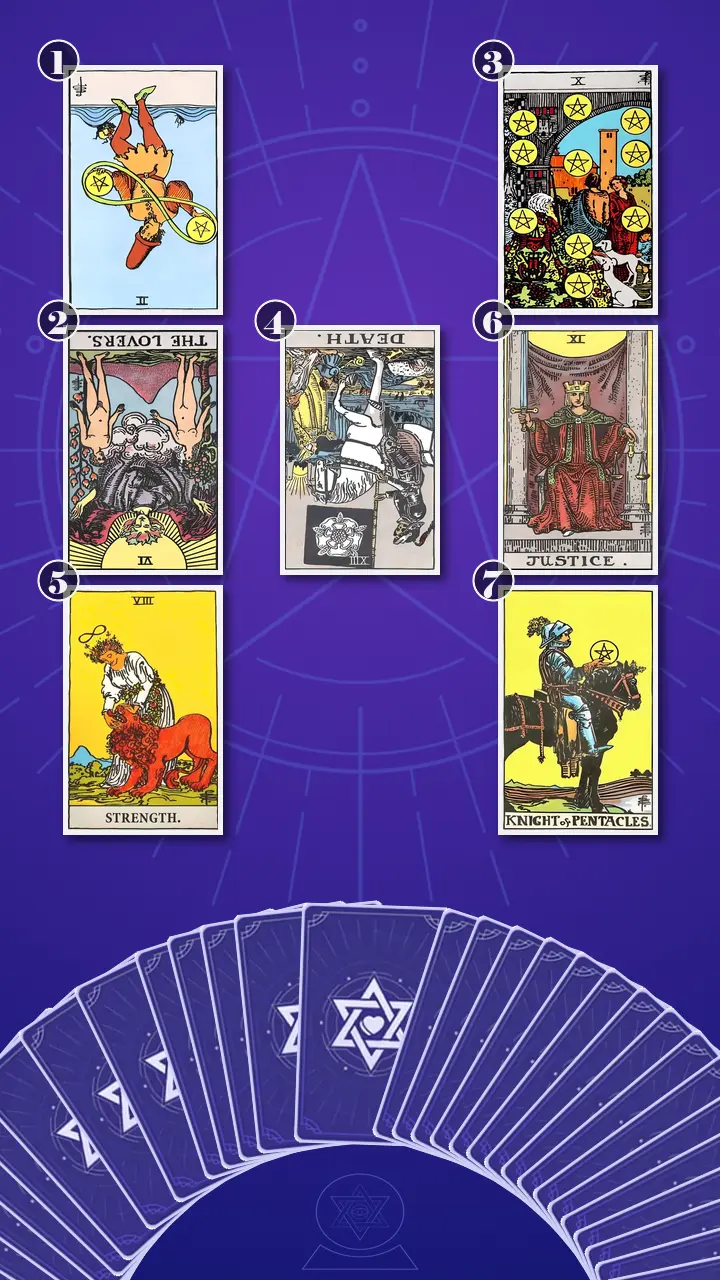
“Today we’ll use a spread I rely on when one trigger spills into multiple life domains,” I said. “It’s called the Energy Diagnostic Map (7) · Context Edition.”
For anyone reading along: this spread works because it doesn’t treat work, love, and money as three separate problems. It treats them as one system. The layout traces a clean chain—surface symptoms, inner tug-of-war, external pressure, the core blockage, then the resource, the turning point, and one grounded next step. It’s like reading a city map from congestion to a clear route instead of trying to solve all of Toronto at once.
I pointed to the center position. “Card 4 sits in the middle—your repeating loop. Then we’ll build an exit path: resource, transformation, next step.”
Reading the Map: From Juggling to a Clean Cut
Position 1 — Surface symptoms: what the spiral looks like day-to-day
“Now flipping over is the card that represents your surface symptoms—what the spiral looks like across work, love, and money,” I said.
Two of Pentacles, reversed.
Even before I spoke, Jordan gave a short laugh—small, bitter. “That’s… rude,” they said. “Accurate, but rude.”
I nodded. “Reversed here looks like imbalance and overload. And your modern version is painfully specific: you sit down to do one focused work task, but your brain starts juggling—you open your bank app ‘for a second,’ reread a partner’s text to check the vibe, bounce back to email. Thirty minutes later you’ve moved a bunch of tiny pieces but completed nothing, and the only thing that feels certain is that you’re behind.”
“That’s literally my Tuesday,” Jordan murmured.
I tracked the energy: reversed Two of Pentacles is not “you can’t cope.” It’s “your coping tool is overloaded.” This is the infinity loop ribbon turned into tab-switching. The action soothes, but it doesn’t solve.
“Here’s the hard truth,” I said softly. “If you need to check again, it’s probably comfort—not data.”
Jordan’s fingers stopped tapping for the first time since we started. Just for a second.
Position 2 — Inner tug-of-war: the values conflict amplifying the spiral
“Now flipping over is the card that represents your inner tug-of-war—the values conflict underneath the behavior,” I said.
The Lovers, reversed.
I watched Jordan’s face tighten, then smooth into a practiced neutrality—like someone replying “All good!” in a work thread while their stomach drops.
“Reversed Lovers often shows misalignment, not only in romance, but in choice,” I explained. “And your life translation is this: you’re treating relationship clarity and career direction like pass/fail exams. You want commitment and momentum, but you also want to avoid being ‘the wrong kind of adult.’ So you draft messages that sound composed, postpone direct conversations, and quietly hope the other person or the next work win will choose for you.”
Jordan’s eyes flicked away from the camera. “I do that thing where I A/B test my personality in texts until no version feels true,” they said, and it landed like a Fleabag aside—half humor, half ache.
“That’s reversed Lovers,” I said. “Not because you don’t care. Because the pressure to ‘get it right’ distorts what you actually value.”
Position 3 — External pressure: what the will is activating
“Now flipping over is the external pressure position—what the will, and the whole legacy theme, is activating,” I said.
Ten of Pentacles, upright.
This card always feels like an archway you walk under without noticing… until you do. Family. Structure. Time. The blueprint you didn’t consciously agree to but still inhale.
“Your modern scenario is: the will lands like a generational spotlight,” I said. “Nothing dramatic happens, but your brain time-travels—RRSPs, property prices, ‘what if someone gets sick,’ ‘what if I’m behind.’ It’s external pressure without anyone actually pressuring you.”
I used the echo technique on purpose—scene-class analogy—because it’s how the mind makes sense of a trigger. “It’s like getting a surprise ‘future admin’ task dropped into your lap mid-week,” I said. “Your brain starts running retirement math while you’re still finishing Monday’s deck.”
Jordan’s expression shifted in three small beats: their breathing paused; their gaze unfocused like they were replaying the moment the PDF loaded; then a slow exhale. “Oh,” they said quietly. “This is why everything suddenly got louder.”
In my Venetian language, I call this an echo in a canal: a single sound—one email—bounces off every wall and suddenly you think the whole city is shouting. That’s one of my signature lenses, Generational Echo Mapping: tracing how a family message ricochets into places it doesn’t “logically” belong. Ten of Pentacles is that echo made visible.
Position 4 — Core blockage: the resistance that keeps the loop cycling
“Now flipping over is the core blockage—the stuck point that keeps the spiral repeating,” I said, and I let my voice slow down.
Death, reversed.
Jordan swallowed. Not dramatic. Just a tight, reflexive swallow like they were trying to keep something from rising into their throat.
“Reversed Death isn’t doom,” I said. “It’s resistance. The card still has a sunrise—the future is present. The blockage is refusing the ending that makes space for it.”
I held up the mirror sentence exactly as planned: “You’re not refusing change; you’re refusing the feelings change brings.”
Then I got hyper-specific, because shame dissolves when the pattern becomes concrete. “This is the loop: rewriting the same message, refreshing the same balance, staying late to ‘prove’ you’re fine—while nothing actually ends, so nothing can begin.”
Jordan’s mouth pulled into a recognition wince. “I do that,” they whispered. “I keep everything the same, but I also need life to feel guaranteed. Which is impossible.”
“Exactly,” I said. “This is the engine underneath the tab-switching. You want stability across work, love, money… and you fear the will proves life can change overnight and you’re not ready. So your system tries to control every variable.”
Position 5 — Available resource: the steadiness you can lean on
“Now flipping over is your available resource—the inner capacity you can lean on to self-regulate,” I said.
Strength, upright.
Jordan’s shoulders dropped a fraction before they even spoke, like their body recognized the tone of this card.
“Strength is not hype,” I told them. “It’s restraint. It’s the kind of courage that looks boring from the outside.”
I named the body cueing: “That tight chest and restless hands? That’s your lion energy. Strength doesn’t kill the lion. Strength holds it.”
Then I gave them a line they could actually use on a workday. “Hold the urge, not the whole future.”
Jordan nodded, slower this time. “Not checking is the brave thing,” they said, like they were surprised by their own sentence.
“Yes,” I said. “And if you need to check again, it’s probably comfort—not data. Strength helps you tell the difference.”
Position 6 — Key transformation: the pivot that restores clarity and agency
When I reached for the next card, the room went quieter in that specific way it does before a difficult truth—like the moment on a ship when the engines shift and everyone feels it in their bones.
“We’re turning over the key transformation card,” I said. “This is the pivot point.”
Justice, upright.
Jordan leaned forward, like their whole attention finally had something to grab.
Setup. I reflected back the exact moment they’d described: “You know that moment where you open the will attachment, then suddenly you’re in a 10-tab spiral—Gmail, Slack, your bank app, the text thread, your calendar—like if you just check one more thing, you’ll feel steady.”
Delivery.
Not endless monitoring—choose one truth, weigh it on the scales, and let Justice’s sword cut the spiral into a next step.
I didn’t rush past the sentence. I let it hang there, clean and almost blunt, like the click of a lock finally turning.
Reinforcement. Jordan’s reaction came in a three-step wave: first, a freeze—lips parting slightly, breath caught. Then the cognitive shift—eyes widening, then narrowing, as if they were mentally testing the sentence against their last week of checking. Then the release—one long exhale that dropped their shoulders and softened their jaw, followed by a tiny shake of the head, not disagreement but disbelief. “Wait,” they said, voice rougher now. “That’s… actionable. And also—” they blinked hard, as if their eyes had been dry for hours “—kind. Like, one clean decision is kinder than ten anxious micro-decisions.”
I nodded. “That’s Justice: scales and sword. Facts and a clean cut. And here’s the ‘two documents’ truth I want you to feel in your body: the will is an external document. It’s information. Justice asks for your internal document—the one sentence that makes your week fair.”
“But if I stop monitoring,” Jordan said, and there was the old fear flashing up like a notification, “doesn’t that mean I’m being careless?”
“No,” I said, steady. “It means you’re being intentional. Reassurance won’t stabilize you right now. One fair decision you can actually keep will.”
I leaned in with the invitation that turns insight into lived memory. “Now, with this new lens—what’s one moment from last week where this would have changed how you felt? A time you checked again, not for information, but to calm the feeling?”
Jordan looked down and rubbed their thumb along the edge of their phone. “Thursday. I rewrote a text for like… forty minutes. It wasn’t about the text. It was about me trying to make sure I didn’t get abandoned over punctuation.”
“That,” I said softly, “is the beginning of your shift—from overwhelm and future-tripping toward grounded confidence built through consistency. This is you moving from ‘What if?’ to ‘What’s fair?’”
Position 7 — Next step: a practical rhythm that makes stability real this week
“Now flipping over is your next step—the practical action rhythm you can actually do this week,” I said.
Knight of Pentacles, upright.
“Project management, not a big reveal,” I said, because Jordan’s whole life lived in calendars and deliverables. “Stability as a recurring meeting.”
Knight of Pentacles is the opposite of the Two of Pentacles reversed. Not juggling. Building. “This card says: keep it boring,” I told them. “Consistency is the receipt. Not intensity.”
Jordan’s face did something I love to see: a realistic willingness, not a dopamine hit. “Okay,” they said. “I can do boring.”
The One-Page “Justice Sentence” and the Boundary You’ll Actually Keep
I pulled the whole reading into one short story, because that’s what clarity is: a narrative your nervous system can follow.
“Here’s what I see,” I said. “A family document—Ten of Pentacles—dropped ‘future admin’ into your week and turned the volume up on everything. Your surface response—Two of Pentacles reversed—was to juggle and check, trying to create certainty through motion. Underneath, reversed Lovers shows you trying to choose the most adult-looking option in work and love, which makes you stay vague. The core blockage is reversed Death: refusing a quiet identity update, so nothing can end cleanly. Your resource is Strength: holding the urge without letting it steer. And your turning point is Justice: one fair decision plus one boundary you keep. Then Knight of Pentacles makes it real: repeatable routine.”
“Your blind spot,” I added carefully, “is thinking that monitoring equals responsibility. But monitoring is often just fear disguised as productivity. Justice wants responsibility to look like structure.”
Then I brought in one of my own tools, the one I’ve seen work for high-functioning spirals: my Bollard Marking Method. In Venice, a bollard is the dock piling you tie a boat to. You don’t argue with the tide all day—you pick a solid point and you tie off.
“We’re going to give you two ‘dock points’ this week,” I told Jordan. “So your mind has somewhere to tie up instead of circling.”
- Set Two Check-In Windows (Your Dock Points)Put two 15-minute meetings on your calendar for the next 7 days: one for money/admin, one for relationship/comms. Outside those windows, keep your banking app and message drafts closed—even if the urge spikes.Start with 48 hours only if a full week feels impossible. The goal is “check on purpose, not on panic.”
- Write the Justice Sentence (On Paper)Each morning, set a 10-minute timer and write on paper: “The next fair step is ____.” Make it painfully specific (one transfer amount, one direct question, one work block). Do that one step before opening any non-essential apps.If you start negotiating with it, circle the first answer anyway. Lower the bar to: “The next fair step is: one thing.”
- Choose One Knight-of-Pentacles RoutinePick one repeatable rhythm for two weeks: a 20-minute weekly “money date,” one 60-minute Slack-off focus block, or one 15-minute relationship check-in request (“Can we do 15 minutes this week to talk about where we’re at?”).Keep it boring. If you miss a day, don’t compensate by doubling it. Consistency is evidence; intensity is not.
Jordan hesitated, then said the most honest obstacle. “But I barely have five minutes some days. Like, my job is… a lot. And if I don’t respond fast, it looks bad.”
I didn’t argue with their reality. “Then we make the first version small enough to survive your week,” I said. “One 10-minute Justice Sentence. One 15-minute check-in window. One 60-minute focus block—just one. Think of it like setting a firewall. It won’t solve your life. It stops the constant leak.”
Jordan nodded once, firmly, like they’d finally found something that didn’t require them to become a different person overnight.

A Week Later: Ownership, Not Certainty
Six days later, Jordan sent me a message that wasn’t an essay—just a screenshot of a notebook page and two small lines of text.
The next fair step is: move $150 to savings on payday and stop checking the balance until Friday.
Under it, they’d written: Boundary: no banking app outside the 12:30 window.
“I did it,” their message said. “First two days I wanted to crawl out of my skin. Then it got… quieter. Also, I asked for a 15-min relationship check-in. No perfect phrasing. Just asked.”
They added, almost as an afterthought: “I slept a full night. Woke up and my first thought was still ‘what if I mess this up?’ But I didn’t grab my phone. I just… noticed it. Then I laughed a little.”
That’s the kind of proof I trust: not a dramatic reinvention, but a nervous system learning it can survive a feeling without turning it into a spreadsheet.
This was Jordan’s journey to clarity—not by forcing certainty across work, love, and money, but by choosing one fair rule and practicing it until their body believed them.
When a family document makes time feel loud, it’s easy to start treating every email, every text, and every purchase like evidence in a trial about whether you’re ‘ready’—and your body ends up carrying that verdict in a tight chest and restless hands.
If you didn’t need to feel 100% certain, what’s one small “fair next step” you’d be willing to repeat for the next two weeks—just to see what steadiness feels like in your actual life?