The Starred Waitlist Email Kept Reopening—Until the Timer Hit 15

Finding Clarity in the 8:47 p.m. Two-Tab Stare
You’ve got the waitlist email starred, your Notes app full of pros/cons lists, and you still can’t choose without immediately second-guessing—because you’ve turned a class into an identity decision.
Alex (name changed for privacy) said it like she was confessing to a petty crime, not describing a totally normal 24-year-old-in-Toronto reaction to a waitlist timeline shifting overnight.
She’d come into my café after her entry-level job downtown, still wearing that “I was on Zoom all day” stiffness in her shoulders. Outside, the street had that damp Toronto evening feel—traffic hissing, a streetcar bell in the distance—while inside my place the espresso machine clicked and sighed like it was trying to calm the room down. Her phone was warm in her palm, and the blue light from her screen made her blink hard.
“It was 8:47 PM yesterday,” she told me, “and I was literally sitting cross-legged on my bed, laptop open, two tabs—dream class and backup—just… staring at me.” Her fingers did a small, restless tap-tap-tap against the phone case. “My chest gets tight, and then I whisper, ‘Just one more check,’ and I open the waitlist email again. Like it’s going to update if I look hard enough.”
I watched her hands reach for the phone the way you reach for a rail when you feel like you might fall—automatic, protective, not dramatic on purpose.
“Refreshing isn’t a plan—it’s a coping mechanism with Wi‑Fi,” I said softly, not as a roast, as a relief. “And your body is treating this like a fire alarm.”
She let out a quick laugh that sounded like it had a little bitterness in it. “That’s… brutally accurate.”
What she wanted was simple and impossible at the same time: the dream class that felt like a step toward the person she wants to become, and the backup that felt like safety—without the panic, without the spiral, without clicking one button and feeling like she’d chosen her whole personality.
The panic in her wasn’t abstract. It was like trying to breathe through a too-tight scarf—tight chest, fast thoughts, and hands that kept grabbing for her phone like it could hand her certainty.
“Let’s make this smaller,” I told her. “Not small like it doesn’t matter—small like we can actually hold it. We’re going to find clarity by building a decision process you can live inside, even with uncertainty still around.”

Choosing the Compass: Decision Cross · Context Edition
I asked Alex to put her phone face-down for one minute—not as a rule, as a nervous-system reset. “Just one slow breath in,” I said, “and a longer breath out. We’re not summoning anything. We’re moving your brain out of emergency mode.”
While I shuffled, the café did what it always does: grounded the moment. The smell of dark roast and vanilla syrup. The gentle clink of a spoon against a cup somewhere behind the counter. Ordinary life—exactly where decisions actually happen.
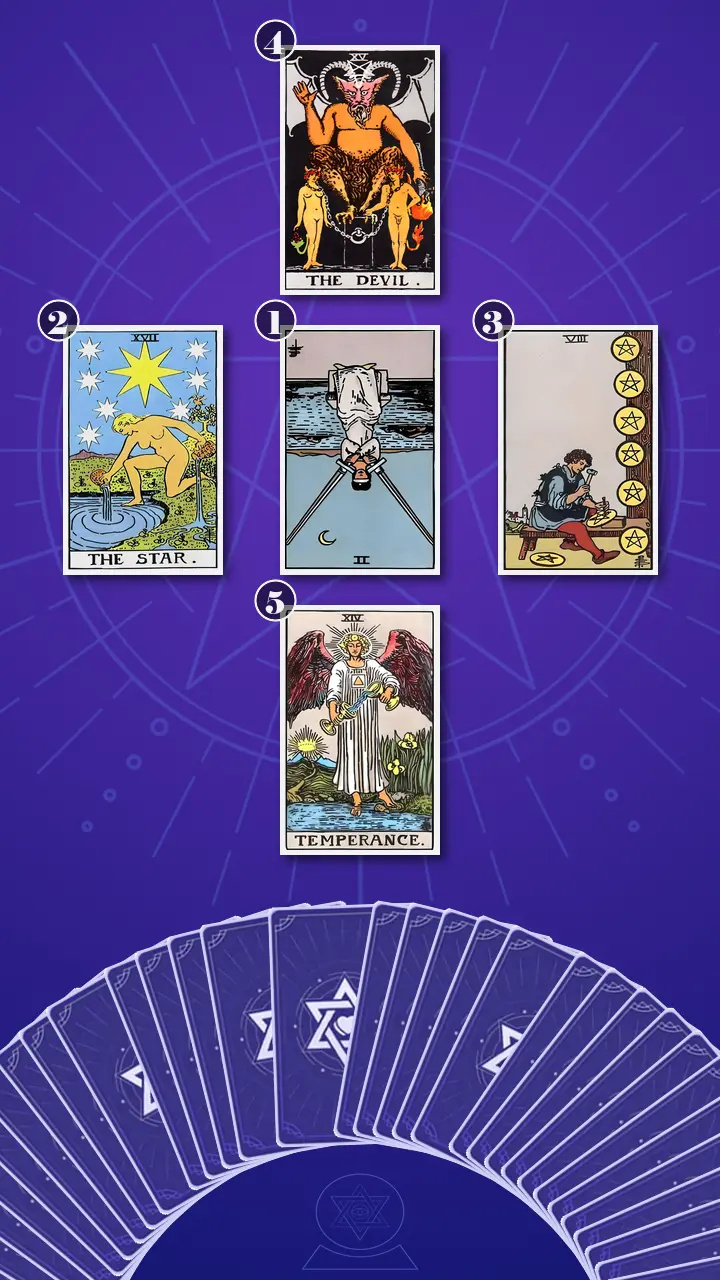
“For this,” I said, “I’m using a spread I call the Decision Cross · Context Edition. It’s a tarot spread for decision making when there’s a deadline—especially the ‘dream program vs backup option’ kind of moment.”
To you reading this: the reason I like this spread is because it separates what’s loud from what’s true. It lays out the present panic loop, the lived energy of Option A, the practical support of Option B, the hidden driver underneath it all, and then—most importantly—guidance that’s about process, not prediction. In a waitlist situation, trying to “predict” often feeds analysis paralysis. Building a paced decision container helps you choose without needing perfect certainty.
“Here’s the map,” I told Alex. “The center card shows the loop you’re stuck in. Left and right are the two paths—dream and backup, but we’ll read what they mean beyond logistics. Above is the hidden pressure hovering over this decision. Below is guidance: how to choose without panic, and what your next step is.”
Reading the Map: The Spiral, the Spark, and the Steady Path
Position 1: The observable panic loop around the waitlist email
“Now we open the card that represents the specific, observable panic loop around the waitlist email and the inability to commit,” I said.
Two of Swords, reversed.
I didn’t have to stretch to translate it into her life. “You keep the waitlist email starred and reopen it between tasks like it’s going to update if you look hard enough,” I said, “and you bounce between two browser tabs—dream class vs backup—until it’s midnight and nothing is chosen.”
In the Rider-Waite image, the figure is blindfolded with crossed swords tight to the chest. Reversed, that stalemate doesn’t resolve into clarity—it collapses into overwhelm. This is blocked Air energy: too much thinking, jammed signal, not enough landing.
“This isn’t you being ‘bad at decisions,’” I told her. “This is you trying to decide without feeling. The blindfold is the demand for certainty. The crossed swords are your body bracing like the choice is dangerous.”
I let the modern metaphor land: “It’s like having 27 browser tabs open and calling it ‘research’ when you’re actually avoiding the click that makes one tab real.”
Alex’s reaction came in a three-beat chain: first her breath paused, like her lungs forgot the next line. Then her eyes unfocused for a second, like she was replaying last night’s Gmail-scroll in her head. Then she exhaled through her nose and nodded—tight, resigned. “Yeah,” she said. “That’s the loop.”
She tried to smile again, but it faltered. “And the worst part is I tell myself I’m being responsible.”
“Responsible is making a container,” I said. “Not refreshing for relief.”
Position 2: Option A — what the dream class represents beyond logistics
“Now we open the card that represents what the dream class represents psychologically—desire, identity pull, meaning—beyond the logistical details,” I said.
The Star, upright.
“When you read the dream class description, you get that rare quiet feeling of ‘this matters,’” I told her. “It’s the tab you open when you want to remember who you’re trying to become.”
This card is balanced Water and Air—hope that’s calm, not frantic. The Star doesn’t shove; it draws. The danger isn’t wanting it. The danger is turning it into a performance you have to win before you’re allowed to breathe.
I asked, “If nobody could see your decision—not LinkedIn, not your group chat—would this still be the truest pull?”
Her shoulders dropped in a way that looked like a tiny surrender to honesty. “Yes,” she said, quieter. “It’s not just aesthetic. It actually… lights me up.”
“Good,” I said. “That’s data. Not a fantasy.”
Position 3: Option B — what the backup offers in practice, without calling it failure
“Now we open the card that represents what the backup option offers in practice—stability, skill-building, continuity—without framing it as failure,” I said.
Eight of Pentacles, upright.
“This is the option that fits your real calendar,” I said. “Available, practical, tangible skills you can use immediately. Not as ‘announcement-worthy,’ maybe—but it builds confidence through reps. Weekly practice. Measurable progress. Momentum that doesn’t depend on a waitlist.”
Eight of Pentacles is Earth energy in balance: repetitive, steady, competence-building. It’s the opposite of the Two of Swords panic loop because it gives your nervous system something to do that actually changes reality.
Alex’s lips pressed together, and I could see a flicker of relief—and then judgment. She caught herself and said it out loud: “When I picture the backup, I feel… calmer. And then I hate that I feel calmer, because it feels like that means it’s boring.”
“Or,” I offered, “your body recognizes structure. Relief isn’t a red flag. Sometimes relief is information.”
Position 4: Hidden driver — the attachment that turns the choice into a self-worth test
“Now we open the card that represents the underlying fear/attachment that turns the choice into a self-worth test and fuels urgency,” I said.
The Devil, upright.
Alex’s eyes went straight to the chained figures. The café suddenly felt quieter, like even the fridge hum had lowered its volume.
“Under the decision,” I said, “there’s a pressure voice that says this class will prove whether you’re ‘the kind of person’ who gets what she wants. That’s why the waitlist feels public and high-stakes. You’re not refreshing for information—you’re refreshing for relief.”
I brought in the modern scene: “Like you’re on the streetcar home, you see an Instagram Story—‘Accepted!! New chapter starts soon’—and your stomach drops. You open the dream class page again, then the backup page, and the Judge voice goes, ‘If I choose backup, I’m settling. If I wait and miss the dream spot, I’m stupid.’”
Her reaction hit hard and fast: shoulders up, a small swallow, then her eyes got shiny with anger at herself. “Oh,” she said. “I’m making this about being valid.”
“Yes,” I said gently, and I made sure my voice didn’t turn clinical. “And here’s the key detail most people miss: those chains are loose. The binding is psychological.”
I added the line I wanted her to keep: “A class can be a good fit without being proof.”
She breathed out like she’d been holding it since the waitlist email arrived. “I hate that I do this,” she whispered.
“We don’t need to hate it,” I said. “We need to understand it. And then we build a structure that doesn’t let it drive.”
When Temperance Poured Between Two Cups
Position 5: Guidance — how to choose without panic, with a concrete next step
I let my hands settle on the deck. “We’re turning over the guidance card now,” I said, “the one that shows a concrete way to choose without panic: a values-based process and a small next action that restores agency.”
Temperance, upright.
The angel’s posture is calm, not passive: one foot on land, one in water, pouring between two cups like patience is an active skill. This is balanced integration—not choosing one extreme, not letting the Devil turn your options into a verdict, not letting the Two of Swords keep you braced and blindfolded.
And because my whole life is coffee, Temperance always makes me think of blending: you don’t get a drink you can actually enjoy by chugging straight espresso or drowning everything in milk. You calibrate. You taste. You adjust. You build something you can sustain.
That’s my practical lens—my Knowledge Filtration approach. I told Alex, “Right now you’re trying to drink the entire internet through a straw. Temperance says: filter. Decide what matters, let the rest drip out. Not because you don’t care, but because your brain can’t absorb everything at once.”
She frowned—resistance first. “But if I filter too much… what if I miss the one thing that would make it obvious?”
I nodded. “That’s the loop talking.” Then I said the reframe cleanly: “You’re not indecisive. You’re treating uncertainty like an emergency.”
The room held still for a moment—just the soft hiss of steaming milk behind the counter, like a long exhale.
Stop treating this choice like a one-shot verdict, and start blending what you want with what you can sustain—like Temperance patiently pouring one cup into the other.
I let the sentence hang there, the way you let coffee bloom before you pour more water—time matters.
Setup. In my mind I could see her exactly as she’d described: 9:36 PM, reopening the waitlist email again, two tabs open, chest tight, thumb hovering like the next refresh would finally make it obvious. She was trying to eliminate uncertainty so she wouldn’t ever have to feel foolish for wanting more.
Delivery.
You don’t need perfect certainty to choose; you need a paced plan that respects both desire and reality.
Reinforcement. Alex’s body reacted before her words did. First: a brief freeze—her fingers stopped tapping entirely, suspended over the edge of her phone. Second: her gaze drifted to the side, like her brain was lining up memories of every pros/cons list she’d ever made, every time she’d asked three friends and still felt worse. Third: her shoulders sank, not in defeat—more like her ribcage finally got permission to expand. She blinked twice, slowly, and her voice came out thinner than before. “So I don’t have to solve my whole future tonight.”
“Exactly,” I said. “Set a 10-minute timer. Write your top two values for the next 8 weeks—like ‘meaning’ and ‘sustainability’—and one hard constraint: time, money, or energy. Then pick one next step that honors all three, even imperfectly. If you feel yourself spiraling, you can stop, stand up, drink water, and come back later. The goal is a calmer process, not forcing a decision through panic.”
I leaned in a little, keeping it human: “Now—use this new lens and look back at last week. Was there a moment when your body knew what it needed, but your brain reopened the debate anyway?”
Her eyes went wide, then softened. “Saturday morning,” she said immediately. “I opened my calendar and realized the backup would actually fit. And I felt relieved. And then I told myself relief meant I was settling.”
“That was you stepping from panic toward self-trust,” I said. “Not full certainty. Just calibration.”
From Insight to Action: The Temperance Decision Container (a brew you can repeat)
I pulled the whole spread into one story for her—because scattered insights don’t help when you’re already overwhelmed.
“Here’s what happened,” I said. “The waitlist email triggered the Two of Swords reversed: your brain tried to think its way into certainty, and you got stuck in the refresh-and-compare loop. The Star shows the dream is real—it’s a genuine pull toward meaning, not a random impulse. The Eight of Pentacles shows the backup isn’t failure; it’s a training ground that builds momentum through reps. The Devil explains why it all felt life-or-death: you weren’t choosing a class, you were trying to prove you’re not behind. Temperance is the way through: a paced plan that blends desire and sustainability.”
“Your cognitive blind spot,” I added, “is believing there is one correct choice and you must not miss it. That belief makes you reach for more information as a substitute for committing. The transformation direction is different: you move from eliminating uncertainty to choosing a values-based next step you’re allowed to revise later.”
Then I made it concrete—because clarity is useless if it doesn’t change Tuesday night.
- The 15-Minute Decision ContainerToday, set a 15-minute timer. In Notes, write three non-negotiables for the next 8 weeks: time (e.g., “2 nights/week max”), money (e.g., “under $___”), and energy (e.g., “no weekend homework”).If your brain says “15 minutes isn’t enough,” treat that as the loop talking. You’re not solving your whole future—just building a container.
- Filter the Noise (not your desire)Make a simple two-row decision grid: Row 1 = dream class, Row 2 = backup. Column headers = your three non-negotiables. Fill it with plain facts only (schedule, cost, workload), no vibes, no status story.This is my café version of “Knowledge Filtration”: if it doesn’t change time/money/energy, it doesn’t get to clog the filter.
- One-Step Commitment (not a verdict)Pick the option that best fits your constraints and take ONE concrete step today: click enroll/confirm, pay the deposit, or email one specific question. Then set a review point on your calendar for 8 weeks out.Trade ‘perfect certainty’ for a paced next step you can live with. Commitment doesn’t have to mean a life sentence—it can mean a calendar invite.
Alex immediately raised a real-life obstacle—because she was honest, not magically cured. “But I’m going to miss the email,” she said, and her hand drifted toward her phone again.
“Let’s build a safety net that doesn’t cost you your sanity,” I said. “Two inbox check windows: one at lunch, one after work—like 12:30 and 6:30. Outside those windows, move the thread into a ‘Waitlist’ folder so it’s not sitting on top, and set a VIP notification only for the school’s email address. You’re allowed to protect your nervous system even if the situation is urgent.”
She nodded, still wary. So I offered one more small anchor, almost playful: I poured her a cappuccino and used the foam like a whiteboard—the Latte Memory Technique from my own toolkit. I wrote two words in the froth with a spoon tip: Meaning and Sustainable.
“This,” I said, sliding it toward her, “is Temperance in a cup. You don’t have to pick one forever. You just have to make a blend you can drink this week.”

A Week Later: The Quiet Proof
A week later, Alex DM’d me a screenshot—not of an acceptance email, not of a perfect outcome. It was a calendar invite.
Subject line: “Decision Review (8-week check-in).” Under it: two inbox-check windows. And one completed action: she’d enrolled in the option that fit her constraints, then sent one focused email to the dream program about the waitlist timeline—one message, not ten drafts.
Her note said, “I still had the urge to refresh. I didn’t become a different person. But I closed the tabs for two hours and went for a walk. Also… the ‘calendar invite’ line was annoyingly helpful.”
That’s the kind of clarity I trust: not the loud certainty that never doubts again, but the steadier self-trust that can notice the spiral and choose a calmer next step anyway.
When you’re staring at two tabs that feel like two different versions of your life, it makes sense that your chest tightens—because you’re not just choosing a class, you’re trying to guarantee you won’t feel foolish for wanting more.
If you didn’t need this choice to prove anything about you, what’s the smallest next step you’d be willing to take this week—just to give your future self something real to build from?