From Money Anxiety to Budget Feedback: Rewriting an Old Scarcity Script

Finding Clarity in the Buzzing Kitchen Light
If you refresh your banking app three times in a row even though nothing changed, and your jaw is clenched the whole time, that’s not “being responsible”—that’s anxiety wearing a budget spreadsheet as armor.
Jordan (name changed for privacy) sat across from me with the kind of stillness that isn’t calm—it’s contained. She was 27, Toronto-competent in the way early-career people learn to be: capable at work, polite in group chats, good at making things happen. And yet her body was telling on her. Tight chest. Jaw set like she was holding a secret between her teeth.
She described a scene so specific I could practically hear it: 8:47 PM on a Tuesday, in her condo kitchen. The overhead light buzzing. Socks on cold tile. Phone in one hand with her TD app open, laptop on the counter with a spreadsheet tabbed like a browser you don’t want anyone to see. Refresh. Refresh again. Not because she was buying anything—because she wanted the numbers to feel quiet.
“It’s my parents’ old budget notebook,” she said, like she was confessing to a crime that had no name. “I found it at their place. I keep rereading it. Like… redoing the math. And then I’m stricter with myself immediately. I’ll literally opt out of a plan while I’m staring at a balance that’s fine.”
What she wanted was insight—What scarcity script did that notebook install in her? What she feared was the script itself: that one unexpected expense would prove she was never actually safe, and all her adult choices were just… temporary luck.
The way her anxiety moved through her sounded like mental math done in a storm: short, stacked calculations, no room to breathe. And in her body it looked like trying to inhale through a zipped-up winter coat—air technically available, but not accessible.
I let my voice soften on purpose. “You’re not bad with money—you’re running an inherited safety protocol. Let’s not fight it. Let’s understand it. We’ll use the cards to map what the notebook awakens—and what your own wisdom is trying to build underneath the noise. This is a Journey to Clarity, not a test you have to pass.”

Choosing the Compass: The Celtic Cross · Context Edition
I asked Jordan to take one slow breath—not to “calm down,” but to locate the question in her body. Then I shuffled, steady and unhurried, the way I used to do on long ocean crossings when travelers would come to me at 2 a.m. with something heavy they couldn’t name. Shuffling isn’t a spell. It’s a threshold: a way to move from spiraling to seeing.
“Today we’ll use a spread called the Celtic Cross · Context Edition,” I told her.
For you reading this: the classic Celtic Cross is one of the best spreads for moments like this because it holds two truths at once—what’s happening right now (the notebook trigger, the clamp-down reflex) and what’s underneath it (the conditioning, the inherited rules, the nervous system logic). It doesn’t force a yes/no prediction. It lays out context so you can make cleaner decisions.
In this version, I pay special attention to the root and the past positions—because when money anxiety is inherited, your “present” is often just an old story reactivated.
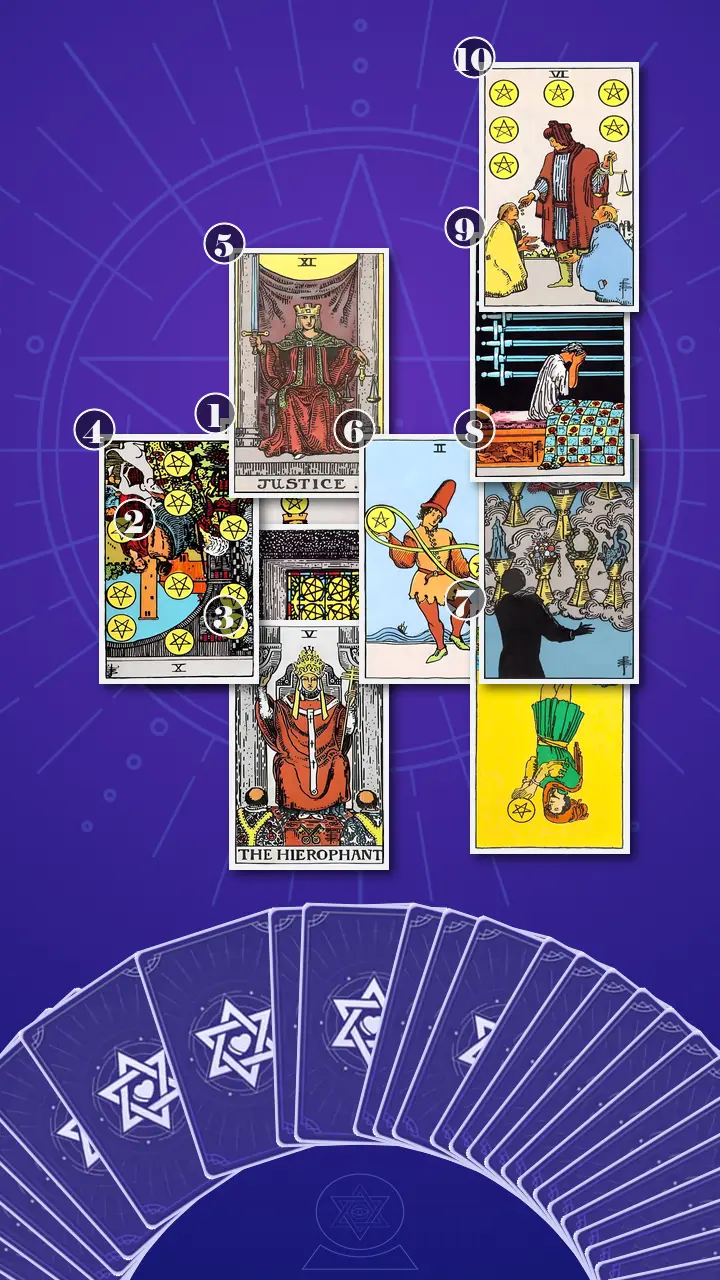
“Here’s the structure,” I said, keeping it simple. “The first card shows what your current money behavior looks like in the moment. The crossing card shows the main friction—the pressure point. The root reveals the inherited belief underneath. And the final outcome shows the most empowering way to rewrite the script into something livable.”
Reading the Map: Card Meanings in Context
Position 1 — The Clamp-Down Reflex in Real Time
I turned over the first card. “Now we open the card representing what your current money behavior looks like in the moment—that immediate tightening response after seeing the notebook.”
Four of Pentacles, upright.
“This is the card of grip,” I said. “And it’s specific.” I tapped the center coin. “It’s 9 PM and you’re not ‘shopping’—you’re policing. You’ve got your bank app, your budget spreadsheet, and a mental rulebook open at the same time. You move tiny amounts between categories so the totals look safe, and you delay clicking buy or replying yes to plans until the numbers feel locked down. Life keeps moving in the background while you grip the coins under your feet.”
In energy terms, the Four of Pentacles is contraction—security-seeking through control. Not inherently “bad.” But here it’s over-tightened. Like gripping the subway pole so hard your hand hurts even after the train has stopped moving.
Jordan gave a short laugh—thin, bitter. “That’s… yeah. That’s exactly me. And it sounds kind of brutal when you say it out loud.”
“Brutal, but not shameful,” I replied. “This card isn’t judging you. It’s showing you the mechanism.”
Position 2 — The Pressure That Makes Control Feel Non-Negotiable
“Now we open the card representing the main friction—how the scarcity script shows up as pressure, restriction, or mental spirals.”
Five of Pentacles, upright.
“A rent notification or a surprise fee hits and your brain instantly jumps to ‘I’m on my own,’” I said. “Even if you have savings, options, or people who would help you troubleshoot, your nervous system treats support as inaccessible—like warmth behind glass. So you tighten rules, cancel plans, and make scarcity your identity in real time.”
This card is blockage—not a lack of resources, but a felt sense of being shut out. It’s the difference between “I have options” and “my body trusts I have options.”
I let the moment land, then zoomed in the way I do as a Jungian psychologist: “Here’s the loop the spread is already naming. Control gives relief fast. It also charges interest in decision fatigue.”
And I did what the Five of Pentacles always asks me to do—freeze-frame it.
“Thumb hovering over ‘transfer.’ Moving $10 from fun to groceries because it looks cleaner. Hovering over a $28 cart total for something you actually want. Telling a friend ‘I’ll confirm’ and then checking RBC/Scotia/TD again before you can say yes. Inner script: If I tighten this one rule, I’ll feel okay.”
Jordan’s eyes flicked down to her hands. She hadn’t noticed she’d been holding her fingers together like a clamp until I described it. She loosened them, then tightened again, like her body didn’t trust the release.
Position 3 — The Inherited Belief Underneath the Anxiety
“Now we open the card representing the inherited core belief underneath the anxiety—the script you absorbed before you had adult choices.”
The Hierophant, upright.
“You’re budgeting with someone else’s doctrine running in the background,” I said gently. “The notebook isn’t just numbers—it’s a ceremonial rulebook: ‘Responsible people do it this way.’ You feel like you have to earn safety by obeying the script, and any deviation triggers guilt or shame like you broke a vow. Money becomes proof of being ‘good,’ not a tool for your actual adult life.”
The Hierophant is structure—but here, the structure is inherited. It’s the parents’ operating system running default settings you never chose.
Jordan swallowed. “I hate that it feels… moral. Like if I can’t explain every dollar, I’m reckless.”
“Exactly,” I said. “This card explains why your spreadsheet doesn’t feel like a tool. It feels like a confessional.”
Position 4 — The Family Imprint That Still Hums in the Background
“Now we open the card representing the family or early imprint that shaped your relationship with budgeting and safety.”
Ten of Pentacles, reversed.
“The family story underneath the notebook feels unstable or conditional,” I said. “Security is something you manage anxiously, not something you can rest inside. When you read the notebook, you don’t just see budgeting—you see the pressure to keep the ‘house’ from cracking. You scan your own life for weak points—‘How many months could I survive?’—as if stability is always one bad month away.”
Reversed, this is foundation-with-a-wobble. Not necessarily financial collapse—often emotional. Like the structure looks fine from the street, but inside, everyone learned to listen for the creak.
Jordan’s face tightened, then softened. “My parents were always… braced. Even when things were okay.”
I nodded. “A notebook like that can be a record of survival—not a prophecy you have to keep reenacting.”
Position 5 — The Standard Your Mind Thinks You “Should” Meet
“Now we open the card representing what your mind says you should do—the ideal rule-set you aim for.”
Justice, upright.
Jordan leaned forward before I even spoke. Something in her recognized the image—scales, sword, a clean stare.
“You’re craving a way to handle money that’s fair, factual, and clean—where a purchase isn’t a character flaw,” I said. “This looks like making one clear decision based on real constraints—rent, bills, income—and your actual values, rather than endlessly tweaking categories to soothe anxiety. Justice is the moment you say: ‘Numbers are data. The shame is extra.’”
Justice is balance when it’s used well. But Justice can also become harsh if you confuse clarity with punishment. Here, though, the energy feels like a doorway: the first real mental space in the reading.
And my mind flashed—just for a second—to my old work on cruise ships: the guest services desk, the forms, the clean lines that made chaos manageable. Fairness isn’t a vibe. It’s a structure. Justice doesn’t ask you to feel perfect. It asks you to see clearly enough to choose.
I offered Jordan a split-screen, exactly as the card demanded. “One side: facts—what’s actually true today. The other side: commentary—the inherited voice narrating what the facts mean about you.”
Her shoulders lowered by maybe half an inch. It was small, but it mattered.
Position 6 — The Near-Future Shift: From Cage to Rhythm
“Now we open the card representing a near-term way the pattern can shift when you try a more flexible practice.”
Two of Pentacles, upright.
“You start practicing budgeting like a rhythm instead of a cage,” I said. “You allow one category to flex. You rebalance once or twice a week—not after every purchase. You notice you can handle small fluctuations without declaring emergency mode. The win isn’t perfect control—it’s staying steady while life moves.”
This card is movement. It’s a controlled wobble, the way you adjust your stance on icy sidewalks. The energy here is balance-through-adaptation—not balance-through-freezing.
And I used one line I’ve seen change people’s entire relationship with “systems”: “You don’t need a perfect system—you need a livable rhythm.”
Jordan exhaled like she’d been waiting for permission to stop optimizing her Notion budget template into a work of art she never actually lived inside.
Position 7 — Your Stance Toward Yourself When Fear Activates
“Now we open the card representing how you relate to yourself when money fear is activated—self-trust versus self-judgment.”
Page of Pentacles, reversed.
“This is the part where you become your own strict teacher,” I said. “You start researching the ‘right’ budgeting method—YNAB, cash stuffing TikTok, a Ramit Sethi ‘money as a system’ video, a Financial Diet checklist—save a bunch of advice, and then freeze before taking one simple step because you don’t want to do it wrong.”
Reversed, this Page is deficiency of beginner-trust. It’s competence anxiety. Not ‘I can’t do money,’ but ‘I’m not allowed to relax until I master money.’
Jordan’s mouth pulled to one side. “I literally have a folder called ‘Money Stuff’ that stresses me out just by existing.”
“That’s the reversal,” I said. “Learning becomes a way to delay living. The antidote isn’t more content. It’s one tiny practice you repeat until your nervous system believes you.”
Position 8 — The External Noise: Comparison and Choice Fog
“Now we open the card representing the external noise around money—comparison, mixed messages, and choices that amplify uncertainty.”
Seven of Cups, upright.
“This is the feed,” I said, and Jordan immediately nodded. “Too many options. Too many philosophies. Someone is #loudbudgeting, someone is doing a no-spend challenge, someone is posting a $65 tasting menu like it’s a Tuesday necessity. It’s not just envy—it’s cognitive overload. Every choice starts to feel like an identity decision.”
The Seven of Cups is excess—too many images, not enough reality-testing. It doesn’t mean you’re shallow. It means you’re trying to choose while standing in a cloud of other people’s highlight reels and advice threads.
Jordan rubbed her forehead. “My group chats turn into ‘wanna do dinner?’ and suddenly it’s a whole itinerary and I’m like… I can’t even predict the tax and tip and Uber home.”
“Exactly,” I said. “External noise makes the Four of Pentacles grip feel justified. If you can’t predict, you clamp down.”
Position 9 — Hopes and Fears: The Night-Watch Spiral
“Now we open the card representing what you secretly hope for and what you’re afraid will be proven true.”
Nine of Swords, upright.
“1:26 AM, phone glow in a dark bedroom,” I said, and Jordan’s eyes widened because it was too exact. “You replay the week’s spending like it’s footage you can re-edit. The room is still, your chest feels tight, and your tongue presses to the back of your teeth. Inner script: ‘What if I missed something? What if I’m the kind of person who doesn’t notice until it’s too late?’ You promise yourself you’ll be stricter tomorrow—and the promise briefly calms you, even though it shrinks your life again.”
This card is blockage in the mind: thought mistaken for truth. It’s not “intuition.” It’s an alarm system going off because the notebook hit an old wire.
Jordan’s voice went small. “I don’t even want luxury. I just want to stop bracing.”
“That hope is real,” I told her. “And it’s not going to be met by stricter rules. It’s going to be met by a different kind of safety.”
When the Six of Pentacles Balanced the Room
I touched the last card before turning it over. “This is the integration card,” I said. “The most empowering way to rewrite the scarcity script into a lived practice.”
The kitchen light outside her memory seemed to buzz louder in the silence between us. Even my room felt quieter, like the air was waiting.
Six of Pentacles, upright.
I spoke slowly, making it modern, making it real. “This is like when you allow money to be a two-way system—accepting help, sharing costs fairly, using resources, and letting budgeting support life rather than shrinking it.”
In energy terms, the Six of Pentacles is balance—but it’s not abstract balance like Justice. It’s embodied balance. It’s the nervous system learning: I can give, I can receive, I can set a boundary, and I don’t have to do adulthood alone to be ‘good.’
Setup: You’re standing under that buzzing kitchen light again, bank app open, spreadsheet tabs multiplying—trying to make your body feel safe by making the numbers behave. You keep reaching for restriction because it works fast, even though the next day your life feels smaller and meaner.
Not ‘hold tighter to feel safe’; choose measured reciprocity and let the scales of the Six of Pentacles teach your nervous system what enough actually feels like.
Jordan went still in a three-step cascade I’ve learned to trust as the moment something true gets through.
First: a physical freeze—her breath caught, fingers hovering above the edge of the chair like she’d been interrupted mid-scroll.
Second: cognitive seep—her gaze unfocused, not blank but replaying; I could almost see Saturday afternoon in Scarborough, the drawer opening, the notebook’s tight handwriting, the old tone sliding into her present like a soundtrack.
Third: emotional release—her shoulders dropped and her jaw unclenched with a tiny click, like a lock finally letting go. She looked irritated for a heartbeat—an unexpected flare. “But if I stop holding tight,” she said, “does that mean I’ve been doing it wrong this whole time?”
I held her eye contact. “It means you’ve been surviving with the tools you were handed. And now you’re ready to upgrade. The notebook taught containment. This card teaches circulation—with discernment.”
This is where I brought in my signature lens—what I call Generational Echo Mapping. “In Venice, if you speak under an archway, the sound returns to you altered,” I said. “Not because you’re wrong—but because the canal amplifies certain frequencies. Your parents’ hardest-season voice is an archway in your psyche. The notebook isn’t the truth. It’s an echo chamber. Our work is to notice when you’re responding to the echo instead of the present water.”
I paused, letting that land like a stone dropped gently into a quiet canal.
“Now,” I asked her, “use this new frame and look back at last week. Was there a moment—an invite, a purchase, a bill notification—where this insight could’ve changed how your body felt? Not what you did. Just how it felt.”
Jordan blinked hard. “There was this group chat,” she said. “They wanted to do dinner. I was already in my head, calculating. I didn’t even ask if we could do something cheaper. I just… disappeared.”
“That’s the before scene,” I said, echoing the card’s imagery. “Kneeling to old rules: obedience, isolation.”
“And the after?” she asked, voice quieter.
“Kneeling as receiving,” I said. “Not begging. Not owing. Just practical support without shame. A clear split bill. A low-key plan. Using a benefit you already have. Letting your life include other people again.”
And I named the transformation out loud, because naming turns fog into a path: “This isn’t just about money. It’s a step from tight, urgent control toward grounded calm—where you can plan responsibly and still let yourself live.”
The One-Page Shift: From Scarcity Script to Actionable Next Steps
I gathered the whole spread into a single story for her—because integration is where tarot becomes practical.
“Here’s what I see,” I said. “The notebook triggers the Four of Pentacles: your body tries to create safety by gripping. The Five of Pentacles crosses it with the belief that you’re on your own and one surprise will end you, so the grip feels non-negotiable. Underneath, The Hierophant reveals why this feels moral: you inherited a doctrine, not just a method. And Ten of Pentacles reversed shows the emotional wobble in the family legacy—security modeled as constant vigilance. Your mind reaches for Justice because you want clean reality. Two of Pentacles offers a rhythm you can actually live. But Page of Pentacles reversed shows how self-judgment stalls you into over-research, and Seven of Cups adds external noise and comparison fog. Then Nine of Swords tells the truth of the cost: nighttime rumination, bracing, a life that gets smaller.”
“And the outcome,” I continued, “is the Six of Pentacles: enoughness learned through fair exchange, not isolation.”
The cognitive blind spot I wanted her to see—without shaming her—was simple: she was treating the budget as proof she was safe, instead of feedback she could update and test. That’s the core shift. A budget is feedback, not a verdict.
“Let’s make this actionable,” I said. “Small. Measurable. Seven-day experiments. Not a personality overhaul.”
- The 7-Minute Justice SplitOnce this week, open Notes and write two columns: Facts (numbers you can verify today—rent, bills, payday, current balance) and Rules I inherited (like “every dollar must be accounted for” or “comfort is suspicious”). Stop at 7 minutes even if it’s unfinished.Set a hard timer. If your chest tightens, do one slow breath and write Facts only for the last minute—no interpretation.
- The Two of Pentacles Range ExperimentFor the next 7 days, choose ONE category to flex on purpose (groceries, social, transit). Give it a range instead of a cap (e.g., $90–$120). Track the range, not every item.Keep it deliberately small so you don’t “optimize” it into a new system. If anxiety spikes, track every two days instead of daily—controlled flexibility, not chaos.
- A Six of Pentacles “Bollard” Boundary + One Receiving MoveThis week, send one simple boundary text to a friend—“I’m doing a low-spend week—can we do a walk/coffee instead?”—and pair it with one receiving move: ask for a low-key suggestion, use a workplace benefit, or put a library hold on something you’d otherwise buy.Think of it like mooring a boat to a dock bollard: one clear tie-off point so you don’t drift into apology or over-explaining. Send it once, no extra justification.

A Week Later: The Quiet Proof
Six days later, Jordan messaged me. Not an essay—just a screenshot and two lines.
It was a Notes app page with the two columns: Facts and Rules I inherited. Under Rules she’d written, “If I can’t explain every dollar, I’m being reckless.” Under Facts she’d written, “Rent is scheduled. Bills are covered. I have options.”
Then: “I texted my friend the walk + coffee thing. I didn’t apologize. We did it. I didn’t check my bank app before I went.”
Her win wasn’t that anxiety vanished. It was that her life expanded by one honest inch. Clear, but still tender: she told me she slept through the night, and in the morning her first thought was still, “What if I’m wrong?”—but this time she noticed her jaw wasn’t clenched when she thought it.
That’s the Journey to Clarity I trust: not certainty. Ownership. A nervous system learning, through lived evidence, that it can loosen without falling apart.
When an old money script gets activated, it can feel like your chest tightens and your whole life has to shrink—just to prove you’re not one surprise away from falling apart.
So if you treated your budget as feedback—not a verdict—what’s one tiny, fair experiment you’d be willing to try for just seven days?