Decision Paralysis After Parent Texts—And How I Chose by Criteria

The Stomach-Drop on Line 1
You get two back-to-back texts—Mom says “play it safe,” Dad says “go bigger”—and your stomach drops because you know your reply will be treated like a decision (hello, decision paralysis).
Alex (name changed for privacy) told me that’s exactly how it happens: 8:47 a.m., Line 1 southbound in Toronto, one hand braced on the pole, the other gripping their phone like it’s a steering wheel. TTC fluorescent lights flicker in that tired way they do, their AirPods hiss between stations, and then the two notifications land like a one-two punch.
Mom: Don’t rush. Be careful.
Dad: This is your chance. Don’t play small.
Alex didn’t describe it as “anxiety.” They described their jaw going so tight it felt bolted, their chest shrinking like a drawstring, and their hands getting that buzzy, restless electricity that makes you want to do something—except the only “something” available is drafting a reply that won’t become evidence later.
“I can’t tell if I’m being careful,” they said, voice low like we were in a library, “or if I’m just stalling.”
I watched them glance at their phone again—even here, in session, even when the screen stayed dark. That’s the thing about family threads: they can live in your body like a second pulse.
“We can work with this,” I told them, keeping my tone warm and plain. “Not by picking a winner between your parents. But by figuring out what fuels the freeze—so you can get back to choosing for yourself, without the cost being your nervous system.”
“That’s all I want,” Alex said. “I want their support… and I also want to stop needing permission.”

Choosing the Compass: The Energy Diagnostic Map (7) · Context Edition
I’m Esmeralda Glen, and I’ve been reading tarot long enough to know that “Should I do X or Y?” is rarely the real question—especially when Mom and Dad are texting like two navigation apps yelling opposite routes at full volume.
I asked Alex to take one slow breath in through the nose and out through the mouth, not as a mystical ritual, but as a clean transition: from reacting to their phone to actually observing what’s happening. While they breathed, I shuffled—slow, deliberate, the way my grandmother taught me back in the Scottish Highlands, where weather is never “background,” it’s information.
For this session, I chose a spread I use when someone is stuck at a career crossroads or in relationship-driven decision fatigue: the Energy Diagnostic Map (7) · Context Edition.
Here’s why it works (and how tarot works in moments like this): a classic “decision spread” can accidentally reinforce the idea that you’re supposed to compare two paths until the universe hands you certainty. But Alex didn’t need more comparison—they had plenty of that in their screenshots, their Notes app, their Reddit rabbit holes. What they needed was a diagnostic lens: what’s happening on the surface, what’s fighting underneath, what pressure is coming from family roles, and what belief turns a simple reply into a threat.
In this map, we read in a path: 1 → 2 → 3 → 4 → 5 → 6 → 7. The center is the bottleneck. The right side becomes the exit route.
I previewed the three positions that tend to change everything for people dealing with conflicting parental advice:
“Card 4 will show the core blockage—the belief that makes this decision feel dangerous. Card 5 will show your usable resource, the skill you can access immediately. And Card 6 is our key transformation: the reframe that returns authority to you.”
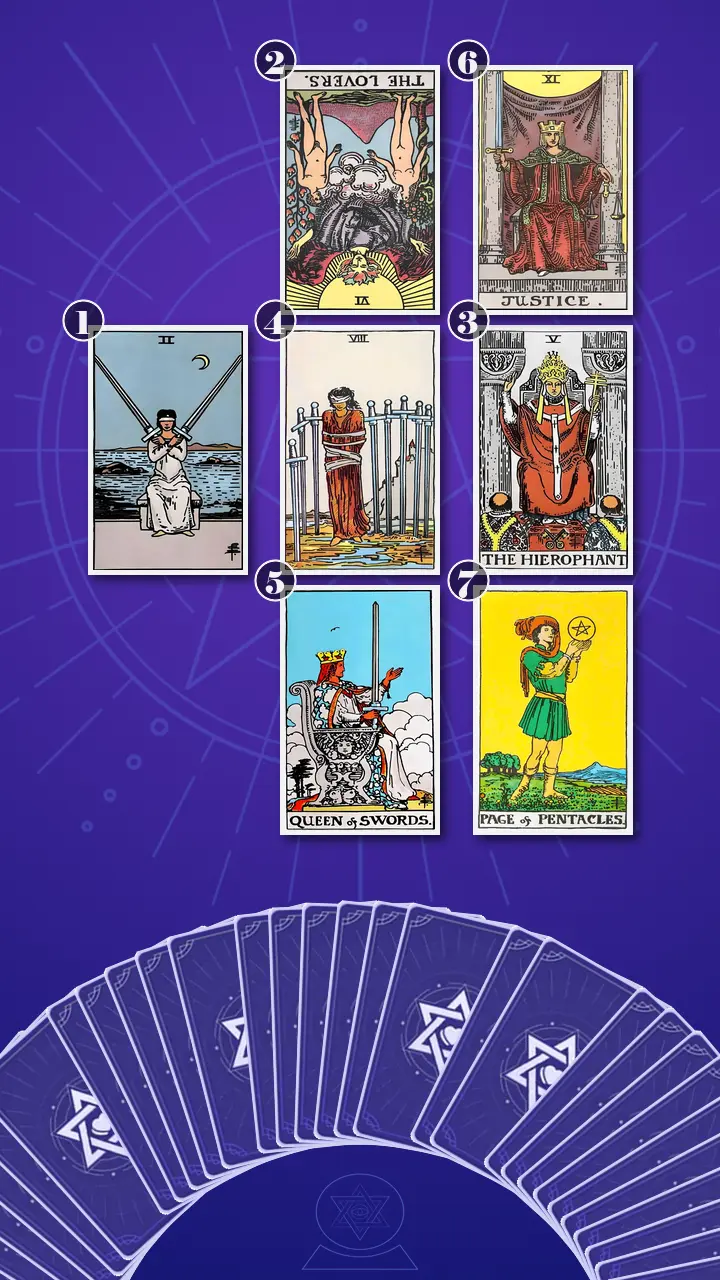
Reading the Map: Freeze, Loyalty, and the Old Rulebook
Position 1 — Surface energy: the visible paralysis behavior
“Now flipped over,” I said, “is the card that represents your surface energy: the immediate feeling-state and the visible paralysis behavior when those opposing texts come in.”
Two of Swords, upright.
The image is simple and brutal: a figure blindfolded, arms crossed, swords held over the chest like a barricade.
“This,” I told Alex, “is the commute moment you described—opening Mom’s message, then Dad’s, then back again like there’s a loophole that lets you reply without choosing. Typing ‘I hear you’ three different ways, deleting each draft, and holding your phone perfectly still while your jaw clenches… calling it ‘thinking it through.’”
In tarot terms, the Two of Swords can look like balance. In real life, it’s often a freeze response disguised as neutrality. The energy here isn’t “bad.” It’s protective. It’s your system saying: If I don’t move, no one can hit me.
Alex let out a small laugh—not happy, not amused. More like someone seeing their own reflection under unforgiving bathroom lighting.
“That’s… insanely accurate,” they said. Then, quieter: “It’s almost mean.”
“It’s not mean,” I replied. “It’s honest. And honesty gives us traction.”
Position 2 — Inner tug-of-war: values vs loyalty
“Now we’re looking at the card for your inner tug-of-war,” I said. “The internalized conflict between needs, values, and relationship loyalty that keeps the choice stuck.”
The Lovers, reversed.
“Reversed here,” I said, “it doesn’t mean love is broken. It means the choice has been hijacked. The decision is getting framed as: Which parent’s worldview am I endorsing? instead of: What fits my life?”
I watched Alex’s eyes go slightly unfocused, like they were replaying a message thread in their head. That’s a very specific kind of pain—the kind where you realize you can argue Mom’s side better than Mom can, and Dad’s side better than Dad can… but when you try to write what you want, your mind goes blank.
“The reversal also points to that detail you mentioned,” I added gently. “Your preference shifts depending on who texted last. Like your inner cursor jumps to the last voice in the chat.”
Alex nodded hard, once. “Yes. It’s like… if I choose X, I’m saying Y about myself. Responsible. Reckless. Ambitious. Ungrateful. Whatever.”
“Exactly,” I said. “That’s loyalty-based choice, not values-based choice.”
Position 3 — External pressure: the family-role dynamics
“Now flipped over is the card for external pressure,” I said. “The family-role expectations that amplify urgency, guilt, and the need to justify yourself.”
The Hierophant, upright.
The Hierophant always looks official. Ceremony. Rules. The feeling of being graded.
“This is where the decision stops being about logistics,” I said, “and starts feeling like a final exam called ‘Adulthood.’ Safe equals responsible. Bold equals successful. And suddenly you’re not choosing—you’re trying to submit the right answer.”
Here’s where my own background always hums in: I’m the seventh-generation matriarch of a healing family. In my home, we learned to read patterns the way you read weather. When I look at the Hierophant, I don’t just see authority—I see inherited scripts.
“Sometimes,” I told Alex, “parents don’t realize they’re texting from roles they inherited too. Your mom’s ‘be careful’ might be a whole lineage of risk management. Your dad’s ‘go bigger’ might be a whole lineage of proving you can survive the climb.”
Alex’s mouth tightened, then softened. “So it’s not… just me being dramatic.”
“Not dramatic,” I said. “Conditioned.”
Position 4 — Core blockage: the belief-trap
“Now we’re at the center,” I said, and I slowed my voice without meaning to. “This card represents the core blockage: the belief that locks the system and turns the decision into a threat.”
Eight of Swords, upright.
Blindfolded again. Bound again. Swords forming a cage—but the bindings are loose, and there’s space to step through if you can risk moving.
“In modern life,” I said, “this is like being trapped in a group chat where every message is screenshotable ‘receipt.’ So you freeze to avoid giving anyone ammo.”
I let the contrast land: “If I answer, I’m locked in. If I don’t, I’m safe—just for today.”
That’s the trap. Safety-now versus freedom-later.
Alex’s reaction came in a three-part wave I’ve seen a hundred times: their breath paused; their eyes dropped to the table like the card had gotten heavier; then their shoulders lowered a fraction, as if they’d been holding up a backpack they forgot they were wearing.
“Oh,” they whispered. Not a dramatic oh. A quiet one. The kind that means the card hit the exact bruise.
“Your system has learned something very logical,” I said. “It’s learned that silence postpones consequences. But it also postpones your life.”
Position 5 — Usable resource: your boundary voice
“Now we look for your usable resource,” I said. “The boundary, skill, or mindset you can access immediately to reduce the noise.”
Queen of Swords, upright.
Clear sky. Steady gaze. One sword raised—decisive, but not frantic.
“This is the part of you that can send a clean update,” I said, “without turning it into a legal brief.”
Then I did what I often do with this card: I wrote a ‘clean text’ demo out loud, in the reader’s voice, the way you’d actually type it with your thumb:
“I’m leaning toward X and I’m deciding by Thursday. I’d love encouragement more than debate right now.”
I watched relief move across Alex’s face like weather. Not a full clearing—more like a break in the clouds.
“That’s… so much shorter than what I write,” they said.
“Because you’ve been texting like you’re on Succession,” I said, “where every sentence becomes a power move that gets brought up later. But here’s the Queen of Swords truth: An update isn’t a courtroom brief.”
Alex actually smiled at that. And for the first time in the session, they sat back in their chair instead of leaning forward like they were bracing for impact.
When Justice Spoke: Scales, Sword, and Adult Agency
Position 6 — Key transformation: the reframe that restores agency
I let the room go quiet for a beat before flipping the next card. Even over video, you can feel when the air changes—like a pause between songs.
“Now flipped over,” I said, “is the card for your key transformation: the reframe that restores agency and turns the choice into something you can own.”
Justice, upright.
Scales in one hand. Sword in the other. Not endless weighing—weighing that leads somewhere.
Setup: Alex had been holding their phone on the TTC, re-reading Mom’s safety text and Dad’s growth text. Each reread made their stomach drop again, because any reply felt like “picking a side.” Their mind kept bargaining: one more opinion, one more data point, one more Reddit thread—anything to avoid a verdict.
Delivery:
Stop trying to be the compromise between two texts; become your own judge and let the scales lead to a decision, not to endless weighing.
I didn’t add anything for a moment. I just let the sentence sit between us, the way you let a bell ring out until it finishes.
Reinforcement: Alex’s first reaction wasn’t relief. It was heat. Their eyebrows pulled together; their lips pressed tight; their hand went to their collarbone like they were steadying themselves.
“But if I’m the judge,” they said, voice sharper than before, “doesn’t that mean I’m saying one of them is wrong?”
I nodded. “That’s the exact fear. And it’s why this keeps feeling dangerous.”
Then I watched the shift happen in layers: their breath caught again; their gaze drifted off-camera like their brain was re-running a familiar argument; and then their shoulders dropped, slower this time, like a careful exhale they didn’t quite trust yet. When they spoke again, their voice had a tremor—not panic, more like a muscle being used differently.
“It’s… not about making them agree,” they said. “It’s about being fair to my life.”
“Yes,” I said, and this was where my Nature Empathy Technique clicked into place. “In my family we track seasons. Not because seasons are romantic—because seasons are honest. Winter doesn’t apologize for being winter. Spring doesn’t ask permission. Your mom’s voice carries one season: caution, conserving energy, staying warm. Your dad’s voice carries another: growth, risk, expansion. Justice is the equinox point: the moment you stop trying to fuse two seasons into one day, and you choose what your life actually needs right now.”
“And here’s the generational pattern,” I added, naming it plainly. “You’ve learned that love equals agreement. That belonging equals obedience. Justice breaks that inheritance without breaking the relationship.”
I leaned in a little. “Now, with this new perspective: can you think of one moment last week—on your commute, at 11 p.m. in your kitchen—where you were about to spiral, and this would have changed your body even 5%?”
Alex swallowed. Their eyes went glossy, not quite tears, more like the nervous system thawing.
“Sunday,” they said. “I was doing laundry, rehearsing what I’d say, like I was about to defend myself in court. If I’d thought ‘fair to my life’… I would’ve stopped trying to write the perfect case.”
And that’s the pivot: not from confusion to certainty, but from confusion to authority. From outsourcing the steering wheel to holding it.
Position 7 — Next-step grounding: one small commitment
“Now flipped over is your next-step grounding,” I said. “One concrete action that moves you forward without requiring a perfect outcome guarantee.”
Page of Pentacles, upright.
After all that air—texts, arguments, rules, mental cages—this card is earth. Two hands around one coin. One thing you can do.
“This is the antidote to the 42-browser-tabs feeling,” I said. “Not a perfect lifelong plan. A small experiment you can actually complete in seven days.”
Alex nodded, slow. “One small step beats ten perfect drafts,” they said, almost testing the words.
“Exactly,” I replied. “And every small step is evidence you can trust.”
From Insight to Action: The Scales-Then-Sword Reset
I pulled the whole map together for Alex in one clean story, because integration is where tarot becomes actionable advice, not just a meaningful moment.
“Here’s what the cards are saying,” I told them. “On the surface, you freeze and call it neutrality (Two of Swords). Underneath, the choice gets framed as loyalty and approval, not your values (Lovers reversed). External pressure adds an invisible grading rubric—‘the right way’ to be an adult (Hierophant). That pressure tightens into a belief-cage: ‘I can’t decide until I can guarantee I won’t be criticized’ (Eight of Swords). Your way out is boundary-language that informs rather than litigates (Queen of Swords). And the transformation is Justice: criteria, trade-offs, and adult ownership—agreement not required.”
The cognitive blind spot, I named gently: “You’ve been trying to resolve your parents’ disagreement. But that’s not your job. Your job is to choose what’s fair to your actual life—and to communicate like an adult, not like a defendant.”
Then I gave Alex a short plan. Not a manifesto. Not a new Notion template. Just next steps.
- The 10-minute “Scales then Sword” resetOpen Notes. Write exactly 3 criteria that are true in your life for the next 6 months (ex: cash flow, energy bandwidth, learning curve). Under them, write one sentence: “Based on these, my next step is ____.”If your chest tightens, do three slow breaths and stop at the draft stage. You’re allowed to come back later—this is momentum, not perfection.
- The two-sentence “Queen of Swords” text (draft first)Draft (don’t send yet): Sentence 1 = your update and timeline (“I’m deciding by Thursday and I’m leaning X.”). Sentence 2 = what support you want (“Encouragement would help more than risk analysis right now.”). No “because…” paragraphs.If your brain says “Two sentences is rude,” remind yourself: An update isn’t a courtroom brief. Respect doesn’t require giving equal voting power.
- A 3-minute family energy check (with your houseplant)Before you open the thread again, look at one plant in your space. Ask: “Am I overwatering (over-explaining), underwatering (avoiding), or giving steady light (clear boundary)?” Then take one tiny care action—wipe a leaf, rotate it, water if needed—before you touch the message thread.It sounds simple because it is. The point is to teach your body: “I can care for something without panicking.” That steadiness transfers to your texting.
I also offered a small, non-dramatic boundary line for when the thread heats up: “I hear you. I’m taking your input seriously, and I’m going to make the call based on what fits my life. I’ll update you by Friday.”
“Disagreement isn’t danger,” I reminded them. “It’s just information you don’t control.”

A Week Later: Ownership, Not Certainty
Eight days after our session, I got a message from Alex.
It was a screenshot—of course it was—but this time it wasn’t a screenshot of their parents’ competing advice. It was their own two-sentence text, sent. Clean. Adult. No courtroom energy.
They wrote: “I did it. My mom asked one follow-up question. My dad sent a thumbs-up and then a paragraph. I didn’t spiral. I went for a walk after.”
The bittersweet part came in the next line: “I still woke up the next morning thinking, ‘What if I’m wrong?’ But I made coffee, read my criteria again, and it didn’t crush me.”
That’s what I mean when I say clarity isn’t a lightning bolt. It’s often a quiet proof: your jaw unclenches a little sooner; your hands stop buzzing a little faster; you choose one step and let that step teach you who you are.
When two opposite texts hit your screen and your chest tightens, it’s not that you’re incapable—it’s that you’ve been trying to choose in a way that guarantees you’ll never be questioned, as if disagreement would mean you don’t deserve to steer your own life.
If you didn’t need your next step to make anyone else agree, what would feel like the fairest, smallest commitment to your actual life this week?