From Self-Monitoring to Quiet Self-Respect: A One-Sentence Reunion RSVP

Finding Clarity on the 8:52 Victoria Line Scroll
You’ve re-opened the reunion invite three times on your commute and still haven’t replied—because you’re stuck in people-pleasing decision paralysis and waiting for social proof to make it “safe.”
Taylor (name changed for privacy) told me that sentence like it had been following them down the escalator. They were 27, a junior UX designer in London, and their phone had become a little slot machine: pull to refresh the attendee list, flick to Instagram Stories, glance at WhatsApp, back to the email. The carriage was too warm. The fluorescent lights turned everyone’s faces slightly grey. The screen in their palm was the only warm thing, and it made the whole decision feel weirdly intimate—like the invite was reading them back.
“If I just know who’s going,” they said, jaw working like they were chewing through a thought, “then I’ll know what to do.”
I watched their hands while they spoke—restless, fast, hovering. Every time the reunion subject came up, their chest tightened as if the RSVP had teeth. Their anxiety wasn’t abstract. It was a tight jaw, a shallow breath, and that small adrenaline spike you get when your name shows up on a screen and your body assumes it’s about to be graded.
Underneath the logistics was the real tug-of-war: wanting to choose based on what they actually wanted vs fearing that their choice would change how others valued them.
“I don’t even know if I want to go,” Taylor admitted, voice dropping, “or if I just want to not look weird.”
I leaned in—warm, practical, no theatrics. “Okay,” I said. “Let’s treat this like a Journey to Clarity. Not ‘Will the reunion be good?’—but what old approval pattern is steering your yes/no, and what would it look like to choose from the present, not from the old room in your head.”

Choosing the Compass: How the Horseshoe Spread Maps a Pattern
I asked Taylor to take one slow breath—not as a ritual, just as a nervous-system handbrake—and to hold the question in a single line: “What’s actually driving this RSVP?” While I shuffled, I kept my tone grounded. Tarot works best, in my experience, when we use it as a structured mirror: it gives the mind something concrete to look at, so it stops spinning in vague threat.
“We’ll use a Horseshoe Spread today,” I told them. “It’s a seven-card arc—past conditioning to present tension, then hidden influence, obstacle, external pull, advice, and finally integration.”
For a question like Taylor’s, this spread is ideal because it doesn’t pretend the dilemma is just a pros-and-cons list. It makes room for the hidden rulebook—the subconscious “shoulds” that steer you before you even realise you’ve been steered. It also forces a landing: advice and integration, so we don’t leave you with more analysis and no next step.
“Card 2 will show the exact stuck posture you’re in,” I added, “Card 3 will reveal what’s quietly running underneath it, and Card 6 will give you the cleanest way to respond—yes with limits, or a calm no.”
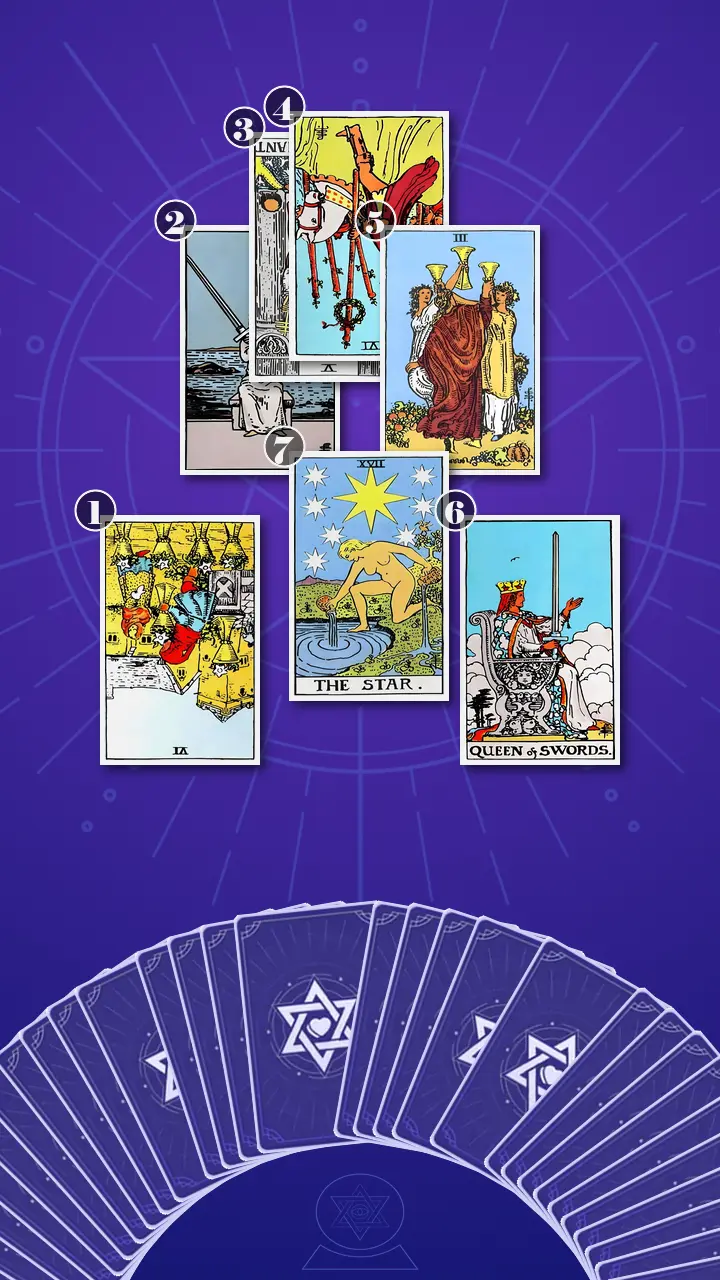
Reading the Arc: Card Meanings in Context (and in Your Inbox)
Position 1 — Past conditioning: the old approval pattern and social role you learned to play
“Now we’re turning over the card that represents your past conditioning: the old approval pattern and the social role you learned to play around this group.”
Six of Cups, reversed.
I tapped the image lightly. “This is like when you open the reunion invite and suddenly you’re not 27 in London—you’re back in an old courtyard version of yourself, trying to be the easy, agreeable one. You start shaping your RSVP to match a memory of how you used to be seen, rather than your current capacity. The past isn’t just a vibe here; it’s a script trying to drive your thumbs.”
Reversed, the Six of Cups often shows nostalgia pulling you backwards—not as sweetness, but as a role you slip into automatically. The energy isn’t balanced Water; it’s Water that’s been rerouted into old approval habits.
Taylor let out a short laugh that carried a little bitterness. “That’s… brutal,” they said. “Like, it’s true, but it’s almost rude how true.”
“It’s specific,” I agreed gently. “Not rude. And it’s useful.”
Position 2 — Present tension: what your RSVP dilemma looks like in real time
“Now we’re turning over the card that represents your present tension: what the stuck moment looks like on your screen and in your body.”
Two of Swords, upright.
“Your email is open, then minimised, then open again,” I said. “You keep switching apps—attendee list, Instagram, WhatsApp—like one more piece of information will finally make the decision safe. You’re not neutral; you’re braced. Not replying feels like control, but it’s really a pause button you can’t stop pressing.”
This is Air energy in blockage: thinking as protection. The blindfold isn’t ignorance—it’s the move of ‘I can’t decide until I can guarantee how it will feel.’ The crossed swords aren’t strength; they’re guardrails over the heart.
And this is where I name it cleanly, because people need a line they can hold: “Social proof isn’t the same thing as self-truth.”
Taylor’s shoulders dropped a millimetre—barely, but I saw it. Their mouth pressed into a line, then loosened. It wasn’t relief yet. It was recognition: a quiet, uncomfortable nod that said, Yeah. That’s exactly the loop.
Position 3 — Hidden influence: the internalised rules about belonging steering your yes/no
“Now we’re turning over the card that represents the hidden influence: the internalised rules about belonging that quietly steer your RSVP.”
The Hierophant, reversed.
“The invite triggers an invisible checklist,” I said, keeping it practical: “be successful, be friendly, don’t be awkward, don’t seem bitter, don’t seem lonely. You start hunting for the socially ‘correct’ RSVP, as if the reunion is an institution that can stamp you approved or rejected.”
This is the ‘rulebook’ card, flipped. The energy here isn’t healthy tradition; it’s a borrowed authority—a set of community guidelines no one posted, but you’re moderating yourself as if you’ll be banned from belonging.
I asked, “If you list three ‘should’ thoughts you’ve had about this reunion—are they group rules or your rules?”
Taylor stared at the card and went very still. Then: “Wait—yeah. They’re… not mine.” Their fingers, which had been picking at a sleeve seam, paused.
Position 4 — Main obstacle: the approval-seeking fear that inflates the stakes
“Now we’re turning over the card that represents the main obstacle: the specific approval fear that makes this choice feel high-stakes.”
Six of Wands, reversed.
“You’re not asking ‘Do I want to go?’” I said. “You’re asking, ‘Will I look like I’m winning if I go?’ You consider the outfit, the story you’ll tell about work, the vibe you’ll project—before you even RSVP. And if you can’t find a ‘win’ to carry into the room, your body pushes you toward decline just to avoid being perceived as less-than.”
This is Fire energy, but distorted—recognition as a condition, not a bonus. It’s a deficiency of internal validation, and an excess of imagined audience.
“It’s like a live LinkedIn annual review,” Taylor said, and winced as they said it—like they’d just admitted something they wished wasn’t true.
“Exactly,” I replied. “And here’s a line to keep close: Connection is real. Applause is optional. The card is showing you where the pressure sneaks in: you’re turning a potential catch-up into a status pitch.”
Position 5 — External pull: social pressure, group energy, and what’s genuinely inviting
“Now we’re turning over the card that represents the external pull: the group energy, the pressure, and the genuine invitation inside it.”
Three of Cups, upright.
“A friend messages, genuinely excited. You remember a couple of people you’d actually like to see—real warmth, real laughter potential,” I said. “The pull isn’t all people-pleasing; some of it is legitimate connection. But the group energy also amplifies the pressure, like your RSVP is a vote on whether you still belong.”
This is Water in balance—a reminder that not every room is a competition. It’s important because it stops the story from becoming ‘going is bad’ or ‘social things are unsafe.’ The card says: there is real relational nutrient here. You just don’t have to pay for it with your self-respect.
When the Queen of Swords Cut the Noise: One Sentence That Doesn’t Beg
When I reached for the sixth card, the room seemed to go quieter—not dramatic, just that natural hush that arrives when the mind senses something true is about to be named.
“Now we’re turning over the card that represents advice: the healthiest boundary-based way to RSVP.”
Queen of Swords, upright.
“This is you stopping the negotiation with your inbox,” I said. “One sentence that’s true and kind. Either: ‘Thanks for inviting me—I can’t make it.’ Or: ‘Yes—can do 7–8pm, then I’m heading off.’ No life-update pitch. No defence brief. Clarity over performance.”
As a Jungian psychologist, I’m always listening for the moment a pattern tries to masquerade as logic. And because I used to train intuition for travellers on international cruises—where we made decisions with weather, schedules, and human limits in real time—I have a way I like to diagnose choices. I call it my Choice X-Ray.
“Let’s X-ray this RSVP,” I told Taylor. “Not ‘What looks correct?’ but hidden costs and benefits. The hidden cost of a yes-for-approval is exhaustion and resentment. The hidden cost of a no-for-image is isolation and rumination. The hidden benefit of a truth-based sentence—either way—is dignity. Your nervous system relaxes because it finally knows where the boundary is.”
Setup: Taylor was still stuck in that Tube moment—invite open, attendee list half-loaded, Instagram already in the other hand—trying to predict the whole night before choosing yes or no. Their mind wanted a guarantee: that they wouldn’t feel exposed, that they’d be perceived correctly, that they could control the narrative.
Delivery:
Stop treating the RSVP like a popularity vote—raise a clear sword of truth, choose one sentence, and let the boundary do the work.
I let the sentence hang there for a beat, the way you pause after a clean edit, so the meaning can land.
Reinforcement: Taylor’s reaction came in a sequence I’ve learned to trust—the body tells the truth before the mouth can package it. First, a micro-freeze: their breath caught, and their hands stopped moving as if someone had finally taken the phone out of the loop. Then the cognitive seep-in: their gaze went slightly unfocused, like they were replaying every draft they’d written—paragraphs of apology padding, achievements smuggled in, the anxious little justifications. And then the release: a long exhale that sounded almost like a laugh, their shoulders dropping, their jaw unclenching in a way that changed the whole shape of their face.
But it wasn’t only relief. There was a flicker of defensiveness too—new clarity can feel like stepping into cold air. “But if I send one sentence,” Taylor said, voice tight again for a moment, “won’t they think I’m rude?”
“That,” I said softly, “is the old rulebook trying to keep its job.” I nodded at the Queen. “You’re allowed to be polite without being porous.”
I leaned forward. “Now, use this new perspective and recall: last week, was there a moment—opening the invite, seeing a classmate’s glow-up post, getting a ‘Are you coming?’ ping—where this one-sentence truth would have changed how your body felt?”
Taylor blinked, swallowed, and nodded once. “Thursday,” they said. “Outside Pret. I saw someone’s promotion post and I immediately started… building a case. Like I needed evidence to exist.” Their eyes went a little shiny, not in a dramatic way—more like a contact lens you suddenly notice.
“That’s the shift,” I told them. “From approval-driven RSVP paralysis and social-proof checking to body-and-calendar-based clarity with compassion. Not ‘confidence’ as a performance—clarity as self-respect.”
Position 7 — Integration: what it feels like when you choose from self-approval
“Now we’re turning over the card that represents integration: what comes after you hit send, and what helps you close the loop.”
The Star, upright.
“After you RSVP, you don’t keep refreshing for reactions,” I said. “You do something small and grounding—shower, walk, one song—so your body registers that nothing catastrophic happened. The reunion stops being a verdict, and becomes what it always was: optional information.”
This is the energy of healing after visibility triggers. Not armour. Not winning. Just an unforced baseline returning. The Star is Water restored to gentle flow—softening the Queen’s clean boundary into self-compassion.
Taylor’s chest rose a little deeper on the next breath. Their shoulders eased back into the chair as if they’d been holding themselves forward for days.
One Sentence. Send. Close the Loop: Actionable Next Steps for RSVP Anxiety
I brought the whole arc together for them, like threading beads into one string. “Here’s the story these cards told,” I said. “The past (Six of Cups reversed) pulls you into an old likeable role. The present (Two of Swords) tries to stay safe by not committing. Underneath, the hidden rulebook (Hierophant reversed) says you must be acceptable to belong. The obstacle (Six of Wands reversed) turns the reunion into a stage—like you need a victory wreath to show up. And yet, the external pull (Three of Cups) shows something real: connection. The way through is the Queen of Swords: one clean truth. And the landing is the Star: closure, self-trust, a nervous system that gets an ‘end’ signal.”
“Your blind spot,” I added, “is thinking the attendee list will give you safety. It won’t. It only delays the moment you have to choose from your own data. The transformation direction is simple, but not easy: from ‘What will they think of my choice?’ to ‘What do my body and my calendar say is true this week?’”
Then I gave Taylor a plan that didn’t require a personality transplant—just a small, clean experiment. I also borrowed my own navigation language from life at sea: on a cruise, you don’t ‘commit to the whole ocean’ in one thought. You decide where to dock, for how long, with what boundaries. I call it my Port Decision Model.
- The Two-Line Check (My body says / My calendar says)Open Notes and write two lines: “My body says…” and “My calendar says…”. Add one specific data point to each (e.g., “jaw tight when I imagine going,” “back-to-back this week; Sunday is recovery”).If you feel yourself trying to make it profound, keep it blunt. One fact each is enough.
- Choice X-Ray Drafts: Yes-with-limits vs Clean NoWrite two one-sentence RSVPs: (A) “Yes—can do 7–8pm, then I’m heading off.” (B) “Thanks for inviting me—I can’t make it this time. Hope it’s a great night.” Read both out loud and notice which one loosens your chest by even 5%.You can be polite without being porous. Put extra explanation in Notes (private), not in the RSVP (public).
- Send + Closure Cue (Phone face-down rule)Pick the true sentence, send it, then put your phone face-down and turn on Do Not Disturb for 10 minutes. Do one finite grounding loop: a quick shower, a short walk round the block, or one song you know by heart.This isn’t forcing calm. It’s giving your nervous system an “end” signal so you stop reopening the decision like a tab.

A Week Later: Ownership, Not Certainty
A week later, Taylor messaged me a screenshot: one clean sentence sent, and beneath it, their calendar with a tiny appointment labelled “Leave at 8.” They’d chosen a yes-with-limits. Not because the attendee list looked safe—because their body and their week did.
They added, “I still woke up and thought, What if I’m wrong? But I didn’t spiral. I made tea, put the phone face-down, and… it passed.”
That’s what I love about this work: clarity doesn’t always arrive as fireworks. Sometimes it arrives as a jaw unclenching, a calendar boundary, and a screen that finally stops asking you to audition.
When an RSVP starts feeling like a verdict, it’s usually because you’re not choosing an event—you’re trying to choose the version of you that won’t get quietly downgraded in someone else’s head.
If you trusted your body and your calendar more than the group chat for just one decision this week, what would your clean, one-sentence truth sound like?