From Guilt-Test Decluttering to Self-Trust: Packing Up a Past Life

The 8:47 p.m. Donation Bag That Stays Flat
Jordan showed up on my screen with that specific, weirdly grown-up feeling of being back in your childhood room in Toronto—like you’ve time-traveled, but only your nervous system got the memo.
“I keep telling myself it’s just a room,” they said, voice steady in a way that didn’t match their eyes. “But it feels like a whole personality I haven’t closed out.”
They described the scene like a timestamped panic: 8:47 PM on a Tuesday, cross‑legged on carpet that still held a faint old-detergent smell, overhead light buzzing like it had opinions, phone warm in their hand. They’d taken yet another “just in case” photo of a notebook, and the donation bag—still perfectly flat—sat there like an accusation.
Downstairs, someone had called them by an old nickname, casual and affectionate, and Jordan’s throat had gone tight anyway. Not dramatic-tight. Mechanical-tight. Like a seatbelt locking.
“I want to clear it decisively,” they told me. “But then I pick something up and my brain… fuzzes. I start cataloging it like evidence. I’m waiting for the moment where it feels obviously okay to let it go.”
I could hear the core contradiction in every sentence: Jordan wanted closure and adult autonomy, but their body was bracing like letting go might cost belonging—or earn a label like ungrateful.
Overwhelm, to me, often has a sound. With Jordan it felt like a low, constant hum under the ribs—guilt as a background app they couldn’t fully close, nostalgia and irritation flickering in and out like notifications.
“That freeze makes so much sense,” I said softly. “We’re not going to force a purge. We’re going to map the pattern you’re replaying—so you can choose your next move with actual clarity.”

Choosing the Compass: Celtic Cross · Context Edition
I asked Jordan to take two slow breaths—not as a mystical thing, just a nervous-system reset—and to hold the question exactly as they’d said it: Clearing my childhood room, what family pattern am I replaying now?
As I shuffled, I listened the way I’ve learned to listen over ten years of radio and music-therapy work: not just to words, but to pacing, pauses, the places the voice tightens. In my world, “energy” isn’t smoke and mirrors; it’s pattern. Rhythm. Repetition. Where you accelerate, where you stall.
“I’m going to use a spread called Celtic Cross · Context Edition,” I explained. “It’s based on the classic Celtic Cross, but tuned for questions like yours—where the present stuckness is real, and the roots run back into family conditioning.”
For readers who’ve googled how tarot works at 1 a.m.: this spread is useful because it doesn’t turn your life into a yes/no fortune. It traces a chain—present experience, immediate challenge, unconscious imprint, conscious aim, and then the most workable near-future path. And in this version, position 9 gets extra sharp: it asks what it costs (or seems to cost) to break a family script.
“A few positions I want you to keep in mind as we go,” I told Jordan. “The first card shows what the room is doing to you in real time. Position 3 is the family imprint underneath. Position 5 is your conscious aim—what you think you’re trying to accomplish. And position 9 is the hotspot: hopes and fears about being judged as you change the pattern.”
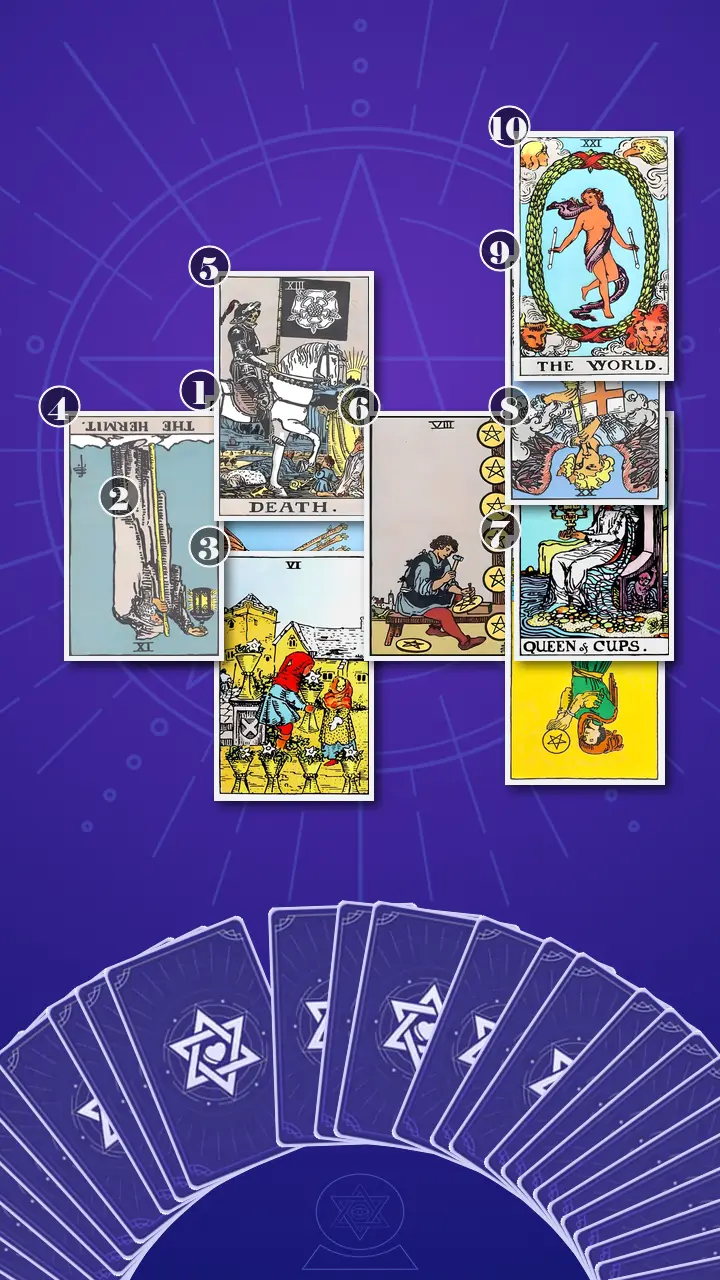
Reading the Map: When Decluttering Turns Into Decision Fatigue
Position 1 — Present situation: the stuck point in real time
“Now flipping over is the card that represents your present situation—how the room-clearing task is functioning as a psychological stuck point,” I said.
Two of Swords, upright.
“This is the moment you described perfectly,” I told them, “where you’re holding an old notebook at chest height like it’s fragile evidence, and your brain goes fuzzy on purpose.”
In modern life terms: this is the camera roll full, donation bag empty loop. It’s not laziness. It’s protection. The Two of Swords is emotional self-defense disguised as neutrality—if I don’t choose, I won’t have to feel what the choice brings up.
“Your body is trying not to have a feeling,” I said. “The tight throat is the tell. The crossed swords across the chest? That’s literally ‘don’t let it in.’”
I watched Jordan’s face do something almost involuntary—an exhale that turned into a small laugh, tense at the edges.
“That’s… mean,” they said, but there was relief in it. “Like, yes. That’s exactly the freeze.”
“It can sound harsh,” I replied, keeping my voice warm. “But here’s the kinder version: not choosing is still a choice—you’re just choosing delay over relief. And you learned that delay works, because it postpones guilt and potential conflict.”
I paused. “When you’re holding an item and you go blank—what feeling are you trying not to have if you choose quickly?”
Position 2 — Immediate challenge: what makes it heavier right now
“Now we’re looking at the immediate challenge—the weight pressing down on the process,” I said.
Ten of Wands, upright.
“This is a room,” I said, “but it’s also a whole invisible checklist.”
I described the image: arms full of awkward, unbalanced weight, the bundle blocking the view. In Jordan’s life, it’s the mental math of: If I finish fast, nobody can comment. If I do it perfectly, nobody can judge. If I keep enough, nobody gets hurt.
Ten of Wands energy is overload—an excess of responsibility, including responsibility you never consciously agreed to. It’s also the “The Bear / yes-chef intensity” applied to a task that doesn’t need to be that intense.
Jordan’s shoulders lifted toward their ears as if they were physically holding those wands. Then they let them drop, just a little.
“I keep making it a two-hour sprint,” they admitted. “And then I’m mad at myself for burning out.”
“That’s the card,” I said. “It’s not that you’re failing at decluttering. You’re trying to carry the practical work and the emotional labor and the performance of being ‘the right kind of child’—all at once.”
Position 3 — Family imprint at the root: the pattern being replayed
“Now we’re going under the surface,” I said. “This card represents the family imprint at the root—the childhood pattern that’s being replayed beneath the sorting.”
Six of Cups, upright.
The second I saw it, I could almost smell what Jordan had described in their earlier text: old paper, marker ink, that dusty sweetness that lives in closed drawers.
“This is nostalgia,” I said, “but not the Instagram version. This is the equation your nervous system learned early: object equals love.”
I kept it concrete. “Like finding a childhood gift that isn’t even your taste—but your stomach drops anyway because it’s carrying a whole family mood: care, effort, a moment you felt safe.”
Jordan swallowed. Their hand went to their chest for a second, like they were checking whether the tightness was still there.
“Yeah,” they said quietly. “If I toss it, it feels like I’m tossing the care.”
“Exactly,” I told them. “And that’s the family pattern: love gets proven through preservation. The room becomes a museum exhibit dedicated to your younger self, and you’re afraid to rearrange it in case you ‘ruin’ the story.”
I let that land, then added the line I use when people are dealing with sentimental decluttering and family dynamics: “You’re not sorting objects. You’re negotiating belonging.”
Position 4 — Recent past: the coping style that set up the stuckness
“Now flipping is the recent past—the emotional stance you’ve been using to cope,” I said.
The Hermit, reversed.
“This is the 11:52 PM version of you,” I said, and I kept my words paced like the card’s loop. “Everyone asleep. Only the desk lamp on. You open one box and—”
“—you scroll Apple Photos ‘On This Day’ with one thumb, you open a decluttering tab, then another, then another… because if you can just find the right method, you won’t have to feel exposed while you decide.”
Reversed Hermit isn’t wise solitude. It’s isolating into a private emotional exam. It turns a simple task into a spiral: start, interrupt, restart. Start, interrupt, restart.
Jordan’s mouth tightened, then softened. “I keep thinking I need to figure it out alone,” they said. “Like I’m embarrassed that I can’t just… do it.”
“That makes sense,” I told them. “But this card is gently calling you out: the alone-time isn’t creating clarity right now. It’s amplifying the inner monologue.”
When Death Held a White Rose
Position 5 — Conscious aim: the closure you actually want
“We’re turning over the card that represents your conscious aim—what you think you’re trying to achieve, and what kind of closure you truly want,” I said.
The room felt quieter on my end, too. Even through a screen, I notice it: the tiny stillness when a Major Arcana card arrives and it names the real thing.
Death, upright.
Jordan’s eyes widened in that immediate, internet-trained way people have when they know just enough tarot to be scared of the word.
“Not literal,” I said quickly, steady and practical. “In tarot, Death is endings and transition. It’s the part of you that wants a clean chapter change instead of a permanent ‘maybe’ pile.”
Setup (the stuck moment): “Here’s what I’m seeing,” I continued, keeping it specific. “You’re on the floor with an old notebook in your hands, phone open to the camera, donation bag still flat. Someone downstairs asks, ‘Are you keeping that?’ and your throat goes tight—like your answer is secretly about love, not paper.”
Jordan nodded once, fast. Then they stopped themselves, as if nodding meant admitting something.
Delivery (the sentence):
Stop treating every object like a verdict on your gratitude, and start practicing clean endings—the white rose of Death says release can be respectful.
I let a small pause hang, the way I do on air when a lyric hits and the silence is part of the medicine.
Reinforcement (the body reaction): Jordan’s breath caught—just a half-second freeze—then their gaze went unfocused, like their brain was replaying a specific scene. Their shoulders, which had been slightly lifted the entire reading, sank. Their mouth opened and closed once before sound came out.
“But… if I let it end,” they said, and their voice changed here—thinner, more honest—“doesn’t that mean I’m saying it didn’t matter?”
It was resistance, and it was real. And it deserved tenderness, not a pep talk.
“No,” I said. “It means you’re changing the way you honor it. Ending isn’t erasing. It’s closing tabs so your system can run what’s current.”
I pointed them back to the card’s image. “Death isn’t a wrecking ball. It’s a rider in black armor holding a banner with a white rose—clean, almost ceremonial. The rising sun behind it? That’s the space you can actually breathe in afterward.”
I leaned into what I do differently as Alison Melody—because for me, family patterns are often audible.
“Can I use one of my tools on this?” I asked. “It’s called Generational Echo. Think of your family as a three-generation playlist. Each generation has a few tracks they replay when they want to feel safe—songs about loyalty, sacrifice, being ‘easy,’ not rocking the boat.”
“When you’re in that room, you’re not just looking at objects,” I said. “You’re hearing the old chorus: Prove you appreciate us. Prove you’re good. Prove you belong. And Death is asking for a remix: Honor the past while choosing what supports your present life.”
Jordan’s eyes went glossy—not fully crying, but close enough that the next blink mattered. They pressed their feet to the floor as if checking gravity.
“Now,” I said gently, “with this new lens—think about last week. Was there a moment where, if you’d believed ‘release can be respectful,’ you would’ve moved differently?”
Jordan stared off to the side, then gave a tiny, almost embarrassed laugh. “The debate club folder,” they said. “I took like fourteen pictures. I kept it. I don’t even want it.”
“That’s the bridge,” I told them. “This isn’t about becoming a person who feels nothing. It’s about becoming a person who can feel something… and still finish one small ending.”
And that’s the shift in plain language: from objects prove I’m a good child to I can honor my past while choosing what supports my present life. From overwhelm and freeze toward self-trust with small completions.
Position 6 — Near future pathway: the next-phase approach that works
“Now we’re looking at the near future pathway—what actually moves this forward,” I said.
Eight of Pentacles, upright.
“This is the workshop mindset,” I told them. “Not a breakthrough, a practice.”
In real life terms, it’s the opposite of the heroic purge. It’s the 30–30 declutter method. It’s one category, one timer, one definition of done. It’s making the process boring on purpose—because boredom is nervous-system safety.
Jordan nodded more slowly this time. “So I don’t have to… solve my childhood,” they said, half-smiling.
“Exactly,” I said. “You just have to do twelve decisions in a row at a good-enough speed and let that be a rep. Like a streak. Duolingo energy, not a personality verdict.”
Position 7 — Self-position: identity and self-trust shaping the decisions
“This next card represents you in the system—your self-talk, your identity posture,” I said.
Page of Pentacles, reversed.
“This is the part of you that wants a fresh practical start,” I explained, “but self-doubt turns simple choices into proof of maturity.”
It’s the IKEA SKUBB temptation. The TikTok/YouTube decluttering rabbit hole. The Notion template for life admin that feels easier than making one irreversible choice.
“Reversed Page energy is preparation as procrastination,” I said. “Learning mode as a hiding place. If you’re forever the Beginner, you never have to risk being imperfect.”
Jordan groaned. “I literally bought new bins last weekend.”
“Of course you did,” I said, and I meant it with kindness. “Buying a system feels safer than ending something.”
Position 8 — Environment: household emotional climate and safety to let go
“Now we’re looking at your environment—the emotional climate in the house,” I said.
Queen of Cups, upright.
“This is a sensitive house,” I told them. “Not necessarily controlling—just emotionally receptive. Like you can feel the temperature shift around a donation bag, even if nobody says a word.”
The Queen’s cup is lidded: feelings are present, but not labeled. That makes you scan for reactions the way you’d scan Slack reactions—one quiet “…” and you rethink everything.
Jordan’s eyebrows lifted. “That’s my mom,” they said. “She doesn’t criticize. She just gets… quiet.”
“And then your system fills in the blanks,” I said. “Because you’d rather over-explain than be misread.”
Position 9 — Hopes/fears: breaking the script and the fear of being judged
“This is the hotspot,” I said. “The card for your hope and your fear about breaking the family script.”
Judgement, reversed.
“Here it is,” I said quietly. “The inner courtroom.”
I described it the way it actually plays: prosecutor voice listing charges—ungrateful, wasteful, dramatic. Defense attorney over-explaining. Exhausted self wanting to leave the room, but staying because the case is “still open.”
Jordan went very still. It was the kind of stillness that isn’t calm; it’s bracing. Then they blinked hard, once.
“I literally rehearse explanations,” they admitted. “Like if someone notices something missing, I have to justify it.”
“That’s Judgement reversed,” I said. “Growth feels like a verdict instead of an invitation.”
And I named the practical pivot: “This is how you stop treating choices like moral proof: stop putting your past on trial. You can choose your present life without prosecuting your younger self.”
Position 10 — Integration direction: completion and wholeness
“Last card,” I said. “This is the integration direction—not a fixed prediction, but what becomes likely if you practice the shift consistently.”
The World, upright.
“This is completion with dignity,” I told them. “Not a shrine. Not a scorched-earth purge. A room that becomes a transition point.”
The World is wholeness—keeping what’s meaningful, releasing what’s over, and recognizing you are not the same person you were in that room. The wreath is a boundary: the cycle ends, on purpose.
Jordan exhaled, longer than before. “I want that,” they said. “I want it to feel done.”
From Courtroom to Workshop: Actionable Advice That Gets Bags Out of the House
I summarized the story the spread had told, because tarot is only useful if it turns into a coherent map.
“Here’s the through-line,” I said. “Two of Swords shows the freeze: you protect yourself from guilt by not choosing. Ten of Wands shows the hidden load: you’re carrying unspoken rules and trying to finish fast so nobody can comment. Six of Cups is the family imprint: love equals preservation, so objects become proof you were loved. Hermit reversed shows the coping style: you isolate and overthink, which turns a practical task into a private exam.”
“Then Death arrives as the bridge: the real goal is a clean ending—release with respect. Eight of Pentacles says the way through is reps, not intensity. Page reversed says you’ll be tempted to stay in ‘prep’ mode. Queen of Cups says the house is emotionally sensitive, so you’ll read the room. Judgement reversed names the cognitive blind spot: you think you’re sorting stuff, but you’re actually bracing for evaluation. And The World is the reward: integration—kept on purpose beats kept out of panic.”
“Your blind spot,” I said plainly, “is that you’re waiting for permission—either from a parent or from the inner judge—to feel ‘allowed’ to let go. But the transformation direction is different: you give yourself permission through small, respectful completions.”
Then I offered next steps—simple, low-barrier, and designed for someone with decision fatigue and a tight chest around sentimental items.
- The One Symbol Item Ending (9 minutes)Choose one object that feels oddly high-stakes (but not the hardest). Take one photo. Write one sentence in your Notes app: “What this represented to me then: ___.” Say (out loud or in your notes) “Thank you for what you represented.” Put it in a donate/trash bag, tie the bag, and move it to the hallway or your car trunk—physically out of the room’s gravity.If your chest tightens or panic spikes, don’t force it. Two slow breaths, feet on the floor, and switch to a lower-sentiment item. Your job is one clean ending, not a perfect emotional state.
- The 30–30 Method (once this week)Do 30 minutes sorting one category (papers, shirts, books), then 30 minutes removing bags/boxes from the house (drop-off, trunk, or by the door for tomorrow). Define “done” before you start: “One bag leaves the house,” or “One drawer is empty.”Make it boring on purpose. Keep your phone face-down during the timer and keep the donation bag visible and open. Consistency beats intensity.
- A One-Sentence Boundary + Soundproof BarrierSay once, kindly: “I’m sorting by what supports my life now, and I’m not looking for approval—just patience.” Then create a small “Soundproof Barrier”: put on headphones with a steady, low-distraction background (brown noise or a 60–80 BPM playlist) while you sort, so you’re less reactive to doorway questions and household mood shifts.If someone comments mid-timer, pause the conversation: “I’m mid-sort; can we talk after?” The goal is less debate, more completion.
I added one more option, because Hermit reversed had been loud: “If you don’t want a family audience, do a 20-minute body-double call with a friend. Keep the camera on the donation bag. You’re practicing decisions while being witnessed—without turning it into a trial.”
And because I’m Alison Melody, I couldn’t resist the smallest dose of sound science: “If you notice your throat tightening when you pick something up, pick a track with a slower pulse and a softer low end. Not to ‘fix’ you—just to cue safety. Your nervous system responds to tempo faster than it responds to logic.”

A Week Later: Kept on Purpose
A week after our session, Jordan texted me a photo—not of a notebook this time, but of a tied bag sitting in the trunk of their car. The message was almost painfully simple: “I did the one symbol item thing. Trophy from middle school debate. Said thank you. Bag left the room.”
Then, a second text: “I felt shaky for like two minutes. Then… weirdly lighter. Still nervous someone will ask. But I didn’t put it back.”
I could picture it: not a montage of total transformation, just a real, bittersweet proof. Clearer space, and a small tremble of vulnerability still present—because change is a process, not a personality switch.
“That’s The World energy starting,” I wrote back. “Kept on purpose. Released on purpose. You’re building self-trust one ending at a time.”
When I think about Jordan’s journey to clarity, I don’t picture a spotless room. I picture that moment Death offered them: the white rose—release as a clean gesture, not a betrayal—and the rising sun behind it, the first inhale of space.
When you’re standing in your childhood room with a tight chest, it can feel like every donation bag is a risk: not just of losing stuff, but of losing your place in the story where you were loved.
If you let one item go this week without putting your past on trial, what kind of space—physical or emotional—might open up for the person you are now?
Every reading at AceTarot is a Journey to connect with inner wisdom and empower next step.
Learn more about our Journey to Clarity.