Packing for a Family Visit Without the Trial Mode: A Good-Enough Shift

The Suitcase on the Floor, the Verdict in Your Chest
You tell yourself it’s “just a weekend,” but the night before a family visit turns into a full-on performance review—suitcase open on the floor, Notes checklist at midnight, and pure family visit anxiety.
Taylor (name changed for privacy) came onto our video call from a small Toronto bedroom that looked like it was lit by one stubborn overhead bulb. The suitcase was already open on the floor beside the bed, half-packed like a project that should’ve been easy—except it wasn’t. Their phone kept lighting up in their hand, warm from constant scrolling. Every time they tugged the zipper, it sounded too loud in the quiet, like the room itself was keeping score.
“I’m not even excited,” they said, then laughed once—short, tired, almost embarrassed. “It’s my family. I love them. It’s a weekend. So why does it feel like a performance review?”
As they spoke, I watched the small tells: shoulders held up near the ears, jaw working like they were chewing something invisible, fingers tapping the suitcase edge and then re-folding the same shirt corner. Anticipatory dread doesn’t always announce itself as panic. Sometimes it feels like being stuck in a narrow hallway with too many doors, trying to choose the perfect one before anyone sees you hesitate.
They were clear about the surface question: packing. The repacking. The “just in case” purchases. The compulsive urge to optimize outfits, toiletries, gifts—until the whole evening disappeared and they arrived tired, irritable, and already braced for commentary.
Underneath it was the real contradiction: wanting to feel relaxed and accepted during the visit, while fearing they’d be judged as not put-together, not prepared, not good enough.
“Let’s make this practical,” I told them, keeping my voice steady and warm. “We’re not here to turn your life into a mystical scavenger hunt. We’re here to find clarity—specifically, what perfectionism script you’re carrying into that suitcase, and what a ‘good-enough’ standard could look like that supports your real needs.”

Choosing the Compass: A Horseshoe Spread for Packing Anxiety
I asked Taylor to put one hand on the suitcase handle and take one slow inhale, then a longer exhale—just enough to shift from “fight the problem” into “look at the pattern.” While they breathed, I shuffled my deck the way I do before every reading at the planetarium in Tokyo—quietly, with the same kind of care I use when I dim the dome lights and let people’s eyes adjust. Not a ritual for luck. A transition for attention.
“For this,” I said, “I’m using a 7-card Horseshoe spread.”
For anyone reading along: the Horseshoe is ideal when a problem is a loop, not a single decision. It tracks a lived arc—past conditioning → present behavior → the hidden driver → the obstacle → the regulating resource → the external trigger → integration. Packing perfectionism before a family visit isn’t really about weather. It’s about relational pressure and old roles. This spread lets us move from roots to regulation to next steps without overcomplicating it.
I laid the seven cards in a gentle horseshoe curve, open side facing up like a cradle—card 1 at the far left, moving clockwise down to card 4 at the hinge, then up the right side to card 7. “We’ll read it like walking a curved path,” I said, “where the horizon changes a little with each step.”
“I like that,” Taylor murmured. “Because right now it feels like I’m walking in circles.”
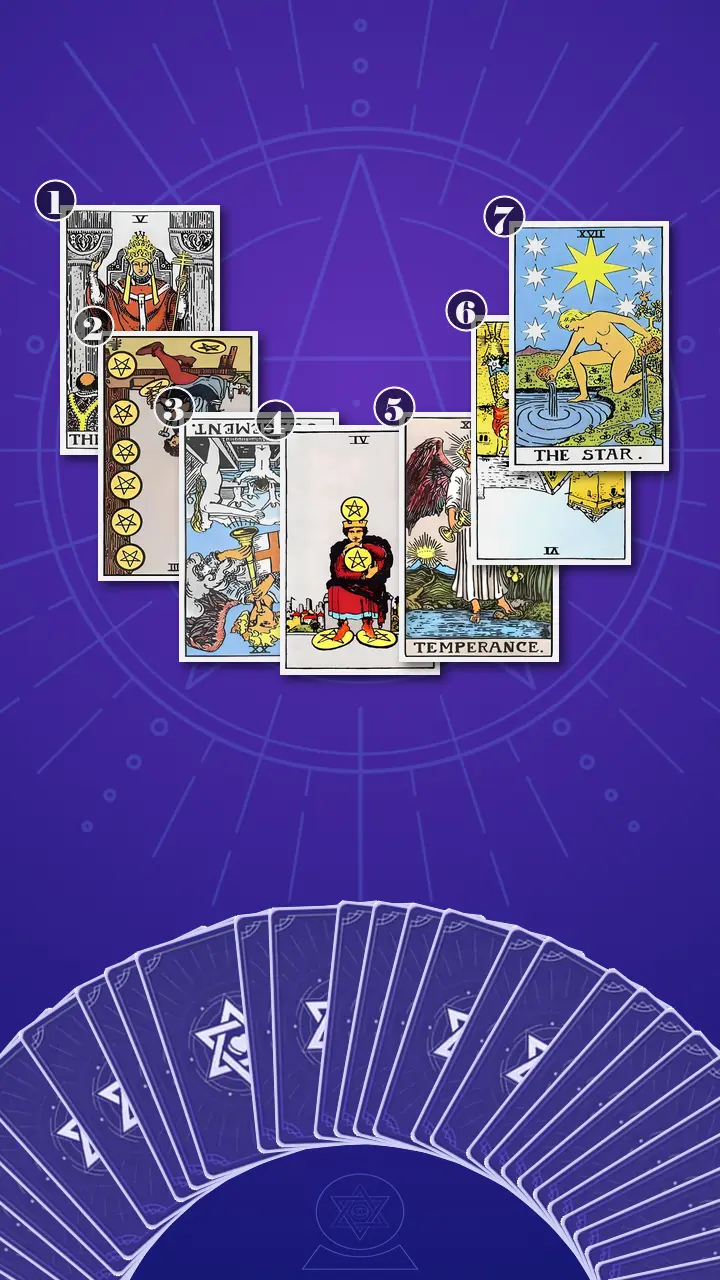
Reading the Arc: The Rulebook, the Loop, the Inner Courtroom
Position 1: Conditioning — The inherited family standard you learned equals ‘acceptable’
“Now we’re opening the card that represents Conditioning: the inherited family standard or ‘should’ that taught you what it means to be acceptable,” I said.
The card was The Hierophant, upright.
“Here’s the lived translation I’m getting,” I told Taylor, and I didn’t soften it because it needed to be seen: “Taylor is standing over the open suitcase like it’s a rubric. They’re not just choosing clothes—they’re choosing signals: the neat sweater that says ‘I’m responsible,’ the ‘adult’ skincare set that says ‘I have it together,’ the perfectly planned outfit that says ‘don’t ask questions.’ Packing becomes compliance with a family standard they didn’t consciously agree to, but their body still treats as law.”
The Hierophant isn’t ‘bad.’ It’s structure. Tradition. The voice that says: do it properly. In this position, it shows how your nervous system learned the access code—pack the right way and you’ll be allowed in without comments.
Energetically, this is Excess—too much authority, too much “should.” It turns a weekend trip into an exam you can’t opt out of.
I asked, “What’s one ‘responsible’ or ‘presentable’ thing you feel you have to prove on this trip—like you’re trying to avoid becoming the topic of a comment?”
Taylor’s mouth twitched. “Wow.” Then, unexpectedly, they let out a small, bitter laugh. “That’s… kind of brutal. I guess… I pack like I’m trying to prove I’m not messy. Like, I’m not a problem.”
“That makes so much sense,” I said. “And it’s not your fault that your body learned that as a survival strategy. But we can update the script.”
Position 2: Present snapshot — The perfectionism behavior showing up in packing right now
“Now we’re opening the card that represents the specific perfectionism behavior showing up in packing right now,” I said.
Eight of Pentacles, reversed.
I nodded once, like seeing a pattern on a star chart I’ve watched return for years. “This is the repacking loop,” I said. “And it has diminishing returns.”
Then I grounded it in the exact modern scenario: “Taylor keeps optimizing the suitcase the way they’d over-edit a work deck: swap one shirt, refold everything, recheck toiletries, rearrange packing cubes, reopen the bag because it doesn’t feel ‘right.’ The weird part is they can feel the diminishing returns—each tweak buys 30 seconds of relief, then the dread comes back louder.”
Reversed here, the Eight of Pentacles is Blockage: effort that doesn’t convert into peace. It’s ‘practice’ turned into compulsive editing.
I used the echo technique that always lands for people who live in Docs and deadlines: “It’s like editing a Google Doc at 1:13 a.m. Each tiny improvement feels responsible. But the document never gets submitted. You tell yourself, ‘If I tweak it one more time, I’ll feel calm’… and then you notice the opposite: ‘Why do I feel less calm?’”
Taylor exhaled sharply—half a sigh, half a laugh. “Why am I editing my suitcase like a work doc?”
“Exactly,” I said. “Progress versus safety. Your brain keeps choosing ‘safety,’ but it’s a false safety.”
Position 3: Hidden driver — The inner critic message fueling over-preparation
“Now we’re opening the card that represents the hidden driver: the fear of evaluation or inner critic message that fuels the over-preparation,” I said.
Judgement, reversed.
The room got quieter in that specific way it does when a truth is about to land. Judgement reversed is not the universe judging you. It’s you living in trial mode—summoned by an imagined trumpet to explain yourself.
I gave Taylor the modern-life scenario, and I watched their eyes drop to the suitcase as if it had been caught doing something: “Before they even leave Toronto, Taylor is already mentally answering questions nobody has asked. They pack extra ‘proof’ items—backup outfits, extra chargers, a small gift—because their nervous system is anticipating a verdict: being seen as messy, unprepared, or behind. The suitcase turns into a defense strategy against a courtroom that might only exist in their head.”
Energetically, this is Deficiency of self-trust and Excess of self-judgment. It’s your brain acting like a constant Slack notification: anticipatory feedback, anticipatory feedback, anticipatory feedback.
“If you wrote the feared comment word-for-word,” I asked, “what would it be—and whose voice does it sound like in your head?”
Taylor’s hand stilled. Their breathing paused for a beat—micro-freeze. Their gaze went slightly unfocused—like their mind was replaying an old scene in the family kitchen. Then their shoulders sank a fraction—release, but not relief yet.
“It’s… ‘How do you always forget something?’” they said quietly. “And it sounds like my aunt. But also… it sounds like me.”
“That’s Judgement reversed,” I said gently. “The inner courtroom. And I want to offer you an adult truth that isn’t motivational, just accurate: forgetting an item is inconvenient—not a verdict.”
Position 4: Main obstacle — The control pattern that keeps you stuck
“Now we’re opening the card that represents the main obstacle: the control pattern that keeps you stuck in repacking and ‘just in case’ decisions,” I said.
Four of Pentacles, upright.
I didn’t even need to reach for metaphor—this card is a body posture: clutching. Holding. Bracing.
“Here’s the real-life version,” I told them: “Taylor adds duplicates they don’t truly need—not because forgetting is catastrophic, but because carrying more feels safer than being caught without something. They feel the tightness in their chest when they consider leaving an item behind, like less stuff equals less protection. The bag gets heavier while the anxiety doesn’t get lighter.”
Energetically, the Four of Pentacles is Excess of control. I mirrored what I’d been observing since the call started: “Notice your hands for a second. Are you gripping your phone tighter while we talk about this?”
Taylor looked down, almost surprised to find their knuckles white around the phone. They loosened their fingers slowly, like they were testing whether anything bad would happen if they let go by 1%.
“Control feels like safety until you notice the price tag: exhaustion,” I said. “Heavier bag versus lighter nervous system. Carrying more versus being safer. Those aren’t the same thing.”
When Temperance Spoke: Balance Beats Proof
Position 5: Regulating resource — The stance that helps you choose ‘good enough’ on purpose
“We’re turning to the hinge of the whole reading now,” I said, letting my voice slow down. “This next card is your regulating resource—the inner stance that helps you choose ‘good enough’ and stay grounded.”
Temperance, upright.
Temperance is the opposite of white-knuckling. It’s the image of a nervous system that can pour without spilling. A steady mix between two cups: logistics and self-compassion, structure and softness.
I offered the exact modern-life scenario: “Taylor chooses one simple standard—45 minutes, one carry-on, essentials only—and then packs with a calmer rhythm. They stop asking ‘Will this prevent judgment?’ and start asking ‘Will this support my body, schedule, and mood?’ They add one comfort item on purpose and prioritize sleep, because arriving regulated matters more than arriving ‘perfect.’”
Energetically, this is Balance. Not perfection—balance.
And this is where my own framework clicked into place. In the planetarium, I teach people that gravity isn’t only force. It’s relationship. It’s what pulls bodies into patterns over time. When I read family dynamics, I often use what I call Galactic Gravity Analysis: we look at who has been acting like the “largest body” in the system—whose standards create the strongest pull—and how you’ve been orbiting that pull without realizing it.
“Taylor,” I said, “your family’s ‘rulebook’ has been acting like a gravity well. Packing becomes a way to tighten your orbit—get closer to the ‘acceptable’ path, avoid the criticism field. Temperance is you choosing a stable orbit that belongs to you. Not escape. Not collision. A regulated distance.”
They blinked, like the idea was new and weirdly relieving—and then their brow tightened with a flash of resistance. “But if I don’t do it perfectly… won’t they notice?”
This was the setup in real time: it’s the night before the trip—suitcase open on the bedroom floor, your phone bouncing between Apple Weather, outfit photos, and a Notes checklist—while your shoulders creep up and your jaw won’t unclench. You’re trapped in “I must make the correct decision” anxiety, trying to pack your way out of being perceived.
Stop packing like you’re on trial; start packing like you’re blending what you need—Temperance’s two cups remind you that balance beats proof.
I let that sit for a moment. In the quiet, Taylor’s face went through the full three-beat chain: first, stillness—like their breath got caught behind their ribs. Then, their eyes drifted off the screen—memory replay, recognition spreading. Finally, a shaky exhale—shoulders dropping as if someone had removed a backpack they didn’t realize they were wearing.
“I hate how true that is,” they said, voice softer. “Because… yeah. I’m packing like I’m about to be cross-examined.”
“And it’s understandable,” I replied. “But here’s the shift: prepared versus regulated. Being ‘prepared’ is having an extra charger. Being ‘regulated’ is arriving with enough sleep that you can hear a comment and not spiral.”
I guided them through the reinforcement practice—because insight without a micro-action doesn’t hold under stress. “Let’s turn Temperance into an experiment,” I said. “The 10-minute ‘Zip It’ experiment.”
“Set a timer for 8 minutes. Pack essentials only—underwear/socks, 1–2 outfits, core toiletries, meds, chargers—plus one comfort item. When the timer ends, zip the bag. Then take 2 minutes and write one sentence: ‘If I stop now, I’m afraid they’ll think I’m ____.’ If your jaw tightens or your stomach flutters, do three slow exhales. You can reopen the bag later—but only after a 20-minute break.”
Taylor nodded slowly, then looked almost vulnerable. “If I stop now, I’m afraid they’ll think I’m… not a real adult.”
“That sentence,” I said, “is the bridge from your starting state—dread and over-control—to the state you actually want: grounded adult self-trust. This isn’t just about packing. It’s you practicing: ‘I can survive discomfort without fixing everything.’”
Then I asked the question that anchors the insight into real memory: “Now, with this perspective, can you think of a moment last week where you tried to ‘prove’ yourself—where balance would’ve helped you more than proof?”
Taylor’s eyes went wet, not dramatic—just honest. “At work,” they admitted. “I stayed late rewriting a status update because I didn’t want anyone to think I’d missed something.”
“Temperance is not just for your suitcase,” I said. “It’s for your life.”
The Past Reaches for the Zipper, and You Reach Back
Position 6: Family dynamic trigger — The old role that hijacks you
“Now we’re opening the card that represents how old roles or nostalgia distort your present-day self during the visit,” I said.
Six of Cups, reversed.
“This one,” I told Taylor, “is the time-travel card—especially reversed. Not nostalgia as comfort, but the past pulling too hard.”
I named the modern scenario plainly: “The family visit pulls Taylor into an older version of themself. They pack like they’re trying to protect Teen Taylor from embarrassment—extra polished outfits, extra ‘prepared’ supplies—because the family home has a way of resurrecting old jokes and old roles. The practical needs of the weekend get mixed up with a deeper need: not to be the punchline again.”
Energetically, it’s Blockage caused by regression: adult skills temporarily offline because the environment hits an old nerve.
“When you picture walking into the family home,” I asked, “what age do you emotionally feel?”
Taylor didn’t hesitate. “Fifteen,” they said, and the word landed like a coin dropping into a mug.
“That’s not you being dramatic,” I said. “That’s your nervous system remembering. Temperance helps you carry both truths: fifteen-year-old you deserved protection—and adult you deserves autonomy.”
Position 7: Integration — The energy that supports your next step
“Now we’re opening the card that represents the most supportive next-step energy for packing and showing up as yourself,” I said.
The Star, upright.
The Star is what happens when you stop armoring. It’s not ‘everything is perfect now.’ It’s: the system has air again.
I gave Taylor the modern-life image: “Taylor packs comfort-forward clothes, a simple routine, and one grounding item, then stops. The bag is closed, the room gets quieter, and they redirect energy toward how they want to show up emotionally—rested, honest, and less armored. The visit becomes less about proving competence and more about staying connected to their adult identity.”
Energetically, The Star is Balance with a gentle tilt toward openness. You don’t need to be impressive. You need to be real enough to rest.
“You’re not packing for a verdict—you’re packing for a weekend,” I said, and Taylor’s eyes closed for half a second like their body recognized the permission before their mind fully did.
The One-Page Plan: Actionable Next Steps for ‘Good-Enough’ Packing
I leaned back and let the whole arc settle into one story—because that’s what tarot does when it’s used well: it turns scattered symptoms into a coherent map.
“Here’s what I see,” I said. “The Hierophant shows an inherited rulebook—pack ‘correctly’ to be acceptable. Eight of Pentacles reversed shows how you’re stuck in endless refinement, like editing your suitcase forever. Judgement reversed reveals the hidden driver: fear of evaluation, trial mode, packing as proof. Four of Pentacles is the obstacle—control as emotional armor. Temperance is the re-centering: one balanced standard, packing for your body and schedule, not for commentary. Six of Cups reversed explains why it spikes with family—you time-travel into an old role. And The Star is the integration: a calmer, more authentic way of arriving.”
“Your cognitive blind spot,” I added carefully, “is that you’ve been treating belonging like something you can earn through flawless preparation. But belonging isn’t a checklist. It’s a relationship—with them, yes, but also with yourself.”
“The transformation direction is clear,” I said. “Shift from packing to pre-empt judgment to packing to support your real needs, with one clear good-enough standard.”
Then I gave them the smallest, most doable actions—because the nervous system trusts what it can repeat.
- Pick Your Good-Enough StandardChoose one rule for this trip: either a 45-minute total packing limit or a one carry-on + one personal item bag limit. Write it at the top of your Notes list before you touch the suitcase.Your brain may call this “lazy.” That’s The Hierophant’s old rulebook voice. Treat the rule like a guardrail, not a moral statement.
- Use the One-Reopen Rule (The Zip-It Standard)Once the bag is zipped, you can reopen it one time only—and only for essentials (ID/meds/charger), not for “vibe improvements” like swapping a top that feels ‘more responsible.’If you feel activated, take a 20-minute break first (water, snack, shower). Reopening while dysregulated just feeds the loop.
- Do the “Younger-Self vs Adult-Self” FilterBefore you add any extra item, make a 2-column note: “What my younger self is trying to prevent” vs “What my adult self actually needs.” Remove one item that only belongs to the first column.Don’t aim for minimalism. Aim for one degree of looseness. You’re training trust, not proving toughness.
Because I’m who I am, I also offered Taylor a timing tool from my own practice—my Comet Cycle Prediction, adapted for family visits. “Family trips are like comets,” I said. “They’re not random. They have predictable ‘closest approach’ moments—like the night before, when the spiral peaks. Don’t fight the comet at perihelion. Plan your packing window earlier in the evening, then protect your sleep like it’s part of the itinerary.”
Taylor’s shoulders lowered another notch. “So the goal is… arrive regulated,” they said, almost testing the words.
“Yes,” I replied. “Good-enough is not carelessness. It’s choosing where your energy actually belongs.”

A Week Later: The Quiet Proof
Five days later—after the visit—I got a short message from Taylor.
“I did the 8-minute timer,” they wrote. “Zipped it. My whole body hated it. I wanted to reopen for like… ‘vibe reasons.’ I took a shower instead. I still felt weird. But I slept. And when my aunt asked if I ‘brought enough layers,’ I didn’t spiral. I just said, ‘Yeah, I’m good.’”
They added one more line: “It wasn’t perfect. But I wasn’t on trial.”
That’s the real Journey to Clarity. Not a magical disappearance of discomfort—just a new rhythm where you stop treating preparation as proof and start treating it as support.
In my head, I saw Temperance’s two cups the way I see two bodies in orbit—distinct, steady, not collapsing into each other. Logistics in one cup. Self-respect in the other. The pour between them is what makes a life livable.
And the bittersweet part—the honest part—looked like this: Taylor sat alone in a coffee shop after the trip, suitcase already unpacked. They felt lighter, but a little raw. The first thought was still, “What if I did it wrong?” This time, they took one slow breath and kept going.
When you’re trying to be relaxed and accepted but your body is bracing to be graded, the suitcase starts feeling like an evidence binder—and no amount of backups can guarantee belonging.
If you trusted—just a little—that you’re allowed to arrive as a real person, what’s one ‘good-enough’ standard you’d choose so you can spend your energy on being present instead of being perfect?