Obsessive Selfie Retakes—And How to Treat the Photo as Neutral

The Front-Facing Camera Dread in a West Village Booth
You’re a NYC marketing associate who can pitch ideas in meetings, but the second someone says “Let’s do a selfie!” at happy hour, you spiral into comparison fatigue and start scanning for what looks “wrong.”
Taylor (name changed for privacy) told me that line almost word-for-word, sitting across from me on a video call with her earbuds in and her hair still damp from a rushed post-work shower. “I was having fun until the camera came out,” she said, like she was admitting something slightly embarrassing and also… not negotiable.
As she talked, I could picture the exact slice of New York she meant: 6:38 PM on a Thursday in the West Village—squeezed into a booth where the bar lights are warm and slightly too bright, someone’s phone already up in selfie mode. Citrus from a spritz hangs in the air; ice clinks; the bass from a playlist turns the table into a tiny drum. And right before the click, her jaw tightens, her chest goes a little tight, and heat floods her face—part of her leaning in to belong, part of her wanting to disappear so she can’t be judged.
Her question sounded simple on the surface: “Happy-hour selfie—what ‘not enough’ story am I replaying, one step?”
But the real contradiction underneath it was sharp: she wanted to feel seen and included… and she feared she’d be judged as not enough the moment she was visible.
Self-doubt, in her body, wasn’t an abstract feeling. It was like trying to hold a glass of water perfectly still on a subway platform—any tiny shake and her brain treated it like proof she couldn’t be trusted. A social night that was supposed to be easy became a micro-optimization sprint: 20–40 shots, one “acceptable” angle, then the subway ride home rewatching the Story and checking viewers like it was a mini performance review.
I kept my voice soft, practical. “Okay,” I said. “We’re not here to diagnose you or shame Instagram. We’re here to find clarity—specifically: what story gets hooked in that split second, and what’s one grounded move that interrupts the loop without turning your life into a self-improvement project.”

Choosing the Compass: A Tarot Spread for Social Media Validation Anxiety
I asked Taylor to take one slow breath—not as a mystical ritual, just as a clean transition. Then I shuffled while she held the moment in mind: the phone flipping to front-facing camera, her body bracing, the sudden urge to retake and retake until she could “earn” belonging through pixels.
“Today,” I told her, “we’ll use a spread called the Four-Layer Insight Ladder · Context Edition.”
For readers who wonder how tarot works in a situation like this: I’m not using these cards to predict whether Taylor will look good in photos next weekend. I’m using them as a structured mirror—one that separates what gets triggered on the surface from the deeper belief underneath, and then maps a realistic way back to steadier self-trust.
This ladder format is ideal when you’re feeling stuck in a repeating loop—especially a modern loop like spiraling into micro-optimization during a group selfie (retakes, over-editing, Story-views checking) because visibility feels like a verdict on belonging.
Here’s what matters in this spread:
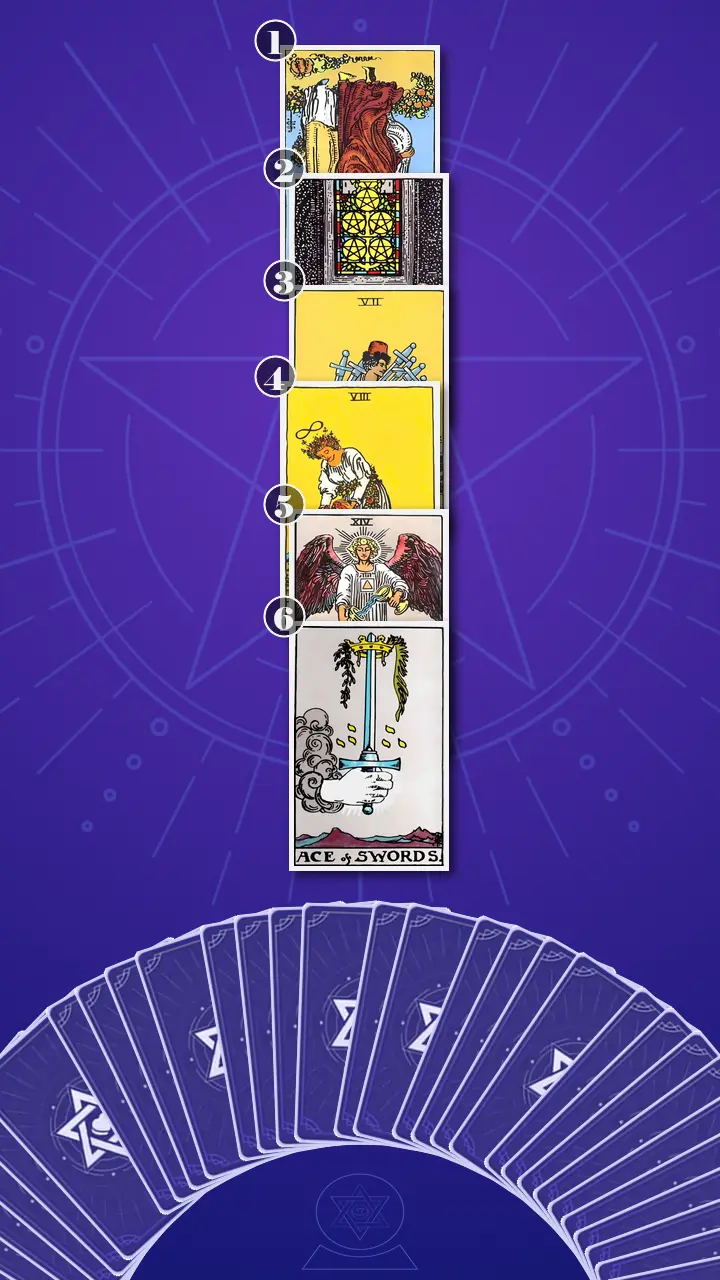
Card 1 shows the visible moment—what activates when the selfie happens. Card 2 drops into the root “not enough” story. Card 3 names the coping strategy that keeps the story alive. Then we climb: Card 4 is the key shift, Card 5 is what makes it sustainable, and Card 6 gives one practical step for this week.
Reading the Ladder: From “Cheers” to “Audit Mode”
The Visible Moment: When Celebration Turns Into a Mirror
“Now flipped over,” I said, “is the card representing The visible moment: what gets activated in you when the happy-hour selfie happens.”
Three of Cups, reversed.
I showed her the card and kept it real-world. “This is exactly that flip you described: you’re at happy hour, genuinely laughing, and then someone says ‘Selfie!’ The vibe shifts inside you. You stop listening, start performing, and your smile becomes something you manage. You’re still in the circle, but your attention leaves the moment to curate proof you belong.”
In terms of energy, the Three of Cups is normally social ease—connection that flows. Reversed, it’s blocked. The joy isn’t gone; it’s just routed through a control panel. You’re not drinking the spritz, you’re auditing your face. You’re not hearing your friend’s story, you’re scanning your posture like you’re A/B testing an ad until you forget you’re a person, not a campaign.
Taylor did something I see all the time with high-functioning people: she let out a small laugh that didn’t reach her eyes. “That’s… cruelly accurate,” she said. “Like, I’m sitting there, and suddenly I’m not.”
The Root Story: Feeling Outside Even When You’re Included
“Now flipped over,” I said, “is the card representing The ‘not enough’ story underneath: the core belief/fear that the selfie moment hooks into.”
Five of Pentacles, upright.
I used a split-screen, because this card is a split-screen. “On one side,” I said, “there’s the warm bar lighting—friends leaning in, someone saying ‘pics!!!’ like it’s nothing. On the other side, there’s an inner narration that sounds like you standing outside in the snow.”
I looked at her and offered the pattern gently, not as a verdict: “If I look ___, then I’ll be ___. If I look awkward, then I’ll be unchosen. If I look ordinary, then I’ll be forgettable. If I don’t look effortless, then I don’t qualify.”
In energy terms, this is Earth scarcity—a feeling of lack that settles into the stomach and makes you act like belonging is a paywall. The painful part is that nothing in the room is actually excluding you. The invitation already happened. You’re literally there. But your nervous system behaves like you’re still auditioning.
Taylor winced—small, almost imperceptible—then exhaled slow, like her ribs finally unclenched. “Oh,” she said. “That’s the actual thing.”
The Maintaining Mechanism: Curation as Crisis PR
“Now flipped over,” I said, “is the card representing The maintaining mechanism: the specific strategy you use to protect yourself that accidentally reinforces the story.”
Seven of Swords, upright.
“This,” I told her, “is your risk-management brain.”
I kept it modern and specific: “You treat the selfie like a crisis PR moment. You direct angles, delete the ‘bad’ ones, pick the safest shot, and polish it until it looks effortless. You’re not trying to lie—you’re trying to feel safe. But the more you curate, the more the night becomes something you manage instead of something you live.”
In energy terms, this is Air tactics in excess—thinking and strategizing to outsmart judgment. The inner monologue is tight and fast: If I can just get the right version, I won’t have to feel this.
I said one of my favorite truths, because it lands cleanly here: Curation is control that costs connection.
Taylor gave me a half-laugh of recognition, the kind that’s equal parts “called out” and relieved. “Wait,” she said. “I literally do that. I’ll be like, ‘One more,’ and everyone’s already back to talking, and I’m still… in the camera square.”
When Strength Spoke: Staying on Your Own Side While You’re Visible
When I reached for the fourth card, the room seemed to get quieter—even through a screen. Taylor’s eyes tracked my hands the way people watch a traffic light when they’re tired of waiting.
“Now flipped over,” I said, “is the card representing The key shift: the inner stance that interrupts the loop and directly challenges the ‘not enough’ story.”
Strength, upright.
Setup. I spoke slowly, because this is the moment people recognize themselves. “You’re at happy hour, someone says ‘Selfie,’ and your brain switches into audit mode—angle, smile, outfit, vibe. You’re still laughing out loud, but inside you’re bracing, like one photo could decide whether you belong.”
Delivery.
Stop treating the selfie as a verdict, and start treating it like a moment you can hold with steady hands—like Strength calming the lion instead of negotiating with it.
I let the sentence sit between us. No rush. No pep talk.
Reinforcement. Taylor’s reaction came in layers, like weather changing. First: a tiny freeze—her lips parted, then closed. Second: her gaze went unfocused for a beat, like she was replaying a hundred front-facing-camera moments at once. Third: her shoulders dropped, not dramatically, but undeniably, and she took one slow breath that sounded like she’d been holding it since every tagged photo in 2019.
This is where my family’s old way of reading people still matters, even in a New York apartment with a ring light and a Notes app. I practice what I call Body Signal Interpretation: your body isn’t being “dramatic,” it’s sending clean messages.
“Your jaw,” I said gently, “is the lion. That clench is your system trying to create safety through control. Your tight chest is your alarm saying, ‘Visibility equals danger.’ And the heat in your face? That’s a flare of exposure—like you’ve stepped into harsh light.”
“Strength doesn’t fight those signals,” I continued. “It doesn’t bargain with them either. It places a steady hand on them. The inner script is simple: ‘I’m not negotiating with this panic—I’m staying with myself.’”
Taylor blinked hard once, then gave a quick, almost annoyed little breath. “But if I stop negotiating,” she said, voice sharper for a second, “doesn’t that mean I was… wrong? Like I wasted years trying to get it right?”
I nodded, because that reaction is honest. “It means you were protecting yourself the only way you knew. That’s not ‘wrong.’ That’s adaptive. We’re just updating the strategy.”
And I named the real pivot clearly, because clarity is kindness: “This isn’t about becoming someone who never cares. This is about moving from hyper-vigilant self-monitoring and comparison fatigue to self-compassionate visibility and steadier self-trust. You can be in the photo without abandoning yourself.”
I leaned in. “Now, with this new perspective, think back to last week—was there a moment on the L train, or at your kitchen counter the next morning, where this would’ve changed how you felt? Even by five percent?”
Taylor looked down and pressed her thumb into her palm like she was anchoring herself. “Yeah,” she said quietly. “I checked who viewed it like… six times before Bedford. I could’ve… put the phone down. I could’ve stayed with myself.”
Mixing the Levels: Temperance and the Middle Lane
The Integration Resource: Turning Down Performance Without Muting Joy
“Now flipped over,” I said, “is the card representing The integration resource: what helps you stay authentic and connected after the insight, especially in social settings.”
Temperance, upright.
“Temperance is the sound engineer,” I told her, a small smile in my voice. “You can turn down the performance impulse without muting your joy.”
I brought it back to her real life scenario: “You find a middle lane. You can take the photo and even post it, but you don’t abandon your internal reality to do it. You pause before editing, check in with your body, and let sharing be a choice—not a compulsion to secure belonging.”
In energy terms, Temperance is balance. Not all-or-nothing. Not ‘post perfectly or vanish.’ Just: blended self. One foot on land, one in water—present with friends, present with yourself.
Taylor nodded, slow and steady. “Okay,” she said. “There’s a middle lane. I don’t have to go full ‘I’m above this,’ and I don’t have to spiral.”
One Clean Sentence Beats Forty Retakes
One Step This Week: The Notes App Clean Cut
“Now flipped over,” I said, “is the card representing One step this week: a single practical move that turns insight into behavior without relying on external validation.”
Ace of Swords, upright.
“This is mental clarity,” I said. “A clean cut through noise.”
I used the exact modern translation: “Instead of spiraling in your camera roll, you open your Notes app and write: ‘The story I’m telling is: I’m not the kind of person people choose.’ Then you add one grounded counter-truth—evidence, not a pep talk. Your mind gets clean enough to choose what to do next without treating the photo like a referendum.”
In energy terms, this is Air in balance. Not frantic overthinking. One true sentence that you can actually hold.
And I said it the way I’d say it to any young woman whose life is starting to feel like it’s always in draft mode: One clean sentence beats forty retakes.
From Insight to Action: The Worth-Test Interrupt You Can Actually Do
I threaded the whole ladder together for her, so it became a story she could recognize in real time.
“Here’s the pattern,” I said. “The Three of Cups reversed shows the moment celebration becomes a mirror. The Five of Pentacles underneath it is the real ache: an outsider narrative that says you must qualify for belonging. Then the Seven of Swords steps in with a totally understandable protection strategy—curation, control, managing exposure. But that strategy quietly teaches your system that the real you isn’t safe to show. Strength is your turning point: staying gently loyal to yourself while you’re visible. Temperance makes that loyalty sustainable. And Ace of Swords gives you the clean sentence that ends the spiral.”
The blind spot was simple and painful: Taylor kept treating the photo like it could grant or revoke membership. As if the group was a lit sanctuary and she had to earn the right to step inside—even though the door was already open.
The direction of transformation was equally simple: shift from selfie-as-verdict to selfie-as-neutral-snapshot, then choose one grounded action that returns you to the actual moment.
I gave her a small plan—low drama, high repeatability.
- The Two-Photo Rule + Phone Face-Down 10At your next happy hour, take exactly two photos, pick the second one, then put your phone face-down for 10 minutes and rejoin the conversation—no camera roll, no caption tinkering.Expect the “just one more” itch. That itch is the Seven of Swords trying to buy safety. You don’t have to obey it—just notice it.
- The Strength Reset (30 seconds, in your chair)Right after the selfie, do a micro body reset: unclench your jaw, drop your shoulders, and press your feet into the floor like you’re coming back into your own body.If you feel self-conscious doing this at the table, do it in the bathroom stall. Same nervous system, more privacy.
- The Notes App Clean Cut (7 minutes, clarity over adrenaline)Before you edit or post, open Notes and write: “The story I’m telling right now is: ____.” Then write one line of evidence that’s already true: “They invited me,” “I’m literally here,” “We’re laughing.” Decide: post, don’t post, or post to Close Friends—any option counts as choice.If anxiety spikes, put your phone face-down and come back later. You’re not required to finish it in one sitting.
- My 5-Minute Balcony Energy Awakening (the next morning)The next day, step to a window, fire escape, stoop—any scrap of outside air. For five minutes, feel the temperature on your skin and take ten slower breaths. Let your eyes land on one real thing (a tree, brick, cloud) before you land on Instagram.This isn’t for “being productive.” It’s to re-enter your day as a person, not a profile. Even one minute counts.

A Week Later: The Quiet Proof
A week later, Taylor sent me a message that was almost annoyingly simple: “Did the Two-Photo Rule. Picked the second. Put my phone down. I felt twitchy for like two minutes, then I actually… came back.”
She told me she still woke up the next morning with the first thought—What if I looked weird?—but then she did the Notes App Clean Cut instead of zooming in on herself. She didn’t feel euphoric. She felt cleaner. Clear enough to make coffee without turning her face into a problem to solve.
That’s the thing about a real Journey to Clarity: it rarely arrives as certainty. It arrives as ownership—tiny, repeatable, and kind.
When you want to be seen so badly that you start editing yourself in real time, it can feel like you’re standing inside the group—but emotionally shivering outside it, waiting for a photo to let you in.
If the selfie didn’t get to be a verdict tonight, what would you notice about the moment you’re already in?