From Intake-Form Freeze to a First Draft: Learning to Submit One Line

Finding Clarity in the 9:38 p.m. Cursor Blink
If you’ve opened your therapy intake form in Toronto three separate nights, typed a “reasonable” goal, then deleted it because it sounded “dramatic,” you might be in goal-setting paralysis—aka the Submit Button Freeze.
Jordan (name changed for privacy) settled into the chair across from my little studio desk, hoodie still on, backpack at their feet like they might bolt. They’re 28, an early-career project coordinator, and their whole vibe said “I can handle a spreadsheet,” even as their fingers kept worrying the seam of their sleeve.
They showed me their laptop screen the way someone shows a dentist a tooth that’s been hurting for months. A Chrome tab—open for days—glowed with that one open-ended prompt: “What are your goals for therapy?” The cursor blinked like a metronome that had decided to judge them. Radiator clicks. Streetcar bell somewhere outside. Blue light in their face. Their jaw was tight enough I could almost hear it.
“I keep rewriting it,” they said, voice careful. “I’ll type something like, ‘I want help with anxiety and motivation,’ and then I… do the whole disclaimer thing. ‘Not severe though.’ ‘Not sure if this makes sense.’ Then I delete it. And then I end up on r/therapy at midnight comparing CBT to EMDR like it’s a product review.”
What I saw wasn’t laziness. It was self-conscious fear dressed up as competence—like trying to swim in a suit made of wet denim. You want help, you want clarity… and at the exact same time you’re terrified of being judged, or locked into the “wrong” goals like they’re a permanent record.
“We can work with that,” I told them, soft and direct. “Not by forcing the perfect wording—but by mapping what’s actually happening in your body and your mind the moment that box shows up. Let’s see if we can turn this into a Journey to Clarity: from ‘I have to prove I’m ready’ to ‘I can name one true starting point and let it evolve.’”

Choosing the Ladder: How Tarot Works for an Avoidance Pattern
I asked Jordan to take one slow breath—not as a mystical ritual, more like lowering the volume before you try to hear a melody. I shuffled while they held the question in their mind: “Therapy intake form asks my goals—what avoidance pattern is this?”
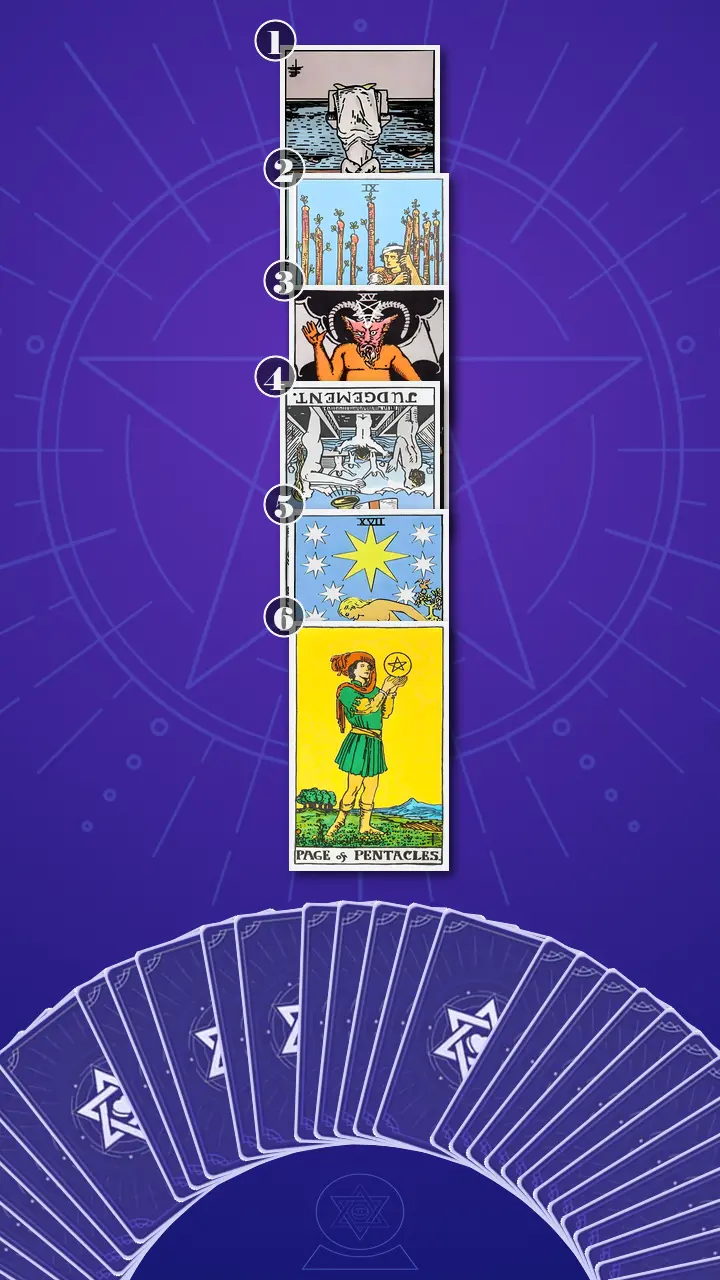
“Today I’m using a spread I like for this exact kind of loop,” I said, laying out six cards in a vertical line. “It’s called the Four-Layer Insight Ladder · Context Edition.”
To you, reading along: this is not a prediction spread. It’s a structure for understanding why you freeze on something like therapy intake form goals—especially when the real issue isn’t ‘choosing between options,’ but a self-protective system that kicks in under perceived evaluation. This ladder tracks: surface behavior → protection → root mechanism → core fear → turning-point medicine → one grounded next step. Minimal cards, maximal clarity.
“Card 1 is the freeze-frame,” I told Jordan. “What you do minute-by-minute. Card 3 is the engine underneath. Card 5 is the turning point—what restores enough safety to tell the truth gently. And Card 6 is your ‘small enough to start’ move.”
Reading the Map: From Blindfold to Verdict
Position 1 — Surface pattern: what shows up on the screen
“Now we’re looking at the card that represents the surface pattern: the specific, observable avoidance behavior that shows up when the form asks for goals,” I said, turning it over. “Two of Swords, reversed.”
I tapped the blindfold, the crossed blades, the still water behind the figure. “This is that 9:45 p.m. moment. You stare at the goals box like it’s a trick question. You type a sentence, delete it, retype it with softer language, delete again. Keeping it unresolved feels safer than picking one honest line—because a ‘draft’ can’t be wrong.”
Reversed, the energy isn’t calm neutrality. It’s a blockage: the blindfold slipping, the stalemate turning into active self-blocking. The mind tries to keep you unjudgeable by keeping you undecided.
“It’s like Google Docs suggesting mode,” I added, because Jordan had that tech-brain. “You’re editing yourself forever so nothing ever becomes the version you can actually share.”
Jordan let out a small, bitter laugh—more exhale than humor. “That’s… too accurate. Like, rude,” they said, but their shoulders dropped half an inch, as if being named was also being relieved.
In my head, I flashed to my old radio booth: a producer hovering over a perfectly good take, shaving off breaths and ‘ums’ until the voice sounded less human. Over-editing can be control. It can also be fear with a microphone.
“It’s not rude,” I said gently. “It’s precise. And it’s common. You’re not avoiding therapy—you’re avoiding being graded.”
Position 2 — Protection layer: what this pattern is guarding
“Now we’re looking at the card that represents the protection layer: what this pattern is trying to prevent or guard in the moment,” I said. “Nine of Wands, upright.”
The figure’s bandaged head and the wand held like a barrier always reads like bracing. “This is you walking into the intake form like you’re walking into a meeting where you expect to be misunderstood,” I told them. “You’re not refusing therapy—you’re preparing for impact.”
In upright form, Nine of Wands is not weakness; it’s persistence with a guard up. Here, the energy is excess: too much bracing, too much pre-emptive defense. It keeps you from being hurt, but it also keeps you from being helped.
“Of course you armored up,” I said, watching their hands uncurl from the sleeve seam. “You’ve learned language is how you stay safe. At work, clarity gets rewarded. In corporate life, vague can get punished. Your nervous system doesn’t magically know this is a different room.”
Jordan nodded once, slow. Their jaw unclenched like they’d given it permission.
Position 3 — Root mechanism: the belief that keeps the loop running
“Now we’re looking at the card that represents the root mechanism: the belief or attachment that keeps the pattern running,” I said, and turned over the next card. “The Devil, upright.”
The room went a little quieter—like when a track drops into a lower register. The Devil isn’t about you being ‘bad.’ It’s about the hook. The bargain.
“Here’s the modern version,” I said. “You start negotiating with approval you haven’t even received yet: ‘If I sound composed, I won’t be rejected.’ The intake form turns into branding—curating the easiest-to-help version of you—so you can avoid the risk of being seen as messy, unsure, or human.”
The Devil’s chains are loose in the classic deck, and that matters. The energy is attachment—a stuck groove. It can feel compulsory even when it’s technically optional. Your mind keeps a tab pinned open that says: How to Be a Good Client. Rules like: Only coherent people get help.Only people with neat narratives deserve care.
Jordan’s eyes dropped to the table. I saw the three-beat loop land: too vague → too intense → too needy. They swallowed.
“Yeah,” they said softly. “It’s like… if I can’t explain it, it means it’s not real. Or I’m not real. Or I’m wasting their time.”
“That’s the chain,” I said. “Worthiness tied to performance.”
Position 4 — Core fear: the verdict you’re bracing for
“Now we’re looking at the card that represents the core fear: the specific evaluation or consequence you’re bracing for if you answer plainly,” I said. “Judgement, reversed.”
Judgement reversed is the intake form turning into a spotlight. “You read ‘goals’ and your brain hears ‘verdict,’” I said. “You imagine a therapist deciding—silently, instantly—whether you’re serious enough, self-aware enough, not-too-much.”
Reversed, the energy is deficiency in self-trust and excess in imagined scrutiny. It’s the fear that your words will become permanent evidence against you.
Jordan’s mouth twitched like they wanted to joke and couldn’t. “It’s like performance review season,” they admitted. “Except the reviewer is… a person who’s supposed to help me. Which makes it worse somehow.”
“Because it matters,” I said. “Because you’re actually asking for care. That’s more vulnerable than asking for a raise.”
When The Star Turned the Screen into Night Sky
Position 5 — Turning point: the medicine that restores safety
I let my palm rest lightly on the table, grounding the moment. “We’re turning over the most important card of the reading,” I said. “The one that changes the temperature in the room.”
“Now we’re looking at the card that represents the turning point: the most effective inner reframe and healing energy for approaching the goals question,” I said, and flipped it. “The Star, upright.”
The image always feels like a sensory downshift: open sky, steady water, no harsh glare. “This is late night, but in a kinder way,” I told Jordan. “You write one sentence like you’re speaking to someone safe: ‘Right now I’m struggling with avoidance and feeling overwhelmed, and I want help getting unstuck.’ No thesis. No perfect arc. Just a starting point.”
Upright, The Star is balance: honesty without performance, hope without certainty. It’s the opposite of Judgement reversed. It says: you don’t have to be impressive to be met.
Because my work lives at the intersection of sound and nervous systems, I leaned into the Star’s “steady pouring” the way I’d lean into a calming tempo on-air. “Here’s a trick I use with clients,” I said. “I call it Space Tuning. If your environment feels like fluorescent evaluation—laptop glare, silence so sharp it makes you self-conscious—your body will brace. So we soften the acoustics on purpose. One lamp. Low volume brown noise or a quiet playlist. Not to ‘fix’ you—just to remove the spotlight effect.”
Jordan blinked, then exhaled as if the suggestion itself lowered a shoulder.
Setup: “If you’ve reopened the intake form three times in one night—typing a careful paragraph, rereading it like an email to your boss, then deleting it because it sounds ‘dramatic’—you already know this weird pressure: the blank box feels like a spotlight.”
Delivery:
Stop treating the intake form like a verdict, and let your words pour out simply—like The Star’s water—so the process can meet you where you are.
Reinforcement: Jordan’s reaction came in a sequence I’ve learned to listen for the way I listen for a song resolving a chord. First: a tiny freeze—their breath paused, eyes fixed on the card. Second: the mental replay—focus went distant, like they were watching themselves hover over Submit on a rainy Thursday, finger on the trackpad, closing the tab to escape the imagined raised eyebrow. Third: the release—air left their chest in a shaky exhale, and their jaw loosened like they’d been holding it for years.
“But what if it is a verdict?” they said, and there was a flash of anger underneath—sharp, protective. “Like… what if I really do sound ridiculous?”
I didn’t argue with the fear. I translated it. “That anger is the part of you that’s tired of being evaluated,” I said. “It’s the Nine of Wands saying, ‘I’ve been misunderstood before.’ We’re not going to bully that part. We’re going to give it a safer way to begin.”
“Try this right now as an experiment,” I continued, voice steady. “Ten minutes. Stop anytime if it spikes anxiety.
1) Open the intake form. 2) In the goals box, type ONE line that begins: ‘Right now I’m struggling with ___.’ 3) Add ONE example that starts: ‘For example, last week I ___.’ 4) Do not edit for tone. Only fix obvious typos. If your chest tightens or your jaw clenches, pause for three slow breaths, then choose: submit now, or save and schedule a five-minute window tomorrow to submit. Either choice counts as follow-through.”
I watched Jordan’s shoulders sink—like they’d been carrying a backpack full of invisible rubrics. “Now,” I asked them, “using this new lens—starting point, not verdict—can you remember one moment last week when this would’ve changed how you felt?”
They nodded, eyes wet but steady. “Sunday,” they said. “I had the form open and I could feel my body doing that thing. If I’d called it a starting point… I think I could’ve pressed submit. Or at least saved it without hating myself.”
That was the shift I wanted: from self-conscious freezing and performance-driven overediting to gentle honesty and draft-based self-trust. Not a dramatic breakthrough—just enough safety to move.
Position 6 — Actionable next step: the grounded beginner move
“Now we’re looking at the card that represents the actionable next step: a small, realistic way to answer the intake goals in a week and move forward,” I said, turning the last card. “Page of Pentacles, upright.”
“This is first-week intern energy,” I told them. “Curious. Concrete. Not trying to sound impressive. Page of Pentacles says: pick one seed goal and let it grow. A minimum viable draft. You don’t redesign your whole life—you plant one thing.”
The energy here is balance moving into stability. It grounds The Star’s hope into something you can actually do on a Tuesday night.
The One-Page Plan for Therapy Intake Goals (Actionable Advice, Not a Manifesto)
I pulled the thread through all six cards and tied it into one story Jordan could carry home: the surface behavior is the drafting-and-deleting loop (Two of Swords reversed). Underneath, you’re guarding dignity and competence (Nine of Wands). The engine is a performance bargain—be coherent, be safe, be worthy (The Devil). The fear is being judged, exposed, or permanently defined by one form (Judgement reversed). The medicine is gentle, steady truth without spotlight energy (The Star). And the next step is a beginner plan that ships (Page of Pentacles).
The blind spot I named for Jordan was simple: they thought they were delaying because they didn’t have the “right” goals yet. But the cards showed something more humane—and more workable. They were delaying because they believed the form required a polished, defensible version of them. The transformation direction was clear: from “I must have the right goals before I begin” to “I can name one true starting point and let goals evolve through the work.”
Then I gave them a set of small experiments—because clarity isn’t a mood, it’s follow-through.
- The Star Sentence (Minimum Viable Goal)Tonight, open the intake form and type: “Right now I’m struggling with ___.” Then add: “For example, last week I ___.” Stop there.Only fix typos. If you feel the urge to add disclaimers, whisper: “A goal isn’t a verdict. It’s a starting point.”
- One Situation / One Skill (Page of Pentacles template)Copy/paste: “Starting point: I want help with ___. Example: when ___ happens, I ___. Skill I want to build: ___.” Pick one concrete situation from the last 7 days.Cap yourself at two bullets. If you start writing a life manifesto, that’s your cue to return to one situation and one skill.
- A 5-Minute Submit Window + 3-Minute Sound ResetSet a 5-minute timer to submit. Before you start, do my “21-Day Sound Bath” micro-version: 3 minutes of slow breathing with a steady, gentle track (or simple room tone) to soften the spotlight feeling.When the timer ends, either hit Submit or schedule a specific submit time within 24 hours. Either choice counts as shipping v0.1.

A Week Later: The Quiet Proof
Six days later, Jordan emailed me a screenshot—not of the whole form, just the goals box. Two lines. No disclaimers. “Right now I’m struggling with avoidance and feeling overwhelmed.” “For example, last week I kept rewriting the intake form and didn’t submit.” Under it: a timestamp and a tiny, almost apologetic note: “Submitted. Alone in a café for an hour after. Felt weirdly calm and weirdly shaky.”
That’s the kind of change tarot is good at making visible: not a new personality, not instant certainty—just the first honest motion in a stuck system. From being graded in your head to being met in real life. From a clenched jaw to a sentence that can breathe.
When a simple “What are your goals?” box makes your chest tighten, it’s not because you don’t want help—it’s because some part of you thinks you have to sound perfectly understandable to be allowed in.
If goals could be a living draft for just one week, what’s the smallest true starting sentence you’d let yourself submit—without defending it?