When the Alarm Felt Like a Verdict—and the Five-Minute Response Shift

Finding Clarity in the 7:14 a.m. Scroll
If you live in NYC and your first move in the morning is snooze → scroll → re-write the to-do list, not because you’re exhausted but because starting feels like walking into judgment, you’re not alone.
Jordan (name changed for privacy) sat down across from me with the kind of careful posture I’ve learned to recognize—the one that says, I’m here, but please don’t make this worse. They were 28, sharp, fast-paced office job, and their mornings had started to feel like a tiny courtroom that opened for business the second their alarm buzzed.
They described 7:14 a.m. on a Wednesday in their small NYC bedroom: the alarm drilling through the quiet, the radiator hissing like it had opinions, and the phone screen glowing warm against their palm. They’d hit snooze, then Instagram “for one minute.” The room felt too bright. Their shoulders climbed toward their ears without permission. Their chest tightened as if the day had already put them on notice.
“I’m not even tired,” they said, voice flat with disbelief. “I just don’t want to start.”
I watched their hands—how they mimed the exact choreography: snooze, scroll, Notes app, rewriting priorities, anything except opening the laptop. It wasn’t laziness. It was dread that felt like being stuck to the mattress by invisible gravity, like a browser tab left open for days draining all your RAM before you even stand up.
“Snooze isn’t a time problem. It’s a self-judgment buffer,” I said gently. “And we can work with that. Let’s treat today like a Journey to Clarity—no shaming, no ‘fix your whole life’ pressure. Just a map that shows what’s driving the avoidance, and what your next step actually is.”

Choosing the Compass: The Transformation Path Grid (6)
I asked Jordan to take one slow breath and hold their question in plain language: What old story drives my snooze-button avoidance—and what’s the next step? While they breathed, I shuffled—not as a spell, but as a focusing tool. A way of telling the nervous system: we’re switching from spiraling to seeing.
“Today I’m going to use the Transformation Path Grid (6) · Context Edition,” I told them. “It’s a 2x3 tarot spread designed for patterns like avoidance and procrastination—especially when the surface behavior is obvious, but the why keeps hiding.”
For you reading this: this spread works because it separates the story into two floors. The top row diagnoses the loop—what it looks like, what keeps it going, and the root belief underneath. The bottom row is the way out—what interrupts the loop, the next doable action, and how the change feels once it’s embodied.
“Card 1 will show your surface state—what the snooze pattern looks like in your body,” I said. “Card 3 will reveal the old story that makes starting feel dangerous. And Card 4 is our pivot: the catalyst. The moment the loop can break.”
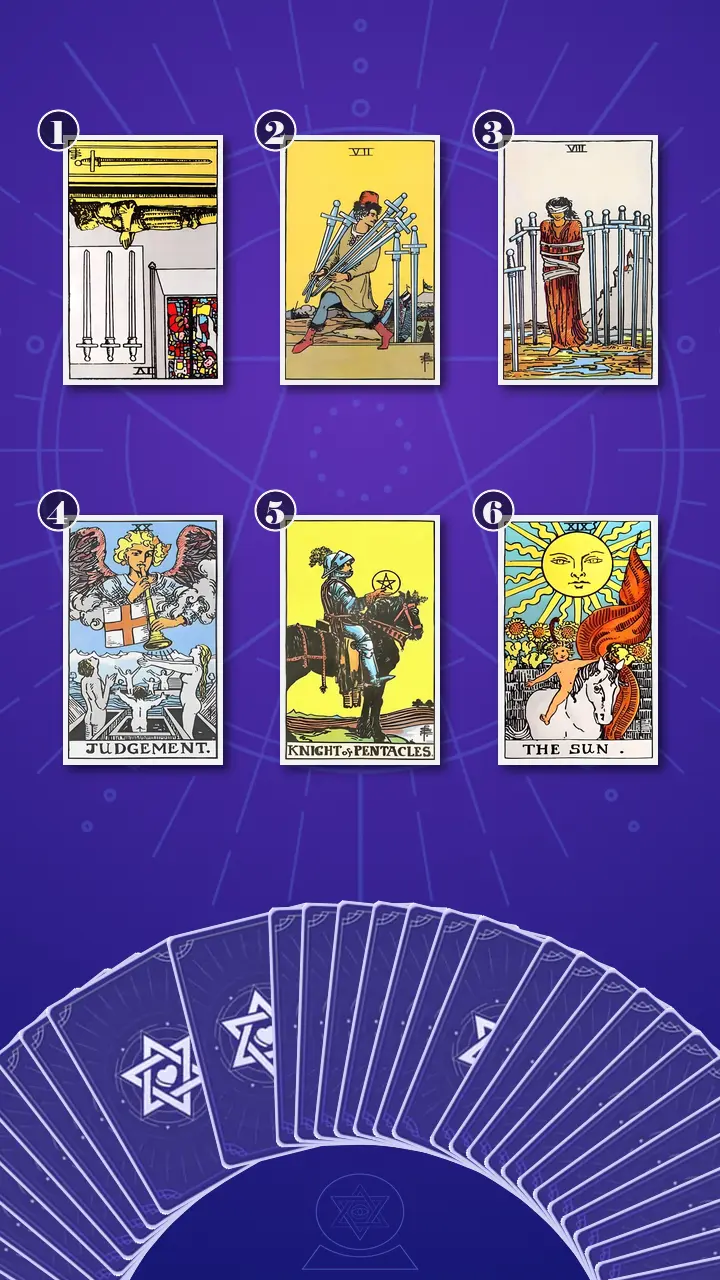
Reading the Map: From Morning Dread to Actionable Advice
Position 1: The Body That’s ‘Resting’ but Not Restored
“Now turning over, is the card that represents Surface state: what the snooze/avoidance pattern looks like in the body and day-to-day behavior,” I said.
Four of Swords, reversed.
I traced the image lightly with my fingertip: a figure lying still beneath suspended swords—stillness with pressure above it. “This is 7:10 a.m. energy,” I said. “You’re not asleep anymore, but you’re not up either. Your body is paused, but your mind is already in Slack, the inbox, the meeting you haven’t even had.”
Reversed, the Four of Swords is a blockage of true recovery—rest that doesn’t restore. “Snooze isn’t giving you rest,” I added. “It’s giving you a temporary reduction in pressure while the thoughts stay loud. Like doomscrolling as a loading screen—you’re waiting for the day to buffer, but it never finishes loading.”
Jordan’s mouth tightened, then loosened. Their eyes flicked down to the card and back up to me, as if checking whether it was safe to admit the obvious.
Position 2: The NYC Morning Heist
“Now turning over, is the card that represents Main blockage: the specific coping move that keeps the pattern going,” I said.
Seven of Swords, upright.
“This is the ‘productive-looking detour’ card,” I told them. “The kind of avoidance that’s so convincing you almost believe it yourself.”
I leaned in a little, keeping my voice casual on purpose. “In NYC terms? This is a morning heist. You’re not lazy—you’re stealing 30 minutes from the day in tiny moves: snooze, Slack check, a ‘quick’ scroll, rearranging the to-do list in Notes, maybe setting up a Notion template like that will magically make the task painless. And all the while you’re looking over your shoulder for the moment you’ll have to face the real thing.”
Then I mirrored the inner monologue I hear in so many readings, letting it sound exactly like a thought Jordan might have had: “This doesn’t count as avoiding… I’m just getting ready… I’ll start once I feel less gross… I just need one more minute.”
The Seven of Swords is an excess of strategy and an avoidance of exposure. “You’re not avoiding effort,” I said. “You’re avoiding the feeling of being seen—by your own standards.”
Jordan let out a short laugh that landed like a wince. “Okay,” they said, shaking their head once. “That’s… too accurate. Almost kind of cruel.”
“I hear you,” I replied. “But I’m not interested in cruelty. I’m interested in precision—because precision is how we stop blaming your character for something that’s actually a pattern.”
Position 3: The Old Story That Makes Starting Feel Unsafe
“Now turning over, is the card that represents Root cause: the old story or belief that makes avoidance feel safer than starting,” I said.
Eight of Swords, upright.
“This one is about rules that feel unbreakable,” I said. “Not because they’re truly locked—but because you’re wearing a blindfold made of fear.”
I pointed to the loose bindings. “The detail that matters is ‘tight-but-loose.’ The ropes aren’t iron. But when you can’t see a way out, your nervous system treats it as absolute.”
Then I translated it into Jordan’s modern life scenario: “One task becomes a referendum: If I can’t do this cleanly, I’m not competent. So you freeze. You wait for certainty, permission, or the ‘disciplined morning version’ of you to show up—like a software update that never finishes downloading.”
The Eight of Swords is a deficiency of perceived options. “Here’s the contrast I want you to hold,” I said, gently but firmly: “What’s actually required?” versus “What are you demanding of yourself to feel safe?”
Jordan nodded slowly, like they were watching a memory replay on the inside of their eyes.
Position 4: When Judgement Sounds Like a Trumpet (The Interrupt)
“Now turning over, is the card that represents Catalyst: the insight or truth that breaks the loop and opens a new option,” I said.
The room felt quieter for a beat—like the city outside had lowered its volume.
Judgement, upright.
I’ve spent ten years guiding visitors through a Tokyo planetarium, timing my words to the slow sweep of projected constellations. The sky teaches you this: the most powerful shifts aren’t always loud. Sometimes they’re a clean cue—a single sound that changes what your body does next.
So I used a hard-cut scene in my voice, like an edit in a film: the top-row mental noise—tabs, Slack pings, LinkedIn humblebrags—then one clean sound cue: the alarm.
In my work, I call this Pulsar Breathing: syncing your next move to a steady rhythm, the way a pulsar sends reliable pulses through the dark. “Ten slow breaths,” I said. “Not to become Zen. Just to give your nervous system a beat it can trust before your mind starts bargaining.”
Setup. It’s 7:12 a.m. Your alarm goes off, and before you even blink you remember the one task you’ve been dodging. Your chest tightens, your limbs feel heavy, and the thought lands like: “If I start and it’s messy, that means something about me.”
Stop treating the alarm like a verdict and start treating it like a trumpet call—respond with one real action instead of bargaining for more time.
Reinforcement. Jordan went still in a way that wasn’t frozen—it was startled. First, their breath caught and their fingers hovered mid-air, like they’d been about to grab a phone that wasn’t there. Then their gaze unfocused for a second, as if replaying every morning negotiation in fast-forward: snooze, scroll, guilt, rush, self-hate, repeat. Finally, they exhaled—long and audible—and their shoulders dropped a fraction, the tiniest unclenching of a jaw that had been bracing for impact.
“Wait,” they said, quieter now. “So the alarm isn’t… proving I’m behind. It’s just… asking if I’m here.”
“Exactly,” I said. “And here’s the key shift I want you to practice, not as a mantra but as a method: Move from ‘I must feel ready and confident before I begin’ to ‘I begin with one small, imperfect step and let confidence be the result.’”
I let the silence do its work, then asked, “Now, with this new perspective—think back to last week. Was there a morning where, if you’d treated the alarm like a call instead of a verdict, you would’ve made a different first move?”
Jordan’s eyes got a little wet, not in a dramatic way—more like the body releasing something it didn’t realize it had been holding. “Tuesday,” they said. “I could’ve just… opened the doc. Two minutes. Instead I made a whole plan to ‘start right’ and then I was late anyway.”
That was the pivot—from dread-driven self-judgment into the first crack of agency. Not certainty. Not hype. A choice point.
Position 5: The Boring First Move Method
“Now turning over, is the card that represents Next step: a concrete, doable action for the next 7 days that builds self-trust,” I said.
Knight of Pentacles, upright.
“This is the Builder,” I told them. “Not the sprinter. This card doesn’t care about motivation. It cares about repeatability.”
The Knight of Pentacles is balance—grounded, steady energy. “Make the first move boring on purpose,” I said, and Jordan actually smiled at that. “You’re not trying to win the morning. You’re trying to prove follow-through exists—without needing your mood to cooperate.”
I connected it directly to their pattern: “If the first five minutes feel impossible, we don’t argue with that. We design the first five minutes so simple it’s almost annoying.”
Position 6: The Sun as the Payoff You Can Feel in Your Chest
“Now turning over, is the card that represents Integration: what it feels like when the new pattern is practiced and embodied,” I said.
The Sun, upright.
After all that Air—mental loops, tight rules, strategic detours—The Sun is what happens when you stop fighting yourself before breakfast. It’s not a perfect life. It’s an internal weather shift: less clutter, more straightforward aliveness.
“This is the part people miss,” I said. “The reward isn’t a flawless outcome. The reward is that your body learns: beginning is safe. Your chest has room. Your mind gets clearer because it’s not burning energy holding the start hostage.”
The Respond-Not-Prove Reset: Next 48 Hours
Here’s the story the cards told in one line: your mornings aren’t failing because you don’t have enough discipline—they’re stalling because you’re waking up into a self-judgment story. Four of Swords reversed shows rest that isn’t rest; Seven of Swords shows the clever detours that steal time; Eight of Swords shows the old rule that says starting equals exposure. Judgement breaks the loop with a clean call to respond, the Knight of Pentacles turns that clarity into a repeatable habit, and The Sun is the lived payoff—lighter motivation because you’re no longer putting your worth on the line before coffee.
The cognitive blind spot hiding in plain sight: you’ve been treating the first minute of the day like it must decide the quality of the whole day. That’s why you bargain. That’s why you buffer. The transformation direction is simpler (and kinder): respond first, evaluate later.
I offered Jordan a few tiny, concrete experiments—actionable advice designed for decision fatigue mornings, not a fantasy morning routine.
- The 60-Second Sit-Up + Pulsar Breathing RuleTomorrow, replace your first snooze with: sit up, put both feet on the floor, and take 10 slow breaths. Then decide on purpose: “Am I resting, or beginning?” (Either answer is allowed—what we’re removing is the unconscious bargaining.)If your mind says “this is pointless,” treat that as the cue to do the smallest version anyway. You’re reclaiming the first minute, not trying to become a morning person overnight.
- The ‘Answer the Call’ 5-Minute TimerSet a timer called “Answer the call.” For five minutes, do only the opening move on the avoided task: open the file/tab, type a rough first sentence, or add three ugly bullets. No polishing. No researching. Just begin.If five minutes feels like too much, do two. If your body spikes into shutdown, return to the breathing and stop—this is an experiment, not a test.
- Night-Before CMB Resonance (So Morning Isn’t a Trial)One night this week, do a 5-minute “CMB Resonance” wind-down: put your phone out of arm’s reach, lie down, and listen to a steady background sound (yes, even the washing machine in your building) while you let your breath lengthen. Tell yourself once: “Tomorrow, one honest step.”Don’t chase perfect calm. The goal is to lower the baseline mental noise so you’re not waking up already ‘on.’

A Week Later: The Quiet Proof
Eight days later, Jordan messaged me. Not an essay—just a screenshot of a timer labeled Answer the call and one line: “Did two minutes. Wrote the ugliest first sentence. Didn’t die. Chest unclenched.”
They told me they’d still hit snooze once or twice some mornings. And one day they slipped and lost half an hour to Instagram like old times. But instead of spiraling into “welp, I’m hopeless,” they did the next smallest thing: feet on floor, ten breaths, open doc, two minutes.
They celebrated in the most NYC way possible: they took their laptop to a coffee shop, did one boring 20-minute block, then sat there alone for a while—quiet, a little bittersweet, but not bracing for a verdict anymore.
That’s what I trust about this kind of tarot reading—especially with a spread like the Transformation Path Grid (6). It doesn’t promise a personality transplant. It gives you a clear map from “feeling stuck” to “one real next step,” and it respects that change is a rhythm you practice, not a switch you flip.
When the alarm goes off and your chest tightens like you’re walking into a performance review, it’s not that you can’t do the day—it’s that you’re tired of having your worth on the line before you’ve even stood up.
If you didn’t have to earn the right to begin, what’s the one tiny, honest step you’d be willing to take in the next five minutes—just to respond, not to prove?