From Decision Paralysis to a Values-Led 90-Day Test: Grad School vs Job

Finding Clarity in the 11:30 p.m. Tab-Switch
If you’ve reread your master’s acceptance email like it’s going to magically include a hidden “correct choice” attachment—and then immediately opened a tuition calculator and a salary thread, you’re in it.
Taylor (name changed for privacy) showed up on my screen from Toronto with that very specific kind of late-night glow: laptop light too harsh on the face, blinds half-open with the city’s orange wash leaking in, and the soft, unhelpful hum of a fan filling the pauses. I watched her thumb keep waking her phone, like her nervous system didn’t trust stillness. Even through a webcam, I could see it in her upper chest—tight, buzzy, the way your body feels when your brain is sprinting in place.
“I got the acceptance email,” she said, and I heard both the sparkle and the weight in the same breath. “And now I can’t stop… running the numbers. And comparing. And imagining two different versions of my life. Grad school feels like future-me. Staying feels like present-me. I’m scared either choice could lock in my identity—or ruin it.”
Choice paralysis after a master’s acceptance email is cruelly efficient: you toggle between grad school and a stable job, you over-research, you over-compare, and you postpone the reply—because postponing briefly feels like control. But then the deadline gets louder, and the loop tightens.
What I saw in Taylor wasn’t a lack of intelligence. It was intelligence trying to guarantee she’d never regret.
“We can work with this,” I told her. My voice was gentle on purpose—like turning down the volume on a room. “Not by forcing a perfect answer, but by making the fog measurable. Let’s take this as a Journey to Clarity: we’ll map the two paths, name the trade-offs, and design a next step you can actually live with.”

Choosing the Compass: How the Decision Cross Spread Works
I asked Taylor to place one hand on her chest for three breaths—not as a mystical ritual, just a nervous-system reset. On my side of the world, I was between planetarium tours in Tokyo, the dome quiet for once. I shuffled slowly, the way I do when I’m trying to hear the difference between “more information” and “more avoidance.”
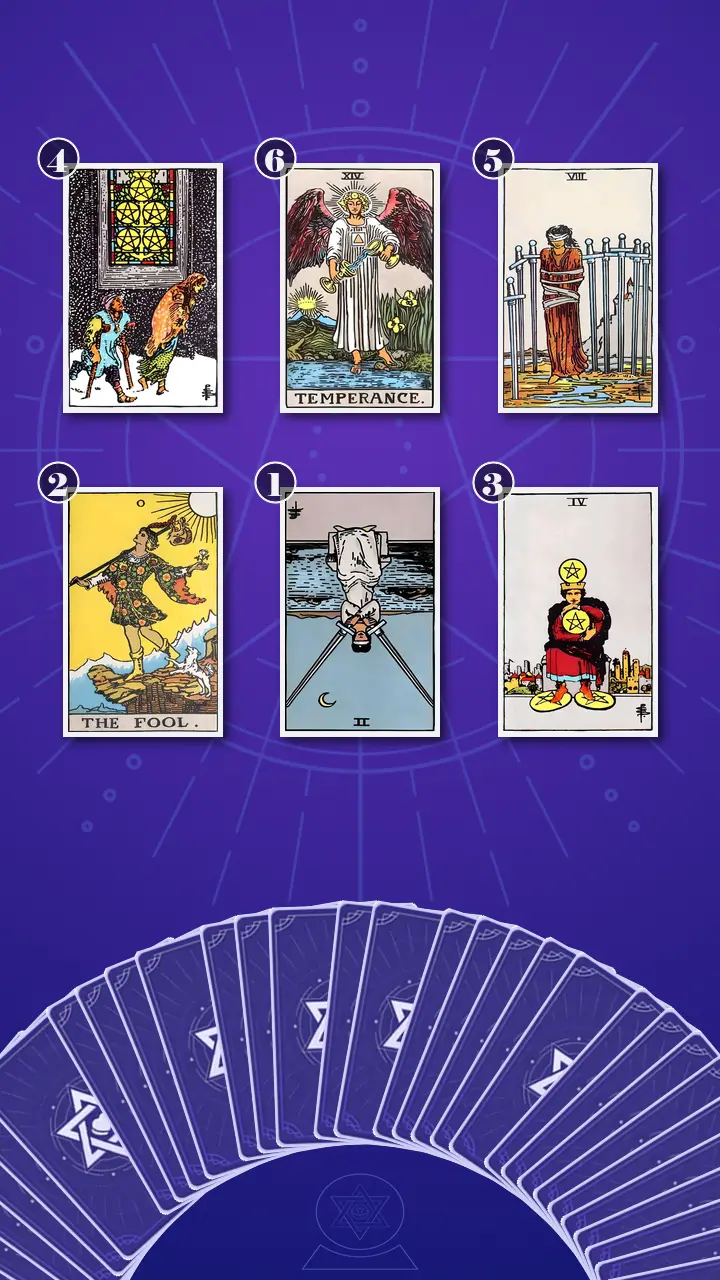
“For this question—grad school or stay in your job—I’m going to use a Decision Cross tarot spread,” I said. “It’s built for a two-path career crossroads. It doesn’t predict a single destined outcome. It makes both options visible, and it forces clarity on what each choice asks of you.”
For you reading this: that’s why this spread fits decision paralysis so well. When your mind is spinning, you don’t need a prophecy—you need a structure. The Decision Cross lays out: the exact stuck loop at the center, the energy of Option A on one side, Option B on the other, the real costs above each path, and then one integrating advice card at the top—like a north star. It turns “either/or” into “here’s what’s true.”
“The center card will show the current stuck point—how this indecision is behaving in you right now,” I told Taylor. “Then we’ll look at grad school, then staying, then the trade-offs. The final card is the integration: how to choose with self-trust rather than fear.”
Reading the Map: When Air Gets Jagged and Earth Grips Tight
Position 1 — The current stuck point: the exact loop you repeat
“Now flipped over,” I said, “is the card representing the current stuck point: the exact way the decision is presenting in behavior and mindset right now.”
Two of Swords, reversed.
In modern life, this card looks exactly like what you described: it’s late, and you’re toggling between your acceptance email, a tuition calculator, and LinkedIn. You keep telling yourself you’re being responsible, but your body stays braced—tight chest, restless energy—because the research isn’t leading to a decision. The real stall is emotional: admitting what you want (and what you fear losing) would make the choice real.
Reversed, the Two of Swords isn’t calm balance. It’s overexposure. Air energy in excess: too many threads, too many opinions, too many tabs. The blindfold frays, and instead of clarity you get glare—like staring at your screen until the white background feels aggressive.
I leaned in a little. “You’re not undecided because you’re careless—you’re undecided because you’re trying to guarantee you’ll never regret.”
Taylor let out a small laugh that had a bite to it. “That’s… too accurate. Like, kind of brutal.” She shook her head once, but her shoulders dropped a millimeter—an involuntary surrender.
“Let’s name the loop the way it actually runs,” I said, keeping it concrete. “There’s the rational voice listing metrics. There’s the body voice saying, ‘My chest is tight, I can’t settle.’ And there’s the fear voice whispering the real stake: ‘If I choose wrong, it proves I’m not in control.’ That’s why refreshing one more Reddit ROI thread never lands—you’re trying to solve an emotional risk with data.”
Position 2 — Grad school path: what it invites you into
“Now we’re looking at the grad school path: what this option is inviting you into psychologically and practically,” I said.
The Fool, upright.
This isn’t the card of guaranteed outcomes. It’s the card of stepping into a chapter where you learn by doing. The modern-life version is so familiar: you open the program website and feel a genuine spark—new skills, new people, the relief of being a beginner on purpose—then you instantly alt-tab to a master’s ROI debate like it’s a fire alarm.
Upright, The Fool is movement when your mind wants a five-year storyboard. It’s Air and Fire in balance: curiosity that doesn’t need to justify itself yet.
I watched Taylor’s eyes soften—surprising, like her face remembered what excitement feels like before it becomes a spreadsheet. “Yeah,” she said quietly. “That spark is real. And then I immediately punish it with numbers.”
“Two movies run at once,” I said. “One is the clean new beginning. The other is the fear montage: debt, awkward networking, being ‘behind.’ The Fool is asking a different question: not ‘Can I guarantee this?’ but ‘Am I willing to be learnable?’”
Position 3 — Stay in the job path: what it stabilizes
“Now flipped over is the stay-in-your-job path: what this option is offering and stabilizing,” I said.
Four of Pentacles, upright.
In real life, this is the predictable paycheck. It’s rent paid. It’s knowing how your week works. It’s the comfort of competence—being good at your job without having to be new.
But in the body, this card shows bracing. Earth energy in excess can become gripping: clutching the pentacle to the chest, holding your breath around your own stability.
“Stability is a resource,” I told her. “It’s not a cage—unless you never touch the lock.”
Taylor pressed her lips together and nodded once, slow. “I can feel where I grip,” she admitted. “I say no to things before they even happen because… what if I lose what I have?”
In my mind, I flashed to the planetarium’s orbital models—how bodies don’t stay stable by freezing. They stay stable by moving inside a pattern that makes sense. Sometimes the grip is the thing that destabilizes you.
Position 4 — The cost of grad school: the hard part you’d have to tolerate
“Now we’re naming the cost/challenge of grad school: what gets harder, what you’d have to tolerate, and what support you’d need,” I said.
Five of Pentacles, upright.
This card is the honest winter-in-the-city feeling: walking past a warm-lit building and hesitating to go in because you don’t want anyone to see you needing a seat. Grad school can bring a temporary hit to the usual markers of security—less income, a different timeline—while your feed is full of promotions and vacations.
Earth energy here isn’t “bad.” It’s strain. It’s the cost side of the ledger your nervous system is already calculating at midnight.
Taylor gave a sober nod—the kind that says, thank you for not pretending money doesn’t matter. “Yeah,” she said. “I’m scared I’ll be struggling while everyone else is… moving forward.”
“This is where pride can become a barrier,” I said plainly. “Five of Pentacles always asks: what support exists that you’re not letting yourself use? Scholarships bookmarked but not applied for. Part-time work options you haven’t priced out. A friend you could ask for a real talk about budgeting. The window is lit—but you have to allow yourself to go in.”
Position 5 — The cost of staying: the invisible constraint if nothing changes
“Now we’re looking at the cost/challenge of staying: what tightens, stagnates, or becomes a longer-term constraint if you don’t shift anything,” I said.
Eight of Swords, upright.
This card is the internal rules masquerading as facts. The modern-life scenario is: you tell yourself, “I can’t pivot without a master’s,” or “I can’t ask for new responsibilities,” or “It’s too late,” and those sentences quietly shrink your world until your job feels like a box.
Air energy here is blocked, not because the ropes are tight, but because the belief is. The bindings in the image are loose—meaning some constraints are real (money, contracts), and some are assumptions you’ve never tested.
I let the echo land by connecting it back to the first card. “Do you see how the blindfold shows up twice?” I asked. “Two of Swords reversed says you’re stuck because you’re trying to avoid the feeling of stakes. Eight of Swords says you’re stuck because you’re calling your assumptions ‘reality.’ If it takes perfect information to choose, you’ve made self-trust impossible.”
Taylor went still for a beat—breath held, eyes unfocused like she was replaying a memory—then she exhaled long. “Okay… yeah,” she said. “That’s the loop.”
When Temperance Poured Between Two Cups
Position 6 — Integration and decision guidance: how to choose with self-trust
“We’re turning over the integrating card now,” I said, and the room on my side of the screen felt quieter—as if even the planetarium dome was listening. “This is integration and decision guidance: the mindset and next-step approach that helps you choose with self-trust rather than fear.”
Temperance, upright.
Temperance is the alchemist. Not the dramatic leap, not the silent stall—the mix. In modern terms, it’s meal-prepping instead of trying to invent the perfect dinner for the rest of your life. It’s building a budget that fits your real life—not an imaginary ‘perfect adult’ spreadsheet.
Setup: Taylor was right back at 11:30 p.m. with three tabs open—acceptance email, tuition breakdown, LinkedIn—clicking like the next thread would finally unlock certainty, while the deadline quietly got louder. Her brain was treating the decision like a pass/fail exam she had to ace before she was allowed to move.
Delivery:
Stop demanding a flawless yes-or-no answer, start mixing a workable transition like Temperance pouring between two cups.
I let that sentence sit there for a second, like a bell tone you can still feel after it stops.
Reinforcement: Taylor’s reaction came in layers. First, a freeze—her mouth parted slightly, and her hand stopped mid-scroll over her trackpad. Then the idea seeped in: her eyes widened a fraction, not with excitement, but with recognition, like she’d just spotted the real pattern behind weeks of noise. Finally, her body released: shoulders lowered, a breath shuddered out of her chest, and she blinked hard once, like she was surprised by the sting of relief.
“But… if it’s a blend,” she said, and there was a flash of resistance—almost anger—like the part of her that had been working overtime didn’t want to be told it wasn’t necessary. “Does that mean I was doing it wrong this whole time? All the research?”
“No,” I said quickly, steady. “It means your mind was trying to protect you. Research became a safety behavior. Temperance isn’t shaming you—it’s upgrading the method. A decision is not a personality test. It’s a process.”
This is where my own framework clicked in—what I call Orbital Resonance. In astronomy, resonance isn’t about one perfect, irreversible collision. It’s about repeated, timed influences that either stabilize an orbit or slowly pull it off course. “Taylor,” I said, “your job and grad school aren’t two cliffs. They’re two possible orbits. The question isn’t ‘Which identity is correct?’ It’s: ‘Which rhythm can I sustain long enough to learn what I need to learn?’ Temperance is asking for a 90-day resonance test, not a forever verdict.”
Then I gave her a contained exercise—small enough to not spike the loop. “Let’s do a 10-minute Temperance Mix,” I said. “Timer on. Notes app. Two columns: Stability I refuse to lose and Growth I refuse to postpone. Exactly three items each—inputs you control, not outcomes. Then one tiny blend you can try this week. And if your brain tries to turn it into a life verdict, label it: ‘This is an experiment, not a prophecy,’ and end the exercise.”
I watched her nod as if the ground under her finally had texture again. “Okay,” she whispered. “That feels… doable.”
“Now,” I asked, gently but precisely, “use this new lens and look back at last week. Was there a moment where this would’ve changed how you felt?”
She swallowed. “Sunday night. LinkedIn. I was spiraling, and I kept thinking I had to pick the ‘right’ life. If I had been allowed to think ‘90-day experiment’ instead… I think I would’ve slept.”
That was the shift in real time: from fear-driven analysis paralysis and comparison anxiety to the first edge of grounded self-trust—naming trade-offs, designing a test period, and letting the nervous system stop bracing like the future is pass/fail.
The Temperance Mix Plan: Actionable Next Steps for the Next 90 Days
I summarized what the spread had built, piece by piece, into one coherent story: Two of Swords reversed showed the loop—research as control, control as fear of regret. The Fool revealed the real invitation in grad school: a learnable new beginning, not a guaranteed payoff. Four of Pentacles honored the truth of stability as a resource. Five of Pentacles named the short-term strain and the pride barrier around support. Eight of Swords exposed the invisible cost of staying without testing your assumptions. Temperance tied it together: a livable blend, paced on purpose.
“Your cognitive blind spot,” I told Taylor, “is that you’ve been treating this like a binary identity verdict. Grad school = brave. Job = safe. That frame makes everything feel like a trap door. The transformation direction here is simpler and harder: values over verdict. A defined test period over a perfect answer.”
Taylor frowned and then asked the most real question of the night: “But I don’t even have five minutes. I get home, I’m wiped, and then I end up researching because it feels like I’m at least doing something.”
“That makes sense,” I said. “So we’ll design the next steps to be small enough to start and bounded enough to stop.”
- The 30-Minute Research Window BoundaryPut one 30-minute research block on your calendar (example: Wed 7:30–8:00 p.m.). Outside that window: no tuition calculators, no rankings, no LinkedIn comparison loops. If a link appears, save it to a single “Later” note and close the tab.Your brain will protest: “This is too simplistic; I need more data.” Label it: “That’s the loop.” Then do one grounding action (water, short walk, or close the laptop for 5 minutes).
- The Two-Paragraph Values ChoiceIn your Notes app, write two short paragraphs: “If I choose grad school, I’m choosing…” and “If I stay, I’m choosing…”. Keep it values-based (learning, stability, autonomy, community), not outcome-based (guaranteed salary, prestige, perfect certainty).If you catch yourself writing like you’re defending your choice to LinkedIn, pause and rewrite one sentence in plain language you’d say to a friend.
- The 90-Day Temperance Test Period + One ConversationDraft a 90-day plan with: (1) one measurable learning goal, (2) one money guardrail (a number), and (3) one support action. Then schedule one 20-minute reality-testing conversation this week—either with a current student/alum about day-to-day budget realities, or with your manager about growth path and timeline.Use my “career visualization via elevator movement”: ask yourself, “Am I trying to switch buildings (grad school), or can I change floors (new responsibilities)?” One conversation is the elevator button—press it once, then see what opens.

A Week Later: Ownership, Not Certainty
Six days later, I got a message from Taylor while I was wiping fingerprints off a planetarium exhibit screen. “I did the 30-minute window,” she wrote. “And I wrote the two paragraphs. It was weirdly emotional. Also—I booked one chat with an alum. Just one.”
Then, in a second message: “I slept through the night. I woke up and my first thought was still, ‘What if I’m wrong?’—but this time I actually smiled. Like… I’m allowed to learn.”
That’s what clarity looks like most of the time: not fireworks, not total certainty. Just your chest unbracing enough to take one honest step. The tarot didn’t choose for her. It returned her to a rhythm she could trust—trade-offs named, supports allowed, and a plan paced like a stable orbit.
When you’re stuck between grad school and your job, it’s not that you can’t think—it’s that you’re trying to guarantee you’ll never regret, and your chest stays braced like your future is a pass/fail exam.
If you didn’t have to choose a ‘perfect identity’ this week—just a 90-day experiment you could actually live—what would you blend first: a little more growth, or a little more safety?