Mail Pile Anxiety and Decision Paralysis—And a Fair Triage Order

Finding Clarity at the Table-That’s-Also-Your-Desk
You pick up one envelope, put it back down, and open your bank app “for a second,” like the balance will magically tell you what your next move is.
Taylor (name changed for privacy) said it like a confession and a joke at the same time, the way New Yorkers do when they’re trying not to let something swallow the whole night.
It was 8:52 p.m. on a Wednesday on their side of the screen—small NYC apartment, radiator doing that aggressive hiss like it had opinions, keys dropped beside a mail pile on a table that had to be a desk because there wasn’t room for both. They pinched one envelope between two fingers, then their thumb did the familiar autopilot arc to their phone. The phone light turned their face a little bluish. Their stomach tightened hard enough that I could see them swallow around it.
“It’s like… money, health, or love,” they said. “I can’t tell which one I’m supposed to handle first. So I handle none of it. I’m not ignoring it, I’m just waiting until I have the bandwidth.”
I watched their shoulders inch upward as they spoke, like their body was bracing for impact even though nothing had happened yet. The feeling in the room—through pixels and time zones—was like standing on a subway platform while three trains arrive at once, all blasting their doors open, all demanding you pick a car right now. Craving clarity and stability… while fearing what the mail might confirm.
“That makes so much sense,” I told them, keeping my voice steady. “When your brain thinks one envelope could turn into ten problems, it tries to protect you by scanning everything at once. But we’re going to do something simpler today. We’re going to make a map. Not a life overhaul—just a path to clarity.”

Choosing the Compass: The Energy Diagnostic Map (7) Spread
I started the session the way I start night-sky tours for anxious school groups—by bringing attention back into the body, where time moves slower.
“Before we touch the cards,” I said, “let’s do three minutes of cosmic breathing. It’s not mystical. It’s just a reset.” I had them inhale as if pulling air up from the belly like a tide, pause, then exhale long and quiet, like dimming a planetarium dome one notch at a time.
Then I shuffled, slow and audible, the way you can hear paper become a decision. “Today,” I explained, “we’ll use a spread I call the Energy Diagnostic Map (7) · Context Edition.”
For you reading this: this spread works especially well for life-admin overwhelm—those moments when money, health, and love all feel urgent, and the nervous system treats your kitchen table like a courtroom. Instead of predicting a single outcome, the spread triages the system: what’s happening on the surface, what’s looping internally, what’s pressing from outside, what the real blockage is, what resource stabilizes you, what principle flips the situation, and what one next move creates momentum.
“We’ll scan the top row first,” I told Taylor, “to name what’s visible and what’s pushing you. Then we’ll drop into the root fear under it. Then we’ll sweep across the bottom row to find your resource, your pivot, and your next move.”
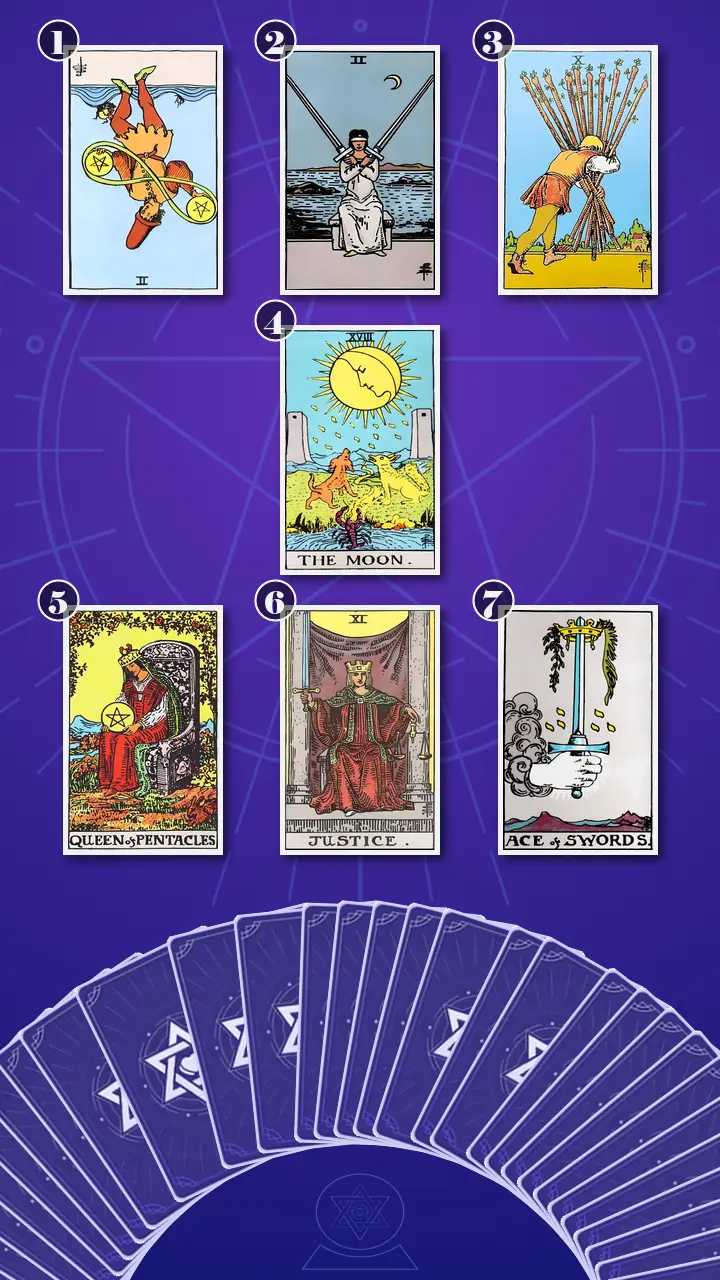
Reading the Map: From Open Tabs to One True Thing
Position 1 — Surface reality: the visible avoidance loop
“Now flipped over,” I said, “is the card that represents surface reality: what you’re visibly doing with the mail pile and how the overwhelm shows up in daily behavior.”
Two of Pentacles, reversed.
I angled the card toward the camera. “This is you at the table with the mail pile in front of you and three apps open—banking, a health portal tab, and your messages. You keep switching like a human browser refresh. It feels responsible. But it’s overload. The balancing act has tipped.”
Reversed, the Two of Pentacles isn’t “you can’t multitask.” It’s “multitasking has become a blockage.” The energy isn’t flexible anymore—it’s chaotic. Too many priorities, too little containment. The infinity ribbon in the card—the loop around the coins—looked exactly like the mental loop Taylor described: money/health/love, money/health/love, as if one of them would crown itself the correct first choice if they just rotated the options fast enough.
Taylor let out a small laugh that didn’t reach their eyes. “That’s… too accurate. Honestly, it’s a little rude.” The laugh cracked into something bitter at the end, and their fingers started restacking the envelopes like they were smoothing a wrinkle out of their own nervous system.
“I know,” I said gently. “And I want you to hear this part clearly: you’re not behind in life—you’re just carrying too many open tabs.”
Position 2 — Inner tug-of-war: the stalemate behind “bandwidth”
“Now we’re looking at your inner tug-of-war: the specific indecision loop between money, health, and love priorities,” I said, and turned the next card.
Two of Swords, upright.
“This is the blindfold,” I told them. “The ‘I’ll deal with it when I have bandwidth’ move. It’s information fasting—but not for productivity. It’s anxiety management.”
I kept it practical: “You hover over the first envelope and your brain splits into three arguments: money is urgent, health is important, love is emotionally loud. To stay calm, you choose nothing—and call it ‘waiting.’ But the cost shows up later as fees, missed appointments, and spiraling over unanswered messages.”
Taylor’s mouth tightened at that. They looked away from the camera for a beat, like they were replaying a week in fast-forward.
“If you don’t pick a priority,” I said, “your anxiety will pick one for you.”
They nodded once, small and reluctant. Not agreement as a performance—recognition, like a bruise being pressed.
Position 3 — External pressure: the load you’re already carrying
“Now flipped over,” I said, “is the card that represents external pressure: deadlines, expectations, and environmental stressors that amplify avoidance and urgency.”
Ten of Wands, upright.
“After a day of Slack pings and deadlines, you get home with zero capacity left,” I said. “The mail pile isn’t objectively huge. But it feels like the final weight on a too-full backpack. You’re carrying money admin, health follow-ups, and relationship ambiguity in your head—so each envelope feels heavier than it is.”
This is Fire energy—effort, strain, the posture of someone still pushing when the body is already done. I watched Taylor rub a hand over the back of their neck. Their shoulders were still up by their ears, like the card had reached through the screen and placed its bundle of sticks on them.
“It’s not a moral failing,” I added. “It’s a load problem.”
Position 4 — Core blockage: The Moon and the worst-case trailer
“Now we go underneath,” I said, “to the card that represents the core blockage: the deeper psychological fear that makes opening and sorting the mail feel emotionally risky.”
The Moon, upright.
In my Tokyo planetarium, I’ve watched thousands of people tense up when the room goes dark—even though the dark is the whole point. The Moon in tarot is that same nervous-system moment: dim light turns ordinary shapes into threats.
“Here’s the lived version,” I said. “You stare at an envelope and your mind runs a full catastrophe simulation: late fees, bad news, a call you can’t handle, a spiral that ruins your week. None of it is confirmed—yet it feels real enough to trigger avoidance. The mail becomes a screen your anxiety projects onto.”
I leaned into the contrast the card demanded: “Facts are printed ink on paper. Stories are your brain filling in blanks with: ‘If it’s bad, it means… and if it means…, then…’”
“Ambiguity isn’t evidence,” I said softly. “It’s just empty space your brain loves to fill.”
Taylor’s reaction came in three steps, quick and unmistakable: their breath snagged like a tiny freeze; their gaze went unfocused for a second, like they were watching those internal trailers; then they released a quiet, surprised “oh.” Their shoulders dropped a fraction—relief, not because the mail was solved, but because the pattern finally had a name.
“I do that,” they whispered. “I make it mean I’m going to lose the whole week.”
“Exactly,” I said. “And we’re going to change the lighting.”
Position 5 — Usable resources: building a soft container
“Now flipped over,” I said, “is the card that represents usable resources: practical support, inner strengths, and conditions that help you regulate and act.”
Queen of Pentacles, upright.
“This is the opposite of a midnight panic sprint,” I told them. “It’s warm lamp light. Tea. A cleared space. One pen. You treat life admin like something your body can be safe doing.”
I described it in sensory terms, because the Queen is Earth: “Harsh overhead light off. Warm lamp on. Sticky table wiped. Keys in one bowl. The goal isn’t to fix your whole money/health/love life tonight. It’s to make the next 20 minutes doable so you actually follow through.”
Taylor exhaled—small, like their ribs finally found room. “That… makes it feel less like punishment,” they said.
“Good,” I replied. “The Queen isn’t here to shame you into productivity. She’s here to give you containment.”
When Justice Spoke: The Editor in Your Apartment
Position 6 — Key transformation: the fair rule that flips the whole system
I let the room go a little quieter before turning the next card. Even over video, I could feel the shift—the way a planetarium hush changes when the stars appear.
“We’re flipping the key card now,” I said. “This represents the key transformation: the mindset or principle that turns confusion into a fair, workable plan.”
Justice, upright.
“This,” I said, “is clarity through honest accounting and clean decisions. Not punishment—reality. In a question centered on mail, Justice is basically a grown-up sword and scales saying: paperwork, boundaries, consequences… and the relief of knowing what’s true.”
Then I used the metaphor that always lands for city people with too many storylines open: “Justice is the editor of your life. She crosses out extra subplots so the story can finally move forward. Mood-based prioritizing—‘what feels least awful’—keeps the plot stuck. Reality-based triage—‘what has a deadline’—moves it.”
And this is where my astronomy brain always shows itself. In orbital mechanics, a spacecraft doesn’t always need more fuel. Sometimes it needs a gravity assist—one clean slingshot around a planet that changes the entire trajectory. “Justice is a gravity assist,” I told Taylor. “A simple rule can change the long-term path without you having to white-knuckle every moment.”
They were right back in the familiar trap: the moment they see the pile, their brain tries to solve money, health, and dating all at once—so they open their phone “for a second” and suddenly it’s 11:46 p.m. and nothing is actually handled.
Stop treating the pile like a verdict and start treating it like a set of items to weigh; pick a fair order with Justice’s scales and make one clean cut with the sword.
I let the sentence sit. No rushing to soften it. Just space.
Taylor’s face did that micro-shift I’ve seen in the planetarium when someone realizes the “stars” above them are a map, not a ceiling. First: their eyebrows lifted slightly, like disbelief. Second: their jaw unclenched, slow, almost reluctant. Third: their eyes glassed just a bit—not dramatic tears, just the sheen of something finally landing in the body.
They blinked hard. Their hands, which had been gripping the edge of the table, loosened. The envelope they’d been pinching fell flat, no longer held like it was dangerous.
“But… if I make a rule,” they said, and there was a flash of irritation, sudden and honest, “doesn’t that mean I was doing it wrong this whole time?”
I nodded. “That’s the part that stings. And here’s the reframe: you weren’t doing it ‘wrong’—you were doing it the only way your nervous system knew how to keep you from a spiral. Justice isn’t a scold. Justice is accountability without self-punishment.”
I watched them take one deeper breath, like their lungs finally got permission to expand. Then the vulnerability after the release: their eyes went distant for a second, like standing on firm ground after being on a boat.
“Now,” I said, “with this new lens—editor, scales, sword—think back to last week. Was there a moment when you touched the pile, felt the stomach drop, and went to your bank app or Instagram instead? What would have changed if you’d only decided the order of operations, not your whole life?”
Taylor stared at the table and whispered, “Sunday. I opened one letter and saw a date. I could’ve just… circled it. Instead I spiraled.”
“That’s the shift,” I said. “From dread-driven avoidance and context-switching to steadier calm and agency. Not by feeling ready—by following a fair rule.”
Position 7 — Next move: the one sentence that cuts through the noise
“Now we flip the last card,” I said, “representing your next move: one concrete, actionable step you can take immediately to create momentum and clarity.”
Ace of Swords, upright.
“One raised sword,” I told them, “equals one instruction you can actually follow.”
I made it painfully specific, because the Ace doesn’t do vibes—it does sentences. “You write one sentence on a sticky note—big letters—like a script: ‘Open all envelopes and identify anything due within 7 days.’ Then you do only that. No side quests. No symptom Googling. No banking app refresh loop. No re-reading texts to decode them.”
Taylor’s eyes flicked to their Notes app, then back to me. I could almost hear their brain trying to negotiate a second step. I kept the channel narrow on purpose.
“One sentence,” I said. “One timer. One next move.”
The Justice → Ace Sprint: Actionable Advice for Life-Admin Overwhelm
I pulled the whole spread together for them, the way I’d summarize a night-sky show: what you’re seeing isn’t random—it’s a system.
“Here’s the story your cards are telling,” I said. “On the surface, you’re juggling too many priorities at once (Two of Pentacles reversed). Internally, you’re protecting your mood by refusing to choose a first priority (Two of Swords). Externally, you’re already carrying a full load from work and city life (Ten of Wands). Underneath it all, uncertainty turns into worst-case trailers (The Moon), so the pile becomes a threat. Your resource is a soft container—calm environment, body safety, simple ritual (Queen of Pentacles). Your turning point is a written, fair triage rule (Justice). And your next move is a single sentence you follow like a script (Ace of Swords).”
“The blind spot,” I added, “is that you’ve been treating prioritizing like a referendum on your worth—like picking money first means you’re neglecting love, or picking health means you’re failing at adulthood finances. But prioritizing isn’t morality. It’s navigation.”
In my head I saw it as interstellar guidance—attitude thrusters making tiny corrections so you don’t drift for miles. “The transformation direction,” I said out loud, “is moving from ‘I must solve all three categories today’ to ‘I will choose one clear priority and complete one contained action before switching contexts.’ A fair rule beats a perfect mood.”
I gave Taylor—and you—three low-friction next steps, designed to work even when your stomach is tight and your thumb wants to open an app.
- The 12-Minute Three-Pile SortSet a 12-minute timer. Without opening anything else, make three piles labeled MONEY / HEALTH / LOVE. Put your phone in another room or on Do Not Disturb for the full 12 minutes.Your brain will call this “not enough.” That’s the old all-or-nothing pattern. Stop when the timer ends—you’re allowed to stop.
- Write the Justice Rule Where You Can See ItOn paper, write one triage rule: “Deadlines first.” Tape it to the table or place it on top of the pile. Then open envelopes only enough to find dates/amounts/required actions—no deep processing yet.If anxiety spikes, create a folder called “Later (Not Today).” Choosing later is still a choice.
- One-Sentence Next Instruction (Ace of Swords)Write one sentence in big letters: “Open all envelopes and identify anything due within 7 days.” Do only that before you reassess. No Googling, no banking app, no texting.If you catch yourself adding “and then I’ll…,” you’re multiplying the task. You’re not allowed to add step two until step one is done.

A Week Later: Ownership, Not Certainty
Six days later, Taylor messaged me a photo: three piles on the same table, but the table had a one-foot square of empty space—like land finally visible after a storm tide.
“I did the ‘deadlines first’ thing,” they wrote. “Ten minutes. I found two bills due next week and one health portal letter that was literally just a reminder. I circled dates. That’s it. Then I stopped. And I didn’t hate myself.”
It was light and a little lonely in the way new habits can be—no confetti, no cinematic transformation. Just a quiet proof: they slept a full night, and in the morning their first thought was still, “What if I mess it up?”—only this time they added, “I can handle one true thing,” and got out of bed anyway.
That’s the Journey to Clarity I trust: not certainty, but agency. Not a perfect week, but a fair rule you can follow when the radiator hisses and the phone tries to pull you into ten tabs again.
When the table starts to feel like a verdict, your body braces—tight stomach, shallow breath—because part of you is scared one envelope will prove you’re not actually in control of your own life.
If you trusted yourself to handle just one true thing tonight, what’s the smallest, fairest rule you’d write down so you don’t have to keep renegotiating with your fear?