From Life-Reset Overwhelm to a 7-Day Two-Anchors Rhythm You Can Keep

Finding Clarity in the 10:06 p.m. Scroll
You’re the kind of early-career city professional who can build a gorgeous Q2 dashboard in Notion… and still feel weirdly unable to start the first 15-minute task on Monday (hello, decision paralysis).
Jordan showed up to our session with that exact energy—the kind that looks polished from the outside and feels like static in the chest on the inside. They’re 27, non-binary, a marketing strategist in Toronto, and they said their new quarter starts Monday like it’s a starting gun.
They described their Sunday night like a scene you can almost hear: 10:06 p.m., cross-legged on the couch, laptop balanced on a throw pillow. Notion open. Google Calendar open. Phone face-up with three productivity apps waiting to be “set up.” The apartment is quiet except for the fridge hum and the faint buzz of street noise—yet their calendar, somehow, sounded loud.
“I keep rewording the same goal to sound more serious,” they admitted. “I just need to start the quarter the right way.”
I watched their shoulders creep up toward their ears as they talked, like their body was bracing for impact. That particular kind of overwhelm isn’t just stress; it’s like trying to tune a radio while someone keeps changing the station—your hands never stop moving, but you never land on a signal.
“I hear you,” I said gently. “Wanting a clean, confident reset—and also fearing that if you start imperfectly you’ll waste the quarter and confirm you’re not disciplined… that’s a real bind. Let’s not force a perfect answer tonight. Let’s make a map. This is a Journey to Clarity, not a performance review.”

Choosing the Compass: Celtic Cross · Context Edition
Before I read, I always do one small thing that’s more practical than mystical: I help people transition from spinning to focusing. “Three minutes,” I told Jordan. “No fixing. Just breathing.”
It’s one of my go-to tools—pre-meeting 3-minute cosmic breathing. In the planetarium, we dim the lights so the stars can appear. In real life, we do the same thing with the nervous system.
We inhaled slowly, like drawing breath into the ribs, and exhaled longer than we wanted to. I shuffled while they held their question: New quarter starts Monday—what should my life reset begin with?
“Today I’m using a spread called the Celtic Cross · Context Edition,” I said. “It’s based on the classic Celtic Cross, which is basically tarot’s best ‘diagnostic chain’ for feeling stuck: what’s happening now, what’s blocking you, what’s underneath it, and how your inner and outer world feed the loop.”
To you, reading this: this is how tarot works when it’s practical. We’re not predicting some fixed fate. We’re mapping a pattern—so you can change what you actually control: your first move, your rhythm, your next steps.
“In this version,” I continued, “we tweak two positions to fit your exact question. One card becomes your quarter’s guiding quality—what to lead with. And another becomes a one-week entry action, to stop the ‘planning instead of starting’ loop.”
I pointed to the center of the spread. “Card 1 will show your reset moment right now—the pattern that’s most visible as Monday approaches. Card 3 will reveal the belief under the pressure. And Card 5—your north star—will give us the first principle to build the whole quarter around.”
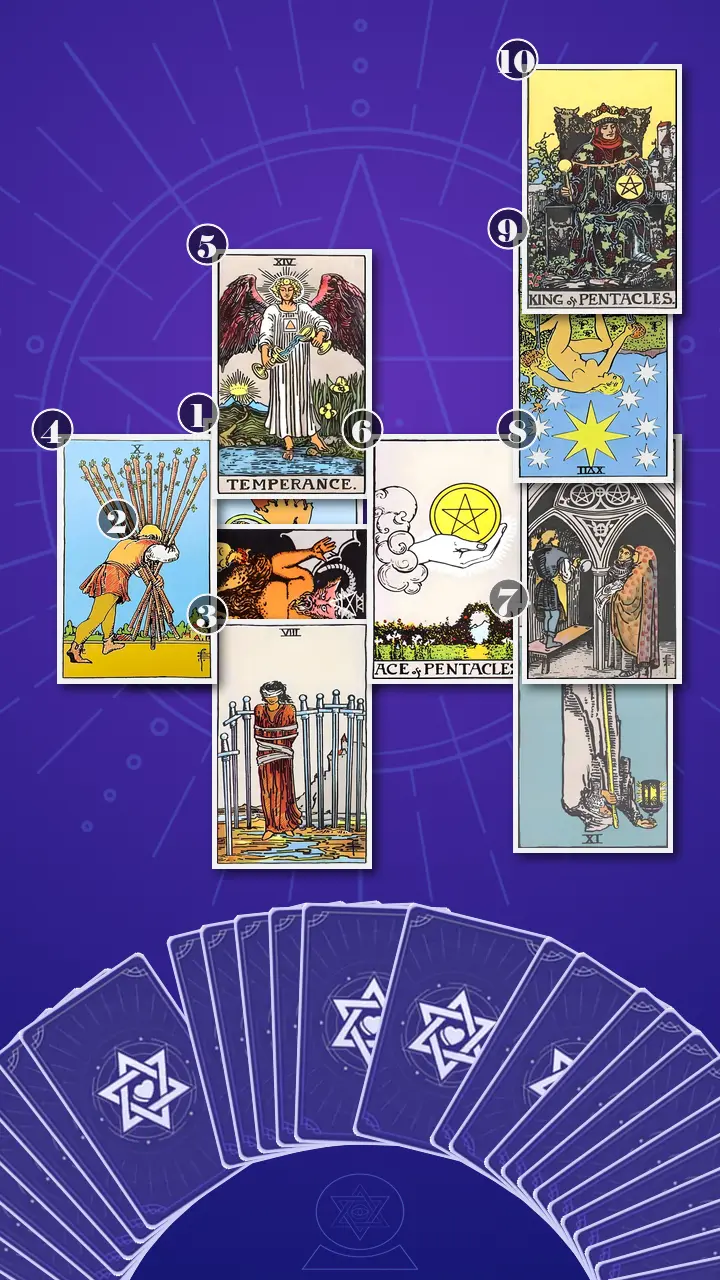
The Crossroads on Your Screen: Reading the First Four Cards
Position 1 — The reset moment right now
“Now we turn over the card representing the reset moment right now: the most observable pattern you’re in as Monday approaches.”
Two of Pentacles, reversed.
I didn’t even need to reach for poetic language—this card already speaks fluent Toronto-Sunday-night. “This is Sunday night you’re juggling three systems at once—Notion, Google Calendar, and a habit app—dragging blocks around until the week looks ‘clean,’” I said. “You feel busy and competent, but Monday still has no single first action.”
Reversed, the Two of Pentacles isn’t balance; it’s imbalance. Not incompetence—more like the energy is overextended. The infinity loop on the card becomes endless re-prioritizing: movement that looks productive but keeps you in the same place.
Jordan let out a small laugh that landed somewhere between recognition and exhaustion. “That’s… brutal,” they said. “Because it’s true. I’ll spend an hour color-coding and then I’m like… why do I feel worse?”
“Because planning can be a comfort behavior, not a strategy,” I said. “It soothes the fear for a minute. But it doesn’t give your body the relief of traction.”
Position 2 — The main obstacle crossing momentum
“Now we turn over the card representing the main obstacle: what specifically crosses your momentum and keeps the reset from beginning.”
The Devil, upright.
“The obstacle isn’t time,” I said, and I watched Jordan’s eyes sharpen, like they expected a scolding. “It’s the grip of the ‘optimize me’ loop. You refresh productivity content for the routine that will guarantee you won’t fail, then feel more behind and more compelled to keep searching.”
The Devil upright is compulsion—a blocked freedom. In modern life, it’s the moment you tell yourself you’re going to choose your quarter focus on the TTC… and your thumb opens TikTok anyway because the algorithm feels like it might hand you certainty.
I tapped the card lightly. “See the chains? They’re loose. This pattern stays powerful because it promises relief. But it costs you your agency.”
Jordan swallowed and looked away from the screen for a second. Their jaw tightened—so small you might miss it. “It’s like… if I just find the right system, I won’t mess it up,” they said.
“Exactly,” I replied. “And that’s why it feels so high-stakes. The reset stops being about your life and starts being about proving you have control.”
Position 3 — The underlying driver beneath the pressure
“Now we turn over the card representing the underlying driver: the belief or fear beneath the reset pressure.”
Eight of Swords, upright.
This was the heart of it. “You treat Monday like a one-shot decision that will define the whole quarter,” I said. “So you freeze until you feel certain. The ‘right system’ becomes your requirement for safety.”
The Eight of Swords upright is a deficiency of perceived options—not because options aren’t there, but because the mind has narrowed itself. The blindfold is certainty-seeking: I can’t move unless I can guarantee I’m moving correctly.
I brought Jordan into a scene they’d already described without realizing it: “It’s midweek, you’ve got a 15-minute gap between meetings, you open the doc titled ‘Q2 Plan’… and your cursor blinks like it’s judging you. Your brain starts negotiating: ‘If I pick wrong, I’ll waste weeks. If I pick right, everything will finally click.’ So you close the doc and answer low-stakes emails because it’s safer.”
Jordan nodded tight—one of those nods that’s more like the body admitting the truth before the ego can edit it. “Oh wow,” they whispered. “That’s exactly what happens.”
“And it’s not laziness,” I said, steady. “It’s a protective strategy that got too expensive.”
Position 4 — What you’re carrying in from last quarter
“Now we turn over the card representing what you’re carrying in: what last quarter taught—or drained—you that shapes how you approach a reset.”
Ten of Wands, upright.
“Last quarter ended with you carrying too much alone—backlog, shifting priorities, and the feeling that your open work time got eaten alive by meetings,” I said. “So the new quarter arrives with urgency: you want a reset to fix everything at once, because you’re already tired of carrying it.”
This card’s energy is excess—too much load, too little visibility. The wands literally block the figure’s view. That’s what burnout does: it turns the next step into a fog because your arms are full of the whole quarter at once.
Jordan exhaled through their nose. “I feel like I’m always late to my own life,” they said.
“That line matters,” I told them. “Hold onto it. We’re going to give you a way to arrive without sprinting.”
When Temperance Spoke: Measured Pours, Not a Verdict
I paused before the next card. In the planetarium, there’s a moment right before the stars appear—when the room is dark enough that even a whisper feels like motion. That’s what the air felt like on our call.
“Now we turn over the card representing your north-star intention for the quarter: the quality to lead with (not a predicted outcome).”
Temperance, upright.
Jordan’s shoulders were still high, like they were waiting to be told they needed to become a new person by Tuesday. Temperance doesn’t do that. Temperance is the opposite of a makeover.
“Your reset begins by choosing a sustainable rhythm and letting it calibrate everything else,” I said. “A pace you can keep even when meetings shift. One foot on land, one foot in water: work reality and actual energy capacity.”
They blinked hard, like their brain tried to reject how… reasonable that sounded. They were still trapped in Sunday night logic—new template, new app, new routine video—trying to find the one setup that would make Monday feel safe.
Stop treating the quarter like a test you must ace, and start blending your life in small measured pours—Temperance over extremes.
I let that sentence hang. The way you pause after a planetarium show when the fake stars turn off and everyone remembers their own body again.
Jordan’s reaction came in layers—exactly the way real insight arrives, not like a movie montage. First, their breath snagged, almost a freeze. Then their eyes lost focus for a second, as if they were replaying every “fresh start” they’d ever tried to perfect. Then, slowly, their shoulders dropped a full inch and their hands unclenched in their lap.
“But if I don’t go hard at the start,” they said, voice tight, “doesn’t that mean I’m… lowering the bar? Like I’m admitting I can’t do it?”
There it was—the hidden fear under the reset fantasy.
“No,” I said, and I kept my tone soft because this part bruises easily. “This quarter isn’t a test to ace—it’s a rhythm to calibrate. Temperance isn’t ‘lowering the bar.’ It’s choosing a bar you can actually lift repeatedly. In orbital mechanics, we don’t change a spacecraft’s entire trajectory by lighting every engine at once. We use small, timed adjustments—sometimes even a gravity assist—to get a huge long-term shift with less fuel.”
That’s my Gravity Assist Simulation: I help someone evaluate long-term choice impacts by imagining the quarter as a trajectory, not a verdict. “A dramatic Monday might feel powerful,” I continued, “but it burns fuel and makes you crash. A measured pour—done seven times—changes the orbit.”
Jordan nodded again, but looser this time. Their eyes watered, then they laughed once, quietly, like the relief surprised them. “Okay,” they whispered. “That… actually feels doable.”
I leaned in. “Now, with this new lens, think back to last week. Was there a moment—maybe midweek, cursor blinking in that doc—where this insight could’ve changed how you felt? Where ‘measured pour’ could’ve replaced ‘perfect plan’?”
Jordan looked down and then back up. “Wednesday,” they said. “I had seventeen minutes between meetings and I told myself it wasn’t enough time to start anything real. I could’ve… just started. Even five minutes.”
“That’s the shift,” I said. “Not from chaos to perfection. From ‘certainty or nothing’ to ‘small and real.’”
The Offered Coin: A Start Small Enough to Survive Monday
Position 6 — Your day-one entry point within the next 7 days
“Now we turn over the card representing your day-one entry point: the smallest concrete start you can make within the next 7 days.”
Ace of Pentacles, upright.
“This is the offered coin,” I said. “Day one looks like one tangible, repeatable action: write one priority on paper, set a 10-minute timer, and take the first step before you open Slack or tweak your planner.”
The Ace of Pentacles is balance turning into matter. It’s the seed, not the system. And here’s the line I wanted Jordan to borrow when the Devil tried to tempt them back into optimization: “Small counts because it repeats.”
Jordan’s hand drifted toward their phone almost involuntarily. “I could literally set a timer,” they said, more to themselves than to me.
“Yes,” I replied. “You don’t need a better system—you need a starter you’ll actually do on a messy day.”
Position 7 — How you’re showing up internally
“Now we turn over the card representing how you’re showing up internally: self-image and the stance you take toward change.”
The Hermit, reversed.
“Internally, you’re cut off from your own signal,” I said. “You keep collecting other people’s routines and advice, but you don’t give yourself quiet space to notice what actually restores you. So the reset is built on borrowed certainty—no wonder it never fits.”
Reversed Hermit energy is blocked inner guidance. It’s the feeling of being surrounded by information and still not having a lantern. And if you’ve ever watched The Bear, you know that frantic competence that’s still not calm. That’s this card.
Jordan’s mouth pulled into a tiny, rueful smile. “I have… so many saved videos,” they admitted. “And none of them know my actual calendar.”
“Exactly,” I said. “No influencer has your meetings.”
Position 8 — The environment shaping the reset
“Now we turn over the card representing the environment: social, work, and practical factors shaping your reset.”
Three of Pentacles, upright.
“Support exists,” I told them. “Your reset doesn’t have to be a solo reinvention. This is a build—like a craft—so feedback and structure help more than private perfection.”
This is balance through collaboration. A shared blueprint. A realistic container. The opposite of the Hermit reversed spiral where you isolate with your apps and call it ‘self-improvement.’
Jordan’s eyes lifted. “I could tell my friend Sam,” they said. “Just… that I’m trying something simple. Not a whole glow-up.”
“That’s Three of Pentacles energy,” I said. “Witness, not hype.”
Position 9 — Hopes and fears about what the reset will prove
“Now we turn over the card representing your hopes and fears about the reset: what you want it to prove, and what you worry it will prove.”
The Star, reversed.
“You want the reset to restore hope,” I said, “but you’re scared you won’t feel inspired fast enough. So you move the goalposts. You scroll highlight reels and conclude your start has to look dramatic to count.”
Reversed Star energy is blocked faith—not because you’re hopeless, but because you’ve been trained to confuse hype with progress. It’s comparison fatigue. It’s the feeling that unless your Monday looks like a YouTube morning routine montage, it doesn’t count.
Jordan’s brow furrowed. “I hate that I do that,” they said. “But I do.”
“We don’t have to hate it,” I said. “We can just see it. And then choose something else.”
Position 10 — Integration if you stay consistent with the first principle
“Now we turn over the card representing integration: what becomes possible when you begin with the right first principle and stay consistent.”
King of Pentacles, upright.
“This is where you’re headed when you begin with measured rhythm and a tangible seed,” I said. “Calm stewardship. Fewer but sturdier rituals. Clearer priorities. A body-level sense of, ‘I can handle my life.’”
The King’s energy is balanced mastery. Not flashy. Not optimized. Reliable. And the way he holds the pentacle—calm grip, no strain—that’s self-trust you can feel, not self-trust you promise yourself in a planner.
From Insight to Action: Your 7-Day Reset Container
Here’s the story the whole spread told me—simple, but specific: last quarter left you overloaded (Ten of Wands), so you tried to protect yourself with planning (Two of Pentacles reversed). But planning turned into a compulsion to control and prove worth (The Devil), reinforced by a belief that you can’t begin without certainty (Eight of Swords). Temperance interrupts that by offering a new first principle—moderation and integration—then the Ace of Pentacles turns it into something you can touch on day one. The environment supports you when you let it (Three of Pentacles), and your hope comes back when you stop demanding instant inspiration (Star reversed) and build evidence. That’s how you grow into the King of Pentacles: steady, not extreme.
Your cognitive blind spot is that you’ve been treating the new quarter like a pass/fail test—something you must start perfectly so you don’t “confirm” you lack discipline. That pressure makes the calendar feel like a courtroom. You keep trying to present a case for every task before you’re allowed to begin.
The transformation direction Temperance asks for is different: shift from designing the perfect reset to choosing one sustainable starting ritual and repeating it for seven days. Think of it as interstellar navigation: you don’t need to know the whole route to adjust your heading. You need a reliable first burn, then a series of small course-corrections.
Here are your next steps—small enough to start, structured enough to calm the nervous system:
- The “Two Anchors” sticky note (7 days)Tonight, choose ONE work anchor and ONE personal anchor. Write them on a sticky note (or your phone lock screen). On Monday–Sunday, do those two anchors before you open Notion, reorganize your calendar, or set up a new habit tracker.If you feel the urge to optimize, say: “Small counts because it repeats.” You’re not banning planning—you’re putting it behind a gate.
- Minimum Viable Monday (10–25 minutes)On Monday morning: (1) drink a glass of water, (2) write today’s single priority on paper, (3) set a 10-minute timer and do the first step of that priority before Slack/email.Make it almost laughably easy. If your calendar is packed, do the 5-minute version. Miss a day? Don’t restart your life. Just do the next repetition.
- The nightly “Evidence List” (5 minutes)For seven nights, write three tiny actions you completed (send one email, opened the doc, took a walk, did 10 minutes). Keep it painfully small on purpose. This is how you rebuild hope without needing a dramatic glow-up.When your mind says “that’s too small to count,” answer: “It counts because it’s real.” Proof beats motivation.
Jordan hesitated here—the practical obstacle finally surfacing. “But what if I literally don’t have ten minutes,” they asked, “because my morning is just meetings and commute and—”
I nodded. “Then we do Spacecraft Attitude Adjustment,” I said. “When a craft can’t change course fast, it changes orientation first. Your five-minute version is an attitude adjustment: water, write one priority, open the doc, type one sentence. That’s enough to break the spell.”

A Week Later: Ownership, Not Certainty
A week later, Jordan texted me a photo: a slightly wrinkled sticky note on their desk. Two anchors. Nothing aesthetic. No perfect dashboard. Under it, a simple line: “Did the 10 minutes before Slack. Again.”
They added: “I still get the buzzy chest sometimes. But now I know what to do with it.”
They didn’t sound like a new person. They sounded like themselves—with a steadier grip.
Clear but vulnerable looked like this (and it was enough): they slept a full night, then woke up and thought, “What if I mess this up?”—and this time they smiled a little, set a 10-minute timer, and started anyway.
That’s what I love about this kind of tarot reading: not vague reassurance, but a real shift in trajectory. Not certainty—ownership. Not a perfect plan—an experiment that builds self-trust.
When a new quarter shows up, it can feel like your chest goes tight because you want a clean, confident reset—but you’re quietly scared that one imperfect Monday will ‘prove’ you don’t have control.
If you let this quarter be a seven-day experiment instead of a pass/fail test, what’s one small starting ritual you’d be willing to repeat—just long enough to build proof that you can trust yourself?
Every reading at AceTarot is a Journey to connect with inner wisdom and empower next step.
Learn more about our Journey to Clarity.