My “Practical” Choice Was Fear: How I Chose Terms Over Nostalgia

Finding Clarity in the 8:57 p.m. Screen Glow
If you’ve reread old performance feedback like it’s courtroom evidence, trying to figure out whether you were the problem or the workplace was, while your rent and grocery costs keep climbing—this offer will hit like relief and threat at the same time.
Jordan showed up on my screen from Toronto with that exact look: not crying, not smiling—just braced. They were on their couch, laptop balanced on their knees. The room was lit by that cold, unforgiving screen glow, and even through the mic I could catch the faint hum of traffic outside, like the city was refusing to let them have a quiet thought.
“I opened the draft to reply,” they said, voice careful. “Five minutes. That was the plan.”
I watched their cursor flicker. Instead of the email, an old performance review PDF sat open, highlighted like a study guide for an exam that never ends. Their jaw worked once—clench, release, clench. “I keep telling myself it wasn’t that bad,” they added, “but then my stomach drops when I picture my old calendar and Slack notifications.”
Their old boss had offered them the job back. A familiar salary bump. A familiar title. And the part of Jordan that could hear “Toronto rent” in every grocery receipt wanted to exhale and say yes.
But another part of them—smaller, quieter, more honest—remembered what it cost to earn that kind of “safety.”
Part of them wanted the familiar job back for security because uncertainty felt like a cliff edge. Part of them feared they’d repeat the same power dynamics and self-abandoning choices that made them leave because their body still remembered the pressure.
The doubt in them didn’t feel like a thought. It felt like trying to breathe through a hoodie pulled half over your face—enough air to function, not enough to feel alive.
“You don’t miss the job,” I said gently, “you miss the certainty.”
They blinked hard, like that sentence had put a name tag on something that’d been pacing around their apartment for days. “Yeah,” they whispered. “That’s it.”
I leaned in, the way I used to on transoceanic voyages when a traveler would sit across from me and finally admit the question behind their question. “Let’s try something together,” I said. “Not to force a yes or no tonight—just to give the fog a shape. We’re here for a Journey to Clarity: a way to see what pattern is getting replayed, and what your next clean step could be.”

Choosing the Compass: The Celtic Cross · Context Edition
I asked Jordan to take one slow breath—not as a mystical ritual, just as a nervous-system handrail. Then I shuffled. The sound of the cards has always reminded me of water against a boat hull back home in Venice: steady, honest, not trying to impress anyone.
“For this,” I said, “I’m going to use a spread called the Celtic Cross · Context Edition.”
If you’ve ever Googled how tarot works in the middle of a career crossroads, here’s the practical reason this spread fits a situation like “my old boss offered my job back.” It maps a chain: what’s pulling you now, what complicates your agency, what deeper script is underneath, what you already walked away from, and what an integrated next step looks like—without making it fatalistic.
This version is a Context Edition for two reasons: we read position 6 as the next 2–4 weeks decision climate (because paralysis is part of the problem), and we read position 10 as integration rather than “final outcome” (because the point is empowerment and actionable advice, not a verdict).
I also told Jordan what to expect so their mind wouldn’t try to control the process by guessing it. “The first card will show the current pattern being activated. The crossing card shows what’s hooking you—temptation, pressure, attachment. The root card will name the old authority script under this. And the last card will show what becomes possible when you choose from boundaries, not nostalgia.”
Jordan nodded, hands wrapped around a mug they’d probably reheated twice. “Okay,” they said. “I can do a map.”
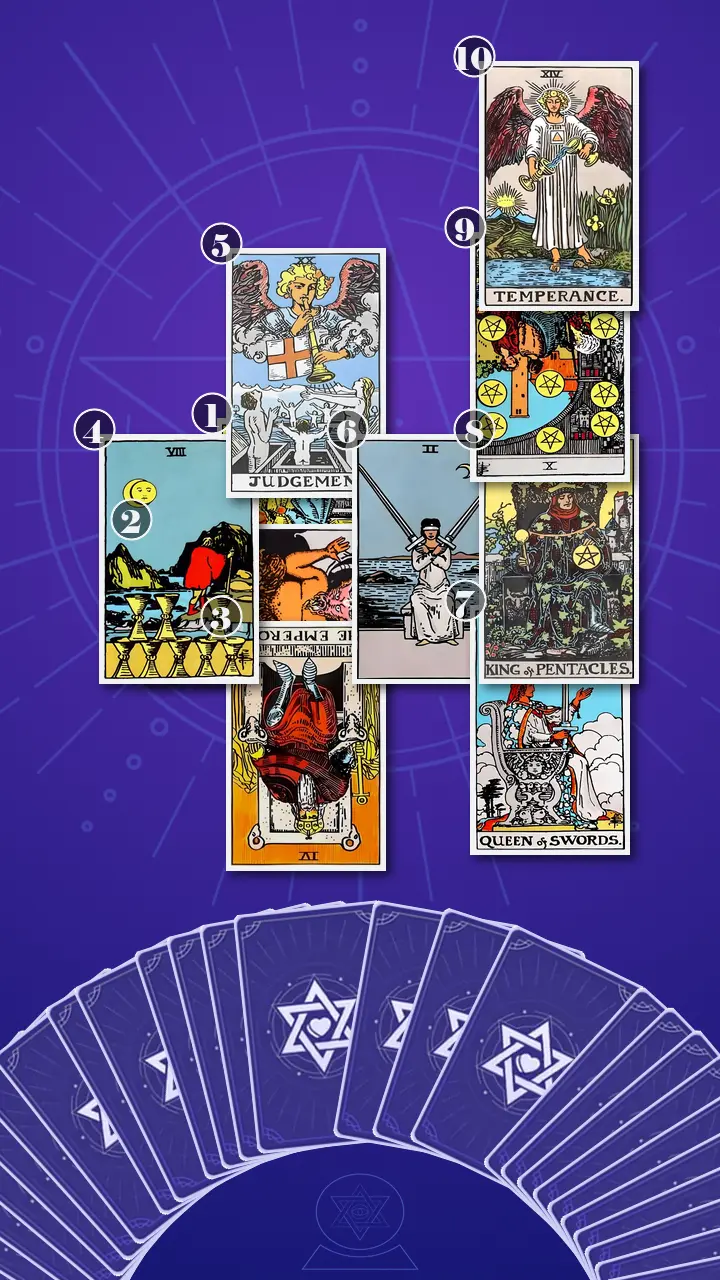
Reading the Map: Nostalgia, Attachment, and the Old Authority Script
Position 1: The Pull in the Present
“Now flipped open,” I said, “is the card representing your current pattern being activated by the offer—the lived, observable pull in the present.”
Six of Cups, reversed.
I didn’t need to dramatize it; the image does that quietly. Two kids. White flowers in cups. A village that looks calmer than real life ever is.
“This is like when you read your old boss’s message and suddenly remember the comforting routines and inside jokes,” I said, using the translation that always lands in modern life, “but not the tightness that used to hit on Sunday nights.”
Reversed, Six of Cups isn’t “memory” as sweetness—it’s memory as editing. The energy here isn’t balanced Water; it’s Water with a selective filter. The comfort is real, but incomplete. Nostalgia becomes a coping strategy: a way to make returning feel safer by softening the parts of the story that were sharp.
Jordan let out a small laugh that didn’t rise to their eyes. “That’s… painfully accurate,” they said. “Like, it’s almost rude.”
“It can feel rude,” I said, “because it’s honest. And it doesn’t mean you’re naive. It means your nervous system remembers relief—and your mind is trying to protect you by presenting the past as a warm room you can step back into.”
I watched their shoulders lift, then settle by a millimeter. Recognition without shame. That’s always the first crack where clarity gets in.
Position 2: The Thing That Hooks You
“Now we’re looking at the card representing what complicates the decision—the temptation, attachment, or pressure that makes it hard to respond cleanly.”
The Devil, upright.
I’ve heard “golden handcuffs” thrown around on career TikTok and LinkedIn like it’s a punchline. But The Devil isn’t a meme. It’s the feeling of your thumb hovering over Reply while part of you thinks, If I take it, I can breathe. If I don’t, I’m reckless.
As I said it, I saw Jordan’s eyes flick down—like their body had already traveled to the salary number on screen, the rent auto-withdrawal notification, the quiet panic that shows up in the last week of the month.
“This card doesn’t call you weak,” I told them. “It calls the chain a chain.”
The Devil’s energy is attachment. Not to “badness.” To relief. To approval. To the fantasy that stability is something you get by surrendering autonomy and calling it being practical.
“Name it in plain language,” I said. “What are you afraid will happen if you say no?”
Jordan’s throat bobbed once. “That I’ll struggle,” they said. “And then it’ll prove I made a stupid decision leaving in the first place.”
There it was: the chain wasn’t the job. The chain was the story of what their future would mean about their worth.
Position 3: The Root Script with Authority
“Now flipped open is the card representing the deeper past script with authority, worth, and control that the old boss represents.”
The Emperor, reversed.
In the Rider-Waite-Smith deck, The Emperor sits on a stone throne, armored under his robe. Upright, it can be healthy structure. Reversed, protection becomes control. Structure becomes a cage.
“This is like preparing for a performance review before a simple conversation,” I said, and I gestured at Jordan’s screen: “Tabs open—old KPIs, last year’s review PDF, a drafted email with too many explanations.”
The reversed Emperor is an internalized authority script: Don’t ask for too much. Don’t be difficult. Be grateful. Earn safety by being easy to manage.
Energetically, this is deficiency in self-leadership and excess in compliance. It explains why the offer doesn’t feel like a negotiation—it feels like a judge returning to re-open your case.
“What are you editing so you stay likable to power?” I asked.
Jordan stared at the edge of their laptop as if the answer was written in the plastic. “My questions,” they said finally. “I keep deleting them. I keep making it… friendly.”
“Friendly is fine,” I said. “Self-erasing isn’t.”
As a Jungian psychologist, I often meet The Emperor reversed as an archetype: the part of us that confuses authority with safety. And as someone who once trained intuition on cruise ships—where docking decisions are literally time-sensitive—I’ve learned this: when an authority figure sets the tempo, your first job is to reclaim your own timing.
Position 4: The Truth of Why You Left
“Now flipped open is the card representing what you walked away from before—the emotional truth that originally pushed you to leave.”
Eight of Cups, upright.
The figure in the card walks away under a moon that doesn’t promise anything. Eight cups remain, stacked like proof. One cup missing like a quiet ache.
“You didn’t leave for no reason,” I said. “This card is the moment you chose emotional integrity over what looked ‘fine’ from the outside.”
Jordan’s eyes went soft, unfocused—memory replaying. “I remember sitting at my desk,” they said. “I could do the work. I was good at it. But I felt… watched. Like I was always being evaluated.”
“That’s the cup that was missing,” I said. “Trust. Space. Respect. Whatever word fits.”
The energy here is balance through movement. Eight of Cups isn’t impulsive quitting. It’s acknowledging something unsustainable and choosing growth without a perfect plan.
Position 5: The Wake-Up Call
“Now flipped open is the card representing what your higher self wants to learn from this ‘second chance’ moment.”
Judgement, upright.
In the background of my own mind, I heard it the way I always do with this card: a clean note cutting through noise. Not dramatic—decisive.
“There are two sounds competing in this spread,” I told Jordan. “The Devil’s low hum: just take it. And Judgement’s trumpet: tell the truth.”
Jordan’s posture changed, subtle but real. Their shoulders dropped a fraction, as if the idea of “truth” was less exhausting than “perfect.”
“This offer is a data point, not a verdict,” I said, and I watched that sentence land like a small weight removed from their chest.
Judgement is the invitation to level up—not into hustle or bravado, but into adult self-honesty. A second chance doesn’t mean repeating the same script with a different mood. It means responding differently when the same doorway creaks open.
“So the question isn’t only ‘Should I go back?’” I said. “It’s ‘Who are you when the past offers you your old identity again?’”
Position 6: The Next 2–4 Weeks if You Keep It Open-Ended
“Now flipped open is the card representing the near-term decision climate—how your mind and body are likely to behave if you keep this situation open-ended.”
Two of Swords, upright.
A blindfold. Crossed swords over the heart. Calm sea that looks peaceful until you notice the rocks.
“This is the draft-that-never-gets-sent card,” I said, plainly. “It’s you keeping the peace by not choosing.”
Energetically, Two of Swords is blockage. Not because you’re incapable—because the stalemate is protective. If you don’t decide, you can’t be wrong. If you don’t ask, you can’t be refused.
“If you leave this open-ended for the next two weeks,” I asked, “what will you do on repeat—research, rewrite, ask for opinions—and what will you avoid?”
Jordan sighed, long and thin. “I’ll avoid… asking them what would actually be different,” they said.
“Exactly,” I said. “The blindfold isn’t ignorance. It’s self-protection.”
Position 7: Your Best Stance in This Negotiation
“Now flipped open is the card representing the stance that helps you not replay the past—your best self in this negotiation.”
Queen of Swords, upright.
The Queen’s sword is upright. Her gaze is forward. One hand open, like: I’m listening. I’m not begging.
“This is clean language,” I told Jordan. “Self-respect without aggression.”
In modern life, it’s the moment you stop writing a 12-paragraph email to prove you’re reasonable and instead write a short, calm message that asks directly about role scope and decision authority.
“Clarity isn’t harsh,” I said. “It’s how you stop negotiating against yourself.”
Jordan nodded once. A small, solid motion.
Position 8: The External Reality of the Offer
“Now flipped open is the card representing the environment—what the boss/workplace is reliably providing or emphasizing.”
King of Pentacles, upright.
This card doesn’t play. It’s the salary number. The benefits. The stability. The feeling that you could finally stop doing mental math at the checkout line.
“The tangible benefits are real,” I said. “This isn’t you being dramatic. Your nervous system hears ‘resources’ and says, thank God.”
But the King of Pentacles can also become the whole argument. And that’s where it quietly partners with The Devil: comfort becomes the lever that moves you back into a dynamic you’ve outgrown.
“The question,” I told Jordan, “is what the price tag is—time, flexibility, values, or your voice.”
Position 9: The Split About Stability
“Now flipped open is the card representing your hopes and fears—your mixed hope-fear about stability: what you crave and what you worry stability will cost you.”
Ten of Pentacles, reversed.
Ten of Pentacles is usually the ‘looks good on paper’ card. Reversed, it becomes: What if I build a life that’s stable—but not mine?
“This is you craving long-term security,” I said, “and fearing a comfortable trap.”
Jordan swallowed. “I keep thinking, ‘This is what adults do,’” they admitted. “And then I feel this… quiet panic.”
“That panic is information,” I said. “Not a command.”
Reversed, this card asks you to define stability more honestly: not just money and status, but emotional sustainability. Boundaries. A voice that doesn’t disappear when someone senior walks into the room.
When Temperance Poured Between Two Cups
Position 10: Integration—The Third Path You Control
I paused before turning the final card. The room felt quieter, even through a video call—like the city hum had stepped back to hear what would be said next.
“Now flipped open,” I said, “is the card representing integration outcome—what becomes possible when you choose from boundaries and alignment rather than nostalgia or compulsion.”
Temperance, upright.
I exhaled, because Temperance is the antidote to the entire loop: it’s not ‘go back’ or ‘run away.’ It’s calibration. One foot on land, one in water. Practical reality cooperating with emotional truth.
And this is where my own inner flashback arrived—quick, contained: me on a ship years ago, watching a captain decide whether to dock as weather shifted. Not by hoping. Not by panicking. By checking conditions, naming non-negotiables, and choosing timing. Port decisions aren’t moral. They’re aligned or not. Temperance is that kind of adulthood.
Setup. Jordan was still caught in the familiar trap: on the couch after dinner, laptop open, rereading old feedback like it’s court evidence—jaw tight at the thought of Slack pings lighting up again—trying to predict the “right” move before they moved at all.
Delivery.
Not ‘go back to feel safe,’ but ‘blend truth with terms’—like Temperance, you pour your hard-won lessons into a clear process that creates a different outcome.
I let it hang there. No extra commentary. Just space.
Reinforcement. Jordan’s breath caught—tiny freeze. Their eyes unfocused for a second, like they were replaying every version of their unsent draft. Then their shoulders dropped, slowly, as if gravity had just gotten permission to do its job. Their jaw unclenched, but their face did something more complex: relief, followed by a flicker of anger.
“But—” they started, voice sharper than before, “doesn’t that mean I was wrong to leave? Or wrong to want to go back? I hate that it feels like I can’t win.”
I nodded. “That’s the part of you that thinks every decision is a verdict,” I said. “Temperance says you’re allowed to stop making choices in court.”
I watched the next three-step reaction chain move through them: first, a swallow and a slight stiffening in the neck; then the eyes softening, the mental grip loosening; then a long exhale that sounded like someone setting down a bag they’d been carrying without realizing it was heavy.
“Set a 10-minute timer,” I said. “Open a blank note titled ‘Terms, not nostalgia.’ Write three bullets under: (1) one non-negotiable, (2) one negotiable, (3) one question you need answered before you can decide. Then draft a 4–6 sentence email that includes exactly one question and one boundary line—something like, ‘I can respond by Friday once I understand X.’ If your body spikes—tight chest, tight jaw—put both feet on the floor and pause. No pushing through.”
Temperance isn’t a vibe. It’s project management for your nervous system.
And this was the key shift showing itself in real time: from tight uncertainty and approval-seeking into clear-eyed boundary-setting. From outsourcing self-trust to building it.
I leaned forward. “Now,” I asked, “with this new lens—terms, not nostalgia—think back to last week. Was there a moment when this insight could’ve changed how you felt?”
Jordan’s eyes went glossy, not with sadness exactly—more like recognition. “On the streetcar,” they said. “I saw an ex-coworker’s LinkedIn post and I decided I was behind. I started writing the email like I was begging to be let back in.”
“And if it’s not begging,” I asked, “what is it?”
They sat up a little. “It’s… evaluation,” they said. “It’s me asking if the role fits me now.”
That’s Temperance: integrating the lessons of Eight of Cups, the wake-up of Judgement, and the clarity of the Queen of Swords—without letting The Devil run the show.
The Temperance Reply Protocol: Actionable Advice for a Clean Next Step
I gathered the whole spread into one sentence-story for Jordan, the way I would for travelers staring at an itinerary and feeling overwhelmed:
You’re being pulled by edited nostalgia (Six of Cups reversed), hooked by the very real relief of security (The Devil + King of Pentacles), and underneath it is an old authority agreement—safety through compliance (Emperor reversed). But you already walked away once for a reason (Eight of Cups), and this moment is asking you to grow into a new relationship with choice (Judgement): treat the offer as information, not a verdict. The way through is boundaries and clean questions (Queen of Swords), so you can create a third path—calibrated negotiation and pacing (Temperance).
The cognitive blind spot I saw most clearly was this: you’ve been treating “going back” as a single yes/no door, when it’s actually a set of terms. That blind spot keeps you stuck in decision fatigue—because you’re trying to solve an entire future with one email draft.
The transformation direction is simpler and braver: shift from seeking a guaranteed safe return to defining non-negotiables and testing alignment through clear questions and boundaries.
When I want to make this kind of crossroads practical, I use my Choice X-Ray—a way of looking for hidden costs and benefits across multiple dimensions. Not just salary, but nervous-system cost. Not just title, but decision authority. Not just “Will they hire me?” but “Will I have to shrink to stay hired?” Temperance tells me the best next step is the one that reveals reality quickly and cleanly.
- The Three Non-Negotiables ListWrite three one-sentence non-negotiables you would require to return (example: “I need written scope clarity,” “I need decision authority over X,” “I need a feedback cadence that isn’t constant evaluation”). Then convert each one into a single clean question you can ask your old boss—no apology, no backstory.If your brain says “too blunt,” treat that as the old Emperor-reversed script protecting you. Lower the bar: you’re not being harsh—you’re being specific.
- The One-Question Clarity Sprint (48 Hours)Choose the single most important question (the one that changes the decision most). Put it in your next message and send it within 48 hours. Add one boundary line about timing: “I can give you an answer by Friday once I understand X.”Expect resistance. If you feel activated, do a 2-minute pause—feet on the floor, exhale longer than inhale—then send anyway. Urgency is not the same as importance.
- The Temperance Email (4–6 Sentences)Draft a short reply: gratitude + one question + one boundary about timeline + one term you’d need for the role to be different. If they suggest a call, write a 5-line agenda: scope, decision authority, success metrics, feedback cadence, timeline.Keep it experimental, not dramatic. You’re gathering alignment data, not trying to “win.” Afterward, do a 60-second body vote check (chest/jaw/shoulders) and write one line: “My body said ___ when they answered ___.”

A Week Later: Ownership, Not Certainty
A week later, I got a message from Jordan: a screenshot of a short email draft—six sentences. No legal brief. No 12-paragraph apology disguised as professionalism. One question. One boundary line. One term stated calmly.
“Sent it,” their text said. “My hands were shaking, but I didn’t die. Also… I slept through the night.”
They didn’t tell me the final outcome yet. And I didn’t need them to. The proof was in the shift: they’d moved from being evaluated by the offer to evaluating it. From bracing to choosing. From “tell me if I’m safe” to “here’s what safety requires for me.”
That’s the real Journey to Clarity I trust most: not certainty, but ownership—making a decision you can respect even if it’s imperfect, because it’s rooted in values and boundaries rather than nostalgia or compulsion.
When the past offers you a familiar paycheck, it can feel like oxygen—right up until your jaw tightens, because some part of you remembers what you had to give up to earn that kind of ‘safety.’
If you treated this offer as information—not a verdict—what’s one boundary or question your future self would quietly thank you for putting into the conversation?