From Spreadsheet Spirals to Calm Focus: Choosing Quit vs Part-Time

Finding Clarity in the Sunday-Night Screen Glare
If your bootcamp starts Monday and you’ve rewritten the same resignation/part-time message so many times it feels like a personality test, you’re not alone—this is career pivot decision paralysis in real time.
Jordan showed up on my screen from a Toronto kitchen table at 12:34 a.m. on a Sunday, the kind of late hour where the whole apartment feels like it’s holding its breath with you. Their radiator clicked like a metronome that refused to soothe. Screen brightness was turned up too high, bleaching their face in laptop-light. A kettle sat cooling beside them, and the faint smell of instant noodles hung in the air like a concession they didn’t want to admit they’d made.
They didn’t say “I’m anxious.” Their body said it first: shoulders lifted as if someone might yell at them through Slack, stomach tight like they’d swallowed a stone, fingers hovering over a half-written message to their manager the way people hover over a “post” button they know will change their life.
“Bootcamp starts Monday,” they said, and I heard the way the start date landed like a gavel. “I keep switching between quitting and going part-time. I’m not scared of hard work—I’m scared of picking wrong. And I keep trying to budget my way out of uncertainty.”
I nodded, letting the silence be a soft landing instead of a pressure chamber. “That makes sense,” I told them. “When the stakes feel high, our brains start trying to do impossible math—like certainty is something you can force out of a spreadsheet. Tonight, let’s make this simpler. Let’s draw a map through the fog and aim for clarity you can actually act on.”

Choosing the Compass: The Decision Cross Tarot Spread
I asked Jordan to take one slow breath with me—nothing mystical, just a nervous-system handrail. While they breathed, I shuffled and explained what I was doing in plain language: “This isn’t about predicting the future. It’s about seeing the pattern you’re already in, and then choosing next steps that reduce the noise.”
“For your question—bootcamp starts Monday: quit my job or go part-time?—I’m using a classic layout called the Decision Cross.”
For anyone reading along: the Decision Cross is ideal for a two-option, time-sensitive dilemma because it does something your spiral brain won’t do at 12:30 a.m.—it separates the options cleanly. One card names the pressure point (what’s actually happening in your calendar and body), two cards show the energy of each path, one card reveals the hidden driver beneath the debate, one offers a decision framework, and the last shows how things tend to settle once you commit.
“We’ll start at the center,” I told Jordan, “then look at quit and part-time side by side. After that, we’ll name what’s secretly inflating the stakes, and we’ll end with a plan that you can communicate clearly.”
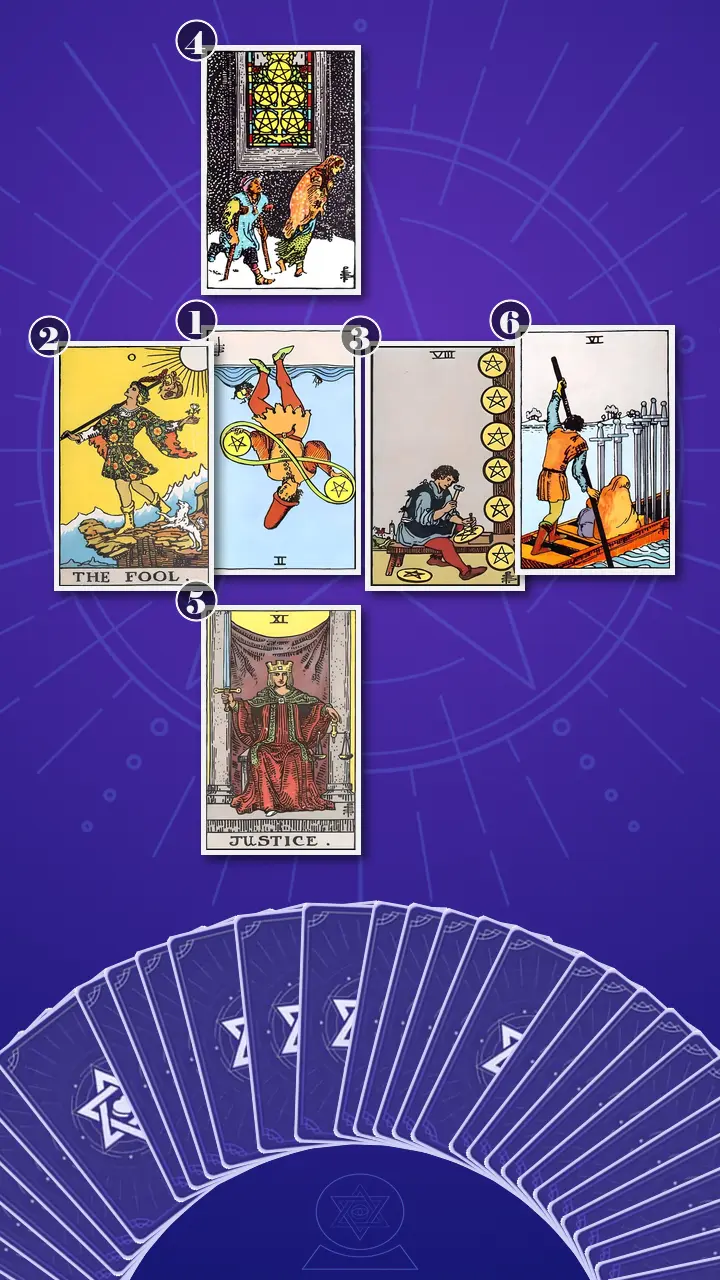
Reading the Map: Card Meanings in Context
Position 1 — The Immediate Pressure Point: Two of Pentacles (Reversed)
“Now we’re turning over the card that represents the immediate pressure point: the concrete way the decision is currently showing up in workload, time, and mental bandwidth,” I said.
Two of Pentacles, reversed.
I angled the card toward the camera. “This is the infinity loop,” I said, tapping the ribbon that wraps around the coins. “It’s the visual of keeping everything in motion to avoid choosing—until the rhythm breaks.”
And in modern life, it’s painfully specific: It’s 12:30 a.m. and you’re juggling three windows—bootcamp schedule, a runway spreadsheet, and a draft Slack/email to your manager. You keep rearranging your calendar blocks and changing budget assumptions because staying in motion feels safer than choosing.
“Reversed,” I continued, “this isn’t balance—it’s blockage. Not a motivation problem. A capacity problem. Like trying to run two full-time apps on a laptop with 12% battery and acting surprised when it overheats.”
I watched Jordan’s face do that micro-flinch people get when something is too accurate to be polite. Their mouth twitched into a small, bitter laugh.
“Okay,” they said, exhaling sharply through their nose. “That’s… rude. Like you just screenshotted my browser tabs.”
“Yeah,” I said gently. “Tarot can be like that—not because it’s here to roast you, but because it shows the pattern without the story you’ve been using to justify it.”
I offered the contrast the card was asking for, the one that lives in their actual night: Calendar → spreadsheet → Slack draft → back to spreadsheet, while the money weather stays the same—rent, TTC fare, groceries. And the inner monologue that keeps the loop spinning: If I quit: reckless. If I go part-time: not serious. If I wait: irresponsible.
“Your shoulders are up,” I said, not as criticism but as data. “Jaw tight. Stomach clenched. That loop is protecting you from shame, not from risk.”
Position 2 — Option A (Quit): The Fool (Upright)
“Now we’re turning over the card that represents Option A—quit your job: what this path offers your learning, energy, and identity shift,” I said.
The Fool, upright.
“This is a clean reset,” I told them, keeping it concrete. “Quitting looks like closing the spreadsheet for the night, giving notice, and letting bootcamp become your main job. Fewer contexts. Fewer interruptions. More momentum.”
That’s The Fool’s energy at its healthiest: intentional simplification. It’s not reckless—unless you demand that it come with a perfect forecast.
“The trade-off,” I said, “is psychological. This path asks you to tolerate uncertainty without trying to spreadsheet it away. If you choose this, we’d build guardrails—runway, a support plan, a re-entry action—so you’re traveling light, not traveling blind.”
Jordan stared at the card like it was both an invitation and a dare. Their shoulders lowered a millimeter, then rose again as if the idea of relief triggered its own fear.
Position 3 — Option B (Part-Time): Eight of Pentacles (Upright)
“Now we’re turning over the card that represents Option B—go part-time: what this path offers your stability, pace, and skill-building process,” I said.
Eight of Pentacles, upright.
“This is apprenticeship energy,” I told them. “Protected study blocks. Steady practice. Measuring progress by reps and projects, not by one perfect breakthrough.”
In real life terms: choosing part-time looks like treating bootcamp like a craft. You build competence by showing up consistently. And the risk isn’t that you can’t learn—it’s that work expands to fill the space and slices your focus into fragments.
“This path works,” I said, “if it’s not performative. If you go part-time but keep acting like you’re full-time to avoid judgment, you’ll still be living in the reversed Two of Pentacles.”
Jordan nodded slowly, but their eyes flicked away—like they could already see the Slack pings bleeding into study time.
Position 4 — The Hidden Driver: Five of Pentacles (Upright)
“Now we’re turning over the card that represents the hidden driver beneath the debate: the fear or scarcity story amplifying the stakes,” I said.
Five of Pentacles, upright.
The room—both my studio in New York and their kitchen in Toronto—felt colder when this card landed. Not because anything supernatural happened, but because the image is honest: snow, limp, the lit window you pass by when shame says you don’t get to go inside.
“Under the debate is a specific fear,” I said. “Being one paycheck away from panic—and interpreting that as personal failure. So every option feels like it could ‘prove’ you lack control.”
I gave them the line they needed to hear without flinching: “Your runway is a number—not a verdict on your character.”
Jordan’s throat bobbed as they swallowed. Their fingers, which had been clenched around a mug, loosened and then tightened again—like their body wanted comfort but didn’t trust it.
“I don’t tell people I’m scared,” they admitted, voice smaller now. “I just… get more responsible. Another spreadsheet tab. Another r/PersonalFinanceCanada thread. Another ‘just checking’ in my banking app.”
“That’s the Five of Pentacles,” I said. “It turns ‘I need support’ into ‘I need to be tougher.’ And it can make you feel shut out of help even when practical support exists—negotiation, savings planning, honest conversations.”
When Justice Spoke: A Clean Decision Beats a Perfect Forecast
Position 5 — Decision Framework: Justice (Upright) (Key Card)
I paused before flipping the next card. Not for drama—for attention. “We’re turning over the card that represents the decision framework: the most aligned way to choose and communicate, including boundaries and terms,” I said. “This is the core of your reading.”
Justice, upright.
“Justice is the moment you stop asking, ‘Which option makes me look confident?’ and start asking, ‘What agreement is fair to my money, my time, and my learning?’” I said. “Scales and sword. Criteria and a clean cut.”
And then I brought it down to a workplace moment Jordan recognized instantly: “It’s staring at the Slack compose box, then switching to a calendar invite titled ‘Schedule check-in’ because clarity begins when the conversation becomes real—not when the spreadsheet becomes prettier.”
Setup — The Cliff Feeling at 12:30 a.m.
If it’s 12:30 a.m. and you’re bouncing between the bootcamp schedule, your banking app, and a draft message to your manager—rewriting the same two sentences like they’ll finally make the future feel safe—this is the moment where the decision starts to feel like a cliff.
Delivery — The Sentence That Changes the Frame
Stop juggling for the illusion of safety, and choose what’s balanced by putting your life on the scales and cutting a clean agreement with the sword.
I let that sit in the air for a beat, the way a director lets a line land without covering it with music.
Reinforcement — Scales, Sword, and the Body Finally Exhaling
Jordan’s reaction came in three beats—the kind you only see when the truth hits the nervous system before it hits the mind.
First: a freeze. Their breath caught and their eyes went a little wide, like someone had turned the sound down in the room. Their fingers stopped moving altogether above the keyboard.
Second: the mind recalibrating. Their gaze drifted off the screen, unfocused, as if they were replaying a week of tab-switching and draft-deleting at 1.25x speed—Calendar, spreadsheet, Slack, banking app—trying to find the moment they could’ve stepped out of the loop.
Third: release, but not the Instagram kind. Their shoulders dropped. Their jaw unclenched with a visible swallow. And then—quietly, almost annoyed at how relieving it felt—they whispered, “So I don’t have to feel sure. I just have to choose terms I can actually live with.”
“Exactly,” I said. “A clean decision beats a perfect forecast.”
I leaned in a little. “Now—use this new lens and look back at last week. Was there a moment where this would’ve changed how you felt? A moment where you kept negotiating with your anxiety at midnight instead of making one bounded move?”
Jordan blinked hard. “Friday. I drafted the part-time message at my desk between tickets. I deleted the clearest sentence because it sounded… like a boundary.”
That was the pivot right there—moving from anxiety-driven analysis paralysis into something steadier: the beginning of grounded confidence through fair terms, clear boundaries, and clean communication.
My Signature Lens — The Mondrian Grid Method
As an artist, I’ve learned that endless nuance can be a form of hiding. When you’re afraid to commit to a composition, you keep smudging the charcoal until the whole page is gray.
“I want to show you this with my Mondrian Grid Method,” I told Jordan. “Mondrian didn’t paint a ‘perfect’ city. He set constraints—clean lines, primary blocks—and the clarity came from structure.”
“Justice is asking you to do the same: make a simple grid for your life this week. Two blocks matter most: Minimum Runway and Minimum Learning Bandwidth. Everything else is detail your anxiety uses to keep you in motion.”
Position 6 — Integration Direction: Six of Swords (Upright)
“Now we’re turning over the card that represents integration direction: how things tend to feel once you follow the advice and commit to a plan,” I said.
Six of Swords, upright.
“This is transition,” I told them. “Not ‘everything’s solved.’ More like: you’re finally in the boat.”
I anchored it in Toronto because that’s where their body lives. “It’s like finally getting on Line 1,” I said, “even if it’s not your dream route. The relief comes from being en route, not from knowing every station perfectly.”
“With Six of Swords,” I added, “your worries don’t vanish—they’re the swords in the boat. But you’re no longer standing in storm water trying to debate your way into calm. Relief shows up when there are fewer open loops: one schedule draft, one baseline budget, one conversation date.”
The Fair-Terms Framework: Next Steps for the Next 48 Hours
I pulled the whole spread into one clean narrative, the way I would storyboard a short film:
“You started in overload—trying to do two full-time things in one body (Two of Pentacles reversed). Both options have real value: quitting gives you a clean reset and momentum (The Fool), part-time gives you apprenticeship and steady progress (Eight of Pentacles). But the real amplifier is scarcity fear (Five of Pentacles), which turns a practical trade-off into a character trial. Justice is your antidote: choose fair terms, then communicate them cleanly. And the Six of Swords promises the nervous system result: calmer water once you commit to a bounded plan.”
“Here’s the blind spot I want you to name,” I said. “You’ve been treating this like there’s one correct move. But your actual job is to pick terms you can live with—then stop renegotiating those terms with your anxiety every night.”
Then I made it practical—actionable advice, not vibes.
- The Two-Threshold Note (Justice’s Scales)In the next 24 hours, open your Notes app and write two bullets: Minimum Runway (the smallest number of weeks/months you need to not panic) and Minimum Learning Bandwidth (the maximum weekly work hours you can do during bootcamp without sacrificing sleep/focus). Keep it brutally simple—one number each.If you start negotiating (“but what if…”), that’s the old loop buying time. Write one number, one hour cap, then stop.
- The One-Message Terms Draft (Justice’s Sword)Draft one message to your manager that is terms, not a life story: timeframe + hours + availability + what stays the same + what gets handed off. Example: “From Monday through [date], I can work up to X hours/week, available [windows]. I can continue owning [key responsibility], and I’ll hand off [other task] by [day].”If your jaw clenches while writing, shorten it. Your nervous system is asking for cleaner terms, not more justification.
- The 15-Min Terms Talk (Make It Real)Send a calendar invite for a 15-minute conversation titled something neutral like “Schedule check-in.” The goal is not to win approval—it’s to confirm a workable agreement before your first bootcamp week really begins.If you can’t find 15 minutes, start with the invite anyway. The invite is the first “oar in the water.”
I layered in my communication strategy because Justice is also about delivery. “Before that 15-minute chat,” I said, “we’ll use Oscars Speech Training. Not to perform—just to be clear.”
“Two minutes. That’s it. Like an acceptance speech: thank you, context, the terms, and the next step. You’re not auditioning for ‘Most Responsible Adult.’ You’re stating a fair agreement.”

A Week Later: The Quiet Proof of Fewer Open Loops
Five days later, Jordan messaged me. Not a paragraph. One line: “I sent the calendar invite. I thought I’d feel sick, but I just… felt quiet.”
They told me they did the Two-Threshold Note in their Notes app, exactly as written. They’d wanted a perfect number; they chose a workable one. They’d wanted the perfect tone; they sent the terms. The conversation with their manager wasn’t magical—but it was real. And real, I’ve found, is where clarity actually lives.
The bittersweet part—because transitions are like that—was what they did right after: they sat alone at a café near a streetcar stop, laptop closed for once, letting the espresso machine hiss while their brain tried to invent new reasons to panic. It couldn’t find many. There were fewer open loops.
That’s the Journey to Clarity I trust most: not certainty, but ownership. Not the fantasy of a risk-free pivot, but a decision with guardrails and clean communication you can stand behind.
When the start date is this close, it can feel like your entire adulthood is riding on a single email—so you keep juggling options not because you’re indecisive, but because you’re trying to avoid the moment fear labels you “reckless” or “not serious.”
If you didn’t have to prove anything to anyone this week, what would your most workable “fair terms” decision look like—just enough structure to move forward without negotiating with your anxiety every night?