After Mom's 'I'm Sorry' Lands Cold: Freeze, Grief, and a Safer Pace

The Pinned Thread Under Fluorescent Light
When Ava (name changed for privacy) came to me, I recognized the pattern before she finished the first sentence: if you’re the downtown Toronto professional who can answer six Slack threads before lunch but still can’t text your mom back after “I’m sorry,” that’s late apology whiplash, not ingratitude.
She was on my screen from her small condo downtown, but the scene she handed me was sharper than the video call. At 12:38 p.m. in the PATH under the Financial District, she had Slack open beside a too-cold grain bowl, fluorescent lights buzzing overhead, and her phone warm in her palm. She tapped into the pinned iMessage thread, reread “I’m sorry” four times, typed “Thank you for saying that” into Notes instead of Messages, deleted it, and reached for iced coffee just to get past how hard her throat had locked.
“I thought this was the text I wanted,” she told me. “So why does it feel like nothing moved?”
What I was looking at was a freeze response after a late apology from a parent that still did not feel safe. On the surface, she seemed blank. Underneath, I could hear the split-screen clearly: she wanted her mom’s apology to finally bring relief, and at the exact same time she did not feel emotionally safe enough to let the guard drop. It had that Severance quality so many high-functioning people know too well—work self fluent, private self suddenly without language. Her numbness felt like noise-cancelling headphones for emotion: nothing clean got in, and nothing clean got out.
I answered her the way I wish more people had answered her already. “Your body is not failing some gratitude test,” I said. “It’s telling the truth about pace. Let’s not force meaning onto the text. Let’s draw a map and see what your system already knows.”

Choosing the Compass: A Relationship Spread for Apology and Boundaries
I asked her to put both feet on the floor, take one slow breath, and hold the real question without trying to solve it too early: not “Should I forgive her?” but “Why do I still feel frozen, and what would make contact safer?” Then I shuffled slowly. For me, that moment is never about theatre. It’s a way to help a crowded mind stop doom-scrolling long enough to hear itself clearly.
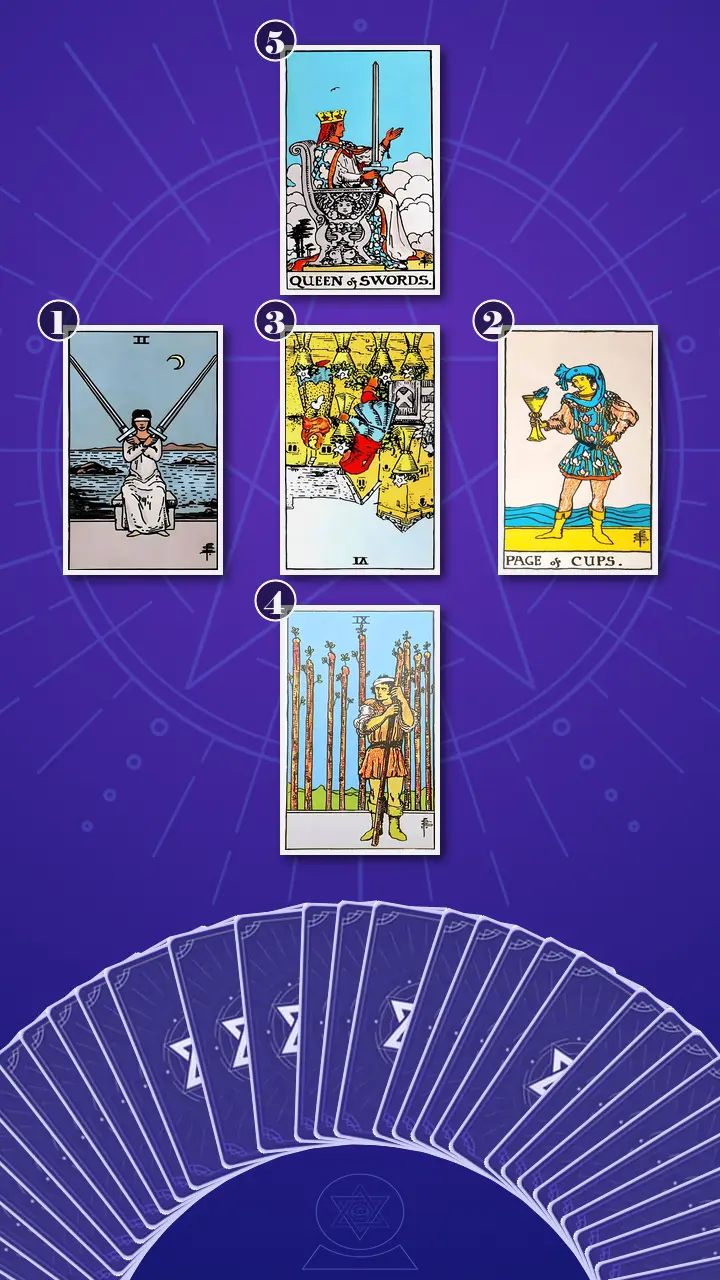
I told her I was using a classic five-card Relationship Spread. For a situation like this, it’s the leanest tool I know that still gives the whole picture: one card for her current stance, one for what her mother is actually bringing, one for the live field between them, one for what the freeze is protecting, and one for the healthiest next movement.
That’s why this spread fits a parent apology that feels too late. I didn’t want prediction. I wanted structure. The cards would let us follow the chain in the order it was happening in real life: the shutdown first, then the actual size of the apology, then the older family material still active, then the protective logic underneath the freeze, and finally the next step that would return agency to her. That, to me, is how tarot works at its best—card meanings in context, not floating abstractions.
Reading the Map: Where the Freeze Lives
Position 1: The Loop That Looks Like “Thinking”
I turned over the first card and said, “Now we’re looking at the position that presents the visible freeze response: the blankness, the delay, the inability to reply even after getting the apology.” The card was the Two of Swords, upright.
I showed her the blindfolded figure with crossed swords over her chest and told her exactly what I saw: this was not random indecision. It was the emotional version of opening your mom’s text on a lunch break, rereading “I’m sorry” until the words lose meaning, drafting a polished neutral reply in Notes, then abandoning it because no option feels emotionally safe enough to send. The energy here was blocked Air. Thought had become a barricade. Her mind was holding the line until her body believed there was less risk.
“Frozen doesn’t always mean unforgiving,” I told her. “Sometimes it means unready.”
She gave one short laugh, the kind that lands with a little bruise in it. “That’s painfully accurate,” she said. Her thumb stopped against the edge of her water glass, then resumed tracing the rim. That bitter little laugh told me the card had landed, because it named the part she had been calling overthinking.
Position 2: A Soft Opening That Still Isn’t the Whole Repair
I moved to the second card. “This position shows what the apology is actually bringing into the interaction, without forcing it to mean more or less than it does.” The card was the Page of Cups, upright.
I told her this was the small, soft apology that pops up on your phone and genuinely opens a door, but only a little. In real life, it’s a brief text that may carry sincerity, tenderness, even awkward effort, and still not have the emotional range to explain the history, name the harm fully, or create instant repair. The energy here was balanced Water, but in a very small container. The fish rising from the cup captured the strange feeling perfectly: softness arriving in something too small to hold the whole reality.
“An apology is information, not an obligation,” I said. “The text can matter and still not be enough.”
Her shoulders shifted half an inch, like a coat seam finally easing. “Okay,” she said slowly. “So maybe I’m not reacting like it’s fake. Maybe I’m reacting because it’s… limited.” The word landed, and I watched some of the black-and-white thinking leave her face.
Position 3: The Old Tab That Reopens by Itself
I placed the third card at the center. “This position reveals the older emotional residue still living between mother and daughter—the past material this text activates.” It was the Six of Cups, reversed.
This was the heart of the spread. I told her that in modern life this looks like being twenty-eight in Toronto while one message from Mom drops your body into an older operating system before your adult brain has even loaded. One present-day text opens an old tab you never meant to revisit. You are not only reading the current iMessage thread; you are also reading every earlier version of this moment stacked behind it: the soft tone before minimizing, the old hallway, the pressure to be easy, pleasant, not messy. The energy here was backward-pulling Water—memory overrunning the present instead of staying in the past.
“It’s not just this text,” I said. “It’s every other version of this moment stacked behind it. Your body is not missing the point. It’s remembering the pattern.”
She went very still. First her breath paused. Then her eyes slipped past me, not dissociated, but clearly replaying something private. When she finally spoke, her voice came out flatter than before, which told me it cost effort. “I always feel sixteen for a second,” she said. “And I hate that.” The dishwasher hum from her kitchen suddenly seemed louder through my speakers, like the room itself had stepped forward to confirm the memory.
Position 4: The Guard Post Under the Freeze
I turned the fourth card. “This position uncovers what the freeze is protecting and why the guard remains in place even when repair is being offered.” The card was the Nine of Wands, upright.
I told her this card was the nervous system that has learned from repetition and now stays posted even when the current threat is ambiguous. In daily life, it looks like leaving the conversation unanswered until you know you can stay steady, keeping the rest of the evening tightly controlled, choosing delay over live vulnerability because one wrong line feels like it could reopen everything. The energy here was excess Fire used defensively—protection working overtime because it has never been given a safer job description.
“This isn’t a character flaw,” I said. “It’s a watch post.”
That was where I brought in one of the frameworks I’m known for. “I call part of this Guilt-Debt Neutralization,” I told her. “A lot of adult daughters get handed a false internal invoice the second a parent says something soft. The bill reads: she apologized, so now you owe warmth, speed, closure. But emotional debt has to be audited before it gets paid. If the apology is real but incomplete, that invoice is unverified.”
She blinked hard, looked away, then back. “So the freeze is me refusing to pay before I know what I’m being charged for?”
“Exactly.”
A longer exhale left her this time. The shame started to give way to function, which is often the first real loosening.
When the Queen Lifted Her Sword
Position 5: Truth at the Pace of Safety
By the time I reached the fifth card, the room felt different. Even over video, I could sense the air settle. “This is the position that points to the healthiest next movement,” I told her, “a boundary-based response that supports self-trust rather than forced reconciliation.” I turned the card: Queen of Swords, upright.
In the Rider-Waite-Smith image, her sword is raised, but her other hand is open. That combination matters. This card is not emotional shutdown dressed up as strength. It is mature Air in balance—discernment that can stay honest without turning cruel. In Ava’s real life, it looked like the adult version of her deciding that a measured reply, a pause, or a text-only boundary was more honest than performative warmth. She knew how to do this already. She did it at work every day: clarify the brief, state the scope, refuse to promise what the project could not deliver. The Queen was inviting that same clean honesty into family contact.
At that moment I had a quick flash of my old life on a trading desk. The most expensive mistakes were rarely about bad information; they were about overpricing a small signal because we wanted it to mean the trend had fully reversed. One green candle is not a new market. One soft text is not yet emotional safety. That memory is part of why I read this card with such care.
So I slowed the reading down. “Right now,” I said, “you’re still sitting in that PATH food court with Slack open, your lunch getting cold, reading ‘I’m sorry’ again and waiting for relief to show up like a late train. Instead, your throat closes and your body stays on guard.”
This is not about forcing warmth because one message arrived; it is about lifting the Queen's sword, cutting through the old fog, and letting truth set the pace.
I let the silence sit.
Her reaction came in layers. First, a full stop: her fingers froze over the sleeve of her mug, and I could actually see her forget to breathe for a beat. Then came the cognitive shift—the eyes unfocused, not in confusion, but like she was replaying a dozen near-identical scenes and watching one line in them suddenly change. Then the feeling landed. Her jaw unclenched. Her shoulders dropped with the strange heaviness that sometimes follows relief, when the body has been braced so long that softness feels almost dizzying. Her eyes glossed, not quite tears, more like the sting before tears. “So I can be honest without pretending I’m ready,” she said, very quietly. Then, with a flash of resistance that mattered just as much, she added, “But if I do that, won’t she think I’m cold?”
“Maybe she might,” I said. “But clarity is not cruelty. And the goal here is not to manage her interpretation better than you manage your own safety.”
I asked her, “Now, with this new lens, can you think of a moment last week when this would have changed how the text felt in your body?”
She nodded once. “On the train,” she said. “I kept rewriting the first sentence because I thought I had to sound warm enough to prove I wasn’t angry. If I’d known I only needed to sound true, I think I would have stopped spiraling.”
That was the shift. Not from pain to perfect peace, but from pressure to self-trust, from numb late-apology whiplash to honest boundary-led clarity.
The One-Page Audit: From Insight to Action
When I zoomed the whole spread out for her, the story was clean. The Two of Swords showed the visible freeze: the reply stuck in draft mode because movement felt riskier than delay. The Page of Cups showed that her mother’s apology likely did carry some real softness, but only in a small amount. The Six of Cups reversed revealed why one short text felt so loaded: the present exchange was landing inside an older mother-daughter script, where the easy daughter role came online before the adult self could sort what belonged to now. The Nine of Wands proved the freeze was not pettiness or failure. It was accumulated protection. And the Queen of Swords gave the direction forward: not forced reunion, not icy punishment, but truth with pacing.
The blind spot was simple and brutal: she had been treating numbness as evidence that something was wrong with her character, when it was actually evidence that her system did not yet believe the impact was over. She kept asking whether the apology should be enough. The reading kept leading us back to a better question: what pace, format, or boundary would make contact feel safer?
That was when I gave her the first phase of what I call The Strategic Disengagement Plan. Not disappearance. Not punishment. Just a calculated reduction of the leverage points that keep family contact running her nervous system. In plain English: less improvising while activated, more structure before contact. Name the missing piece before you name the reply.
She looked at me and gave me one more honest objection. “Five minutes sounds small,” she said, “but when it’s her, I feel like I don’t even have five clean minutes. It takes over everything.”
I nodded. “Then we start with two. Strategy is supposed to reduce friction, not become another standard you fail.”
- The Apology-as-Data Check Open a note on your phone and split it into two headers: “What this text acknowledges” and “What it does not repair yet.” Give yourself five minutes on the Line 1 train, at your desk before lunch, or on the couch after work. Copy the exact apology under the first header. Under the second, list only concrete missing pieces: accountability, changed behavior, time, or a fuller conversation. Use bullet points, not essays. If your throat, chest, or jaw starts bracing hard, stop at two minutes. The goal is clarity, not a courtroom brief.
- The Boundary-First Holding Reply Draft one or two sentences in Notes before you ever open the thread again: “I saw your message. I’m taking some time before I respond more fully.” If written contact feels safer than a call, add it plainly: “I’m not up for a call right now; text is better for me.” Save it as a pinned note or text replacement so you are not inventing language while activated. If sending it feels too big, don’t send it yet. Read it out loud once and notice whether your body tenses or softens. Pace is part of the boundary.
- The 5% Safer Contact Test Before opening the thread, plant both feet on the floor and name three things: one body sensation, one feeling, and one need. For example: “Cold hands. Angry and sad. I need slowness.” Then give family contact a ten-minute window so it does not leak into your whole workday or night. If ten minutes feels like too much, make it three. If speaking out loud feels awkward, do it in your head. Self-trust grows from repeatable structure, not from forcing yourself to be chill.
None of that was about performing the “right” daughter. It was about choosing a response format that kept her present. That is the practical difference between feeling stuck and finding clarity.

A Week Later: Ownership, Not Certainty
A week later, she sent me a message at 8:19 a.m., probably from the train. She had done the two-column note first. Under “What this text acknowledges,” she wrote: She did apologize. Under “What it does not repair yet,” she wrote: the minimizing, the lack of specifics, the pattern. Then she sent a holding reply—nothing ornate, nothing cruel. Just true.
She told me she slept a full night after sending it, though the next morning her first thought was still, What if she pushes back? This time she noticed the thought, made coffee, and didn’t treat it like prophecy. That is what I mean by clarity. Not certainty. Ownership.
I closed the reading the same way I often do when someone is learning to move from performative calm to honest boundaries: the cards did not hand her a perfect relationship. They handed her back her adult voice. In this Journey to Clarity, that was the real repair.
Sometimes the hardest part isn’t that the apology came too late—it’s feeling your throat close around a soft message because your body still doesn’t believe the impact is over. If tonight you’re staring at your own pinned thread and wondering whether you’re protecting yourself or just staying stuck, what would make this contact even 5% safer for you first: more time, a written boundary, or one Queen-of-Swords sentence that tells the truth without reopening the old fog?
Every reading at AceTarot is a journey to connect with inner wisdom and empower your next step. The stories shared here are psychological mirrors, not private records—crafted to reflect universal emotional loops and help you find your own clarity. Learn more about our Journey to Clarity.
Author Profile