Resume Rewrite Spiral—and How to Move From Optics to Evidence

The Sunday-Night Resume Rewrite Spiral
If you're a late-20s city professional who can spend two hours rewriting your resume but cannot hit apply on the role you actually want, this might be career optics paralysis.
When Jordan (name changed for privacy) sat across from me, twenty-eight and tired in the way ambitious people often are, she did not arrive with a dramatic collapse. She arrived with a scene. It was 10:12 p.m. on a Sunday at her kitchen counter in Toronto: laptop half-charged, cold pasta gone tacky beside it, rain tapping the window, Slack finally quiet, blue light making the whole room look flatter than it really was. She had the posting open for a communications role at a climate nonprofit, started a cover letter, then flipped to LinkedIn to compare titles with people she graduated with and spent the next hour rewriting one resume bullet for the fourth time.
'I know what I want until I imagine having to explain it,' she told me. She was a content marketer at a mid-sized tech company, paid on time, competent, respectable, and increasingly dulled by work that felt more legible than alive. The contradiction was clear from the first minute: she wanted a next step that felt real, but she feared it would not look good on the resume. She gave me another line a few breaths later, with a Fleabag-sharp kind of self-awareness: 'I can handle uncertainty, just not the kind that looks unimpressive.'
I watched the words land back in her body. Her chest was held so tightly it looked as if she were trying to breathe through a winter scarf gone damp: constricted at the ribs, caught in the throat, heavier the more she tried to force air through it. That is the particular pain of status-driven career freeze. Not loud panic. More like a private, sinking drop in the stomach the second a meaningful option stops sounding impressive out loud.
I folded my hands over the table and met her where she was. 'That makes sense to me,' I said. 'You are not lazy, and you are not failing at strategy. But something in you has started treating every interesting step like it has to survive a public cross-examination before you're allowed to touch it. Let me help you make a map through this fog. We are not here to predict your fate. We are here to find clarity, so the next step belongs to your life again, not to an imagined audience.'

Choosing the Shadow Spread: A Mirror for Career Optics Paralysis
I asked Jordan to place one hand on the table and take one slower breath than usual while I shuffled. In my practice, this part is never theatre. It is simply a threshold: a way to help the body stop sprinting long enough for the mind to tell the truth.
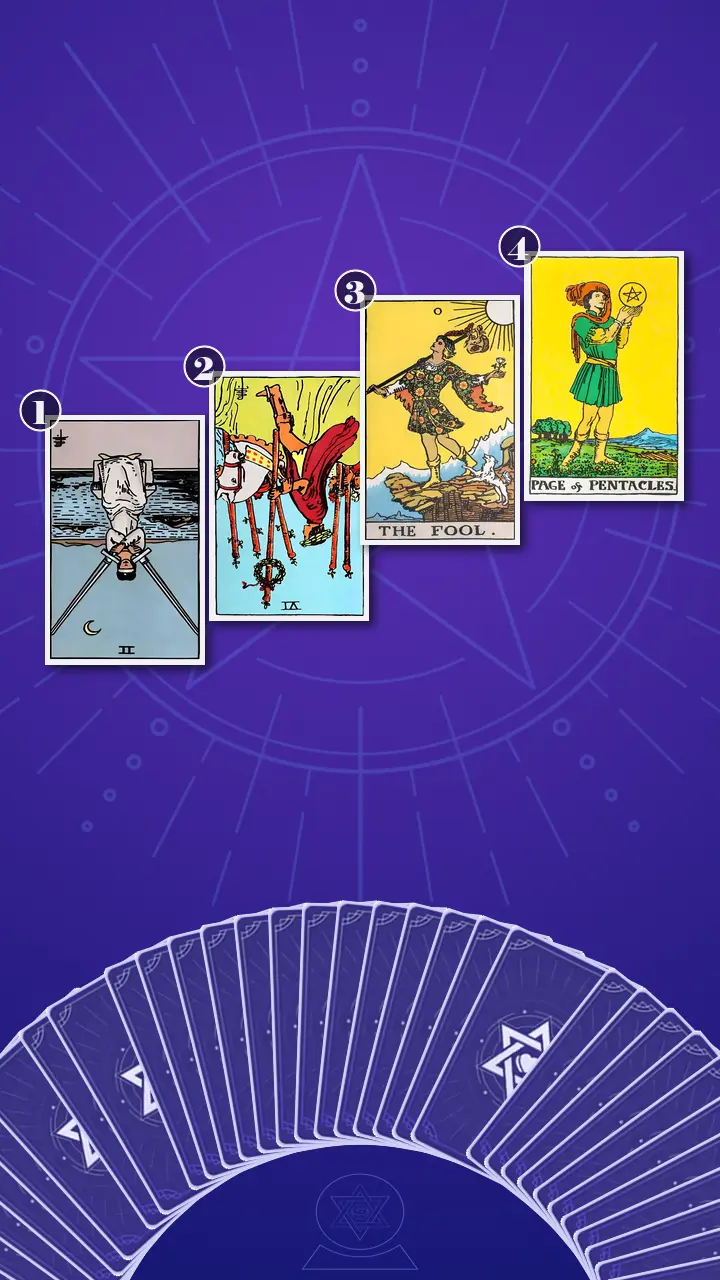
I chose the Shadow Spread, a compact four-card layout I use when someone is caught in approval-based career indecision. This is how tarot works when it is useful: not as fortune-telling, but as structured pattern recognition. Jordan's question was not really, 'Which job will win?' It was, 'Why do I freeze when the next step looks bad on my resume?' For that, a Shadow Spread is more precise than a larger forecasting layout, because it follows the exact chain from symptom, to root fear, to medicine, to practical integration.
I laid the cards in a rising left-to-right line, like a short runway turning into a path. The first position would show the conscious freeze itself: the stalled applications, the resume rewrite spiral, the choice paralysis that looks like research. The second would show the hidden driver under it: the fear that a less legible move might reduce worth, credibility, or momentum. The third would name the medicine that restores self-trust. The fourth would translate insight into one grounded next step based on fit, learning, and lived evidence rather than optics.
Before I turned the first card, I said to her, and to the quiet part of the room that already knew: 'We are not looking for a perfect story tonight. We are looking for the real hinge.'
Reading the Freeze That Calls Itself Strategy
The Card of Stalled Tabs
'Now I am turning the card that shows the diagnosis-level freeze behavior,' I said, 'the stalling that happens when an interesting option does not read as obvious resume progress.' The card was the Two of Swords, reversed.
In modern life, this card was almost painfully exact. It was Jordan sitting with a saved role that genuinely interested her, opening the application, then instantly running a private mock interview in her head about how the title would sound. One browser tab was the safe option. One was the real option. All her battery went into switching between them. She ended the night with a cleaner resume bullet and no closer contact with the work itself.
Reversed, the card showed blocked clarity and overactive Air. Not balanced thinking, but thinking jammed into a defensive loop. The blindfold became self-protective image management. The crossed swords at the chest became bracing against emotional exposure. I told her plainly, 'You are not confused. You are pre-editing your life for an audience.'
Jordan let out a short laugh that carried more ache than amusement. 'That is accurate enough to be rude,' she said. Her fingers stopped at the rim of her mug, hovered, then dropped to her lap. It was the reaction I often see when a card does not invent a problem, but names it too cleanly to hide behind.
I asked her when she had last spent more energy editing the narrative of an option than taking one real step toward it. She did not need time to search for the answer. 'Last night,' she said. 'And, if I'm honest, most nights.' I nodded. The Two of Swords reversed was showing me that the real blockage was not lack of options. It was a nervous system that had learned to hold still until every choice could be defended.
The Imagined Crowd in the Room
'Now I am turning the card that reveals the hidden mechanism beneath the freeze,' I said, 'the fear that a less legible move will reduce worth, credibility, or social standing.' The card was Six of Wands, reversed.
This one reached under the surface immediately. In real life, it looks like mentally drafting the future LinkedIn post, the dinner-party explanation, or the recruiter answer before checking whether the actual work would feel meaningful on a Tuesday. Jordan had been imagining the crowd first: old coworkers, former managers, people from university, the invisible panel of promotion posts that somehow all say 'thrilled to announce' at exactly the wrong moment. Her own desire got downgraded the second it might not win obvious applause.
Here the energy was not missing. It was distorted Fire. Ambition was alive, but it had been recruited into audience management. I told her, 'Some freezes are not about fit. They're about exposure.' Then I laid out the private script I could feel running underneath her choices: 'How would this look? How would I explain it? Would this sound like a step back?' That is how a living option gets forced to answer the crowd before it ever answers the self.
She winced first. Then her breath stalled halfway in her chest. Then it left her in one long exhale, slow enough that I could see the muscles near her collarbone release. 'The imagined audience part got me,' she said quietly. 'I do that before anyone has even asked.'
I believed her. In my own language, I could feel what I call Environmental Friction Sensing: the mismatch between her internal growth energy and the soil of the environment she had trained herself to answer to. Her current work gave her something solid to defend, but the soil was compacted. Useful, respectable, and too tight for the kind of growth she actually wanted. No wonder she kept mistaking friction for wrongness.
When The Fool Stepped to the Cliff
The Medicine Card
When I turned the third card, the room altered in that subtle way it sometimes does when the truth gets close. The rain against the window softened to a hush. Even the old kettle on the shelf behind me chose that moment to fall quiet. 'This,' I told her, 'is the card in the medicine position. The one that names the core transformation energy that interrupts approval-based decision making and restores self-trust.' It was The Fool, upright.
In card meanings in context, The Fool is not recklessness. It is fresh-start energy. It is permission to take a real step before it is perfectly branded: a short contract, an informational conversation, a course, a mission-driven role with a smaller title, a portfolio experiment, even a planned pause if that pause returns you to yourself. The small pack says carry less explanation. The cliff edge says movement comes before polished certainty. I asked her, 'If nobody could see the headline of your next move, what experience would still feel worth having?'
This was where my own old language of seasons arrived, because it fit too precisely not to use it. In my work, I call this Seasonal Trajectory Alignment. Jordan had been trying to judge a seedling by harvest standards. She was asking an apprenticeship season to arrive looking like a promotion season. She was trying to force a spring harvest during a stretch of life that was actually asking for experimentation, rooting, and first contact. Of course she froze. Anyone would, if they demanded public fruit from a moment meant for private growth.
You know that moment when you're alone with a job tab that feels weirdly alive, and the second you imagine explaining it to a recruiter or friend, your chest tightens and you close it? That is the hinge.
Stop treating every path like a public verdict; choose the step that gives you real experience, and let The Fool's cliff edge remind you that clarity appears after movement, not before it.
The problem is not that you need a more impressive story before you move. The problem is that you have been asking a future audience to approve a life you have not let yourself experience yet.
Jordan did not relax immediately. First came the freeze: her breath stopped so suddenly I could see the stillness at the base of her throat. Then came the cognitive hit: her eyes went slightly unfocused, as if she were replaying a dozen quiet scenes at once, the nonprofit tab, the cursor blinking in the cover letter, the jump to LinkedIn, the hollow dip in the stomach. Then came the emotional turn. She looked back at me with a flash of anger that was really grief wearing sharper clothes. 'But if that's true,' she said, 'doesn't that mean I've been making this harder than it had to be?'
'Harder, yes,' I said. 'But not stupidly. Protectively. There is a difference. Your mind built a stage because being seen unfinished felt dangerous. The card is not shaming that. It is changing the rule.'
I watched the message move through her in layers. Her jaw tightened, then unclenched. Her shoulders, which had been sitting almost level with her ears since she arrived, dropped a full inch. Her hands rubbed once against each other, as if warming back into circulation. Relief reached her, but so did that slightly unsteady feeling that often follows relief, the small vertigo of realizing you might be allowed to choose differently now. She gave a shaky laugh and looked straight at The Fool. 'I think I knew that,' she said. 'I just didn't want to admit the job might feel right before it looked smart.'
I let the silence do its work for a beat, then slid her notebook closer. 'Now, with this new perspective,' I said, 'think back to last week. Was there a moment when this would have changed how you felt?' She answered immediately. 'Sunday night. If I'd asked what the role would actually give me instead of how I'd explain it, I think I would've stayed with the tab.'
That was the crossing point right there: from approval-driven resume paralysis to self-trusting, experience-based career movement. Not a finished reinvention. Not a dramatic leap off a cliff. Just the first honest shift from watching to doing.
I asked her to make the shift practical before her old pattern could turn insight into another beautiful theory. 'Within the next ten minutes,' I said, 'open one option you've been avoiding and write two lines: 'What this gives me in real life' and 'What this gives me in optics.' Fill in the first line completely before touching the second. If comparison or shame spikes, pause and come back later. A two-minute version still counts.' She uncapped her pen.
The Coin That Asked for Study, Not Display
'Now I am turning the card that translates insight into a small practical move aligned with learning and lived experience rather than optics,' I said. The card was Page of Pentacles, upright.
The Page brought us down to earth, exactly where we needed to land. In modern life, this is Jordan treating the next chapter like an apprenticeship instead of a verdict: one person to message, one skill to test, one budget check, one calendar block, one small proof-of-interest project. Not posting. Not proving. Not branding. Just learning. Like running a small career lab instead of trying to finalize your entire personal brand strategy before the first experiment.
Its energy was balanced Earth: steady, teachable, and practical. The Page studies the coin rather than displaying it. That detail mattered. I told her, 'A move can be real before it is legible. Stop writing the explanation. Touch the experiment.'
This time she nodded without flinching. One hand had moved from her throat to the notebook. 'That I can do,' she said. 'If it's small enough, I can do that.' And there it was: not certainty, but willingness. For a reading like this, willingness is enough to begin.
From Optics to Evidence
When I looked at the spread as a whole, the story was remarkably coherent. Two of Swords reversed showed the visible symptom: the tab-switching, over-research, resume rewrite spiral, and decision fatigue that feel productive but keep a person still. Six of Wands reversed showed the shadow underneath it: the worth wound that turns career choice into social performance. Then The Fool interrupted the old contract by reopening curiosity, breath, and permission to be a beginner in public. Page of Pentacles grounded the change through practice. Air had been jammed. Fire had turned self-conscious. Only when the reading reached Earth did movement become usable.
The blind spot was not ambition. I was careful to tell her that. Prestige matters in the real world, and pretending otherwise helps no one. The blind spot was treating external legibility as proof of worth, and calling that strategy. The transformation direction was simpler and braver: move from choosing for external optics to choosing for lived alignment and learning value. Ask not only how a step looks, but how it lives.
I also told her what the cards did not say. They did not say she had to blow up her life, quit tomorrow, or stop caring about practicality. They said she needed real-life evidence before she asked for a perfect narrative. That is a very different thing.
At that point Jordan did what many intelligent people do when insight starts becoming real: she reached for the practical objection. 'But what if I turn the experiment into a referendum anyway?' she asked. 'What if I still make it mean everything?' I smiled, because the question itself told me she was already catching the loop in real time.
'Then we make it smaller,' I said. 'Small enough that completion matters more than performance. This is where I use what I call the Winter Dormancy Protocol. Not hiding. Not giving up. A deliberate grounding pause, so you stop forcing motion in the wrong climate and return to the next living thing you can actually touch.'
- Winter Dormancy Protocol The next time title comparison spikes your chest, whether on Line 1, at your kitchen counter, or right after someone asks what's next, put your phone face down, plant both feet on the floor, and take three slower breaths. For the next 10 minutes, do not edit your resume, polish LinkedIn, or make any major decision. Say to yourself, 'No career verdicts while activated.' If 10 minutes feels too long, do 3. The pause is the medicine.
- Private One-Line Reason This week, open one saved role that feels alive but awkward to explain. In your Notes app, write one private sentence about why you want it without mentioning title, prestige, salary, or how it would read online. Then set a 10-minute timer and answer only this: 'What would my actual Tuesday feel like in this role?' Use bullet points, not strategy language. Keep it private. You are not building a case for the room. You are listening for fit.
- A 14-Day Career Lab Block 20 minutes on your calendar labeled 'career lab, not career verdict.' Create one note with three headers: energy, learning, and daily rhythm. Before you look at compensation bands or LinkedIn titles, fill in those three for one path you are considering, then choose one experiment-sized step for the next 14 days: one informational message, one course trial, one portfolio sample, one volunteer shift, or one freelance pitch. Make the step small enough to finish. You do not need a five-year story to try a two-week test.
I told her to ask herself one simple question whenever comparison flared: 'Am I choosing for explanation or for experience?' Not because explanation never matters, but because she had been overfeeding one side of the scale until the other had almost disappeared.

A Week Later, the Quiet Proof
A week later, Jordan sent me a message from a coffee shop on Queen Street. She had used the private one-line reason exercise, blocked a 'career lab, not career verdict' session into her calendar, and sent one low-stakes note to someone at the nonprofit. 'I still hate how small it sounds,' she wrote, 'but I liked how I felt doing it.' For this kind of reading, that sentence is gold.
Then she added one detail I loved for its honesty: she had slept through the night after sending the message, but woke with the old thought, 'What if this looks smaller?' and laughed before opening her notebook instead of LinkedIn. Clear, but still human. Lighter, but not finished.
That is what this Shadow Spread tarot reading for career optics paralysis revealed, and it is what I most want people to remember about finding clarity at a career crossroads: the cards do not hand your life back to you by magic. They simply show where your own wisdom has been getting outvoted. Once you can see the pattern, your next step stops needing to be a performance and starts becoming contact with reality again.
There is a very particular loneliness in wanting something honest, then feeling your chest tighten because it might not sound impressive enough to count.
If tonight you can feel that old audience gathering at the edge of your choices, I want to leave you with the same doorway I left Jordan: if you stopped asking whether the next step looks impressive for just one moment, what tiny experiment would feel worth trying because it teaches you something real?
Every reading at AceTarot is a Journey to connect with inner wisdom and empower next step.
Learn more about our Journey to Clarity.