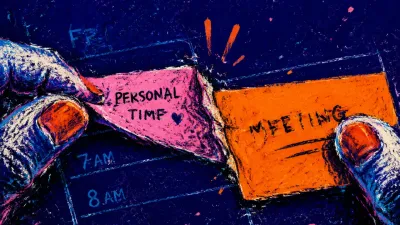
Shift-Cover Guilt in the Group Chat—And a Cleaner Way to Say No

The 8:43 PM WhatsApp Ping
You see “Any chance you can cover?” in the rota WhatsApp and your stomach drops before you even open the message.
Taylor (name changed for privacy) was on a video call with me from her flatshare kitchen in East London, standing by the sink like she’d been caught mid-breath. The extractor fan did that tired little rattle. Her phone buzzed on the counter, screen glowing against the dim yellow under-cabinet light, and even through the camera I watched her shoulders climb—up toward her ears—like her body was trying to disappear.
“It’s always the same,” she said, thumb already hovering. “I’m not even sure I want the money. I just… I don’t want to be the reason the team struggles.”
That was the core of it: workplace people-pleasing and guilt-driven yeses to last-minute shift cover requests. Wanting to be seen as helpful and reliable at work vs fearing that saying no will make you look difficult—or worse, replaceable.
Her guilt wasn’t abstract. It was a tight stomach and heavy shoulders the second the message landed, followed by a wired tiredness during the shift—like she’d plugged herself into a charger that only overheats your battery.
“A fast yes isn’t kindness. It’s panic in a friendly font,” I said gently. “And we’re not here to shame that reflex. We’re here to give it a pause… and find clarity inside the moment where your body answers before you do.”

Choosing the Compass: The Decision Cross Spread
I asked Taylor to take one hand to her stomach—right where she said the clamp happens—and we did my pre-meeting 3-minute cosmic breathing: inhale as if you’re widening space between ribs, exhale as if you’re turning down the brightness on a screen. Not mystical. Just a nervous-system handbrake.
“Today we’re using the Decision Cross,” I told her, shuffling slowly on camera. “It’s clean for moments like this—because a shift-coverage request is usually a choice-point disguised as admin.”
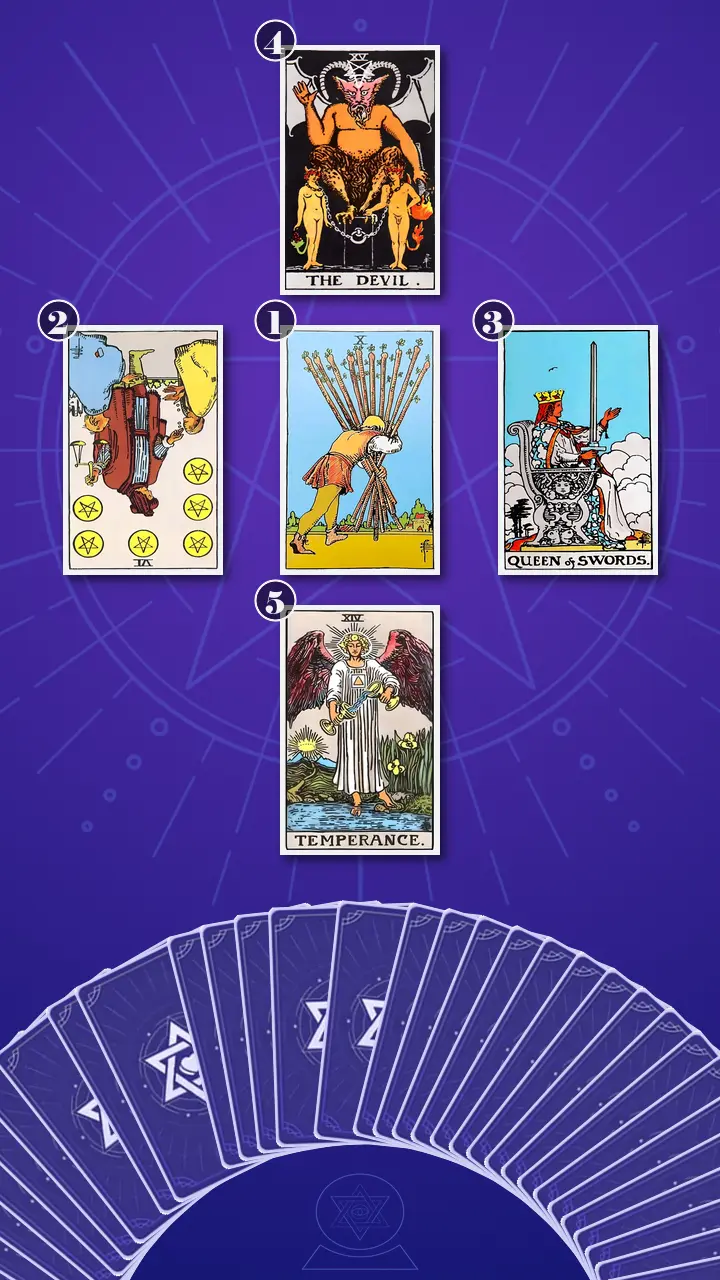
For you reading: this spread works because it separates two paths—saying yes vs saying no—while also surfacing the hidden driver (the real fear underneath) and ending with an integration lesson you can practice either way. It makes the internal tug-of-war visible: burden at the center, one choice pulling toward imbalance, the other toward clear boundaries, with the deeper attachment revealed above and the grounding next step below.
“Card 1 shows what the pattern looks like in real life,” I said. “Card 2 shows the ‘say yes’ path. Card 3 shows the ‘say no / boundary’ path—this one often carries the clean script you can actually use. Card 4 is the hidden driver. Card 5 is the stabilizer—how you stop this from being an all-or-nothing personality makeover.”
Reading the Map: Five Cards, One Boundary
Position 1: The present dilemma — Ten of Wands (upright)
“Now we turn over the card representing the present dilemma: what your current pattern looks like in real life when the request comes in.”
Ten of Wands, upright.
This is you already tired, and then the request lands like another weight on a stack you’ve been carrying for months. You say yes while mentally rearranging your life in real time—swapping plans, promising yourself you’ll recover later, pushing through the shift with that bent-forward, just get through it energy. The burden isn’t only the hours; it’s the identity of being the dependable one, even when your body is asking for a stop.
In the card, the person’s arms are full. The bundle blocks their view. That’s what it feels like when your needs disappear behind “making it work.” In energy terms: this is excess Fire—effort pushed past sustainable limits. Not bravery. Not character. Just load.
I added the picture that always lands for hospitality: “It’s like carrying trays through a crowded café—smiling while your wrists shake. And the inner script is: If I just push through this one, I’ll earn rest later.”
Taylor gave a small laugh that sounded like it had been living in her chest for weeks. Then came a three-beat reaction I’ve seen a hundred times: (1) her breathing paused, like she’d been caught; (2) her eyes unfocused, replaying a specific night; (3) she exhaled through her nose, half-annoyed, half-relieved. “That’s… yeah. That’s exactly it. And it’s kind of brutal to hear out loud.”
Position 2: Option A (say yes) — Six of Pentacles (reversed)
“Now we turn over the card representing Option A: what happens internally and practically if you say yes and cover the shift again.”
Six of Pentacles, reversed.
This is the one that looks polite on the surface and draining underneath. Saying yes again keeps things smooth—no awkwardness, no disappointment in the chat—but it quietly reinforces a one-way exchange. You give time, energy, and flexibility, and the return doesn’t match: no real notice, no consistent reciprocity, and not much space for your needs. Later you feel resentful, then guilty for feeling resentful, and you end up even more depleted for the next ask.
Energetically this is an Earth imbalance: resources (your time, your energy, your body) getting distributed like they’re public property. So I said it plainly: “Your time isn’t a communal resource just because you’re ‘good to work with.’”
I watched Taylor’s face tighten, not in disagreement—more like recognition with a sting. “I hate that I keep count,” she admitted. “On the Night Tube I’ll be like… okay, that’s three covers this month, and no one even offers to swap back. And then I feel petty.”
“That’s not pettiness,” I told her. “That’s your nervous system noticing the scales are off. And when you try to say no with a paragraph—when you’re basically applying for your own permission—if you need a paragraph to justify it, it probably wasn’t a free choice.”
Position 3 (Key Card): Option B (say no / hold a boundary) — Queen of Swords (upright)
When I reached for the third card, the room felt quieter—like we’d both stopped pretending this was just about a schedule. I could hear the low hum of my planetarium office lights on my side of the call, and it reminded me of guiding visitors through a night-sky show: when the stars appear, people don’t talk over them. They just… look.
“Now we turn over the card representing Option B: what happens internally and practically if you say no and hold a boundary this time.”
Queen of Swords, upright.
This card’s modern life translation is almost a script: saying no looks like writing a clean, respectful message and letting it stand. No paragraph. No apology tour. No trying to manage everyone’s feelings. It’s the moment you choose to be reliable in a grown-up way—by communicating clearly and consistently, rather than by sacrificing yourself on demand.
In energy terms, this is balanced Air: discernment and clean communication. The raised sword isn’t aggression—it’s definition. A visible line, doing the work so you don’t have to perform emotional labour in the group chat.
And this is where I use my signature tool, because boundaries are a timing problem as much as a wording problem. “Taylor, I want to run a quick Spacecraft Attitude Adjustment simulation,” I said. “In space, a tiny change in orientation—made early—prevents a massive burn later. Your boundary is that tiny adjustment. The goal isn’t to become a different person. It’s to stop your nervous system from treating every ‘can you cover?’ like an emergency transmission.”
She swallowed. “It feels like if I don’t answer fast, I’m rude.”
I nodded. “That’s the old training. But the Queen of Swords doesn’t rush. She chooses.”
Then I gave her the setup, exactly where she lives: it’s 8:43 PM, the phone buzzes, the stomach clamp hits, and she’s already typing “Sure!” while her calendar is still on-screen—like her body answered before she did.
Not ‘I have to be nice to be safe,’ but ‘I can be clear and still be respected’—lift the sword like the Queen of Swords and let the boundary do the work.
I let the sentence hang for a beat.
Her reaction came in layers. First, a freeze: her thumb stopped moving entirely, hovering over an invisible “send” button in the air. Second, the meaning sank in—her eyes went glossy, not with tears yet, but with that look of someone realizing they’ve been negotiating a contract that was never signed. Third, the release: her shoulders dropped a full inch, and she let out a shaky laugh that turned into a long exhale. “But if I’m clear… won’t they just… stop asking me?” she said, and there was fear in it, and also something like hope.
“That’s the point where your brain tries to protect you,” I said softly. “Let’s reality-check. Most workplaces don’t fire someone because they can’t cover tomorrow. They move on. They ask someone else. The scary part isn’t the shift—it’s the story that one ‘no’ changes your worth.”
I asked her, “Now, with this lens—clear and still respected—think back to last week. Was there a moment when you typed yes before you’d even checked your body?”
She looked off-screen, like the memory was pinned to a tile above her kettle. “Thursday,” she said quietly. “I’d booked a ClassPass thing. I cancelled it. And I didn’t even need to. I just… panicked.”
“That’s the shift,” I told her. “From panic-driven compliance and resentment toward calm self-respect—and reliability defined by clear communication.”
Position 4: Key factor (the hidden driver) — The Devil (upright)
“Now we turn over the card representing the key factor: the deeper attachment or fear that most influences the decision.”
The Devil, upright.
Under the shift request is a fear that your worth at work is conditional: if you aren’t easy, available, endlessly helpful, you’ll be seen as a problem—or replaceable. That belief pulls you toward the instant yes because it buys immediate safety (no tension) even though it costs long-term freedom (your time never feels like yours). The chain isn’t the manager—it’s the story that your belonging has to be paid for with self-sacrifice.
And here I switched to my other diagnostic lens—Dark Matter Detection. “In astronomy, dark matter is the thing you don’t see directly, but you know it’s there because it bends everything,” I said. “In your situation, the unseen mass is the belonging fear. It warps your choices so the ‘yes’ feels like gravity and the ‘no’ feels like danger.”
Her eyes widened a little. “It’s also money,” she admitted, almost annoyed at herself. “Like… I’ll check Monzo and think, okay, extra hours equals safety.”
“Exactly,” I said. “That’s not a moral flaw. That’s a real factor. The Devil loves real factors—because they make the chain feel tighter than it is.”
I named the pattern in one small moment: notification (chain tug) → pause (space) → choice (new pattern). “The chain is loose,” I said. “But it tugs hardest when the ask is public in the group chat and everyone can see you typing.”
Position 5: Integration (the stabilizer) — Temperance (upright)
“Now we turn over the card representing integration: the lesson and healthiest next step to practice.”
Temperance, upright.
This isn’t a personality reset. This is pacing. The next step isn’t swinging between ‘always cover’ and ‘never cover.’ It’s creating a simple, repeatable boundary that blends your values: income, teamwork, recovery. You decide your rule (notice period, frequency cap, or protected day off) and communicate it steadily—so your yes becomes intentional and your no becomes calm.
“Temperance isn’t ‘never help.’ It’s ‘help on purpose,’” I said. “Like mixing hot and cold water: not scalding self-sacrifice, not ice-cold shutdown—just livable.”
Taylor nodded slowly, like the concept finally had edges she could hold.
The One-Message Flight Plan: Actionable Next Steps
I summarized what the Decision Cross had drawn in plain language: you’ve been living in Ten of Wands mode—overcommitment as identity. When you say yes again, Six of Pentacles reversed shows the cost: an uneven exchange that quietly teaches people your availability is up for grabs. The Devil explains why it feels compulsory: the fear that one ‘no’ makes you less safe and less wanted. And the Queen of Swords offers the antidote—clean language—while Temperance shows how you make it sustainable with one simple rule.
Your cognitive blind spot here is subtle but powerful: you’ve been treating speed as proof of reliability. The transformation direction is the opposite: capacity-first reliability—a short pause, then a bounded response that matches what you can actually give.
Here’s the practical “flight plan” we built—small enough to do even when your stomach is tight and the group chat is loud:
- The 15-Minute BufferNext time a shift-cover request lands, do not reply immediately. Put your phone face down, set a 15-minute timer, and do nothing related to the request until it rings.If your brain starts sprinting into worst-case stories, label it: “Devil loop.” That label is a brake.
- The Two-Sentence No (Queen of Swords Script)Copy/paste this into Notes now so you’re not composing under pressure: “I can’t cover tonight. I can do [specific alternative] if that helps.”No apology required. If two sentences feels impossible, start with one: “I can’t cover tonight.”
- Constellation Alignment Check (Quick Pros/Cons)During the 15-minute pause, do a 30-second “alignment” check: does this yes support (1) money needs, (2) recovery, (3) relationships outside work? If it breaks two of the three, it’s a no.This isn’t overthinking—it’s making the trade-off visible before your thumb hits send.
- One Temperance Rule for 30 DaysPick one rule you can keep consistently: “I only cover with 48 hours notice,” OR “one extra shift per month,” OR “I don’t cover on my only full day off.” Then use it as your default reason.If the ask is in the group chat: reply once, then stop. Mute the chat for 60 minutes to ride out the guilt spike.

A Week Later: Ownership, Not Certainty
Eight days later, Taylor messaged me a screenshot—no dramatic speech, just proof. Someone had asked in the rota chat: “Any chance you can cover tomorrow?” She’d waited. Fifteen full minutes. Then she’d sent: “I can’t cover tomorrow. I can do Friday close if that helps.”
Her follow-up text to me was almost surprised: “No one argued. They just said ‘ok’ and asked someone else.”
It wasn’t a movie ending. She told me she still felt a wobble afterward—then went to a café alone, sat by the window, and let the quiet feel a little bittersweet and a little powerful at the same time.
That’s the whole Journey to Clarity, really: not becoming fearless, but becoming less available to panic. When you can pause, check capacity, and speak cleanly, you don’t lose reliability—you redefine it.
When the rota message lands and your body tightens, it’s not just a shift you’re answering—it’s the fear that one ‘no’ could make you feel less wanted, less safe, and easier to replace.
If you didn’t have to earn your place by being endlessly available, what would your next reply look like—just two calm sentences that match your real capacity?
Every reading at AceTarot is a Journey to connect with inner wisdom and empower next step.
Learn more about our Journey to Clarity.