Mom Liked My Post at 11:46 PM—From Panic Edits to a 12-Hour Pause

Finding Clarity in the 11:19 p.m. Blue Glow
If you’ve ever posted something you actually meant… and then immediately spiraled the second your mom liked it, like you just got put under a stage light you didn’t consent to.
Casey (name changed for privacy) sat across from me in the back corner of my little Italian café, the one with the cracked terra-cotta tiles and the espresso machine that hisses like it has opinions. Outside, Toronto was doing its usual shoulder-check of wind and street noise. Inside, it was late enough that the pastry case looked sleepy and the only soundtrack was the low clink of dishes and a distant TTC rumble.
“It was fine,” she said, like she was trying to convince her own nervous system. “I posted. I closed the app. I was literally proud of myself for not overthinking.”
Then she mimed the moment with her phone—thumb hovering, a tiny pause before she spoke again. “And then… Instagram notification. Mom liked your post. And my stomach did that small clench, like I’d stepped onto an elevator and it dropped half an inch.”
I watched her swallow. Her throat worked like she was trying to get a pill down without water.
“I reopened it,” she admitted. “Reread the caption. Checked who else liked it. Opened Notes and started drafting a DM I didn’t even want to send. Like… just to clarify. Nobody asked for clarification. But I couldn’t stop.”
What she was describing wasn’t “being too online.” It was a very specific kind of family approval anxiety on social media—the moment being perceived by family turns into a silent audit.
Her self-consciousness wasn’t abstract; it had a shape: a tight throat like a drawstring pulled one notch too far, and a small hard knot in her stomach that kept asking, Are we safe?
“We can work with this,” I told her, keeping my voice steady in the way I’ve learned to keep espresso steady—no rushing, no forcing. “Not to figure out what your mom ‘really meant’… but to figure out what got activated in you. Let’s try to turn the spiral into a map. This is a journey to clarity, not a trial.”

Choosing the Compass: The Four-Layer Insight Ladder Spread
I asked Casey to take one slow breath—not as a mystical thing, just as a clean transition. I shuffled the deck the way I tamp coffee: gently, consistently, without drama. “Keep your question simple in your mind,” I said. “Mom liked my post—what old family role is running me, one step?”
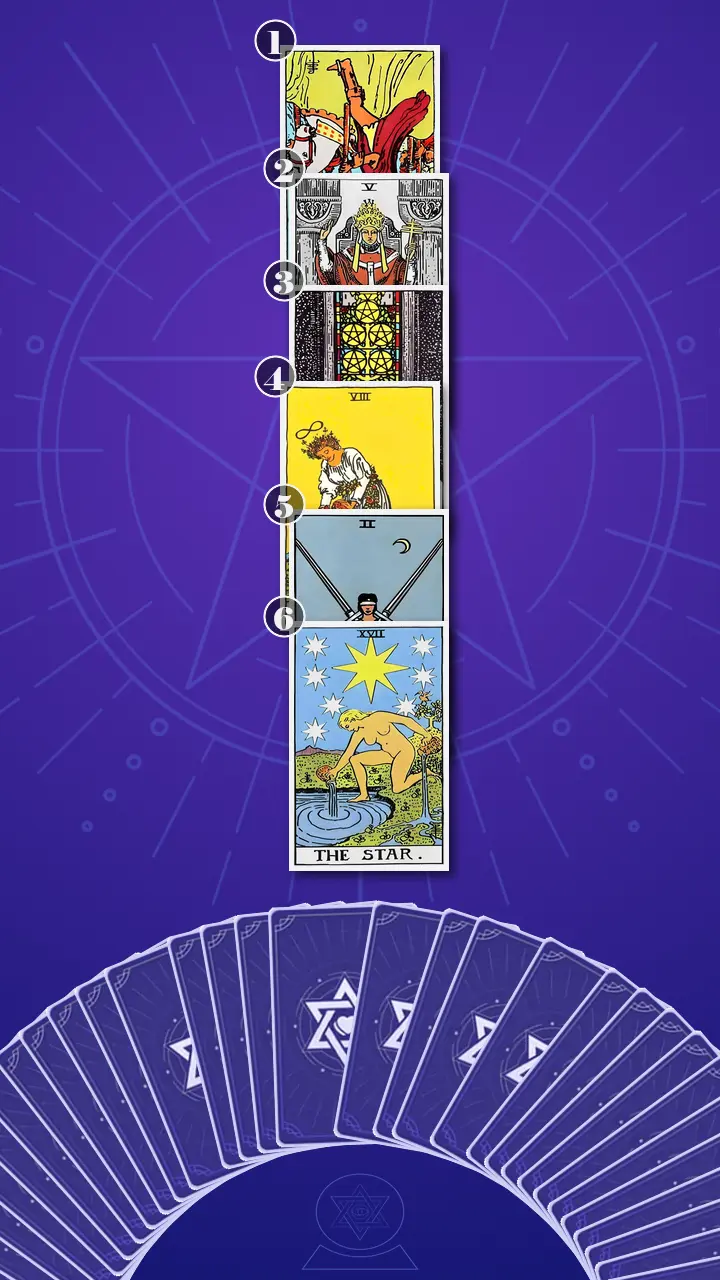
“Today I’m using a spread I built for moments exactly like this,” I continued, turning slightly as if I was also speaking to you, the reader. “It’s called the Four-Layer Insight Ladder · Context Edition. It’s designed for micro-triggers—the tiny things that hijack your whole system.”
The point isn’t prediction. It’s structure. This spread tracks the moment down through its layers—surface reaction, inherited role, underlying fear—then back up into one practical boundary and what integration actually looks like. A three-card pull can catch the vibe, but it often misses the specific family script and the one-step interruption that makes change repeatable.
“Here’s what to watch for,” I said. “The first card shows what got triggered in your nervous system. The second names the old family role—your internal ‘who I have to be.’ The fourth is the turning point, and the fifth is the simplest one-step boundary you can practice this week.”
Reading the Ladder: When a ‘Like’ Becomes a Spotlight
Position 1: Surface activation — the moment your body got the memo
“Now we turn over the card representing Surface activation: what specifically got triggered in you by the ‘Mom liked my post’ moment,” I said.
Six of Wands, reversed.
The image is recognition—laurels, a raised wand, the implied crowd. Reversed, that same visibility gets glitchy. It’s not celebration; it’s pressure.
And the modern version landed instantly: You posted something that felt genuinely you… and you were fine—until the notification hits: ‘Mom liked your post.’ Suddenly it’s not a post, it’s a performance review. You reopen it, reread the caption with ‘misinterpretation prevention’ eyes, check the like list like it’s an attendance sheet, and hover over Edit as if the tiniest tweak could protect you from being judged.
“This card is your stage light,” I told her. “You’re alone on your couch in sweatpants, but your nervous system acts like you’re live-streaming.” I kept it plain. No moralizing. Just accurate.
In energy terms, this is blockage—confidence that can’t receive recognition cleanly. The moment you’re seen, you don’t feel supported. You feel evaluated.
I watched Casey’s mouth pull into a quick, bitter half-smile. She let out a small laugh that had no humor in it. “That’s… yeah. That’s exactly it. It’s almost mean how accurate that is.”
“It’s not mean,” I said softly. “It’s precise. And precision means we can work with it.” I paused, then added a phrase I’ve seen unlock people faster than any lecture: “A like isn’t a verdict—it’s a ping. But this card shows your system treats it like a verdict.”
Position 2: The old family role/script — the internal policy manual
“Now we turn over the card representing The old family role/script: the inherited ‘who I have to be’ pattern that wakes up when family is watching,” I said.
The Hierophant, upright.
This is tradition, rules, approved pathways. In real life, it’s the internal HR policy manual that pops up the second a parent reacts. Not What do I want to express? but How do I make this acceptable?
The modern scenario fit her like a jacket she’d worn for years: The old role that runs you isn’t being dramatic—it’s the internal rulebook that says: be understandable, be respectable, don’t make it awkward, don’t make anyone worry. You switch from self-expression to compliance.
“This is why you start translating,” I told her. “You’re not writing a caption anymore. You’re filing a report for a family committee.”
Energy-wise, the Hierophant is structure. Not bad. Not good. Just powerful. Here it shows up as an inherited authority you default to before you even notice you’ve done it.
Casey’s eyes dropped to the table. Her thumb rubbed the edge of her phone case in a small, repetitive circle. “I hate that I’m still trying to be the easy one,” she said, quietly.
“You’re not dramatic,” I said, meeting her gaze. “You’re conditioned. That’s different. Conditioning can be rewritten.”
Position 3: Core fear/need — the cold outside the warm window
“Now we turn over the card representing Core fear/need underneath the role: what you’re trying to prevent or protect,” I said.
Five of Pentacles, upright.
Two figures in the cold, a warm window nearby—classic exclusion imagery. This isn’t about Instagram. This is about belonging feeling revocable.
I translated it the way I’d say it if she’d searched at 2 a.m., trying to name the real thing: Under the ‘be a good kid’ script is a colder fear: if you’re misread, you’ll be treated like the problem—like you’ll be on the outside of the family vibe. Your body reacts like belonging can be revoked.
As I spoke, the café felt quieter. The espresso machine had stopped. The street noise thinned. It was as if the room itself made space for the deeper layer.
“It’s not even that she’d yell,” Casey said. “It’s… the vibe shift. Like next holiday, I walk in and everyone’s polite and I can tell I’m… different. Like I made it weird.”
That was the Five of Pentacles: a temperature drop in the imagination. Energy-wise, it’s deficiency—not of love necessarily, but of felt safety. The body acts like connection is subscription-based and might get canceled if you stop being the acceptable version of yourself.
I nodded. “So your brain tries to pre-pay the risk—edit, explain, soften, shrink.”
When Strength Held the Lion: The Moment the Loop Breaks
Position 4: Transformation key — the inner capacity that resets your center
I let my hand rest on the deck for a beat. “We’re turning over the pivot now,” I said. “This is the card that shows how the pattern changes—not by fighting your mom, and not by disappearing.”
“Now we turn over the card representing Transformation key: the inner capacity that breaks the loop and resets your center.”
Strength, upright.
Before I said anything else, I noticed Casey’s posture—shoulders slightly raised, like she was bracing for impact even from a kind interaction. That’s the moment I use what I call my Stress Flavor Profile. In coffee, over-extraction happens when you pull too much, too long. The shot turns bitter, sharp, anxious—technically “more,” but not better. People do the same thing with meaning.
“You’re over-extracting,” I said gently. “Not coffee—interpretation. One like becomes a whole storyline. Your system pulls it until it tastes like danger.”
Strength doesn’t yank the lion into submission. It holds the lion with steady presence. It’s quiet inner authority—the kind you feel in your body, not the kind you win in an argument.
And here’s the setup, exactly where Casey lived: it’s 11:46 p.m., blue light on her face, reopening the post like it might change if she stares hard enough—throat tight, stomach clenched—already drafting an explanation she never wanted to write.
Stop treating visibility as danger; start practicing gentle self-leadership—like Strength, you don’t force the lion, you hold it with steady presence.
It hung in the air. Even the grinder behind the bar felt like it waited.
Casey’s reaction came in a sequence I’ve seen a thousand times, but it’s always tender to witness. First: a tiny freeze—her breath paused mid-chest, her fingers suspended above her phone like the screen had turned hot. Second: her eyes unfocused, like she was replaying a memory of being twelve and “reasonable” at the exact wrong time. Third: the release—her shoulders sank a fraction, and she exhaled through her nose like she’d been holding air hostage.
“But if I don’t manage it,” she said, and there was a flash of irritation in it, “doesn’t that mean… I’ve been doing this wrong for years?”
I didn’t rush to soothe her out of that truth. “It means you did what worked,” I said. “You kept belonging by being easy. That was intelligent. Strength isn’t calling you wrong. It’s offering you an upgrade: you don’t have to manage the narrative to stay safe.”
I guided her through what I call a Like-Is-Data Pause, the practical side of Strength. Under ten minutes. No spiritual theatrics—just a reset.
“Right now,” I said, “imagine your mom liking the post. Put your phone face-down for 90 seconds. Name the feeling out loud: ‘I feel exposed.’ Then write one line in Notes: ‘What I meant when I posted was ____.’ That line is for you, not for her. Then set a timer—12 hours. No edits, no viewer-list checks, no clarifying DM. If that’s too activating, make it two hours. The point is a buffer, not a perfect performance.”
Casey blinked fast, eyes glossy but steady. “Okay,” she said, voice quieter. “Yeah. I can… feel how that would change the night.”
“Now,” I asked, “with this new lens—quiet inner authority instead of reflexive self-management—think back to last week. Was there a moment you could have used this? Even for sixty seconds?”
She nodded once, slow. “Yesterday. I was going to delete a Story because my aunt viewed it.” She gave a small, almost embarrassed laugh. “Like… I didn’t even post anything controversial. It was just me at a show.”
“That’s the shift,” I said. “From approval-whiplash and reflexive self-management to quiet inner authority and deliberate choice. You don’t have to become a different person. You just practice coming back to center.”
Not Tonight Is a Boundary: The Two of Swords in Real Life
Position 5: One step — the simplest micro-boundary for this week
“Now we turn over the card representing One step: the simplest boundary or micro-action you can take this week to stop feeding the old role,” I said.
Two of Swords, upright.
This card is a pause you can trust. Still water. Crossed swords. A blindfold that says, I’m choosing what gets my attention right now.
The modern scenario was almost a direct script: Your one step is a pause boundary with your attention. You decide: ‘Not tonight.’ No edits, no checking the viewer list, no explanatory DM until tomorrow. You put the phone down, turn on Do Not Disturb, and you give your nervous system time to stop treating a like as a verdict.
I leaned in. “Here’s the mantra for this card,” I said. “Not tonight is a boundary. You don’t have to set a boundary with your mom yet. You set it with your own midnight brain.”
Casey’s shoulders loosened more noticeably this time. Relief, but also that tiny fear that comes right before you stop performing. “I can do ‘not tonight,’” she said. “I can’t do ‘never care.’ But I can do tonight.”
“Exactly,” I said. “Two of Swords isn’t ‘I don’t care.’ It’s ‘I choose timing.’”
Post—Then Return to Your Life: The Star as Integration
Position 6: Integration — what life feels like when you’re back in your own signal
“Now we turn over the card representing Integration: what it feels like and looks like when you live from the new stance,” I said.
The Star, upright.
After the cold street of the Five of Pentacles, the Star is open sky. It’s healing that doesn’t require anyone else to approve of it first.
In modern terms: Integration looks like posting and then returning to your actual life—making tea, answering a friend’s text, taking a quick walk, going to bed—without spiraling. You still care about your family, but you don’t outsource your identity to their reactions.
I smiled a little, because this is where my café brain always shows up. “In Italy we have riposo,” I told her. “A pause built into the day. Not because you earned it by being perfect—because you’re human. The Star is riposo for your identity. Post—then return to your life. Let the nervous system learn that being seen isn’t an emergency.”
Casey looked down at the Star card like it was a window she’d forgotten existed. “That sounds… calm,” she said. “Almost too calm.”
“Calm is learnable,” I said. “Not by forcing it. By practicing the buffer.”
The One-Page ‘Like-Is-Data Protocol’: Actionable Advice for the Next 48 Hours
I pulled the whole ladder together for her, like lining up cups on the bar. “Here’s the story your cards told,” I said. “The trigger is visibility that feels like evaluation (Six of Wands reversed). The moment that happens, your internal family policy manual opens (The Hierophant), and underneath it is the belonging fear—the cold thought that you could become ‘the problem’ if you’re misread (Five of Pentacles). The reset is Strength: gentle self-leadership that holds the impulse without obeying it. The action is Two of Swords: a time-bound pause. And the result is The Star: you get to be real and still feel steady.”
“Your cognitive blind spot,” I added, “is that you keep treating anxiety like a content problem. Like if you rewrite the caption perfectly, you’ll be safe. But the spread shows the content isn’t the emergency—the old role is.”
“The transformation direction is simple,” I said. “Move from interpreting your mom’s reaction as a verdict to treating it as data you can notice—and then return to your own values before you respond or change anything.”
Then I gave her a short plan—small steps, testable, no perfection required. I borrowed from my café tools on purpose, because bodies learn faster than brains.
- The 12-Hour No-Edit BoundaryAfter you post, set a phone timer for 12 hours: no editing captions, no deleting, no checking the viewer/like list, and no “just to clarify” DMs to your mom. If 12 hours feels impossible, start with 2 hours.Expect the thought “If I don’t manage it now, it’ll get worse.” Label it as the Hierophant script, not a fact. Then keep the timer anyway.
- Phone Face-Down + 6 Breaths (Strength Practice)When the notification hits, put your phone face-down and take 6 slow breaths before you touch anything. Say one clean sentence out loud: “I feel exposed.”If you can’t breathe slow, do it café-style: stand up and rinse one mug or wash one spoon—one physical action to tell your body it’s not under attack.
- Cup Temperature Scan (Catch the Energy Leak)Make a tea or coffee, set it down, and notice how fast you feel compelled to pick up your phone again. If your attention “cools” in under a minute, that’s your cue to step away from the screen for 5 minutes before you decide anything.You’re not testing willpower. You’re measuring pacing—like checking whether an espresso machine needs maintenance before it starts pulling bitter shots.
Casey nodded as if each bullet point was a handrail. “This feels doable,” she said. “Annoying,” she added, then smiled despite herself, “but doable.”
“Good,” I said. “If it’s a little annoying, it means it’s interrupting the autopilot.”

A Week Later: The Quiet Proof
Six days later, I got a message from Casey while I was opening the café—rolling up the front awning, the street still half-asleep, espresso scent starting its daily takeover.
“I did the 2-hour version,” she wrote. “Mom liked my Story. I put my phone face-down. I didn’t edit anything. I felt twitchy for like ten minutes, then it passed. This morning I re-read what I wrote in Notes—what I meant—and I actually… still agree with myself.”
It wasn’t a Hollywood transformation. It was better: a small, repeatable proof. Clear but a little tender. She didn’t stop caring about her family. She stopped letting one notification drive the whole car.
That’s how this kind of tarot reading works at its best: not as fortune-telling, but as a practical mirror. A spread that turns “Why do I panic when my mom likes my Instagram post?” into “Oh—this is my old role waking up, and here’s my one-step boundary.”
When a single notification makes your throat go tight and your mind start writing explanations, it’s not about the post—it’s the old fear that belonging disappears the moment you stop being the easy version of you.
If you treated the next family ‘like’ as data—not a verdict—what’s the smallest pause you’d want to give yourself before you change anything?