Boundary Guilt Around an Ex's Wedding—And the Monday-Morning Test

Finding Clarity in the Sunday-Night RSVP Spiral
If you’ve drafted three different RSVP responses—one warm, one neutral, one hyper-mature—and sent none because you’re terrified it’ll say something about you, yep.
Jordan (name changed for privacy) sat across from me with their phone face-down on the table like it might vibrate with a verdict. They were 29, a marketing coordinator in Toronto, the kind of person who could run a campaign calendar in their sleep—yet a single wedding invite had turned their week into a low-grade alarm that never fully shut off.
They told me it hit hardest at night. “It’s due Sunday,” they said, almost apologizing for needing help with something that sounded so simple out loud. “And I keep… opening it. Closing it. Opening it again. Like if I stare at it long enough, it’ll tell me what the emotionally mature version of me would do.”
In my mind I saw the scene before they even described it, because I’ve lived some version of it—just with different stakes. 11:03 p.m., blue phone-light bleaching your face, duvet pulled up, the RSVP page refreshed like it’s going to update itself. The room is quiet except for the tiny electronic hiss of your screen. Your thumb hovers. Your throat tightens the way it does right before you speak in a meeting you didn’t ask to be in.
Jordan swallowed hard and rubbed their chest once, like they could smooth the tension down with their palm. “If I say no, I feel petty,” they said. “And if I say yes, I feel exposed. I’m tired of performing unbothered.”
What they were describing wasn’t just indecision. It was boundary guilt: wanting closure and social ease—wanting it to look graceful—while fearing an emotional relapse and losing self-respect. Anxiety, not as a concept, but as a physical contract: a tight throat, a tight chest, and a restless stop-start energy that wouldn’t let them fully exhale until the RSVP was sent.
“Okay,” I said, keeping my voice warm and plain. “Let’s make this smaller and truer. We’re not here to predict the wedding night like it’s a simulation. We’re here to find clarity—enough to choose a boundary you can respect when you wake up on Monday.”

Choosing the Compass: The Decision Cross · Context Edition
I asked Jordan to take three slow breaths—not for mysticism, but for a nervous-system reset. Then I shuffled with them watching, the way I used to watch price action on a trading screen: not looking for drama, looking for signal.
“For this,” I said, “I’m using the Decision Cross · Context Edition.”
And here’s why this spread works so well for time-sensitive RSVP anxiety: it’s designed for clarity, not fortune-telling. You’re staring at a hard yes/no choice with a deadline, and your brain is trying to solve it by collecting more ‘evidence’—mutual friends’ Stories, old texts, group chat opinions—like one more data point will make the risk feel controllable. A Decision Cross interrupts that loop by forcing the question into structure.
In this layout, card 1 goes in the center: the current bind—how indecision is showing up and what it’s costing you. Card 2 and 3 form the horizontal line: the real emotional reality of “yes, I go” versus “no, I protect my peace.” Card 4 sits above: the hidden driver inflating the stakes. Card 5 anchors below: the integration advice—the boundary-based next step you can actually do.
“We’ll read it like a crossroads sign,” I told Jordan. “Center, then left/right, then the ‘why it’s so intense,’ then the clean next move.”
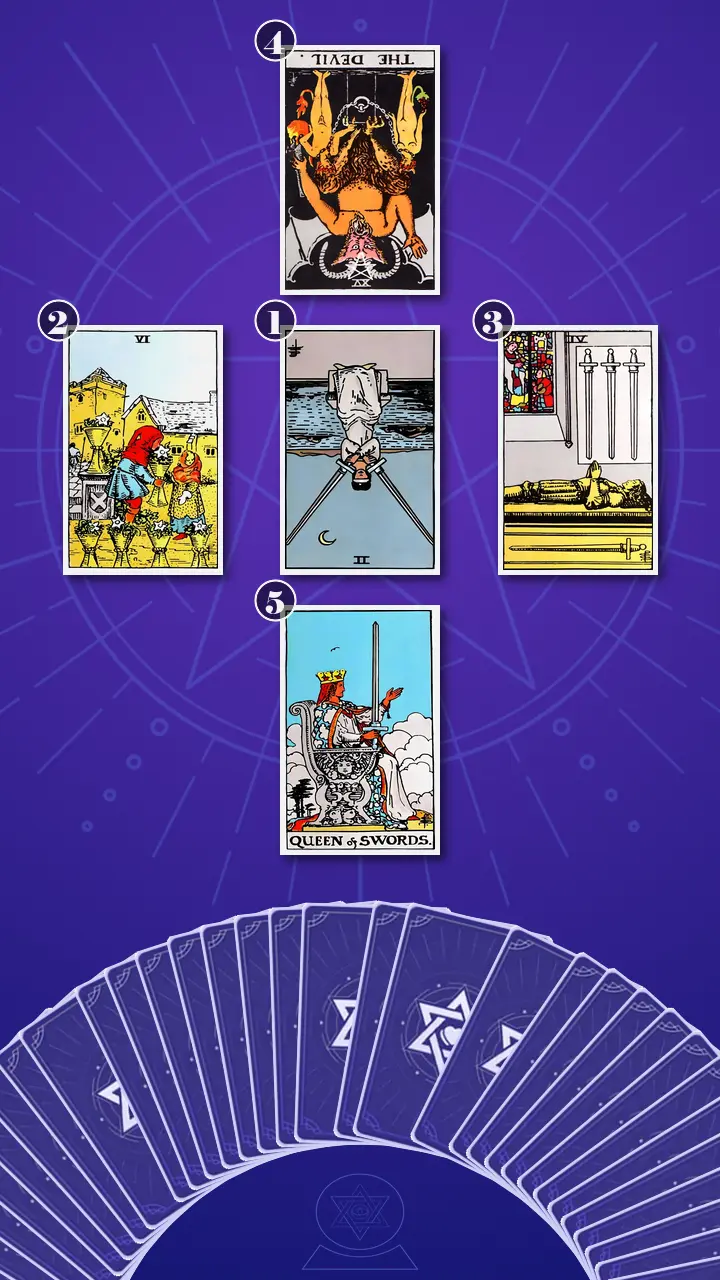
Reading the Map: Card Meanings in Context for an Ex’s Wedding RSVP
Position 1 — The current bind: what the RSVP loop is costing you
“Now we flip the card for The current bind: the specific way indecision shows up around the RSVP and what it’s costing emotionally and practically,” I said.
Two of Swords, reversed.
In modern life, this is the too-many-tabs card. The RSVP page open. Instagram open. Notes app open with a pros/cons list that reads like a Notion table for feelings. A half-written text to a friend: “What would you do?” Outwardly you’re calm; privately you’re stuck in a loop because pressing “Yes” or “No” feels like it will publicly define your healing.
Reversed, the Two of Swords isn’t balanced stalemate—it’s a blockage that leaks. You try to stay perfectly neutral—blindfold on, swords crossed over your chest—but the effort of pretending you’re fine becomes its own kind of noise. It’s decision paralysis under imagined social scrutiny.
I watched Jordan’s face as I mirrored the inner monologue I hear all the time in sessions like this: “If I go, it means I’m mature. If I don’t, it means I’m still hung up. If I go and feel weird, it proves I’m not healed. If I don’t go, it proves I’m petty.”
Then I softened it. “But what if it just means… you chose a boundary?”
Jordan let out a small laugh that wasn’t amused—more like a wince with receipts. “That’s… kind of brutal,” they said, eyes flicking down to the card and back up. Their shoulders stayed high, but their gaze steadied. The pattern had a name, and naming it made it slightly less powerful.
Position 2 — Path A: what “going” is really about (and the internal tone)
“Now we flip the card for Path A: what ‘going to the wedding’ is really about for you,” I said.
Six of Cups, upright.
This card is nostalgia with good lighting. It’s the highlight reel: inside jokes, the old friend-group vibe, that sense of “maybe we can be cordial.” It’s the pull to be the bigger person, to smooth the social surface, to make everything look… settled.
Upright, the Six of Cups is a balance of sweetness and goodwill—but in this position, it comes with a hidden cost. The risk isn’t drama. It’s slipping into old roles: over-smiling, over-performing ease, letting the past get a vote in the present. Like reopening an old archived thread because you miss the feeling of being understood there—then remembering why you archived it in the first place.
I gave Jordan a quick contrast flash—warm, then sharp. “You imagine the clink of glasses, familiar faces, maybe even relief,” I said. “And then—dry mouth. Tight chest. You’re already checking where the exits are.”
They nodded, but their eyes went slightly glossy, like the recognition stung. “Yeah,” they said quietly. “The idea is sweet. My body is not sweet about it.”
Position 3 — Path B: what “protecting your peace” is really about (relief and discomfort)
“Now we flip the card for Path B: what ‘not going / protecting your peace’ is really about for you,” I said.
Four of Swords, upright.
This is the chapel-door energy of Do Not Disturb. Not punishment—protection. It’s opting out as nervous-system recovery, not failure. In real life for Jordan it looked like: phone on Focus mode, a walk through cold air, takeout from the go-to spot, one comfort-show episode, early bed. A calendar block called “Do Not Book” that’s as real as any meeting.
Upright, the Four of Swords is a balance—a deliberate pause that lets your mind and body stop negotiating. The discomfort isn’t the night itself; it’s the story in your head about what others will assume. The fear of being interpreted. The urge to pre-explain in a group chat before anyone even asks.
“Try something,” I said. “Imagine you decline. No speech, no defense. Just a clean no. Notice your throat and chest.”
Jordan’s breathing changed immediately—still cautious, but longer. Their shoulders dropped maybe half an inch, like a backpack strap finally loosened. “It’s relief,” they admitted. “And then my brain goes, ‘But what if people think—’”
“Right,” I said. “Quiet relief versus fear of being interpreted. That’s the actual tug-of-war.”
Position 4 — The hidden driver: what’s inflating the stakes
“Now we flip the card for The hidden driver: the deeper attachment, fear, or social pressure making this feel higher-stakes than it is,” I said.
The Devil, reversed.
Reversed Devil is one of my favorite cards in relationship boundary readings because it’s not about doom—it’s about release. The chains aren’t locked the way you think they are. What’s driving the intensity here isn’t the wedding. It’s the optics. The feeling that other people’s opinions get to grade your healing.
I named it the way my old desk used to name things: operationally. “This is you prepping for a performance review you never agreed to,” I said. “Outfit planning, rehearsing facial expressions, imagining mutuals’ captions, timing your exit so it doesn’t look ‘dramatic.’”
Jordan made a sound that was half laugh, half groan. Their eyes squeezed shut for a second. Then they opened them and looked at me like I’d read their search history. “I literally imagined the ‘I’m so happy for you’ face,” they said. “Like… the exact face.”
“Being liked can start to feel like being safe,” I said. “But that’s the Devil’s old subscription—still billing your attention every month. Reversed means you’re ready to cancel.”
Position 5 — Integration advice: the boundary-based next step you’ll respect afterward
I let the room go quiet for a beat before we turned the last card. Outside my window, a streetcar bell rang once—clean and bright—like punctuation. “This is the anchor,” I said. “The advice card.”
“Now we flip the card for Integration advice: the clearest boundary-based next step for responding to the RSVP in a way you can respect afterward.”
Queen of Swords, upright.
Jordan leaned forward without realizing it. Upright, the Queen of Swords is discernment with a steady gaze. Kind, but not porous. Honest, but not dramatic. She doesn’t do closing arguments; she does clean boundaries.
Here was the setup I could feel in Jordan’s body: they were trapped in the thought that the “right” choice was the one that made them look healed. It was 10:43 p.m. in their head, finger hovering, flipping to Instagram to see which mutuals liked the post—trying to avoid being seen wrong.
Stop trying to be 'unbothered' behind a blindfold and choose the Queen’s clear gaze—one honest boundary, one clean RSVP.
Jordan’s reaction came in a chain—three small movements that told me the message landed where it needed to. First: a tiny freeze, like their breath caught on the way in. Their fingers hovered above their phone as if they were about to flip it over. Second: their eyes unfocused for a second, like they were replaying every draft they’d written in fear—warm, neutral, hyper-mature—trying to anticipate judgment that hadn’t even arrived. Third: a slow exhale that sounded almost like a laugh, but softer, more tired. Their shoulders dropped enough that I could actually see their neck lengthen.
Then, unexpectedly, the steadiness triggered a flash of resistance. Their brows pulled together. “But if I’m that clear… doesn’t it mean I’ve been making this a thing for no reason?” they asked. Their voice sharpened on no reason—not at me, at themselves.
I kept my tone level. “Not for no reason,” I said. “For a reason that makes sense: you’ve been trying to control perception to avoid pain. The Queen isn’t here to shame you. She’s here to hand you the adult tool: clarity.”
I leaned in. “Now, use this new lens and look back at last week. Was there a moment—on the TTC, in bed on Sunday night, hovering over the RSVP—where this could have changed how you felt?”
Jordan blinked, and their eyes went a little red around the rims—not tears spilling, just that edge you get when you finally stop arguing with yourself. “Yeah,” they said. “When I screenshot the mutual’s Story. I felt disgusting after. Like… why am I doing investigative journalism on my own life?”
“Exactly,” I said. “This isn’t just about a wedding. This is a move from anxiety-driven image management and decision paralysis to grounded self-trust and compassionate firmness. That’s the shift.”
The One-Page Decision Ledger for an RSVP You Can Respect
I gathered the spread back into one story, the way I used to summarize a deal for a room full of executives who needed clarity without drama. Two of Swords reversed showed the present: too much mental litigation, too many tabs, treating an RSVP like a referendum. Six of Cups showed the “yes” path’s real engine: nostalgia and social smoothing—sweet, but potentially expensive. Four of Swords showed the “no” path’s truth: rest as an active boundary—relieving, but prickly because of optics. The Devil reversed explained why it all felt so charged: you’re not tethered to the ex; you’re tethered to being perceived as over it. The Queen of Swords was the antidote: one clean sentence, no closing argument.
“Your blind spot,” I told Jordan, “is thinking you need to predict the wedding-night version of you in order to choose. That’s impossible forecasting. The transformation direction is simpler: choose the boundary you can respect on Monday morning, then communicate it like the Queen—clear and kind.”
This is where I used my own hybrid approach—part Tarot, part boardroom. I call it a Decision Ledger: a weighted scoring system that turns emotional fog into something you can actually move through without outsourcing your agency.
“We’re not optimizing for optics,” I said. “We’re weighting for peace.”
- The 10-Minute Ledger (SWOT-TAROT hybrid)Set a 10-minute timer. In Notes, make two columns: Go and Don’t go. Under each, write one Strength (what you gain), one Weakness (what it costs your nervous system), one Opportunity (what boundary you practice), and one Threat (what pulls you back into optics).If you start writing to convince a group chat, stop and rewrite as if only Monday-morning you will read it.
- The One-Clean-Sentence RSVPWrite two drafts: (1) a one-sentence “Yes” and (2) a one-sentence “No.” Read each out loud once. Choose the one that lets your shoulders drop even 5%. Then submit the RSVP and close the tab—literally.Expect the urge to overexplain right after you hit submit. Pre-commit: no group-chat debrief for 24 hours.
- The Pre-Commitment Focus Move (trading-floor style)Right before you hit submit, take three slow breaths, put your phone on Do Not Disturb for 20–90 minutes, and do one grounding action (shower, tea, short walk). This locks in the decision before the anxiety tries to reopen the case.If 90 minutes feels impossible, start with 20. The goal is a closed loop, not a perfect self-care night.
Jordan hesitated at the 24-hour rule. That was the practical obstacle, the real one. “But my friends will ask,” they said. “And if I don’t explain, it’ll feel… cold.”
“That’s the Queen of Swords lesson,” I replied. “Clarity isn’t coldness. It’s honesty with limits. You can be warm without being porous. If you need a script, try: ‘I made my RSVP—no debrief, just sending you a heart.’”
They nodded slowly, as if they were trying on a jacket and realizing it fit.

A Week Later: Quiet Proof, Not Perfect Certainty
Six days later, Jordan texted me a screenshot—not of a mutual’s Story, not of a thread, not of a pros/cons table. Just a single line in their Notes app: “I’m not taking feedback on this decision.” Under it: “RSVP submitted.”
They added, “I muted the couple and two high-trigger mutuals for a week. It felt dramatic for like… ten minutes. Then my brain got weirdly quiet.”
In a follow-up message, they described the bittersweet part with a kind of surprised honesty: they slept through the night for the first time in a while, but when they woke up their first thought was still, What if I picked wrong? Then they wrote, “I laughed a little. Like—oh, there’s the old script. And I didn’t obey it.”
That’s the Journey to Clarity I trust the most: not fireworks, not a perfect emotional outcome—just the quiet proof that you can choose what’s steady, communicate it cleanly, and let your life be the evidence.
When an RSVP feels like a public grade on your healing, you can end up holding your breath—trying to look unbothered while your body begs you to choose what you’ll still respect the next morning.
If you didn’t have to prove you’re “fine” to anyone, what would your cleanest, kindest boundary sound like in one sentence?