From 401(k) Rollover Deadline Panic to Criteria-Based Follow-Through

401(k) Rollover Deadline Anxiety at the Kitchen Table
If you’ve had 8–12 tabs open—old plan portal, IRA providers, IRS pages, Reddit threads—and somehow you’re still not one step closer to clicking submit… I know exactly what that screen feels like.
Jordan (name changed for privacy) showed up to our Zoom session from a Queens apartment kitchen, laptop planted on the table like it was an opponent. The overhead light did that cheap-bulb buzz that makes your teeth feel slightly on edge. A paper plate of cold dumplings sat off to the side. Their trackpad looked shiny from overuse.
They angled the camera down for a second—almost apologetic—and I saw it: the old 401(k) portal banner screaming a rollover deadline, a calculator tab half-filled, and a Reddit thread from r/personalfinance where three strangers sounded 100% certain and fully disagreed.
Jordan’s jaw flexed like they were chewing something tough. Shoulders crept up toward their ears. Fingers kept tapping the edge of the laptop, fast and staccato.
“I’m not trying to get rich,” they said, voice tight. “I’m trying not to mess this up. IRA rollover or keep the old plan. It feels… irreversible.”
What I heard underneath was the real tug-of-war: wanting to protect and simplify their retirement savings, while fearing one wrong move will lock in a costly mistake.
The anxiety in the room wasn’t abstract. It had weight. It was like holding two stacks of paperwork while standing at a revolving door that won’t stop spinning—every time you try to step through, the door knocks the papers out of your arms and you have to gather them again.
I softened my voice, the way I do when someone is trying to look like a competent adult in public while privately bracing for impact. “We can work with that. Not by predicting a perfect outcome, but by building you a clear process you can actually follow before the deadline. Let’s make a map through the fog—something you can defend to your future self.”

Choosing the Compass: How the Decision Cross Spread Works
I asked Jordan to take one slow breath—not as a mystical ritual, just as a gear shift. Then I shuffled while they held the question in plain language: “I have a rollover deadline—do I roll to an IRA or keep the old 401(k) plan, and what’s my next step?”
“For this,” I said, “I’m using a Decision Cross tarot spread.”
For anyone wondering how tarot works in a situation like a 401(k) rollover deadline: I’m not using the cards as financial advice or pretending there’s one correct move for everyone. I use them as a structured mirror—something that surfaces what you’re optimizing for, where you’re stuck, and what would make the decision smaller and executable. Under deadline pressure, that’s often the difference between ‘researching’ and actually finishing a task.
The Decision Cross is perfect here because it keeps the problem clean and binary: Option A vs Option B, with a vertical axis for the missing lens (criteria) and the grounded support, and a final position that forces a real-world action. It’s built to end with next steps, not vibes.
I told Jordan what to expect:
“Card 1 shows the surface reality—what your stuck pattern looks like in a way we can point to. Cards 2 and 3 show what each path is really offering you psychologically. Card 4 is the key consideration—the lens that cuts regret. And card 6 will be your action within the deadline.”
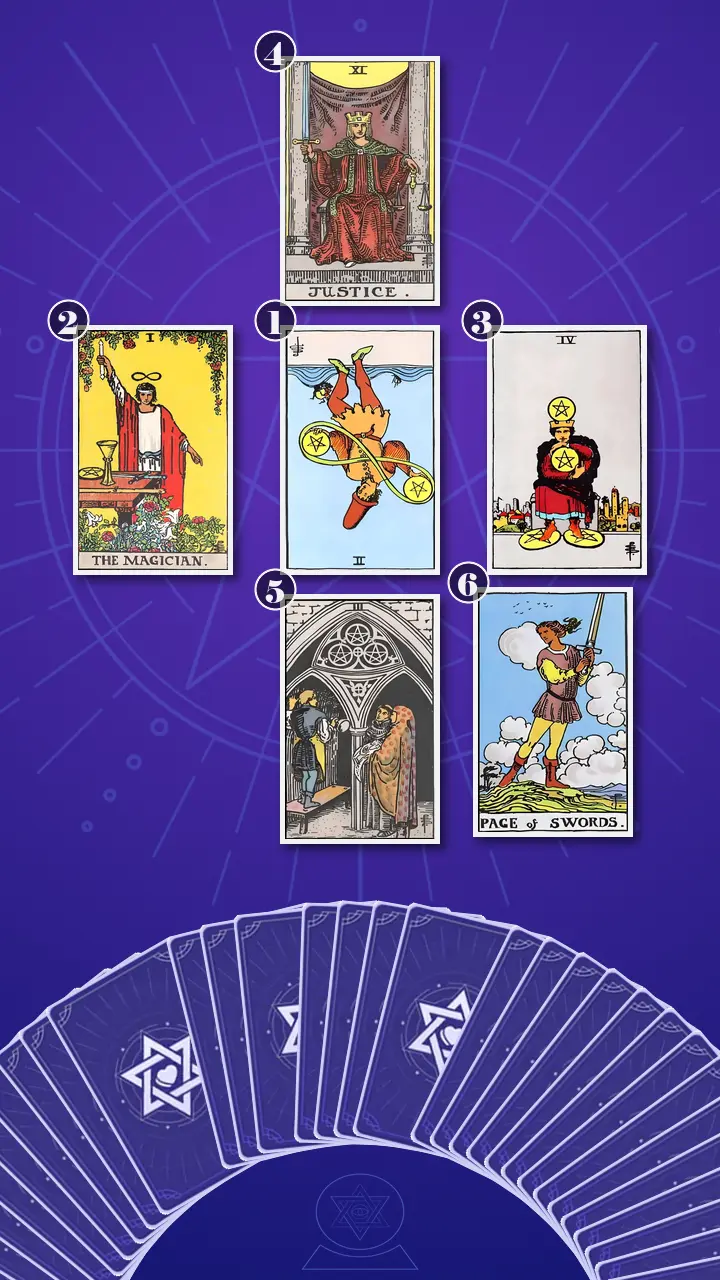
Reading the Map: A Tarot Reading for a 401(k) Rollover Decision (IRA vs Keep Old Plan)
Position 1 — Surface reality: the stuck loop under the deadline
“Now we’re turning over the card that represents Surface reality: the specific stuck behavior and deadline-driven overwhelm around the rollover decision.”
Two of Pentacles, reversed.
This card always makes me think of rhythm. In the classic image, someone juggles coins in an infinity loop while waves toss ships behind them. Reversed, that rhythm breaks. The sea looks choppier. The juggling becomes panic-management.
In modern life, it’s exactly this: You’re trying to carry fees, tax rules, provider reputations, deadlines, and form vocabulary in your head at the same time. So you bounce between the old 401(k) portal, an IRS page, and IRA comparison sites until your brain feels scrambled—then you shut the laptop for ‘later,’ even though the deadline is exactly what’s making you frantic.
The energy here is blockage through overload. Not laziness. Not incompetence. Just too many variables held at once, so your nervous system does what it’s designed to do—hit the emergency brake.
Jordan let out a short laugh that had no joy in it. Their eyes flicked to the side, like the card had just read their browser history out loud. “Okay,” they said. “Yep. That’s literally my screen right now. That’s… kind of mean.”
I nodded. “It can feel brutal when it’s accurate. But here’s the thing: this isn’t a personality flaw. This is a pattern.”
And because I’m a Jungian psychologist, I can’t not name the mechanism when it’s right there. I used my Procrastination Decoding lens—the one I developed watching thousands of people freeze at ‘simple’ admin tasks on long voyages, right before a ship docked and time got real.
“Your loop is: deadline email → unfamiliar jargon → the belief ‘if I can’t be 100% sure, I shouldn’t choose’ → you open more tabs to feel responsible → you get temporary relief → then more confusion and less time → and the last belief gets louder: ‘maybe I’m not competent.’”
Jordan’s shoulders lifted again at the word competent, like it hit a nerve.
“A rollover isn’t a referendum on your competence,” I added, gently but firmly. “It’s paperwork with a story attached.”
Position 2 — Path A: what an IRA rollover is really offering you
“Now we turn over the card that represents Path A: what choosing an IRA rollover is really offering you psychologically and practically.”
The Magician, upright.
I always notice the Magician’s table first: all the tools laid out. No chaos. One hand up, one hand down—an image of translating intention into a system.
In your real-life scenario, it’s this: The IRA option feels like getting your hands back on the controls: you can choose the custodian, consolidate accounts, create a clean system, and stop being at the mercy of an old employer’s plan. The hidden tension is that autonomy can quickly turn into pressure—like you have to prove you’re the kind of person who can do this flawlessly without help.
The energy here is balance that can tip into excess responsibility. The IRA path doesn’t just promise “better.” It promises ownership. For a product designer, that’s catnip.
I mirrored it in their language. “This feels like setting up a new project workspace—new folder structure, single source of truth, tools you chose. It’s not just money. It’s the relief of a dashboard that makes sense.”
Jordan’s eyes widened—small, quick recognition. “That’s… exactly it. It feels cleaner. Like I could finally make it make sense.”
“And the shadow,” I said, “is that it can also whisper: ‘If I choose wrong, it’s on me.’ Magician energy is powerful, but it shouldn’t become a solo performance.”
Position 3 — Path B: what keeping the old 401(k) is really offering you
“Now we turn over the card that represents Path B: what keeping the old 401(k) plan is really offering you psychologically and practically.”
Four of Pentacles, upright.
The image is all containment: a figure clutching a coin to their chest, one under each foot, one balanced on the head. Guarded. Closed. The city in the background feels distant, like life is happening elsewhere while they hold still.
In modern life: Keeping the old plan promises immediate relief: fewer steps, less paperwork today, and the comfort of leaving everything contained. But it can also become a way to postpone the emotional discomfort of deciding—so the account stays put not because it’s best for you, but because moving it feels like inviting risk.
The energy here is security through holding. In a city like New York, I think of the subway—how you grip your phone tighter when the announcements crackle and blur. You hold tight because movement feels risky.
Jordan’s mouth pulled sideways. Not a smile. More like a wince. “Yeah. ‘If I don’t touch it, I can’t break it.’ That’s… absolutely what my brain is doing.”
“That impulse isn’t wrong,” I said. “It’s protective. We just need to make sure protection doesn’t turn into postponement.”
Position 4 — The key consideration: what reduces regret and clarifies tradeoffs
“Now we’re turning over the card that represents The key consideration: the missing lens, decision criteria, or non-negotiable that reduces regret and clarifies tradeoffs.”
As the card slid free, the room got quieter in that very NYC way—like a siren passed and suddenly you can hear your own fridge again.
Justice, upright.
Scales in one hand. Sword in the other. No drama, no sparkle—just structure. I’ve always loved that about Justice. It doesn’t soothe you with reassurance. It steadies you with a framework.
Here’s the setup Jordan was living inside, whether they named it or not: portal open, provider comparisons open, deadline email blinking like a warning light, brain trying to carry every possible consequence at once. “Being responsible” had turned into mental static.
Not “endless research to eliminate uncertainty,” but “set your scales and make the sword-cut” through a clear rubric and one decisive step.
I let the sentence sit. On my end of the screen, I saw Jordan freeze for a beat—breath held mid-chest, fingers hovering above the trackpad. Then their eyes softened, as if something inside them finally stopped sprinting.
“Justice is telling you the decision isn’t: ‘Which option is objectively best?’” I continued. “It’s: ‘What process would be fair and defensible to my future self?’”
And here’s where my Venice shows up, because I can’t unsee decisions as trade routes and docking windows. I slipped into my Choice X-Ray—the tool I use to reveal hidden costs and benefits across multiple dimensions, not just the loudest fear in the room.
“Let’s X-ray this,” I said. “We’re not trying to see the future. We’re trying to see what you’re paying for with each option.”
“The scales are your three criteria—what you’re optimizing for. The sword is the cut: one protected time block where you do the next concrete step. Not a whole life plan. A cut.”
Jordan’s reaction came in a three-part wave: first a physical thaw (their shoulders dropped, like someone finally lowered a heavy backpack), then a cognitive shift (their gaze went unfocused for a second, like they were replaying last week’s Sunday-night spiral), then an emotional release (a long exhale that sounded like air escaping a valve).
They blinked hard. Their eyes went a little wet, which surprised them. “But… if I do that,” they said, voice catching on the edge of irritation, “doesn’t it mean I’ve been doing it wrong this whole time?”
There it was—an unexpected flash of anger, not at the process, but at the shame behind it.
I kept my tone steady. “It means you’ve been trying to protect yourself with the tools you had: more information, more checking, more control. Justice isn’t calling you wrong. It’s offering you a cleaner tool.”
Then I followed the reinforcement like a small guided practice, because insight without an action container becomes—ironically—another tab.
“Set a 10-minute timer. Open your notes app and write: (1) your deadline date, (2) three decision criteria—your ‘scales,’ (3) five exact questions—your ‘sword.’ Then stop. If you feel your jaw clench or you start reaching for Reddit, that’s your cue to pause—no forcing. You’re allowed to close the laptop and come back when the timer ends.”
I watched Jordan swallow, jaw loosening as if they’d just realized it could. “Okay,” they whispered. “That makes it… smaller.”
“Yes,” I said. “This is you moving from deadline-driven panic and tab-switching overwhelm to calm, criteria-based follow-through you can defend to your future self. That’s the real transformation.”
I leaned in, gentle but precise. “Now, with this new perspective—process over perfect prediction—think back to last week. Was there a moment when you opened another tab, and this could’ve helped you do something different?”
Jordan looked down and nodded once. Slow. “Sunday night. I could’ve just… written the questions instead of trying to find the one magic Reddit comment.”
Position 5 — Support system: the help that keeps you grounded
“Now we turn over the card that represents The support system: the resource, mindset, or help you can use to make a grounded decision without spiraling.”
Three of Pentacles, upright.
Three figures in consultation. A plan in hand. A shared space built for craft. This is competence that comes from collaboration and clear roles—not from doing everything alone.
In modern terms: You stop treating this like a solo test and start treating it like a small collaborative project: you contact the plan administrator or IRA custodian with a short question list, get clarifications in writing, and save everything in one folder. The support isn’t random opinions—it’s roles, receipts, and a shared plan that makes the next step obvious.
The energy here is grounding through structure + reliable channels. Not “ask everyone.” Ask the right people, in the right place, in the right way.
Jordan’s hands, which had been fidgeting, went still on the tabletop. “I hate calling,” they admitted. “I don’t want to sound like I don’t know what I’m doing.”
“That’s exactly why Three of Pentacles is here,” I said. “You don’t have to perform expertise. You just have to collect specifics.”
Position 6 — Action within the deadline: the next concrete step
“Now we turn over the card that represents Action within the deadline: the next concrete step that turns clarity into execution and breaks the research loop.”
Page of Swords, upright.
The Page stands alert, sword raised—not to fight, but to cut through noise. Wind everywhere. Thoughts moving fast. But the posture is clean.
In your real-life scenario: You draft five precise questions (direct vs indirect, any withholding, how it’s processed, timelines, who to contact if something stalls). You send them in one email or make one call with the script in front of you. When you get answers, you write them down and stop researching for 24 hours—because your next step now lives in specifics, not speculation.
The energy is curiosity with boundaries. Investigation that ends in an artifact, not obsession disguised as due diligence.
Jordan exhaled, then immediately tried to bargain with reality. “But I can’t even find five minutes. Work is… constant. Slack, meetings, Figma, and then my brain is fried.”
I didn’t argue. I adjusted. “Then we don’t start with a phone call. We start with one email you can send in three minutes. Page of Swords isn’t ‘be fearless.’ It’s ‘ask a clear question.’”
I said it the way I’d say it to a friend on the F train: “Ask five questions. Save the answers. Stop scrolling.”
Set the Scales. Make the Cut: Actionable Next Steps for the Next 48 Hours
Here’s the story your cards told in one clean line: the Two of Pentacles reversed shows the loop—overload, tab-switching, and the belief that certainty has to come before action. The Magician and Four of Pentacles show the two pulls: autonomy through building your own system vs safety through leaving things contained. Justice is the bridge that reframes the whole dilemma: you don’t need the internet to agree with you—you need a fair process. And Three of Pentacles + Page of Swords turn that process into support, questions, and receipts.
Your cognitive blind spot is subtle but common in deadline-driven money decisions: you’ve been treating the choice like a character verdict—am I the kind of adult who can be trusted with money?—instead of a manageable admin project with a rubric.
The transformation direction is clear: shift from seeking the “perfect” retirement choice to committing to a written decision process (criteria + one message + one completed action) before the deadline.
To make this real, I want you to borrow a cruise principle I used for years: when a ship docks, you don’t try to see every street in the city. You choose one route, with a time limit, and you return to the ship on purpose. I call it my Port Decision Model: a time-bounded docking window for action, not endless wandering.
- Build your “Justice Rubric” (10 minutes)Open a notes app and write your rollover deadline date, then write three criteria in plain language (example: “cost transparency / ease of management / access to support”). Keep it to three—no bonus criteria.If your chest tightens, switch to writing-only mode. No portals, no calculators. You’re making a container, not a decision yet.
- Send the Five-Question Cutthrough (3–7 minutes)Draft five precise questions and send them in one email/secure message to the plan administrator or the IRA custodian. Keep questions yes/no or short-answer where possible (direct vs indirect, withholding, processing timeline, how to confirm completion, who to contact if it stalls).Make it awkward-proof: you don’t need to sound like an expert. You need to ask a clear question. Copy/paste your list and hit send before you can overthink it.
- Create a “Rollover—Receipts” folder (5 minutes)Make one folder in Drive/Dropbox/Notion titled Rollover—receipts. Put every PDF, confirmation email, plan doc link, and your call/email notes in it. This becomes your single source of truth.Security isn’t always ‘holding on’—sometimes it’s having receipts. When you feel the urge to open new tabs, open this folder instead.
- Do a 24-hour “no new tabs” ruleAfter you send your questions, do not open any new provider comparison threads for 24 hours. You can reread only what you’ve already saved in your receipts folder.If you need a boundary, set a screen-time block for Reddit/YouTube finance content until tomorrow. Let the answers come to you in writing.
If you want an extra layer of steadiness, use my Reality Testing strategy: make this a 48-hour trial checklist, not a lifetime decision. In the next two days, your only win condition is: criteria written, questions sent, receipts folder created. That’s it. That’s the dock time.

A Week Later: Ownership, Not Certainty
A week after our session, Jordan emailed me a screenshot—not of a comparison spreadsheet, but of a sent message with five bullet questions and a neat little folder titled “Rollover—receipts.” They wrote, “I didn’t spiral. I sent it. I feel… weirdly adult?”
They still weren’t floating on certainty. The next morning, they told me, the first thought was still: What if I choose wrong? But this time they saw their own criteria right there in their notes—and their shoulders dropped. A small smile. Then coffee.
That’s the Journey to Clarity I trust the most: not the kind where fear disappears, but the kind where fear stops driving the car.
When a rollover deadline hits, it can feel like you’re not choosing between two accounts—you’re choosing whether you’re the kind of adult who can be trusted with money, and your body tightens like the whole thing is a verdict.
If you didn’t need 100% certainty—just a process you could defend—what would your three criteria be right now?