The One Priority Sentence That Turned a Deadline into Two Next Steps

The Gmail Drafts Graveyard on a Sunday Night
You’ve rewritten the same internship acceptance email three times, but you still can’t hit send—because it feels like picking wrong will brand you forever.
Jordan said it like a confession, half-joking and half not, sitting across from me on a video call from their Toronto bedroom. It was 11:56 p.m. on a Sunday, laptop balanced on a duvet. The glow from two tabs—Gmail and the university registration portal—made their face look slightly underwater. Somewhere in the background, a fridge hummed and a neighbor’s bassline thumped through the wall like an unwanted metronome.
I watched their shoulders creep up toward their ears as if their body was trying to become smaller than the decision. Their leg bounced off-screen. Their jaw tightened, then tightened again. Pressure wasn’t an emotion in that moment—it was a physical posture, like their skeleton was bracing for impact.
“It’s dumb,” they added, eyes darting to the corner of their screen. “But I keep toggling between the offer email and the course registration page like it’s a slot machine that might finally spit out certainty. Internship equals momentum. Classes feel… safer. And the deadline is getting closer, so I’m asking everyone, and somehow I’m more confused.”
I nodded. “It’s not dumb. It’s human. When a choice starts to feel like a referendum on your future, your brain treats it like an emergency—even if it’s ‘just’ one summer.”
I let a beat of silence hold us. “Our goal today is simple: finding clarity without pretending we can guarantee the future. Let’s turn the mental noise into a decision you can actually steer.”

Choosing the Compass: A Decision Cross Tarot Spread
I asked Jordan to take one slow inhale and notice their shoulders and jaw—no fixing, just noticing. Then I shuffled, not as a mystical performance, but as a transition: a way to stop feeding the tab-switching loop and start listening for structure.
“For this,” I said, “I’m going to use a Decision Cross—a classic two-path decision tarot spread for comparing an internship offer vs summer classes.”
And for you reading along: the reason I like the Decision Cross for deadline decisions is that it doesn’t try to predict some fated outcome. It forces a clean comparison. It names the bottleneck, gives each option its real psychological and practical profile, then points to one deciding principle and a grounded next step. That structure is the antidote to decision fatigue—especially when your brain keeps demanding a guarantee before it allows you to move.
“Here’s the map,” I told Jordan. “Card 1 shows how you’re getting stuck day-to-day. Card 2 is the internship path—what it teaches and what it asks. Card 3 is the summer classes path—what it supports and what it costs. Card 4 is the deciding factor, your north star. Card 5 is the next step—how to move forward in a way that reduces regret and builds self-trust.”
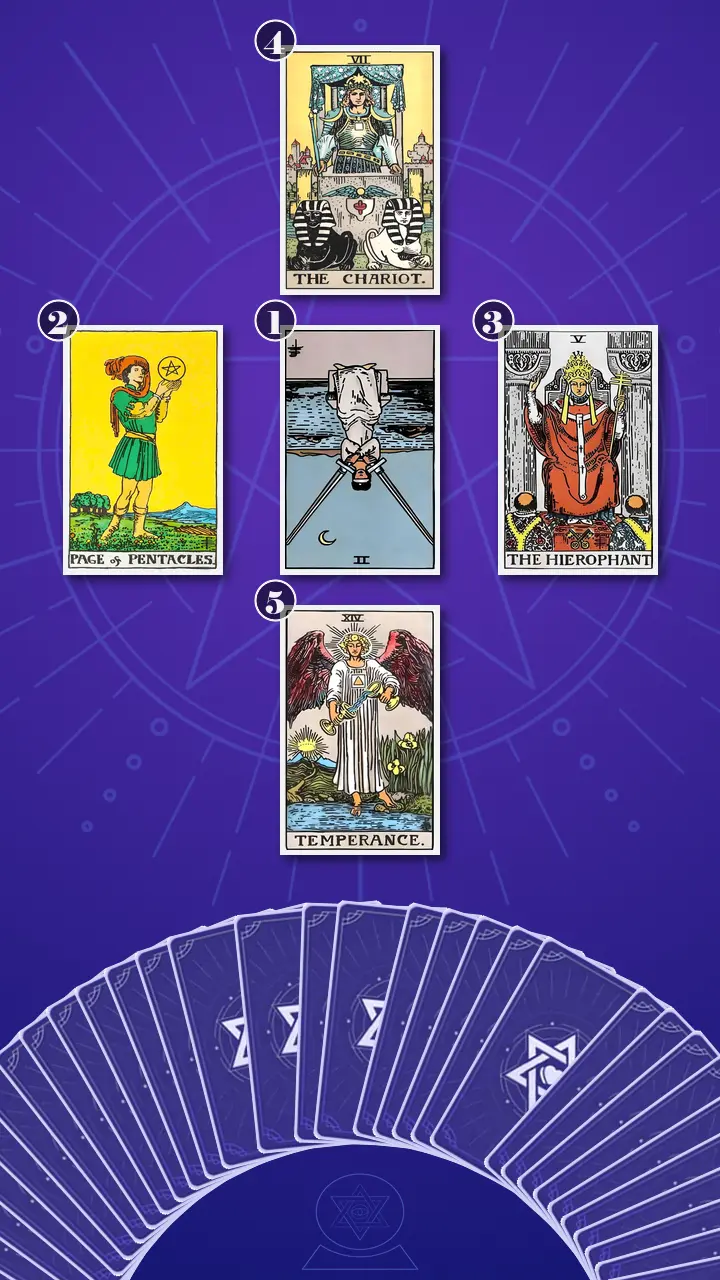
Reading the Map: Where Decision Fatigue Hides
Position 1: Your current decision bottleneck (the stuck behavior)
“Now flipped over,” I said, “is the card representing your current decision bottleneck and how it shows up day-to-day.”
Two of Swords, reversed.
“This is like you sitting with your laptop open, bouncing between the internship offer email, the university enrollment page, and LinkedIn,” I said. “You keep telling yourself you’re ‘gathering info,’ but what you’re really doing is postponing the moment you have to live with a trade-off.”
I tapped the screen gently where the blindfold would be. “The blindfold is the part of you that doesn’t want to look directly at the trade-off. The crossed arms are self-protection that blocks action—hovering over ‘accept’ but physically not letting yourself click.”
Then I said the line I use when I want to be kind and accurate: “Tab-switching isn’t a decision strategy—it’s an anxiety strategy.”
Jordan gave a short laugh that had a bitter edge. “Okay… that’s rude,” they said, then swallowed. “But yeah. That’s exactly it.”
I kept my voice steady. “It can feel like you’re being thorough. But the loop usually sounds like this:”
One more check.
One more opinion.
One more refresh.
One more rewrite so I sound decisive.
“You’re not stuck because you don’t know enough—you’re stuck because you’re demanding a guaranteed outcome.”
Jordan’s eyes flicked away from the camera. Their fingers worried the seam of their sleeve—tight, then looser. The calm face they’d been trying to hold cracked for a second, like their body finally admitted how loud it’s been inside.
Position 2: Option A—the internship path (what it teaches you and what it asks of you)
“Now flipped over,” I said, “is the card representing Option A: the internship path—what it teaches you and what it asks of you.”
Page of Pentacles, upright.
“This is the apprenticeship season card,” I said. “Not instant mastery—consistent reps. Learning tools. Getting feedback. Shipping small deliverables. Building real-world confidence.”
I watched Jordan’s posture shift just slightly forward, like their attention wanted to reach for something tangible. “This card asks you to be a beginner on purpose,” I continued, “and to define what success means so the internship isn’t a performance stage.”
“In a practical way,” I said, “if you chose the internship, I’d want you to name one hard skill and one soft skill you want by August. Otherwise, your brain will keep trying to use the internship as proof you’re ‘ahead’—and that’s a fast track to burnout.”
Jordan’s mouth twitched. “Skill rep gym,” they murmured, as if testing the phrase. “Not… a stage.”
“Exactly.”
Position 3: Option B—summer classes (what it supports and what it costs you)
“Now flipped over,” I said, “is the card representing Option B: the summer classes path—what it supports and what it costs you.”
The Hierophant, upright.
“This is the ‘approved route’ energy,” I said. “Syllabi, rubrics, credits, prerequisites—clear milestones that calm anxiety because they’re measurable.”
Jordan nodded fast, like their brain finally had a handrail. “Reading a syllabus genuinely makes me feel calmer,” they admitted. “It’s like… at least I know what ‘good’ looks like.”
“That makes total sense,” I said. “Structure can be stabilizing. But here’s the cost this card sometimes brings: it can turn into permission-seeking. Choosing what feels defendable to others instead of what matches your timing and bandwidth.”
I let that land, then asked, “If you pick classes, is it because you truly need the credits—or because having a syllabus makes you feel safer right now?”
Jordan exhaled through their nose, small and sharp. Their shoulders didn’t drop, but their eyes softened. “Both,” they said. “And I hate that it’s both.”
“Good,” I replied. “That’s honesty. And honesty is how we get out of this.”
When the Chariot Took the Reins
Position 4 (Key Card): The deciding factor—what you must prioritize to choose cleanly
“We’re turning over the most important card in this spread,” I said, and the room seemed to go quieter—like even the fridge hum on Jordan’s end stepped back for a second.
“Now flipped over,” I said, “is the card representing the deciding factor: what you must prioritize to choose cleanly.”
The Chariot, upright.
“This isn’t asking, ‘Which option is objectively best?’” I said. “It’s asking: what are you prioritizing this season—momentum or academic structure—and can you commit without needing 100% certainty first?”
Jordan stared at the screen. I could see the Sunday-night moment replaying behind their eyes: offer email open, enrollment portal open, LinkedIn lurking in the background, their body already acting like the decision is an emergency.
Stop waiting to feel 100% sure and start steering like the Chariot—pick the reins you’ll hold (your priorities) and let that direction decide the route.
I didn’t fill the silence after I said it. I let it echo.
Jordan’s reaction came in three steps—so quick it would’ve been easy to miss if I wasn’t watching for it.
First: a freeze. Their breathing stopped mid-inhale, and their eyes widened like I’d just turned on a light too bright.
Second: a drift. Their gaze unfocused, as if their brain was replaying every almost-decision: the unsent drafts, the Google Sheets pros/cons that became a second full-time job, the group chat takes stacked on top of each other until nothing sounded like their own voice.
Third: a release—messy, not cinematic. Their shoulders dropped, then their hands came up to their face for a second, palms pressing into their eyes like they were rebooting. When they spoke, it was softer and a little shaky. “But if I steer and it’s wrong… doesn’t that mean I should’ve known better?”
There it was: the hidden contract they’d been trying to sign with the universe—I will commit only if you promise me I can’t be embarrassed later.
I felt my own old professional reflex flare. On Wall Street, I used to watch smart people get stuck because they wanted the trade that couldn’t lose. The problem was never intelligence. It was the fantasy of a risk-free identity.
“Jordan,” I said, “steering isn’t declaring you’re infallible. It’s declaring you’re in the driver’s seat.”
Then I brought in the framework that’s become my signature since leaving finance—because it turns ‘vibes’ into something you can act on.
“I want to run a quick Potential Mapping,” I said. “Not to label you, but to reduce friction. When you’re under pressure, do you become a Deep Thinker—someone who tries to think their way into safety—or a Sprinter—someone who makes a fast move to escape discomfort?”
Jordan blinked, then laughed once, cleaner this time. “Deep Thinker,” they said immediately. “I can research forever.”
“Exactly,” I said. “So The Chariot isn’t telling you to ‘go faster.’ It’s telling you to choose the reins that matter—your priorities and constraints—so your Deep Thinker brain has a job that actually produces movement.”
I leaned in. “Now, with that new lens: think about last week. Was there a moment you were about to click ‘accept’ or ‘enroll’ and your body went tight—shoulders, jaw, chest—and you opened a new tab instead? What would ‘taking the reins’ have looked like in that exact moment?”
Jordan looked down at something off-screen—probably their phone, probably the Notes app. “It would’ve been… writing one sentence. Like, what I actually want the summer to be for,” they said. “Not what makes the best story.”
“That,” I said, “is the shift from chaotic over-analysis into grounded self-direction. Not certainty—direction.”
Position 5: Your next step—actionable integration that reduces regret and builds self-trust
“Now flipped over,” I said, “is the card representing your next step: how to move forward in a way that reduces regret and builds self-trust.”
Temperance, upright.
“Temperance is the anti-burnout card,” I said. “It’s not all-or-nothing. It’s the design of a workable blend.”
I described it in Jordan’s language: “This is like setting quiet hours on your phone—same life, better pacing. It’s like mixing a playlist so you don’t burn out on one intense track on repeat.”
“And it’s important with The Chariot,” I added. “Direction first. Balance second. Balance isn’t what you wait for—it’s what you build after you choose.”
Jordan’s shoulders rolled back for the first time all session, like their body finally got permission to stop bracing. “So even if I choose the internship,” they said, “I’m allowed to make it… sustainable?”
“You’re allowed,” I said. “And if you choose classes, you’re allowed to protect your momentum in other ways. Temperance makes the decision livable.”
The One-Page “Reins” Plan: Actionable Next Steps
I pulled the spread together for them in plain terms: Two of Swords reversed showed the bottleneck—deadline-driven choice paralysis where research and opinion-seeking replace committing to a next step. Page of Pentacles and The Hierophant weren’t enemies; they were two kinds of legitimacy—apprenticeship learning versus institutional validation. The Chariot demanded ownership: choose a priority and steer. Temperance promised regret reduction through adjustability: a plan with boundaries and check-ins, not a summer you try to “win.”
“Your blind spot,” I told Jordan, “is treating the decision like an identity test: one correct choice equals one correct version of you. The transformation direction is different: choose based on values and constraints, then commit to the next two steps. Self-trust is built by follow-through, not by perfect prediction.”
Jordan frowned slightly. “But I don’t have time for a big process,” they said. “I have an exam this week and I’m already behind on… everything.”
“Perfect,” I said, gently. “Then we use my 5-Minute Decision Tools. Small, sharp, and steerable.”
- The 25-Minute Timer (Paper Only)Set a 25-minute timer. On paper, write two lists: (1) “By end of summer, I want these 3 things to be true,” and (2) “Weekly I can realistically handle: ___ hours work/school, ___ hours commute/admin, ___ hours rest.” Then choose the option that matches both lists best.If 25 minutes feels like too much, do 10 minutes and write just 1 item per list. If your shoulders climb or your jaw locks, take three slow breaths and continue with the smallest version.
- Write Your North Star Sentence (The Reins)Pick ONE deciding priority sentence—“This summer is for real-world skill reps” or “This summer is for prerequisite progress.” Copy it into the top of your Notes app so it’s the first thing you see before you open Gmail or the course portal.If your brain starts negotiating, ask: “Am I choosing a summer—or choosing a story I won’t have to defend?” Then return to the one sentence.
- One 5-Line Email Before You SpiralBefore the timer ends, send ONE concrete email: either (A) accept the internship, or (B) ask one targeted question you genuinely need to decide (start date flexibility / hours / remote option). Keep it to 5 lines.If hitting send feels impossible, draft it and email it to yourself first. “Draft saved” still counts as steering—then schedule the send for tomorrow morning.
- The 48-Hour Two-Step Commit (Calendar Block)Immediately calendar-block the next two steps for the path you chose (e.g., “Complete onboarding forms” + “Register classes”), each as a 20-minute block within the next 48 hours.Color-code it if you want—but treat the calendar as your Chariot. If it’s not scheduled, it’s not real.
“And one boundary,” I added, “because your Deep Thinker brain loves infinite inputs: do a Two-Email Rule for the next 48 hours. Two people max, and only if you send them the same three constraints—deadline, money, weekly hours. After that: no new opinions.”

A Week Later: The Quiet Proof
Six days later, Jordan messaged me: “I accepted. I asked for clarity on weekly hours first, then sent the yes. Also—north star sentence is pinned in Notes. I still felt shaky after, but I slept through the night for the first time in a week.”
Their follow-up came the next morning: “Woke up and my first thought was still ‘what if I messed up?’ But this time I just… read the note titled ‘If I doubt this choice later’ and went to class. It didn’t spiral.”
That’s what I mean when I say this work is a Journey to Clarity. Not a cinematic certainty. A small, lived proof that you can steer—then adjust—then steer again.
When two good paths are in front of you, it can feel like your chest is the battleground—because you’re not just choosing a summer, you’re trying to prove you can trust your own judgment.
If you didn’t need 100% certainty, what’s one tiny ‘taking the reins’ step you’d be willing to try in the next 24 hours—an email draft, a calendar block, or a single priority sentence?