From Contract-Deadline Anxiety to Clean Terms: The Monday Email Pivot

Contract Attached—Need It Signed by Monday
Jordan showed up on my screen with the kind of smile that’s technically polite but doesn’t reach the jaw.
“You got an email that says ‘Contract attached—need it signed by Monday,’ and suddenly your weekend becomes a spiral disguised as ‘due diligence,’” I said—not as a punchline, but as a recognition code.
They laughed once, short and dry. “Okay. That’s… rude accurate.”
Jordan is 27, an independent musician/producer in Los Angeles, steady online growth, income that still does the month-to-month rollercoaster. The label email landed like a spotlight and a countdown timer in the same click.
They described Saturday night: 1:07 a.m. in a small LA apartment, laptop glow harsh against the dark, PDF zoomed to 140% like the fine print might confess if you stare hard enough. The AC made the air feel paper-dry. Their cursor kept dragging over the same clause with the highlighter tool on—neon yellow on gray text—while their phone buzzed from the couch, warm from Reddit and YouTube “label deal breakdown” threads.
“I keep highlighting the same paragraph,” they admitted. “Then I close it and Google more. I don’t even write a single question. I can’t tell if this is my big break or a trap with better branding.”
I watched their leg bounce just out of frame, like their nervous system was tapping Morse code for please make this stop. Their chest felt “tight,” their jaw “locked.” Anxiety wasn’t an abstract feeling in the room—it was a physical posture, like wearing a too-small hoodie zipped all the way to the chin.
“You want career momentum and real support,” I reflected, “but you’re terrified you’ll sign away autonomy and end up locked into a deal that proves you misjudged your own worth.”
Jordan’s eyes flicked down—toward the contract, toward their phone, toward the part of themselves that wanted someone else to decide.
“That’s it,” they said. “If I sign and it’s bad, I’m an idiot. If I don’t sign, I’m scared. I feel like I need to be 100% sure before I respond.”
I softened my voice. “We’re not here to force a yes or no out of you by Monday. We’re here to get you to clarity—real, usable clarity. The kind you can feel in your body and translate into one clean next step.”

Choosing the Compass: The Decision Cross Spread
I asked Jordan to take one breath where they could actually feel it—down into the ribs, not up in the throat. Not as a ritual for the universe, but as a reset for the nervous system.
Then I shuffled slowly, the way I used to on ships when the ocean was loud and the passengers were louder—people asking me to read the weather of their lives while the vessel itself kept moving forward. Deadlines do that, too. They don’t stop because you’re unsure.
“Today I’m using a spread called the Decision Cross,” I told them. “It’s built for time-sensitive crossroads—especially when it’s a clean A-versus-B choice with a deadline.”
For you reading this: this is one of the most practical ways to see how tarot works in a decision freeze. The Decision Cross doesn’t pretend to predict a fixed outcome. It compares the energies and trade-offs of two paths side by side, reveals what’s driving the paralysis underneath, and then points to the best next move you can take before the clock runs out.
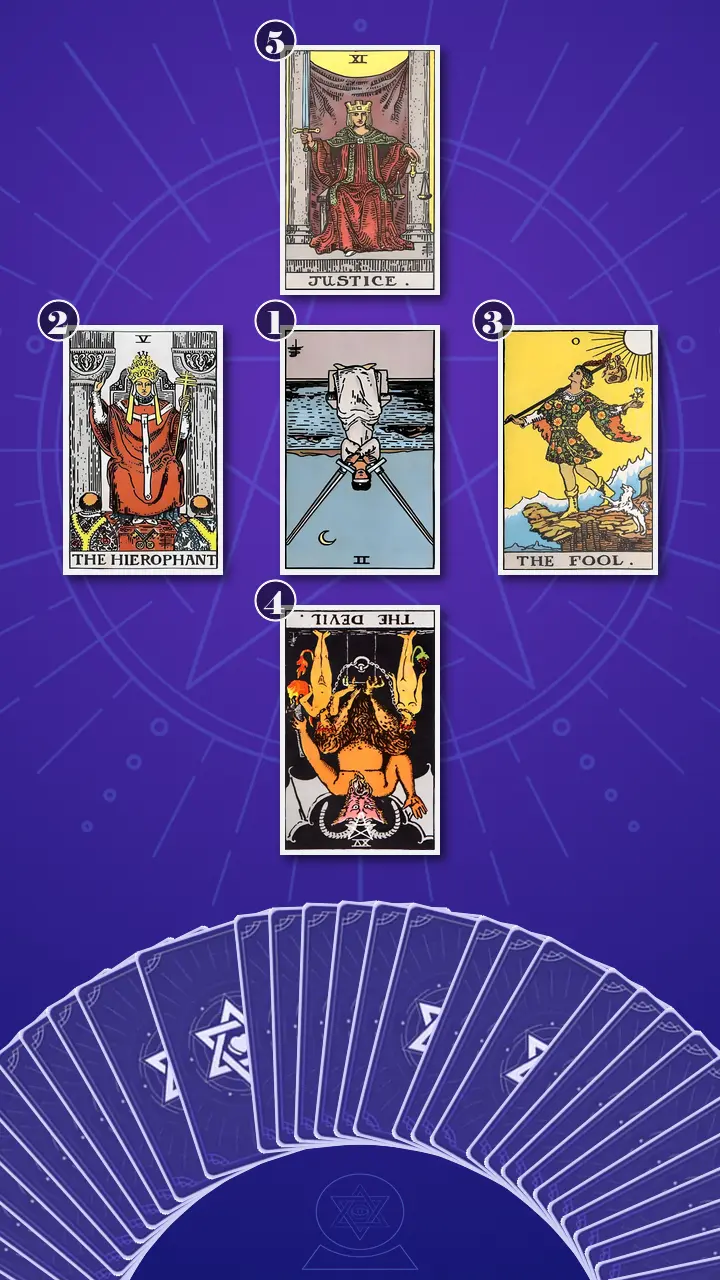
“Card 1 is the heartbeat—what your deadline behavior looks like right now,” I said. “Card 2 is Option A: sign. Card 3 is Option B: stay independent. Card 4 is the hidden driver under the whole thing. And Card 5 is guidance—the step that restores your authority.”
Jordan nodded, but I could see the skepticism fighting the hope: Please don’t let this be vague. Please let this be usable.
Reading the Map: The First Turn of the Cards
Position 1 — The Deadline Loop You Keep Calling “Research”
I turned the first card. “Now flipping over is the card that represents the decision’s present tension—what your behavior and emotional state look like right now under the Monday deadline.”
“Two of Swords, reversed.”
The image is a figure with a blindfold, swords crossed over the chest—self-protection that becomes self-blocking.
And the modern-life version landed immediately: It’s 1:00 a.m. and you’re sitting on the edge of your bed with the contract open. You’ve highlighted the same clause three times. You close the PDF, open Reddit, watch a ‘label deal breakdown’ video, then reopen the PDF like it changed while you were gone.
Jordan let out a bitter little laugh. “Stop.”
“I know,” I said. “It’s almost cruelly specific.”
This reversed Two of Swords is Air energy in blockage: thinking that keeps moving but never arrives. It looks like caution. It feels like diligence. But it functions like avoidance—because the one thing that would create new information is the thing you haven’t done: asking direct questions, proposing edits, or making a clean yes/no.
I framed it like a split-screen, because that’s exactly how it lives in a modern apartment.
“Left side of the screen: your contract PDF, the same paragraph highlighted. Right side: seventeen tabs—r/WeAreTheMusicMakers threads, YouTube lawyers, TikTok clips. And there’s an inner monologue that goes: ‘If I read one more clause… I’ll know.’ But the other sentence—‘If I ask one question… I might be seen as difficult’—that one feels dangerous, so the blindfold stays on.”
Jordan went still. Then: a slow exhale. A tiny nod. The kind of nod that isn’t agreement—it’s recognition.
“Research is only helpful if it turns into one clean sentence you’re willing to send,” I added, and I felt them swallow, like that sentence had weight.
Position 2 — Option A (Sign): The Enterprise Plan of Belonging
I touched the second card. “Now flipping over is the card that represents Option A—signing: the core energy, benefits, and trade-offs of choosing label structure.”
“The Hierophant, upright.”
In card meanings in context, The Hierophant is institution, mentorship, established systems—keys to a gate.
I translated it in the language Jordan already speaks: “This is the onboarding portal. The project management workspace. The scheduled rollout calls. Deadlines, checklists, ‘approved assets,’ a team that knows the industry ladder.”
Jordan’s shoulders dropped a millimeter—relief, the appeal.
“Signing can bring resources and legitimacy,” I said, “and the deep exhale of not carrying every logistical detail alone.”
Then I let the other side of the card breathe, because Hierophant always has a price. “But it also asks: which traditions and rules are you agreeing to? And do they actually support your craft—or do they slowly sand down your voice?”
I watched the flicker of resistance cross their face. Their mouth tightened, not in panic—more like a protective ‘don’t disappear in this.’
Jordan said quietly, “This could make me real… but will I still sound like me?”
“That’s the exact question,” I replied. “This isn’t ‘good vs bad.’ It’s values-fit.”
Position 3 — Option B (Stay Independent): Freedom That Needs a Tiny Scaffold
“Now flipping over is the card for Option B—staying independent: the energy and trade-offs of continuing self-led.”
“The Fool, upright.”
The Fool is the beginning of a journey—learning-forward risk, creative experimentation, traveling light.
“This is drop day energy,” I said. “It’s midnight, you upload when you want, you choose the cover, you move fast, you iterate in public.”
Jordan’s expression softened—relief, possibility.
“But here’s the non-romantic truth of The Fool,” I continued. “Freedom can become drift if you don’t choose a minimum structure. Otherwise you wake up two weeks from now with a brain full of ideas and a calendar full of admin—and suddenly you resent the independence you fought for.”
The card’s energy here is balance with a warning edge: expansive, but it needs intentional scaffolding.
Jordan nodded again, but slower. “Yeah. I’ve been there. The ‘I can do anything’ feeling turns into ‘I have to do everything.’”
Position 4 — Hidden Driver: The Worst-Case Movie Trailer Running the Show
I placed my hand over the fourth position. “Now flipping over is the card that represents the hidden driver—the underlying fear or attachment making this feel high-stakes and immobilizing.”
“The Devil, reversed.”
Jordan’s eyes widened a fraction. Not because of superstition—because the word itself names something people avoid saying out loud: power.
“In modern terms,” I said, “this is the worst-case movie trailer your brain keeps playing: you’re owned, stuck in approvals, you can’t release what you want, you’re asking permission for your own voice.”
And then the reversal matters: this is the loosened chain moment. The possibility of release.
“Reversed Devil isn’t ‘doom.’ It’s awareness,” I said. “The real panic isn’t the contract—it’s the future-you you’re imagining: trapped and blaming yourself for it.”
Jordan went through a quick three-step reaction chain I’ve seen a thousand times in different bodies and different cities: first a freeze—breath held, eyes fixed; then a flicker of distance—like they were rewatching a memory; then a small release—an exhale that sounded like, “Oh.”
“I do that,” they admitted. “I run the whole film. Like… I’m already miserable in the deal.”
“And then the fear becomes the boss in the room,” I said. “Before the label ever asked for anything.”
There’s also a temptation with Devil reversed—an overcorrection. “To prove you can’t be controlled,” I warned, “you might reject the deal impulsively and call any collaboration ‘selling out.’ That’s still fear steering.”
Jordan’s jaw worked, like they were chewing on a truth they didn’t like. “So either way, fear gets a vote.”
“Unless you do what Devil reversed is offering,” I answered. “Name the chains. Put them into words. That’s how power comes back.”
When Justice Spoke: A Scales-and-Sword Moment
Position 5 — Integration Guidance: Terms + Message, Not Vibes
I let the room go quiet for a beat—no filler, no rushing—because some cards change the temperature when they show up.
“Now flipping over is the card for integration guidance—the most empowering next step to create clarity without outsourcing your authority.”
“Justice, upright.”
If you’ve ever Googled “Justice tarot meaning for contracts,” this is exactly why: it’s the archetype of clean terms, fairness, accountability, self-respect in writing.
I pointed at the symbols. “The scales are your values and trade-offs. The sword is the part your nervous system keeps trying to avoid: decisive, explicit language.”
Jordan’s face tightened, then they blurted, unexpectedly sharp: “But if I ask for changes, they’ll think I’m ungrateful. They’ll drop me.”
I didn’t argue with them. I met it. “That’s the fear talking like it has insider information. Let’s reality-check it.”
My mind flashed briefly to my old life on transoceanic voyages—watching captains dock a ship in a narrow port window. You don’t get calm by pretending the harbor isn’t tight. You get calm by making clear calls, early, with precision.
“This is where my Choice X-Ray comes in,” I said, and Jordan looked up—curious despite themselves. “Your brain is trying to X-ray the contract for a perfect guarantee. But we’re going to X-ray your decision for hidden costs and benefits across three dimensions: rights, process, and identity.”
“Rights: what do you own? Process: who approves what, and how? Identity: what version of you are you practicing by saying yes, no, or ‘let’s revise’?”
Justice is the bridge between Hierophant and Fool: structure that supports rather than controls, freedom that doesn’t collapse into chaos.
The Aha Setup
And I brought us back to where they started, because the breakthrough always touches the loop.
When it’s 1:00 a.m. and you’re highlighting the same clause for the fifth time, your jaw is locked, your leg won’t stop bouncing, and you’re flipping from the PDF to Reddit threads like the “right answer” is hiding in someone else’s comments.
Jordan’s eyes got glossy—not tears yet, just that thin-waterline look of someone who’s been holding their breath for days.
The Delivery
Stop treating the decision like a blindfolded guess and start treating it like a scales-and-sword moment: name your terms, ask your questions, and choose from self-respect.
I let it hang in the air, like the moment after a bell rings in a quiet hallway.
The Reinforcement
Jordan’s body responded before their logic did.
First: their shoulders dropped, like they’d been carrying the contract on their trapezius muscles. Then: their hands unclenched on their mug. Their gaze went unfocused for a second, like the internal tabs were finally closing—one by one. When they spoke, their voice had that soft, disoriented honesty that comes right after a mental shift.
“So I don’t need to feel certain,” they said slowly. “I need to be… clear.”
“Exactly,” I said. “Clarity isn’t something you discover by reading harder—it’s something you create by naming your non‑negotiables and putting them into clean words.”
I gave them a structure, because Justice loves structure that protects you.
“Set a 10-minute timer,” I told Jordan. “Open a blank doc titled ‘Monday Decision Brief.’ Write: (1) three non‑negotiables—things like masters ownership, creative approval, term length, (2) three negotiables, (3) five bullet questions or edits. Then stop. If your chest tightens or you start spiraling, pause, close the laptop, and come back later—this is boundary-setting, not a punishment.”
Jordan blinked a few times. The brief anger from before melted into something more vulnerable. “That feels… doable. Like I can actually move.”
“And then,” I asked gently, “with this new lens—scales and sword—think back to last week. Was there a moment you could’ve asked for clarity, but you chose another hour of scrolling instead?”
Jordan’s mouth curved with a pained little smile. “Thursday. I literally had the draft open. Then I watched three videos about recoupment and convinced myself I was being responsible.”
“That’s not a moral failure,” I said. “That’s a nervous system trying to protect you by chasing certainty. But this”—I tapped Justice—“is the move from deadline-fueled panic and outsourced certainty to values-led clarity and boundary-based confidence.”
And I watched it land: not as inspiration, but as permission.
From Insight to Action: The Five-Bullet Clarity Email
I pulled the whole story together for Jordan, the way I would for any client whose mind is spinning: simple, coherent, kind.
“Here’s what the spread says in one line,” I told them. “You’re stuck not because you’re incapable, but because the Two of Swords has you waiting for certainty to appear. The Hierophant shows the appeal of structure and access. The Fool shows the relief of freedom and fast iteration. Devil reversed shows the real engine: fear of being bound and blaming yourself. Justice says: your way out is written clarity—terms, questions, boundaries—so the decision becomes a tool you steer, not a verdict on your talent.”
The cognitive blind spot is subtle but brutal: you’ve been treating being ‘easy’ as the same thing as being professional. Under a deadline, that turns into people-pleasing in business clothes.
“The transformation direction is clear,” I said. “Shift from chasing perfect certainty to defining your non-negotiables and taking one concrete boundary-setting step—clarify, negotiate, or decline—based on your values.”
Then I switched into my cruise-trained practicality. “I’m also going to use my Port Decision Model here,” I said. “On a ship, you don’t decide whether to dock by imagining every possible storm for twelve hours. You decide by checking conditions, stating constraints, and making a clean approach within the time window. Monday is your docking window.”
Here are your next steps—small, specific, and sendable:
- The 10-Minute Monday Decision BriefTonight, open a blank Google Doc titled “Monday Decision Brief.” Write three non-negotiables, three negotiables, and five bullet questions/edits. Stop at 10 minutes—even if it’s messy.If your brain screams “It has to be perfect,” lower the bar: it only needs to be clear. Put your phone face down for the full 10 minutes.
- Draft the Five-Bullet Clarity EmailCreate one email draft titled “Contract Questions (before Monday)” with exactly five bullets. No paragraphs. No apologies. Add one neutral opener: “I’m excited about the possibility and want to make sure the terms are aligned before moving forward.”Read it out loud once. If it sounds like you’re over-explaining, shorten. You don’t need to be “easy.” You need to be clear.
- Name the Two Chains (Devil Reversed → Language)Write down two “chains I won’t wear” (examples: masters ownership, broad creative approval, excessive term length). For each, write one emotionally neutral negotiation line: “Can we revise X to Y?” or “I’m not comfortable with X—what flexibility is there?”Refusing specific terms is not refusing support. It’s self-respect in writing.
- One Tone Check, Not Ten OpinionsTomorrow morning, choose one person to sanity-check the tone (not to decide for you). Ask: “Does this read clear and respectful?” not “What should I do?”If you ask five people, you’ll get five different nervous systems. Borrow clarity, not identity.
I added one last thing, quietly, because it’s the sentence that changes everything for people who freeze at “sign by Monday” emails:
“A contract isn’t a verdict on your talent. It’s a tool you can negotiate—or decline.”

A Week Later: Ownership, Not Certainty
Six days later, Jordan sent me a message that was almost aggressively simple: “Sent the five-bullet email. Didn’t apologize once. They replied and offered a call.”
Then another text: “I slept. Like, a whole night.”
They told me the next morning still came with a flicker of fear—What if I’m wrong?—but this time it didn’t spike into a spiral. It was just a thought passing through a room they finally owned.
That’s the kind of proof I care about: not a perfect outcome, but a nervous system that can breathe while making adult decisions.
For me, this was a clean Journey to Clarity. We didn’t banish risk. We brought authority back into the room—by translating fear into terms, and terms into a message you can send.
When the deadline is loud and your chest is tight, it can feel like you’re not choosing between two paths—you’re choosing whether you get to keep your freedom without proving you misjudged your own worth.
If you didn’t need 100% certainty by Monday, what’s one boundary you’d want in plain words—just so your decision can feel clean in your body?