From Deadline Panic to a Fair Major Choice: Clicking Submit by Friday

The 11:57 p.m. Portal Tab
You keep reopening the major declaration portal like it’s going to feel different on the fifth refresh, even though your chest still tightens the second your cursor hits “Submit” (classic decision paralysis under a deadline).
Taylor (name changed for privacy) sat down across from me on a video call from a Toronto apartment bedroom that looked like every student bedroom I’ve ever seen: a desk that’s half textbooks, half survival supplies; a hoodie draped over the chair; the harsh laptop glow making everything feel slightly unreal. The laptop fan had that dry, constant whir—like it was stressed too—and their phone kept lighting up with group chat pings that made the screen feel warm from constant tapping.
“It’s due Friday,” they said, and it came out like a timer going off in their throat. “I keep… reopening it. Reading requirements. Making lists. I know it’s just a form, but it doesn’t feel like just a form.”
I watched their shoulders creep upward as if their body was trying to protect something vital. Their hand hovered near the trackpad the way people hover over “Send” on a message that would change the whole situation. You could feel the contradiction in the air: wanting to keep every future door open, while fearing that choosing one path will prove you made a wrong choice.
Decision panic doesn’t always feel like fear. Sometimes it feels like your ribcage is a seatbelt that won’t unclick—tight chest, wired energy, a mind switching tabs faster than your fingers can keep up—because your brain is trying to outrun the moment where you actually have to choose.
“You’re not alone in this,” I told them. “And you’re not broken for being stuck. Let’s try something different tonight: not more information, not another pros/cons list. Let’s draw a map for the fog. Our goal is clarity you can actually act on by Friday.”

Choosing the Compass: The Decision Cross · Context Edition
I asked Taylor to take one slow breath in, one out, and to bring their attention to one simple sentence: “Double major, or choose one path?” Not as a life sentence—just as the decision in front of them.
Before I started reading Tarot full-time, I spent years in rooms where people made high-stakes choices with too much data and not enough honesty. On the trading floor, we had a rule for moments like this: you don’t wait for your nervous system to feel perfect—you create a focus container, then you execute. So I borrowed that same energy now: a small pre-commitment ritual. “We’ll do this in a structured way,” I said. “No open-ended spiraling.”
For this, I used a spread called the Decision Cross · Context Edition. If you’ve ever wondered how tarot works in a practical way, this is a good example: it’s not a prophecy machine. It’s a decision framework that turns a messy, emotionally loaded question into positions you can actually think with—symptoms, options, root drivers, and next steps.
This spread is ideal for a two-option choice under a hard deadline because it creates a clean chain from what your indecision looks like → what each path asks of you day-to-day → what fear is fueling the loop → the principle that cuts through panic → one real-world action. No extra fluff. No mystical detours.
I told Taylor what to expect: “The first card shows the exact stuck point. The left and right cards compare double major versus choosing one. The card beneath reveals the hidden engine—the attachment or fear feeding the loop. The card above is the key shift, the advice that brings balance. And the last card shows how to make it real this week.”
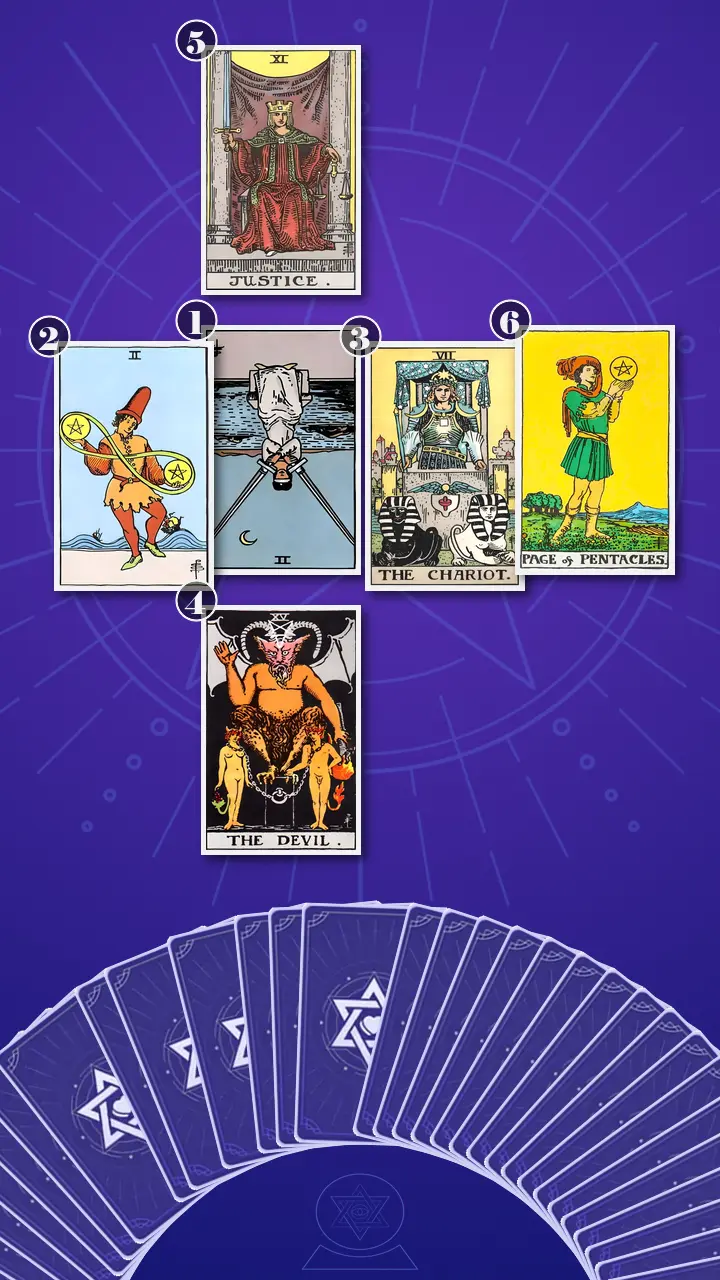
Reading the Map Through Choice Paralysis
Position 1: The current stuck point under the Friday deadline
“Now flipped over,” I said, “is the card that represents the current stuck point: the exact way indecision shows up in behavior under the Friday deadline.”
Two of Swords, reversed.
I didn’t need to stretch to translate it into Taylor’s life—the card practically spoke in browser tabs. “This is you sitting at a cramped kitchen table or in Robarts with the major declaration portal open in one tab, requirements in three more, and a pros/cons doc you keep reformatting like that will magically produce certainty,” I said. “Your cursor hovers over ‘Submit’ and you physically can’t click—so you refresh the page, check one more Reddit thread, and DM another upper-year. It feels like responsible research, but it’s avoidance dressed up as productivity.”
Reversed, the energy here isn’t a calm pause. It’s an Air blockage—thoughts moving fast but going nowhere. The blindfold in the classic imagery becomes fourteen tabs open and not letting any one truth land. The crossed swords become two arguments you keep sharpening until your chest clamps down.
“If you’re doing ‘one more round of research,’ you’re probably not researching—you’re negotiating with fear,” I added gently.
I asked the question that this position always demands: “In the last 24 hours, what’s the exact move you’ve repeated instead of doing the one irreversible step—and what feeling hits your body right before you bail?”
Taylor let out a small laugh that didn’t have humor in it—more like a pressure valve releasing. “Wow,” they said. “That’s… accurate. Like, kind of rude.” Their fingers rubbed the edge of their sleeve, faster than they seemed to notice.
Position 2: Path A — Double major, day-to-day reality and psychological promise
“Now flipped over,” I said, “is the card that represents Path A: double major—what this option asks of you day-to-day and what it promises psychologically.”
Two of Pentacles, upright.
“This card is a juggler,” I told them, “and it’s honest about the glamour and the cost.” I described the scene the card points to: “Choosing the double major looks like living inside a constantly moving spreadsheet: recalculating credits, prerequisites, commute time on the TTC, and part-time work shifts every week. Some days it feels weirdly thrilling—like you’re the kind of person who can do it all. Other days it’s you eating a granola bar for dinner while moving a deadline in Google Calendar again, because there’s never a quiet week where both majors are calm at the same time.”
Upright, Two of Pentacles is balanced motion—flexibility, adaptability, skill. But it’s also a warning about living in permanent optimization mode. The infinity loop ribbon says, “You’ll keep balancing forever.” The waves and ships say, “Midterms don’t care about your aesthetic plan.”
“So here’s the real question,” I said. “Not ‘can you do it in theory?’ but: Can you do it on a Wednesday in October when you slept five hours and you still have a shift? Because this path makes your capacity the bottleneck.”
Taylor stared slightly off-screen, like they were pulling up a mental version of their calendar. Their leg bounced once, then slowed. “My life already feels like… color-blocking that turned into a full-time job,” they admitted.
Position 3: Path B — Choose one major, emotional requirement and focus unlocked
“Now flipped over,” I said, “is the card that represents Path B: choosing one major—what this option requires emotionally and what it unlocks in focus and identity.”
The Chariot, upright.
“This is the focused driver,” I said, and I felt Taylor lean in a fraction. “Choosing one major looks like picking a lane and building momentum: mapping an 8–12 week semester plan, choosing a course sequence that fits your actual energy, and stopping the constant contingency mode. Doubts still show up—usually at night, usually after you see someone else’s internship post—but you keep moving anyway, because focus becomes a form of self-command.”
The Chariot isn’t “I’m calm now.” It’s “I can steer while two inner voices pull.” The black-and-white sphinxes are those competing narratives: curiosity vs practicality, passion vs employability, ego vs energy.
“Here’s the permission hidden in this card,” I told them. “You don’t need certainty. You need direction.”
Taylor’s shoulders dropped a millimeter, like their body understood the sentence before their brain could argue with it. “I think part of me would feel relieved,” they said quietly. “And part of me would freak out about what I’m giving up.”
“That’s normal,” I said. “You’re not choosing a personality. You’re choosing a workload.”
Position 4: The hidden engine — the fear/attachment powering the loop
“Now flipped over,” I said, “is the card that represents the hidden engine: the core fear or attachment that keeps you looping instead of deciding.”
The Devil, upright.
The energy in the room shifted—like the call got quieter even though nothing changed technologically. Outside my window, a car passed on wet pavement, a long hiss that felt like the universe saying, yes, this part.
“This isn’t about you being lazy or indecisive by nature,” I told them. “This is about what you’re chained to.”
I translated the imagery without shaming it: “Under the indecision is the part of you that feels chained to being impressive. If you don’t double major, you’re ‘wasting potential.’ If you pick one path, you’re closing doors and you might look behind. The Friday deadline heats it up—suddenly the choice isn’t academic, it’s identity. One LinkedIn update from a classmate and your brain goes: ‘If I choose wrong, I lose status. I lose control. I lose who I thought I could be.’”
Taylor had a three-step reaction that I’ve seen in boardrooms and dorm rooms alike: first, a tiny freeze—breath held, eyes fixed. Then the mind catching up—gaze unfocusing like a memory replaying. Then the release—an exhale that sounded like it came from their chest, not their mouth.
“Yeah,” they said, voice thinner. “I hate that it’s LinkedIn, but… it is. I’ll see someone post an internship and my stomach drops. And then the major thing feels like a public ranking.”
“That’s The Devil,” I said. “Not evil—just sticky. The part of you that confuses external approval with internal safety.”
Position 5: The key shift — the principle for clarity you can stand behind by Friday
“We’re turning over the core card now,” I said. “This is the one that lifts the spread: the key shift—the most clarifying principle to make a decision you can stand behind by Friday.”
Justice, upright.
On the card, the scales were steady. The sword was clean. The throne was stone—no mood swings, no bargaining. I felt my old Wall Street brain kick in, the part of me trained to stop chasing perfect feelings and start building defensible process. In deals, you don’t buy certainty. You buy a framework you can justify, then you manage what happens next.
Taylor was still trapped in the midnight courtroom of their own mind—trying to win a case called “Prove I Won’t Regret This.” Their body was asking for reassurance, and their brain kept offering more data.
Stop treating this like a forever verdict; start weighing it like Justice—choose what’s fair to your capacity and values, then let the scales settle through action.
I let the sentence sit there. No extra interpretation for a beat—because sometimes clarity needs silence the way a decision needs a deadline.
Then I brought in what I call my Strategic Crossroads Analysis—it’s basically M&A thinking applied to life choices, with probability weighting. “Here’s what Justice is asking,” I said. “Not ‘which major is objectively best?’ That’s an impossible question. Justice asks: what’s fair to you this semester, given your capacity, your values, and your actual schedule?”
“In finance, when the future is uncertain, we don’t pretend it isn’t,” I continued. “We do a three-scenario forecast: base case, upside, downside. We don’t need omniscience—we need range. You can do the same here. Double major has an upside scenario (you thrive on variety), a base case (you juggle constantly), and a downside (you lose sleep and the whole system shakes). Single major has an upside (momentum and depth), a base case (steady progress with occasional doubt), and a downside (you grieve the door you didn’t walk through). Justice says: pick the option whose downside is still fair to your nervous system.”
Taylor’s reaction came in layers. First, their jaw unclenched like it had been holding a secret. Then their eyes went shiny—not dramatic, just suddenly human. Their shoulders dropped and stayed down, like someone finally set a heavy backpack on the floor. And then, oddly, there was a flicker of defensiveness—almost anger. “But if I do that,” they said, “doesn’t it mean… I’ve been doing this wrong? Like, wasting time?”
“It means you were trying to feel safe,” I said, steady and warm. “And it makes sense. But Justice doesn’t punish you for the spiral. Justice says: draw a line, use fair criteria, and move. That’s how self-trust gets built—through follow-through.”
I leaned forward slightly. “Now—using this new lens—think back to last week. Was there a moment, even a small one, when you felt your chest tighten and you started reopening tabs, and this idea of ‘fair to my real life this semester’ could have changed what you did next?”
Taylor swallowed, slow. “Tuesday night,” they said. “I was on like… my third ‘double major vs single major’ thread in bed. I could’ve just… stopped. And written criteria instead of reading strangers argue.”
“Exactly,” I said. “This is the shift from deadline-fueled panic and FOMO to grounded resolve—self-trust built through action, not perfect certainty.”
Position 6: Integration — making the decision real in one practical action this week
“Now flipped over,” I said, “is the card that represents integration and next step: how to make the decision real in one practical action this week.”
Page of Pentacles, upright.
“This is the Beginner Investor,” I told them. “It’s not asking you to solve your whole life. It’s asking for a first deposit.”
I brought it into their world immediately: “You make the decision real in one tangible step: select next semester’s courses—even if it’s just a draft cart. Send one short advisor email with one clear question. Put one repeatable study block in your calendar that you can keep while working part-time. Version 1.0. Workable, not perfect.”
The Page’s energy is grounded Earth: learning-by-doing, not thinking yourself into safety. “A decision becomes real when it touches your calendar,” I reminded them.
Taylor nodded, then reached for their phone like they were about to actually do something instead of just discuss doing it. That tiny movement—hand to phone, eyes steadier—was the whole point of this position.
The One-Page Decision Ledger for Friday
When I stitched the spread together for Taylor, it told a clean story. The Two of Swords reversed said: you’re protecting yourself by not choosing, and the protection has become a physical clamp—tight chest, frozen cursor, endless tabs. The Two of Pentacles said: double major is doable, but it’s a lifestyle of constant juggling, and your week-to-week capacity is the real cost. The Chariot said: one major gives you momentum and focus; you can steer even with mixed feelings. The Devil said: the loop isn’t fueled by logic—it’s fueled by attachment to being impressive, and by letting comparison (especially social feeds) grade your worth in real time. Justice said: stop chasing the perfect feeling; choose with fair criteria. The Page of Pentacles said: prove it with one tangible step so your brain stops reopening the case.
The cognitive blind spot underneath all of it was simple and brutal: Taylor was treating more information as if it automatically created more clarity—and treating the declaration as a forever verdict instead of a next chapter.
The transformation direction was equally clear: move from “I need the perfect answer” to “I need a fair, values-based decision and a workable plan I can execute by Friday.”
So I offered actionable advice in the most Lucas Voss way I know how: like a tiny boardroom meeting with your future-week self. I called it a Boardroom-style Decision Ledger—a weighted scoring system, but simplified so it doesn’t become another procrastination masterpiece.
- The 10-Minute Justice TimerSet a timer for 10 minutes. Write exactly three non-negotiables that are fair to you this semester: (1) weekly workload capacity/time, (2) genuine interest you’ll still care about in November, (3) stress tolerance with part-time work in the mix.If your chest spikes and your brain begs for “one more criterion,” that’s the spiral. Keep it to three on purpose. If 10 minutes feels impossible, do a 5-minute version—still counts.
- One-Score-Only Rule (No Re-Scoring)Score each option (double major vs single major) from 0–10 for each non-negotiable. Add the totals. Score it once, and do not revise the numbers later “with new insight.”Take a photo/screenshot of the criteria and totals so you can’t memory-edit them at 1 a.m. when anxiety tries to renegotiate the contract.
- The Page of Pentacles DepositWithin 24–48 hours, do one tangible step that matches the option currently leading: add next semester’s courses to your cart (draft is fine), or draft one concise advisor email with one clear question, or block one weekly study session in your calendar.Label it something boring and doable—“Major plan: 45 min,” not “Fix my future.” The goal is real-world contact, not a perfect plan.
I could see Taylor’s brain trying to do what overthinking brains do—argue with structure by inventing edge cases. So I gave them one final boundary, trading-floor style: “If you feel the urge to open the portal for the seventh time tonight,” I said, “you’re allowed to open it—but only after you’ve run the 10-minute ledger. Process first. Then click.”

A Week Later, the Quiet Proof
Six days later, I got a message from Taylor: “I did the timer. I scored it once. And I clicked submit.” Then, a second text: “Also, I added courses to my cart right after so I couldn’t pretend it wasn’t real.”
Their follow-up wasn’t a fireworks moment. It was softer than that—and more believable. “I slept,” they wrote. “Like an actual full night. I woke up and my first thought was still, ‘What if I picked wrong?’ But it didn’t grab me by the throat. It was just… a thought. Then I got up.”
That’s the Journey to Clarity I trust: not certainty, but ownership. Not a forever verdict, but a next chapter you can actually live inside—built with a fair process and proven through follow-through.
When the deadline gets close, it can feel like you’re holding two futures in your hands—so tightly your chest locks up—because choosing one path feels like you’re gambling your worth on being right.
If you let “fair to your real life this semester” be the decision-maker—not fear—what would your next small, honest step look like before Friday?