From Late-Night Roommate Toggling to a Clear Pre-Move-In Agreement

Finding Clarity in the 11:47 p.m. Tab-Switching Spiral
You’re a 20-something in Toronto with a lease starting next week, and you keep switching between your friend’s texts and a roommate app inbox like it’s a full-time job—classic housing decision paralysis.
That was the first thing I said to Jordan (name changed for privacy) after she angled her laptop camera down and I caught the glow on her face: 11:47 p.m., condo bedroom, cross-legged on the edge of the bed with a throw pillow acting as a desk. The room behind her was dark except for a sliver of streetlight through blinds. The air looked like it smelled faintly of laundry detergent. Her phone, warm in her hand, kept lighting up as she toggled between iMessage and a Roomies.ca-style inbox.
“I’m rewriting the same three rules again,” she admitted, thumb hovering. “Cleaning. Guests. Money. If I pick wrong, I’m stuck with it for a whole year.”
I watched her shoulders climb until they were practically earrings. Her stomach-tightness showed up in her breathing—short inhales like she’d missed a step on the stairs and never quite recovered. Anxious anticipation, but braided with guilt: guilt about potentially disappointing her friend, guilt about being “too intense,” guilt about not deciding like everyone else seems to.
“Living with a friend sounds safe, until it isn’t,” she said. “A stranger could be totally fine… or it could be a nightmare. I just want one option that doesn’t come with a hidden cost.”
I nodded slowly, letting the quiet do some work. “I get it. When home feels like the one place that can’t afford to go wrong, your nervous system treats this like a survival decision.”
Then I added, gently direct: “You’re not indecisive—you’re trying to buy certainty with research.”
Her mouth twitched into a half-smile that didn’t reach her eyes. Like: called out, but relieved to be seen.
“Let’s make tonight less about chasing the risk-free option,” I said, “and more about finding clarity—something you can actually act on before your lease starts.”

Choosing the Compass: How Tarot Works When Time Is Tight
I do readings from my small office at the Tokyo planetarium after the last school group leaves—when the building finally gets quiet enough to hear the soft whir of the projector cooling down. I’ve spent a decade teaching people how celestial motion works: not as fate, but as rhythm. Deadlines are a kind of orbit too. They don’t care how we feel.
“Before we pull cards,” I told Jordan, “we’re going to give your body a signal that you’re not trapped.”
I guided her through my pre-meeting 3-minute cosmic breathing: three minutes, in through the nose for four, hold for two, out for six—like you’re fogging up a cold window and watching it clear. Not mystical. Just a reset. When her shoulders dropped even a centimeter, I began to shuffle.
“Today we’re using a spread called the Decision Cross,” I said. “It’s built for a two-option choice under a deadline—friend versus stranger—without turning it into a prediction machine.”
For anyone reading along: this is how tarot works best in real life. The cards don’t tell you which roommate will wash dishes on time. They do show you the pattern you’re stuck in, the real risk underneath the surface debate, and the mindset that turns an overwhelming decision into a workable plan.
In this spread, the center card names how the pressure is showing up day-to-day. The left and right cards describe each path. The card above reveals the hidden factor that could derail either option. The card below offers the principle for choosing well. And the final card gives a next step you can take this week—even if you don’t feel 100% certain.
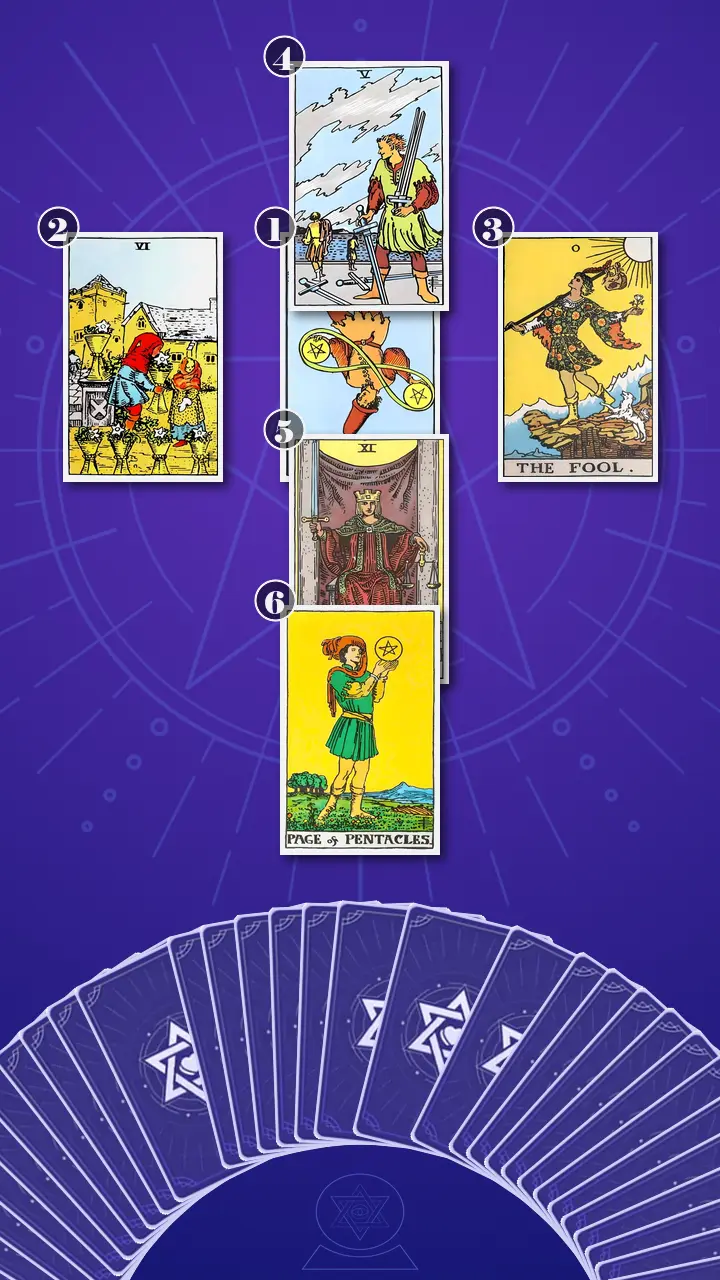
Two Doors, One Nervous System
Position 1: When “Being Responsible” Turns Into Toggling
“Now we’re turning over the card that represents current decision pressure and the observable way the choice is showing up in daily behavior,” I said.
Two of Pentacles, reversed.
It landed like a screenshot of her week: two open conversations, two sets of pros/cons, and that constant urge to keep both doors cracked so she doesn’t have to feel the click of commitment.
“This is you juggling your lease-start countdown like a product launch with no spec,” I said, using the plainest language I could. “Spreadsheet edits at midnight. Messages left on draft. Refreshing listings because action feels riskier than research.”
Reversed, the energy here is blocked Earth: the practical part of you that usually stabilizes a decision is overwhelmed. The juggling isn’t balance anymore—it’s a wobble. And the longer you keep wobbling, the choppier the emotional water behind you gets.
Jordan let out a short laugh—quick, bitter, almost impressed. “That’s… actually brutal,” she said. “Because it feels like I’m doing something. But I’m not.”
“Exactly,” I said. “Keeping both options alive gives you ten minutes of relief, but it steals your power to choose. And it can backfire: vague texts can damage trust with your friend, and make you look flaky to a stranger.”
I asked the question I ask when I see this card reversed: “In the last 48 hours, what’s one specific toggle that gave you relief but didn’t move anything forward?”
She didn’t even need to think. “I rewrote my guest policy text four times. Then I closed the app. And then I went on r/TorontoRenting like that was going to solve it.”
Position 2: The Familiar Harbor (And What It Quietly Asks From You)
“Now we’re turning over the card that represents Path A: what ‘room with a friend’ offers and what it asks of you,” I said.
Six of Cups, upright.
“This is the built-in warmth,” I told her. “Coming home after a brutal UX sprint and not having to perform. Inside jokes. Shared context. The nervous system loves ‘known.’”
Upright, this is balanced Water—comfort, emotional ease, the relief of familiarity.
But I kept my voice calm as I added: “This card can also be ‘default settings.’ Like rewatching a comfort show. Soothing—but not automatically the best fit for who you are now.”
I glanced at her hands. She was rubbing her thumb against the side of her phone like she could sand down the anxiety with friction.
“If you lived with your friend,” I asked, “what’s the one boundary you’re most tempted to skip because it’ll feel awkward?”
She stared at the corner of her screen. “Money,” she said finally. “Like… when rent is due, what happens if someone’s late. I hate talking about it. It feels like I’m accusing her of being irresponsible.”
“It’s not an accusation,” I said. “It’s a container. And containers protect good things.”
Position 3: The Clean Slate Leap—Smart, Not Careless
“Now we’re turning over the card that represents Path B: what ‘room with a stranger’ offers and what it asks of you,” I said.
The Fool, upright.
Her eyebrows lifted—like she already felt the edge of it. “Yeah,” she murmured. “That’s… terrifying.”
“It’s also clean,” I said. “No friendship history. No emotional debt. You get to define the relationship like a straightforward contract.”
This is excess openness if unmanaged—too much ‘it’ll probably be fine’ can become reckless. But upright, with awareness, it’s balanced beginner energy: a fresh start with clear terms.
“Think of it like starting a new job,” I offered. “You don’t know the culture yet, but you can still ask about expectations. You can still set boundaries.”
I asked, “What’s one unknown you can accept with a stranger—and one unknown you cannot live with?”
Jordan sat a little straighter. “I can accept… not being best friends,” she said. “I can accept different decor vibes. I can’t accept late rent. I can’t accept constant guests.”
“Good,” I said. “Those are not ‘too much.’ Those are livability requirements.”
Position 4: The Dark Matter in the Roommate Decision
“Now we’re turning over the card that represents the hidden factor to weigh: the underlying relational pattern or risk that could derail either option if ignored,” I said.
Five of Swords, upright.
Even through a screen, I felt her brace. Like her body recognized the card before her mind did.
“Unspoken rules don’t stay unspoken—they turn into scorekeeping,” I said.
“This is the shared-apartment version of a passive-aggressive Jira board,” I continued. “Invisible tickets everywhere. Somehow you’re always behind. Or a Venmo feed turning into a relationship: every request is technically ‘fair,’ but emotionally it starts to feel hostile.”
Here, the energy is excess Air friction—mental receipts, arguments rehearsed in advance, the quiet competition of who’s carrying more.
And this is where my research brain always clicks into its own kind of tarot. I called on my signature skill—Dark Matter Detection.
“Jordan, the debate you’re having—friend versus stranger—that’s the visible universe,” I said. “But this card is the dark matter: the invisible force shaping everything. The real threat isn’t a person. It’s a system where nobody says what they need, so the home becomes a win/lose tally.”
I let her see a micro-flashforward, not as fearmongering—just as reality design.
“Picture it,” I said. “A kitchen counter with dishes. A late-night guest. A rent transfer that’s one day late. No one screams. Someone makes a ‘joke.’ Then there’s that silence after. Peace versus politeness. Avoiding awkwardness now versus resenting later.”
Her reaction came in a chain, fast and honest: her breath paused (freeze), her eyes unfocused like she was replaying an old roommate memory (cognitive seep), and then she exhaled through her nose, shoulders dipping (release).
“That,” she said quietly, “is what I’m actually afraid of.”
“And you don’t need a perfect person to avoid that,” I told her. “You need a structure that doesn’t reward scorekeeping.”
Position 5 (Key Card): When Justice Turns Vibes Into a Livable Plan
“We’re turning over the most important card in this reading,” I said. In my office, the planetarium ceiling speakers ticked softly as they cooled, and the quiet felt like a dome closing—an intentional space.
Justice, upright.
I watched Jordan’s face change in real time: a wince first, like she expected to be scolded, and then something like relief that she didn’t have to keep guessing.
Justice is balanced truth energy. Not coldness—clarity. Scales and sword: criteria and follow-through. It’s choosing with a rubric instead of vibes. It’s writing acceptance criteria before a project so you’re not fighting later about what “done” means.
And I could feel her still reaching for the fantasy of certainty—the option that would guarantee peace without requiring her to be direct. That’s when the key shift had to land.
Setup: I said, “This is that moment in bed with the phone glow on your face, switching between your friend’s chat and a roommate listing, trying to find the one option that won’t punish you later—like if you can predict enough, you won’t have to risk discomfort.”
Delivery:
Stop trying to find the risk-free option, and choose the arrangement you can keep fair and clear—like Justice holding the scales and the sword.
I let the sentence hang there. No rushing to soften it.
Reinforcement: Jordan’s first response wasn’t a nod. It was a flash of irritation—protective, real. “But that means I have to be the one who brings up all the rules,” she said. “Like… I’m the intense one. I’m the bad guy.”
“I hear that,” I said. “And I’m going to push back gently: being direct isn’t being harsh.” I paused, then gave her the permission I wished more people got at 26 in a high-cost city. “Clarity isn’t harsh. It’s consent.”
Her face did that subtle sequence people do when something hits home: her eyebrows lifted (surprise), her jaw unclenched (release), and her eyes went shiny (grief for how hard she’s been trying). She swallowed and looked away from the camera for a second, like she needed to find a stable object in the room.
“Okay,” she whispered. “So it’s not… ‘Which person won’t hurt me.’ It’s ‘Which setup can I keep fair.’”
“Yes,” I said. And this is where I brought in my other signature lens: Gravity Assist Simulation. “In astrophysics, when a spacecraft needs to go farther than its fuel should allow, it uses a gravity assist—borrowing momentum from a planet’s motion. You don’t win by having zero risk. You win by using structure to change your trajectory.”
“Let’s run a one-year simulation,” I said. “Two timelines: friend and stranger. In both, there will be dishes, guests, money, moods. Justice says your ‘fuel’ isn’t perfect prediction—it’s agreements. When expectations are spoken, normal friction doesn’t become catastrophic. It becomes manageable.”
Then I gave her a concrete prompt, right there in the moment, like putting a handrail on a staircase.
“Open your Notes app,” I said. “Write three bullets: Money, Guests, Cleaning. Under each, write one sentence that describes your baseline—not your fantasy. Set a 10-minute timer. When the timer ends, you’re allowed to stop, even if it’s messy. If sharing it feels too intense today, save it as your private draft. Clarity still counts, even before conversation.”
She inhaled—deeper than before. “I can do ten minutes,” she said, almost like she was surprised she could.
I leaned in. “Now, with this new lens, think back to last week. Was there a moment—scrolling listings, rereading texts—where this would’ve changed how you felt?”
Jordan’s eyes went unfocused again. “Yeah,” she said. “When my friend said ‘we’ll figure it out as we go.’ I took it as comforting. But… I think it was actually what scared me.”
“That’s the shift,” I told her. “This isn’t just about choosing a roommate. It’s moving from trying to eliminate uncertainty to designing boundaries that make uncertainty livable. That’s a step from ‘racing what-ifs’ toward calm confidence.”
Position 6: The Page Who Stops Refreshing and Starts Building
“Now we’re turning over the card that represents the next step you can take this week to move from indecision into action without needing perfect certainty,” I said.
Page of Pentacles, upright.
“This is you treating the decision like a practical mini-project,” I said. “One script. One affordability check. One checklist. One message sent.”
The Page is balanced Earth: steady, learn-by-doing energy. Not dramatic. Not doomed. Just forward.
I gave her a Sunday-afternoon picture to replace the midnight spiral. “Calendar event: ‘Decision + Send Messages.’ A single roommate interview script you reuse for both friend and stranger, so you stop reinventing the wheel. Your brain settles when the plan becomes finite.”
She nodded, slow this time. “I can do this in under an hour,” she said. “I can start tonight.”
The One-Page “How We Live” Doc: Actionable Advice for a Lease Starting Next Week
I pulled the whole spread together for her, like drawing a line between stars until a shape appears.
“Here’s the story,” I said. “You’re in Two of Pentacles reversed—deadline pressure has you stuck in toggling, trying to keep both doors open so you don’t have to feel the discomfort of choosing. Six of Cups shows why the friend option feels emotionally safe—familiarity is a real resource. The Fool shows the stranger option could be clean and workable—but only if you take a smart leap, not a blind one. Five of Swords names what makes this feel so loaded: you’re afraid of a home that turns into quiet competition and resentment. Justice says the solution isn’t a perfect person—it’s a fair system. And Page of Pentacles says: small, repeatable steps will calm your nervous system faster than more research.”
“Your blind spot,” I told her, “is thinking you need a choice that guarantees peace. That’s what keeps you over-researching. The transformation direction is different: build clarity and accountability so normal roommate friction doesn’t feel like personal failure.”
Then I gave her a short plan—low drama, high traction. I framed it as navigation, because that’s what it is: you don’t control the entire universe, but you can choose your heading and stabilize your craft.
- Three minutes to drop your shouldersBefore you write anything, do the 3-minute cosmic breathing: inhale 4, hold 2, exhale 6. Then name the fear in one sentence: “I’m scared home won’t feel safe.”If you feel silly, do it anyway. A calmer body makes a cleaner decision.
- Three Non-Negotiables, Two Flexibles (20 minutes total)Set a 20-minute timer tonight. Write your Top 3 Non-Negotiables for home (money/payment timing, guests, cleaning baseline). Then write Top 2 Flexibles (decor vibe, occasional noise, shared groceries). Stop at 3+2—no bonus criteria.If you catch yourself opening another Reddit thread, pause and ask: “Is this new info, or is this me trying to feel safe?” Then return to the list.
- Create a one-page “How We Live” doc (Justice in writing)Open Google Docs/Notes and draft a one-page roommate agreement in plain language. Include one sentence each for Money, Guests, and Cleaning with examples (e.g., “dishes same-day = by bedtime”). Add one line on communication: “If something bugs us, we bring it up within 48 hours.”Clarity isn’t harsh. It’s consent—this document helps both people opt in honestly.
- One message sent within 24 hoursSend two clear messages: (1) To your friend: “Can we do a 20-min house rules talk about guests/cleaning/money before we commit?” (2) To the stranger path: send three screening questions mapped to your non-negotiables (rent timing, guest frequency, cleaning expectations).If it feels intense, send the “minimum version” text first. You can refine later; you can’t refine a message you never send.
- A 48-hour criteria-only decision windowPick a 48-hour window where you evaluate both options only against your Top 3 Non-Negotiables—like aligning to a constellation you can navigate by. Put a decision moment on your calendar (e.g., Sunday 6:00 p.m.): “Decision + Send Commitments.”If you think of a new criterion, park it in a note titled “Later.” The win is reducing toggling, not being perfect.
I repeated the simplest version, because memorable beats perfect: “Three non-negotiables. Two flexibles. One message sent.”

A Week Later: Ownership, Not Certainty
Six days later, during my lunch break between planetarium shows, my phone buzzed with a message from Jordan.
“I did the one-page doc,” she wrote. “I thought it would take hours. It took 25 minutes. I sent the text to my friend and we did the 20-min talk. It was awkward for like… two minutes. Then it was fine. Also: I stopped opening roommate listings at night. I didn’t realize how much that was keeping me wired.”
She added, almost as an afterthought: “I still feel nervous. But it’s different. It’s like—if something goes sideways, I’ll handle it. I won’t just spiral.”
I pictured her in that same condo bedroom, but this time with a calendar event set and a document saved—still human, still unsure, but no longer pinned under the weight of “one wrong choice ruins the year.”
Clear but vulnerable: she slept a full night, then woke up and her first thought was still, “What if I’m wrong?”—only this time she exhaled, looked at her notes, and let herself start the day anyway.
That’s the journey I trust: not certainty, but agency. The cards didn’t pick a roommate for her. They helped her stop orbiting the decision and start steering—toward a home that’s livable because it’s clear.
When home feels like the one place that can’t afford to go wrong, even a simple roommate choice can make your stomach clamp down—because it starts to feel like you’re choosing between comfort and control.
If you stopped trying to eliminate uncertainty and focused on making it livable, what’s one boundary you’d actually feel proud to say out loud this week?