Three Tabs Open Before the Drop Deadline, Then the Facts Got a Vote

The 11:47 p.m. Spiral — Achievement-Based Decision Paralysis Before a Class Withdrawal Deadline
When a second-year student in Toronto tells me she’s staring at the drop page, the syllabus, and a grade calculator in three separate tabs an hour before the deadline, I know I’m not looking at laziness. I’m looking at achievement-based decision paralysis before a class withdrawal deadline.
Maya (name changed for privacy) came onto my screen at 11:47 p.m. from a student apartment near St. George station, her laptop balanced on the bed. Quercus glowed beside a half-finished assignment and a Google Sheets grade calculator; the room looked too warm, her charger cable dug into her leg, and the stale smell of coffee seemed to hang even through video. Her phone kept buzzing with class group chat screenshots while her jaw stayed locked and her shoulders crept higher with every notification.
“If I drop it now, does that mean I couldn’t handle it?” she asked me. Then, almost immediately: “If I stay, I need to prove I can finish.”
I could see the pressure in her body like a phone on 1% battery still trying to run five apps at once — tight chest, clenched jaw, jittery fingers hovering over the trackpad. She wasn’t stuck because she didn’t care. She was stuck because both choices felt like they could say something final about who she was.
I told her, “A class can be hard without becoming a verdict on your character. Let’s make a map tonight — one that helps us separate facts from fear and find the kind of clarity your calmer self could still respect tomorrow.”
Choosing the Compass: The Decision Cross
I asked her to put both feet on the floor, close the extra tabs for one breath, and hold the question in its simplest form: withdraw, or grind through?
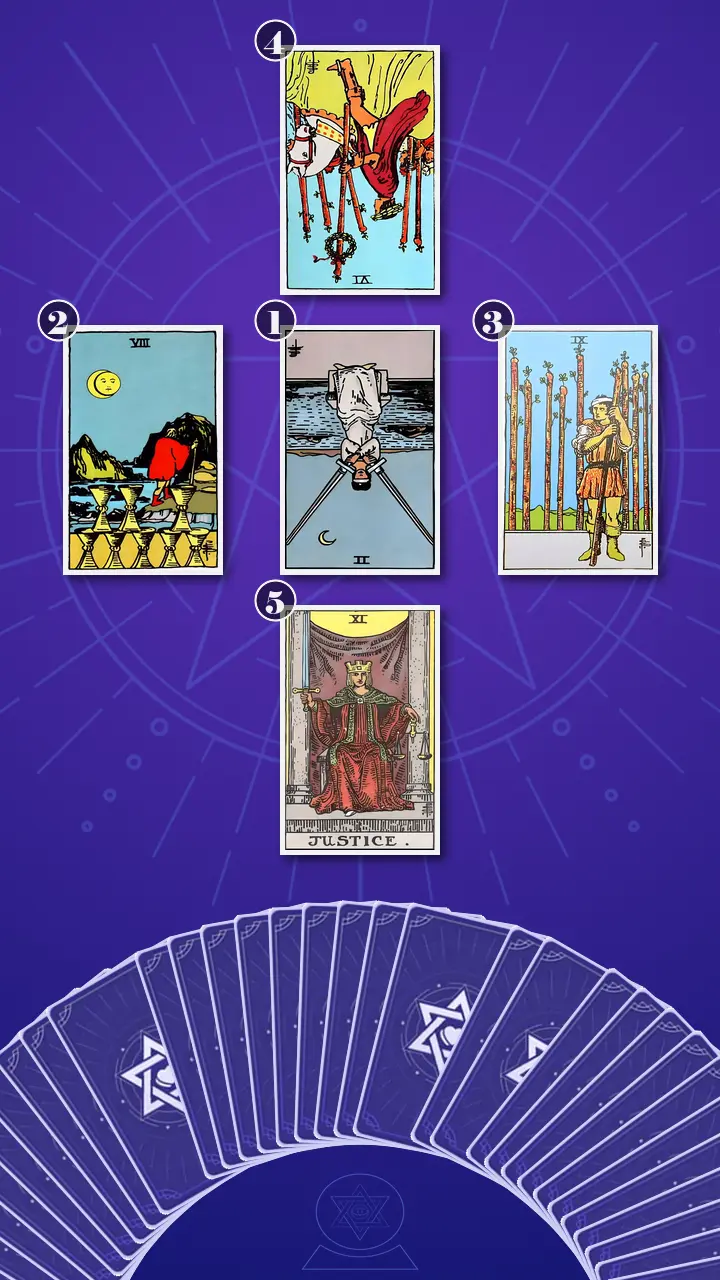
As I shuffled, I told her I was using a Decision Cross, a five-card decision spread I reach for when someone needs fast clarity without more emotional clutter. This is how tarot works best for a deadline problem like this: the center card names the live pressure point, the left and right cards let each option speak on its own terms, the card above shows the hidden fear warping the choice, and the card below gives us a decision standard sturdy enough to restore self-trust.
For Maya’s question — really, for anyone searching for a tarot reading for whether to drop a class — this spread is lean on purpose. It doesn’t let panic sprawl. It turns the whole thing into a structure: symptom in the center, one path on each side, unseen pressure above, grounded guidance below.
Reading the Tabs, the Shame, and the Split
Position 1: The Loop That Calls Itself Research
Now I was looking at the position that presents the diagnosis-level symptom: the immediate choice paralysis, deadline pressure, and split attention. The card was Two of Swords, reversed.
At the center of the decision, this looked exactly like keeping the withdrawal page, the assignment doc, and the grade calculator open at the same time, hoping one tab would suddenly become morally safer than the others. One more check. One more comparison. One more minute before I make it real. The blindfold in this card feels like selective looking, and the crossed swords over the chest feel like defensiveness hardening in the body while the mind keeps circling.
I told her this wasn’t a lack of intelligence. It was blocked Air — clarity jammed into a loop. The stalemate had stopped protecting her and started running her. It had that Severance-like split-self energy: one part of her wanted to perform competence, the other wanted to stop the pain, and neither fully trusted the other enough to choose.
Maya gave a short laugh that came out sharp around the edges. “Okay,” she said, rubbing her forehead, “that’s so accurate it feels a little rude.” Her cursor froze over the trackpad, and then she nodded once, the kind of nod people give when they’ve just been caught doing something they’ve been calling “research.”
Position 2: The Exit With Its Dignity Intact
Next I turned to the position that reveals what the withdraw path is trying to protect, honor, or make possible beneath the surface question. The card was Eight of Cups, upright.
On the withdraw path, this is the moment someone admits a class may no longer fit the rest of the term, even if it once did. The figure on the card leaves cups that are still neatly stacked, and that detail matters to me. Nothing is trashed. Nothing is declared worthless. This is what it looks like when stepping back protects your other courses, your campus job, your sleep, or your mental bandwidth before the whole semester tips over.
I called the energy here honest Water — movement through sadness, not collapse. “Not every clean exit is quitting,” I told her. “Sometimes it’s bandwidth with boundaries.” I watched that land. Her shoulders softened by maybe half an inch, and she took the first deeper breath of the session. “So leaving wouldn’t automatically mean I failed,” she said. “It could just mean… it doesn’t fit now.”
Position 3: What Staying Would Actually Cost
Then I opened the position that reveals what the grind-through path would require and what part of her wanted to prove or preserve by staying. The card was Nine of Wands, upright.
This card never tells me, “Everything is fine.” It tells me survival is possible, but only with boundaries. In modern life, it looks like a seven-day emergency plan: cutting nonessential commitments, emailing for clarity, protecting work blocks, and accepting that finishing the class would require guardrails because you’re already tired. The bandage is visible depletion. The row of wands is the temporary fence you would need around your energy.
I named the fire in it as overextended rather than triumphant. “If the only way to stay is self-punishment, that matters,” I said. “This route might be doable, but it isn’t free.” Maya pinched the bridge of her nose and stared at the card. “Yeah,” she said quietly. “I could probably finish. But something else would absolutely catch fire.”
Position 4: The Invisible Audience
Above the cross sat the position that uncovers the hidden fear and validation wound shaping the choice more than the actual facts do. The card was Six of Wands, reversed.
This is where the reading stopped being only about coursework. As the hidden fear card, Six of Wands reversed is the imagined audience in your head: classmates, friends, future applications, LinkedIn, the study Story you saw at exactly the wrong time, even the internalized version of yourself who is always supposed to be handling everything. The class becomes heavier because it stops being a logistics problem and starts feeling like reputation management — like making a private course decision under an imaginary LinkedIn comment section.
I told her what I saw: the pressure wasn’t only “Can I handle this class?” It was also “What will this seem to say about me if I can’t?” That is excess attention to the crowd and too little trust in the self that actually has to live in the body. I saw the reaction move through her in a chain: first her tapping hand went completely still, then her eyes lost focus as if some memory had stepped in front of the webcam, and only after that did the feeling arrive in her voice. “This is exactly it,” she said, suddenly quiet. “I can maybe survive the class. I don’t know how to survive what it means.”
When Justice Set the Scales Down
Position 5: The Standard That Restores Self-Trust
By the time I turned the final card, even the room seemed to conspire with it. Her phone had stopped buzzing. Somewhere behind her, the old radiator gave one soft click and then went still. This was the key card — the one offering the clearest decision criterion and the shift that could restore self-trust. The card was Justice, upright.
Justice is the version of Maya who closes the extra tabs, pulls the real numbers into one place, and weighs workload, grade reality, credit cost, and energy cost with equal honesty. The scales come before the sword. In plain language: weigh before you cut. Ask not which choice looks stronger tonight, but which choice is actually fair.
Justice always gives me a little studio flashback. When a painting turns muddy, I don’t fix it by adding more paint everywhere. I think of Mondrian — clean edges, distinct blocks, nothing allowed to bleed into everything else. I call this my Mondrian Grid Method. Shame loves a smear: GPA, pride, money, sleep debt, identity, all sloshed together until every part feels equally catastrophic. Justice asks me to square the canvas back up so each fact gets its own boundary and its own weight.
You do not have to suffer your way into being good enough; put this class on Justice's scales and choose the path that is true, accountable, and sustainable.
She went very still. First came the physical freeze — her breath caught, and her fingers hung over the keyboard like she’d missed a step in the dark. Then came the inward replay; her eyes shifted past the camera, unfocused, as if she were rewatching the TTC ride, the 11:47 p.m. tabs, the moment the class quietly turned into a character trial. Only after that did the emotion break the surface: her jaw eased, one shoulder dropped, and she let out a long breath that sounded almost embarrassed to be relief. Then, right on its heels, came the resistance. “But if I do it that way,” she said, a flicker of anger lifting into her voice, “doesn’t that mean I’ve been torturing myself for nothing?”
“Not for nothing,” I said. “You’ve been trying to survive a shame storm with analysis. That makes sense. It just doesn’t make a fair judge.” I let the silence hold for a second. “Now, with this new lens, think back to last week. Was there a moment when this would have made you feel different?”
She nodded before she answered. “On the train this morning,” she said. “I kept rereading the grading breakdown, but I think I already knew the workload was bigger than the hours I had.”
That was the hinge of the reading. Not perfect certainty. Not a magical answer. Just the first real move from shame-fuelled deadline panic to grounded self-trust and clean ownership. Facts deserved a vote too.
From Shame-Courtroom to Facts Not Fear
When I stepped back and looked at the whole spread, the story was clean. At the center, Two of Swords reversed showed the live symptom: a mind looping between tabs because not choosing still felt safer than being wrong. On the left, Eight of Cups gave real dignity to stepping back — grief, yes, but also protection of bandwidth. On the right, Nine of Wands admitted that staying might be possible, but only in survival mode, with visible cost. Above it all, Six of Wands reversed named the real distortion: an invisible audience turning one course into a referendum on worth. And below, Justice offered the correction. In practical terms, Justice translated into a Facts Not Fear capacity check grounded in grade reality, workload, available hours, and energy cost. The blind spot wasn’t lack of effort. It was treating suffering like proof of seriousness.
I told Maya the transformation was simple to say and hard to practice: move from proving seriousness by suffering to choosing based on clear capacity, real consequences, and self-respect. The decision did not need to be heroic. It needed to be honest.
- Justice Scale CheckOpen one plain note titled “Facts, Not Fear.” Make two columns only: Stay / Withdraw. Under each, list just four items — current grade, remaining workload, actual hours available this week, and what that choice would cost another class, your campus job, or your sleep. Set a 15-minute timer. Until it ends, do not text anyone.If your body spikes, pause, unclench your jaw, and come back after two minutes. The goal is not perfect certainty; it’s a decision standard you can respect.
- The No-Audience SentenceIn your Notes app, finish this privately: “If nobody else knew about this class, I would choose ___ because ___.” Leave it unsent for at least 10 minutes. If the sentence points toward withdrawing, check the exact policy, refund or transcript impact, and draft one facts-only email to an advisor or TA.You might want to argue with the sentence as soon as you write it. That’s normal. Let the private truth land before you explain it to anyone else.
- Jazz Solo 7-Day PlanIf your note points toward staying, make a survival version of the next seven days, not an ideal one. Circle only the tasks that still move the grade in a meaningful way, cross out decorative effort like over-formatting notes or rereading week one, email one person today for clarification or reduced scope, and cancel one nonessential commitment to buy back recovery time.I borrow this from my Jazz Solo Planning tool: improvise measure by measure, not by trying to play the whole song at once. Keep the plan ugly and realistic. If the only way to stay is self-punishment, that matters.
That was my practical advice for finding clarity in a school decision like this. Not more tabs. Not more opinions. A fair self-assessment, a private truth, and one small next step that returned the choice to the person who actually had to live it.

A Week Later: The Quiet Proof
Four days later, Maya sent me a screenshot of a note so plain it almost made me smile. Two columns. Real numbers. One line beneath them: “If nobody else knew, I would choose withdraw because I want the rest of my semester back.” She had checked the policy, made the click, and emailed her advisor. Then she sat alone in a campus café with a Tim Hortons cup cooling beside her — sad, steady, and finally eating the snack she’d packed instead of spending her break refreshing the portal.
That is what I mean when I talk about a Journey to Clarity. My job is rarely to hand someone a dramatic answer. It’s to help them make the call their calmer self could live with tomorrow. In this Decision Cross tarot spread for a drop-deadline class decision, the real shift wasn’t from weakness to strength. It was from proving to honest capacity, from split focus to clean ownership.
When one class starts feeling like proof of whether you’re still capable, even a simple deadline can make your chest lock up like you’re choosing between relief and your identity. If nobody had front-row seats to this decision — not the group chat, not LinkedIn, not the imaginary audience in the bleachers — what choice would let your body unclench a little and still feel honest to you tomorrow?