From Spreadsheet Spirals to Self-Trust: Choosing an Offer Under Deadline

Finding Clarity in the Split-Screen Inbox
If you’ve reopened the two offer emails so many times your inbox is basically a split-screen, and the deadline date makes your chest tighten every time you see it—hi, career choice paralysis.
Jordan showed up on a damp Tuesday evening in London with that exact look: eyes bright from adrenaline, jaw set like she’d been clenching through her commute. She’s 27, a UX designer, and she’d been living inside the same loop for days—startup offer on one tab, corporate offer on another, and a Google Sheets pros-and-cons template that had evolved into something that looked like a small tax return.
“It’s 8:47,” she said, glancing at her phone as if time itself had teeth. “The kettle clicked off and I literally felt my heart jump. I keep flipping between the salary calculator and the benefits page, then LinkedIn, then r/UKJobs threads like they’re… evidence.”
The laptop glow washed her face the way late-night scrolling does—pale, a little unreal. The trackpad on her MacBook was slightly sticky under her thumb. Every few minutes her cursor hovered over an email draft titled Accepting Offer like she was about to touch a hot stove.
“I know this sounds dramatic,” she added, then laughed once—short, thin. “But if I choose wrong, it’s going to set me back years.”
What I heard beneath her words was the real contradiction: making a clear next move (startup or corporate) versus fearing she’ll commit to the wrong offer before the deadline—like this single click would prove whether she has judgment, whether she’s in control of her life direction.
Pressure is rarely abstract in the room. In Jordan, it lived as a tight chest and restless, keyed-up energy that spiked every time the deadline flashed in her mind—like her body was braced for impact while her brain kept trying to out-think the clock.
“You’re not irrational,” I told her. “You’re responding to a hard boundary—time—while trying to make a decision that touches identity, money, and the story you think you’re supposed to be living. Let’s not try to force certainty tonight. Let’s draw a map through the fog and find clarity you can actually use.”

Choosing the Compass: The Decision Cross · Context Edition
I asked Jordan to take one slow breath—not as theatre, just as a gear shift. A way to move from doomscrolling brain into observing brain. I shuffled while she held the question in plain language: Offer deadline: startup or corporate—what’s my next move?
“For this,” I said, “I’m using a two-option tarot spread called the Decision Cross · Context Edition.”
For anyone reading along: this spread is built for exactly this kind of career crossroads decision under deadline pressure. It separates the present gridlock from what each path actually feels like day-to-day, then it forces the decision to be made through values—not vibes, not LinkedIn optics, not a committee of opinions. The final position is contextualized: instead of a fixed ‘outcome,’ it gives a next move before the deadline, because the point is empowerment and action, not prediction.
“Card one,” I explained, “shows the knot—what your indecision looks like as observable behaviour when the clock is real. Cards two and three contrast startup versus corporate. Cards four and five are the truth checks—the hidden costs you can’t afford to romanticize. Card six is the filter: values and non-negotiables. And card seven is the immediate move that lifts the stalemate.”
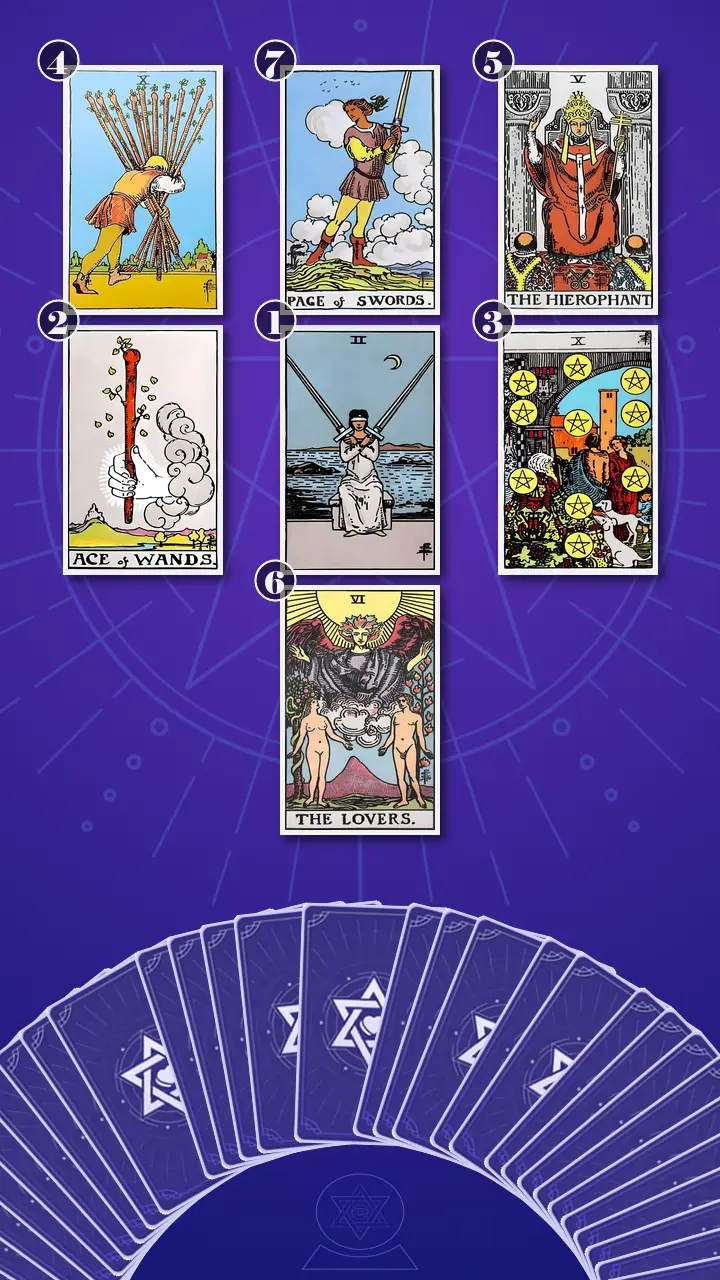
Reading the Map: A Career Crossroads Under a Deadline
Position 1: The current decision gridlock
“Now we turn over the card that represents the current decision gridlock—what your indecision looks like in real behaviour under the offer deadline,” I said.
Two of Swords, upright.
It was almost comically on the nose: a figure blindfolded, arms crossed, holding two blades like she’s trying to keep two realities perfectly balanced. And Jordan—London, two offer PDFs open in separate tabs, a weighted spreadsheet in Google Sheets, LinkedIn as background noise—re-reading the same lines (salary, benefits, start date) as if staring hard enough would make the ‘right’ choice glow.
“This,” I told her, “is a blockage state of Air energy. Thinking isn’t helping you decide; it’s helping you stay protected. The blindfold is the way you avoid admitting what you actually want—because wanting makes you responsible for choosing. And the crossed swords are moving goalposts: every time you get close, you add a new criterion so you can stay ‘neutral.’”
I let a beat pass, then said one of the simplest truths I know in readings like this: “Your spreadsheet isn’t the problem. The need for certainty is.”
Jordan huffed out a laugh that didn’t reach her eyes. “That’s… too accurate,” she said, and the laugh turned a little bitter. “Like, it’s kind of brutal.” Her fingers rubbed the rim of her mug as if friction could make the decision warm enough to hold.
In my head, an archaeologist’s image flickered: the way a site can look empty until you stop digging where it’s comfortable. People think excavation is about finding more; often it’s about being willing to see what’s already there.
Position 2: Path A (Startup)—the core energy
“Now we turn over the card that represents Path A—the startup: the core energy and what it would likely demand of you day-to-day,” I said.
Ace of Wands, upright.
“This is the spark,” I said. “The part of you that imagines shipping features fast, real ownership, learning by doing instead of waiting for permission. Grab it and run energy.”
In modern life terms, it’s that lunch-break daydream near Old Street: your creative drive wakes up when you picture the work. This is a balance state of Fire—healthy momentum, initiative rewarded, uncertainty normal.
Jordan’s shoulders lifted a fraction, like her body recognized the warmth. “That’s the thing,” she said. “It feels… alive.”
Position 3: Path B (Corporate)—the core energy
“Now we turn over the card that represents Path B—the corporate offer: the core energy and what it would likely provide structurally,” I said.
Ten of Pentacles, upright.
“This is stepping into an already-built system,” I said. “Predictable pay, benefits you can plan around, a brand name that travels, clear cycles—onboarding, reviews, promotions. In a high-cost city, this can hit your nervous system like a deep exhale.”
Earth energy here is in balance. Not glamorous, but stabilizing. It’s not you improvising the scaffolding while also trying to build the house.
Jordan’s face softened, then tightened again. “It’s relief,” she admitted, “and also… I don’t know. Like I’m about to be absorbed into a system.”
Position 4: Truth check for Path A (Startup)—the hidden cost
“Now we turn over the card that represents what you must be honest about in the startup path: the hidden cost, pressure point, or growth edge,” I said.
Ten of Wands, upright.
I didn’t sugar-coat this one. “This is Fire in excess—spark that becomes load. The wand you grab turns into a bundle you carry alone.”
I gave her the split-screen as the card asked for it: the startup fantasy in fast motion—whiteboards, quick wins, shipping, autonomy—then the cut to weight: Slack pings at 9:40 PM, a product fire drill, you holding context across design, research, and PM because ‘we’re lean.’ Shoulders tight like you’re already carrying the bundle.
“The question isn’t ‘exciting or not,’” I said. “It’s exciting vs sustainable. This path can be meaningful and still be too much if you don’t define scope and recovery time early.”
Jordan exhaled slowly, like her body had been waiting for someone to say that sentence out loud.
Position 5: Truth check for Path B (Corporate)—the trade-off
“Now we turn over the card that represents what you must be honest about in the corporate path: the trade-off, constraint, or cultural fit question,” I said.
The Hierophant, upright.
“This isn’t ‘corporate is bad,’” I said. “It’s institutional. Approvals. Performance cycles. Norms. A specific way of speaking and moving to be taken seriously.”
I tapped the keys at the base of the throne in the image. “The keys are real: mentorship, legitimacy, doors that open because you’re in the building. But the trade-off is also real: you accept the rules of the building.”
Jordan made a face that told me she’d already lived the micro-scene: waiting for sign-off on a simple design change that shouldn’t require a meeting about a meeting. She looked both calmer and slightly boxed in—exactly the mixed feeling this card carries.
“It can feel a bit like Severance,” I added, “minus the sci-fi. Not that you lose your mind—just that the system has its own logic, and it will shape you if you let it.”
When The Lovers Became the Filter—Not the Performance
Position 6 (Key Card): Your true decision filter—values and non-negotiables
The room got quieter in that particular way it does before the central insight lands—like even the kettle in the next flat might decide to hold its breath.
“Now we turn over the card that represents your true decision filter: the values and non-negotiables that should choose for you when certainty is unavailable,” I said.
The Lovers, upright.
Jordan’s eyes flicked to the card and then away, as if it was too intimate. That’s what people misunderstand about this card: it isn’t romance; it’s integrity. Alignment. Choosing a trade-off you can live with.
In her life, it looked like this: stopping the comparison game—better/worse, impressive/safe—and asking the workday-true question: Which trade-off can I live with and still respect myself?
Setup: She was still trying to see the next five years from a single decision like it was Google Maps—deadline in the email thread, tabs open, chest tight—waiting for her body to feel 100% certain before she’d let herself hit send.
Delivery:
Stop waiting for the ‘perfect’ answer and choose the path that matches your values—like The Lovers, let alignment be the yes.
I let silence do what it does best: make room for truth to arrive without being argued with.
Reinforcement: Jordan’s reaction came in layers—first a tiny freeze, like her breath paused halfway in. Then her gaze unfocused, not dissociating, but searching memory as if replaying the last week in fast-forward: the LinkedIn refresh, the spreadsheet edits, the group chat opinions she couldn’t metabolize. Finally, her shoulders dropped—an honest, unglamorous unclenching—and she let out a shaky exhale that sounded almost like a laugh.
“But… if I choose based on values,” she said, and there was a flash of irritation under the fear, “doesn’t that mean I’ve been doing it wrong? Like I wasted days?”
“No,” I said gently, and I meant it. “It means your nervous system used the tool it knows—analysis—to try to keep you safe. But now we switch tools.”
This is where my own framework comes in—the one I’ve used in digs and in people’s lives. I call it Skill Archaeology: you stop excavating for more and start unearthing what’s been overlooked. In Jordan’s case, the overlooked artefacts weren’t hidden talents in a CV—they were her non-negotiables, buried under optics and other people’s certainty.
“Right now,” I said, “your decision criteria keep moving because you’re trying to optimize away discomfort. The Lovers asks for a stable filter. Three non-negotiables. Not ten. Not twenty. And not ‘what looks smartest on LinkedIn.’ A career isn’t a résumé sentence; it’s a lived workday.”
I leaned in slightly. “Now, with that new lens, look back at last week. Was there a moment—maybe on the Victoria line, maybe at 2 a.m. with Glassdoor open—when this insight could’ve changed how you felt?”
Jordan swallowed. “Thursday,” she said quietly. “On the escalator at Victoria. I kept rehearsing two versions of my future like trailers. And I remember thinking, for half a second, ‘Which one would I respect myself for?’ Then I refreshed LinkedIn and the panic came back.”
“That half-second,” I told her, “was you moving from deadline-driven hyper-analysis and self-doubt to values-based clarity and grounded self-trust. It’s not a personality transplant. It’s a small, repeatable shift.”
The Email That Cuts Through the Wind
Position 7: Next move before the deadline
“Now we turn over the card that represents your next move before the deadline: the most useful immediate action to create clarity without trying to predict everything,” I said.
Page of Swords, upright.
Air again—but finally healthy Air. Not the locked circuit of the Two of Swords. This was open eyes, upright blade, movement in the wind.
“This is clarity-through-action,” I said. “One clean burst of targeted inquiry: email both recruiters or hiring managers today with three sharp questions tied to your non-negotiables. Then decide.”
I watched Jordan’s hands, because hands tell the truth before words do. Her fingers opened and closed once, like she was rehearsing the physical act of hitting send.
“Three good questions beat thirty anxious ones,” I added. “And you’re allowed to stop researching after you ask them.”
The One-Page Plan That Replaces Certainty
I pulled the whole spread together for her—because tarot works best when it becomes a coherent story, not seven disconnected moments.
“Here’s what happened,” I said. “The Two of Swords shows the present: you treated a values decision like a logic problem, hoping certainty would arrive if you stared long enough. Then the options appear as real, valid energies: the startup’s Ace of Wands is genuine spark and growth-through-doing; the corporate Ten of Pentacles is genuine stability and inherited structure. But the truth checks keep you honest: the startup’s spark can become an unsustainable Ten of Wands load; the corporate stability comes with Hierophant rules, approvals, and culture. The Lovers is the bridge—values choose when the comparison game can’t. And the Page of Swords says the stalemate breaks with one brave email, not another spreadsheet rebuild.”
“Your cognitive blind spot,” I added, “is thinking: ‘If I don’t feel certain, I’m not ready to choose.’ That’s not readiness. That’s fear of being wrong in public.”
“The direction of change,” I said, “is the key shift: stop trying to guarantee the ‘right’ offer. Choose based on your non-negotiable values, then commit with a practical 30–90 day learning plan so you can adjust after you choose.”
As an archaeologist, I’m wary of shiny things. I’ve watched people fall in love with a relic that turns out to be modern filler. So I offered her my strategy in plain language: Relic Authentication—assess opportunities carefully, but with a finite checklist, not an endless dig.
Then I gave her the next steps—small, specific, and deadline-proof. (And yes, I treat goals like moving a megalith: you don’t “willpower” a stone across a plain; you put it on rollers and move it one metre at a time.)
- The 12-Minute Non-Negotiables FilterOpen Notes. Write two headers: “Non‑negotiables (3)” and “Nice-to-haves (5).” Set a 12-minute timer. No spreadsheet, no tabs. Just words.If 12 minutes feels like a lot, do a 5-minute version and pick ONE non-negotiable (mentorship, pace, boundaries, money, meaning, autonomy).
- The 3-Question Cut-Through EmailEmail both recruiters/hiring managers today with 3 questions tied to your non-negotiables: (1) first-90-day success metrics, (2) team decision-making speed/approvals, (3) typical after-hours expectations. Then stop researching.Start with bullet points in a draft to yourself, then paste it into the email. Three good questions beat thirty anxious ones.
- The 25-Minute Decision Meeting (Choose + Send)Put a 25-minute “Decision Meeting” on your calendar for tomorrow. In that meeting: choose using your 3 non-negotiables, then immediately send the acceptance email. If you truly can’t choose, send both parties a message stating “Final decision by X time tomorrow” to protect your timeline.Expect your brain to say, “This is too simplistic.” That’s the Two of Swords trying to keep you safe by staying undecided.
“And after you choose,” I said, “we replace terror with structure. Tool Evolution: you upgrade progressively. You’re not choosing a forever. You’re choosing a 90-day experiment with a spine.”

A Week Later: The Quiet Proof
Six days later, Jordan emailed me a screenshot—not of a spreadsheet, but of a sent message. Subject line: Quick questions re: first 90 days. Three bullets. Clean. Brave. Page of Swords in the wild.
Under it she wrote: “I did the 12-minute non-negotiables thing. My chest still freaked out, but it wasn’t chaos-freak-out. It was like… okay, this is real. Also, I slept. Like a full night.”
Her follow-up was honest in a way I trust: “This morning my first thought was still ‘what if I’m wrong?’ But I smiled a bit because I have a plan now.”
That’s the journey I care about: not from confusion to perfect certainty, but from decision fatigue and overthinking to values-based clarity and grounded self-trust—built through one aligned action and the willingness to adjust.
When the deadline is staring back at you, it can feel like your whole judgment is on trial—so you keep searching for the one ‘correct’ answer, even as your chest tightens and your confidence gets quieter with every new tab you open.
If you didn’t need to be 100% certain—only aligned—what’s the smallest next step you’d take today to make your choice feel like something you can stand behind?