AI-Era Deadline Paralysis—and the Boundary That Got the Draft Moving

The 11:12 p.m. Three-Tab Freeze
If you’re the undergrad who keeps rewriting the first paragraph while the submission portal clock gets louder in your head, and the real problem isn’t just the essay but AI-era deadline paralysis, you’ll recognize Jordan (name changed for privacy) immediately.
It was 11:12 p.m. in a Robarts Library cubicle on their side of my screen. Quercus sat open in one tab, Google Docs in another, and a ChatGPT window kept appearing and disappearing like it couldn’t decide whether it was a rescue boat or a trap. The HVAC hummed above them. The laptop fan warmed their wrists. On my side of the call, my café still smelled faintly of dark roast and orange peel, but Jordan’s cursor blinked in the document so steadily it almost felt rude.
“I cannot tell if I’m stuck on the essay,” Jordan told me, “or stuck on what using help says about me.” They glanced down, typed half a thesis, deleted it, then checked the course AI policy again. Torn between using ChatGPT for speed and figuring it out themself for ownership, they were treating a same-night paper like a referendum on whether they were still a capable, honest student.
The panic had become a cursor lodged behind their sternum—blinking, blinking, and never becoming a sentence. I softened my voice and said what I knew they needed to hear first: “You’re not stuck on the essay alone. You’re stuck on what the method seems to say about you.” Then I slid my deck onto the small marble café table in front of me and added, “Let’s make a map for the fog, and let’s find some clarity before the deadline chooses for you.”

Choosing the Compass: The Decision Cross Spread
I asked Jordan to plant both feet on the floor, take one unromantic, ordinary breath, and hold the exact question in mind: essay due tonight—use ChatGPT, or figure it out myself? While they breathed, I shuffled slowly. Not for theatre. For focus. A ritual works best when it helps the nervous system stop sprinting long enough to notice what is actually true.
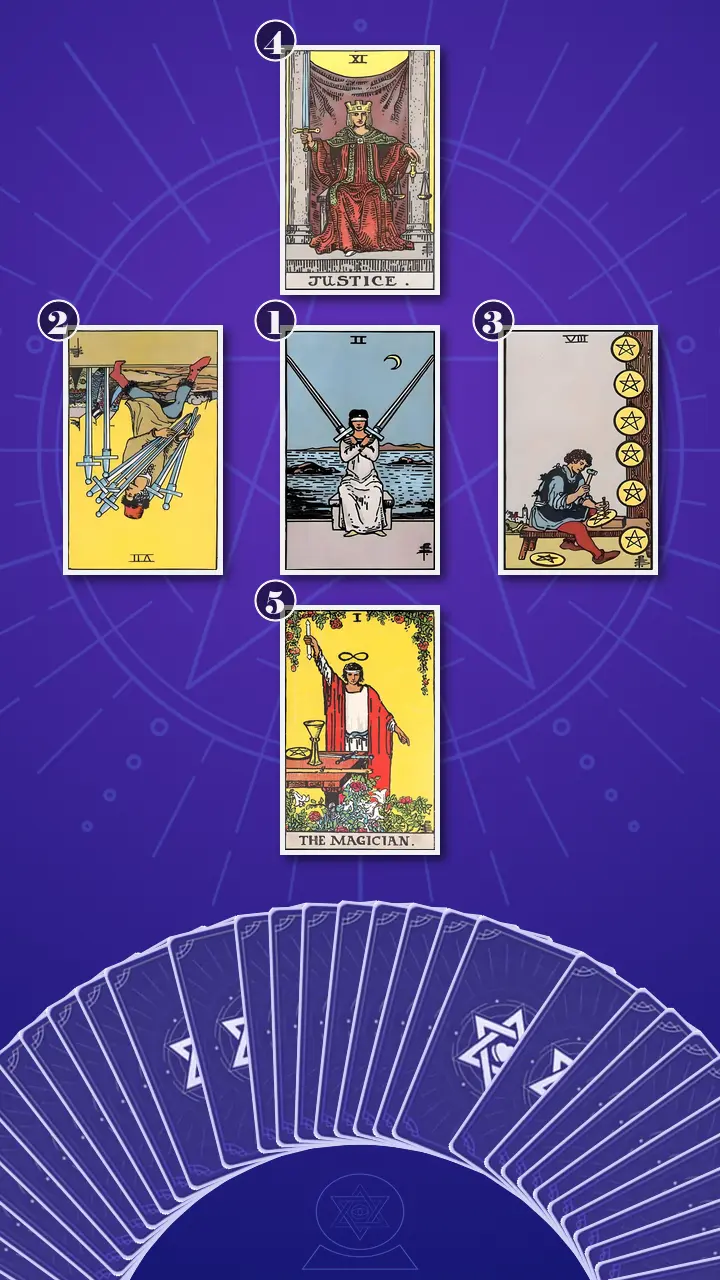
For this reading, I used a Decision Cross spread—a five-card decision spread I reach for when someone is trapped in a choice that looks simple on paper and emotionally messy in real life. For me, tarot works best in questions like this as a structured mirror, not a moral judge.
A larger spread, like the Celtic Cross, would have added noise tonight. A three-card comparison would have been too thin. Jordan didn’t just need Option A versus Option B. They needed to see the visible knot, the promise and cost of each path, the deeper integrity conflict underneath it, and the most constructive way forward. In this spread, the center card names the trap on the screen; the left and right cards compare the two routes; the card above reveals the real principle at stake; and the card below shows how to act without handing the wheel to panic.
Reading the Map of AI-Era Deadline Paralysis
Position 1: The Loop That Feels Like a Verdict
Now I turned over the card representing the immediate knot: the visible indecision loop between the blank page and the tool.
Two of Swords, upright.
This card could not have been more literal. Jordan was stuck in the classic three-tab freeze: essay doc open, assignment brief open, ChatGPT open, but no real drafting happening because choosing a method felt as loaded as choosing whether they were still a real student. The blindfold on the figure told me they were trying to solve the whole identity question before testing a practical next move. The crossed swords over the chest looked exactly like the two rules they had locked against their ribs: finish fast and keep it fully mine.
Energetically, this was blockage—Air with nowhere to go. A held breath. Hovering hands. Locked shoulders. The kind of gridlock that feels productive because you’re checking tabs, policies, and wording, but is really just stillness in smarter clothes. It was like having twelve tabs open and treating the click itself as the dangerous part.
Jordan let out a short laugh that carried more fatigue than humor. “Wow,” they said. “That is accurate enough to be annoying.” Their fingers stopped drumming on the desk; then they pressed both palms flat, as if contact with the table might keep them from floating off into another spiral.
“Good,” I said gently. “Because a deadline is not a verdict on your intelligence. If we can name the loop clearly, we don’t have to keep obeying it.”
Position 2: The Shortcut That Looks Over Its Shoulder
Next I opened the card representing what the ChatGPT path promised—and what it risked obscuring about ownership, relief, and voice.
Seven of Swords, reversed.
This is the part where Jordan types a prompt for a thesis or outline, feels thirty seconds of relief, and then reads the result with their stomach dropping. The language might sound competent, even polished, but not quite defensible in their own voice. The figure on the card keeps looking over his shoulder; that is exactly the feeling of pasting AI-generated wording into a document and mentally checking over your shoulder at the same time.
Reversed, the energy is blocked cleverness. The tool can absolutely offer speed, structure, and a way around the blank page. But ease doesn’t arrive cleanly. Instead of solving the essay, it can create a second problem: can I explain this sentence out loud? Can I stand behind it tomorrow? It’s like downloading a template for speed and then spending longer trying to hide the seams.
I asked, “If you opened ChatGPT right now, what are you honestly hoping it would save you from in the next fifteen minutes—the blank page, the pressure, the shame, or the fear of sounding underprepared?”
Jordan stared at the card, then at their minimized tab. “The shame,” they admitted. One shoulder lifted, then dropped. “And maybe the feeling that everyone else already knows how to do this better.”
Position 3: The Paragraph-by-Paragraph Return
Then I turned to the card showing what figuring it out alone develops—and what it demands under pressure.
Eight of Pentacles, upright.
This was not a card of noble suffering. It was a card of craft. Jordan narrowing the job to one body paragraph: one claim, one source, one explanation block, done imperfectly but by hand. The row of pentacles on the card felt like a progress bar filling one usable block at a time. The single pentacle in the craftsperson’s hand was not the whole essay. It was the next sentence.
Here the energy was balanced Earth—steady, practical, embodied. This path builds trust because competence grows through shaping the argument itself, not through waiting to feel morally spotless or impressive first. I told Jordan, “Write the paragraph before you solve the philosophy of the paragraph.”
They blinked, and something in their posture loosened. Not fully relaxed—more like a knot tugged slightly less tight. Their hands, which had been hovering over the keyboard all evening, finally came to rest.
Position 4: Justice Writes the Rule
Above the center, I revealed the card that uncovered the deeper value conflict beneath the choice: integrity, fairness, and self-respect.
Justice, upright.
This was the turning point. Jordan had been rereading the course AI policy, checking Reddit, glancing at breezy group-chat messages, and hoping some outside wording would remove the burden of judgment. Justice said no. No syllabus sentence, no classmate’s “I just used it for the outline lol,” and no late-night forum thread was going to define the line for them with enough precision to calm the nervous system. The real question was not purity versus cheating. It was explainable versus unexplainable, owned versus vaguely borrowed.
Energetically, Justice is balance with edges. It doesn’t soothe by saying anything goes. It soothes by making criteria explicit. Like setting app permissions for your own process instead of giving every tool full access, Jordan needed a standard they could defend out loud. I said, “You do not need purity. You need a process you can stand behind.”
Whenever Justice appears, I think of the menu board in my café just before morning rush. If I don’t label what’s decaf, what’s strong, and what contains nuts, charm is useless; people cannot choose safely from vibes alone. Clear lines are kindness. Jordan needed that same kindness from themself tonight.
“So my real job,” Jordan said slowly, “isn’t finding the morally flawless method. It’s finding the line I can explain.” The radiator behind them clicked on right then, a small metallic sound in the quiet, and their shoulders dropped about an inch. That was the first clean breath of the session.
When the Magician Cleared the Desk
Position 5: Tool on the Desk, Not in the Driver’s Seat
When I turned over the final card, even my little after-hours café seemed to lean in. The espresso machine had long since gone silent, and the refrigerator hum flattened into the background until the room felt held and still. This was the card pointing to the most constructive way to approach the decision so Jordan could keep agency instead of reacting from panic.
The Magician, upright.
This is the exact moment when the doc, the prompt, and the AI tab are all open, the breathing goes shallow, and somehow choosing a method starts to feel bigger than the essay itself. Panic turns a process question into an identity trial. That was the pressure sitting in front of Jordan.
Stop treating the tool as a replacement for your mind, and place it on the Magician’s table as one resource you direct with intention and clear ownership.
I let the sentence sit between us. Then I added, “Tool on the desk, not in the driver’s seat.” The Magician’s table held everything: notes, sources, rubric, timer, messy thinking, even the AI tab. None of those things were the author. They were only useful if Jordan assigned each one a job.
Jordan’s reaction came in three small waves. First, their breathing stopped for half a beat and their fingertips froze above the keys. Then their eyes went slightly unfocused, as if they were replaying every minute they’d spent tab-hopping and calling it research. Then the breath came out of them in one shaky exhale, their jaw unclenched, and their shoulders fell so suddenly that the release looked almost dizzying. Right behind the relief came a flare of irritation. “But if that’s true,” they said, voice thin and honest, “then I’ve basically been making this harder than it had to be.”
“Harder, yes,” I said. “On purpose, no. On fear.”
That was when my own café-brain lit up with the metaphor I use all the time: Knowledge Filtration. Every morning, I put hot water through good grounds and a paper filter. The filter matters. It shapes the flow. But it never becomes the coffee. If the filter tears, the cup turns muddy; if the filter does its job, what reaches the cup is still the bean’s character. AI can be the filter for structure. It cannot be the brew. Your reasoning is the brew.
I watched that land. Jordan pressed one hand to the center of their chest, then laughed once—smaller this time, less bitter. “Okay,” they said. “That actually makes sense. I can direct resources without handing them authorship.”
“Exactly,” I said. “Now, with this new perspective, can you think of a moment from last week when this insight would have changed how you felt?”
They nodded almost immediately. “The second I thought even asking for an outline made me fake.”
I gave the insight a body right away: “So for the next ten minutes, write five bullets from your own brain first—claim, evidence, counterpoint, conclusion, question. Only if you still need structure after that, ask one bounded support question. No pasted sentences for this round. If your body spikes again or the line starts blurring, close the tab and return to the bullets. Small is strong tonight.”
That was the shift, right there: from panic-driven tab-switching to grounded, self-directed authorship. Not total certainty. Something better. A clearer boundary, a calmer body, and a way to stay in relationship with their own mind while still using support with discernment.
From Moral Panic to a Workable Method
Seen together, the cards told a tight story. The Two of Swords showed the live freeze: a practical process choice inflated into an identity verdict. The reversed Seven of Swords showed why the shortcut felt tempting but sticky—quick relief followed by ownership anxiety. The Eight of Pentacles reminded Jordan that self-trust does not arrive through abstract moral perfection; it returns through making one real paragraph at a time. Justice named the hidden conflict clearly: they were outsourcing the verdict because no external rule felt precise enough. And The Magician resolved the false binary by turning every available resource into a tool with permissions, not a substitute for authorship.
The blind spot was simple and brutal: Jordan was treating the essay as a purity test instead of a thinking task. The transformation direction was just as clear: from moral second-guessing to clear ownership, from frozen indecision to a workable authorship-first workflow.
So I gave them the next steps in the plainest language I could.
- Write the Fair-Use LineBefore drafting anything else, open a blank note and write one sentence called ‘My line’: ‘I can use ChatGPT for structure ideas, but I will write the thesis and body paragraphs in my own words.’ If your course policy is stricter, tighten the sentence until it matches the actual rule and your own standard.Give this 60 seconds, not a philosophy seminar. If the official policy clearly forbids a use case, that boundary wins.
- Run a 10-Minute Authorship-First SprintFor the first 5 minutes, write bullets from your own brain only: claim, evidence, counterpoint, conclusion. Only after that, if you still need structure, ask ChatGPT one bounded question such as: give me three possible outline orders for these points. Then close the tab and draft from your bullets, not from pasted sentences.Use a timer and a one-prompt rule for the next 20 minutes. If the wording coming back feels sticky or not yours, switch the tool back to structure only.
- Draft One Ugly Paragraph, Not the IntroPick one body paragraph only. Use this bare structure: one claim sentence, one quote or source point, two lines of explanation, one sentence linking back to the thesis. Leave the introduction alone until later.If you feel the urge to polish the opening again, type INTRO LATER in all caps and keep moving. Usable beats elegant tonight.

A Week Later: The Quiet Proof
Four days later, just after sunrise, I was grinding beans for the first round of cappuccinos when Jordan’s message arrived. “I wrote the line. Did the bullets. Used one prompt for outline order and closed it. The paper isn’t genius, but every sentence is something I can explain. I submitted.”
They told me they slept a full night afterward, then woke with the old thought—what if it still wasn’t good enough?—and laughed, because this time the thought sounded like weather, not truth.
That is the kind of finding clarity I trust most. Not a life transformed by midnight. Just a person stepping out of an identity spiral and back into their own authorship, with actionable advice that actually fits the next twenty minutes of real life. This is why I love a Decision Cross spread for student dilemmas: it doesn’t choose for you. It returns you to the point where you can choose without abandoning yourself.
When the cursor keeps blinking and your chest goes tight, sometimes you’re not just trying to finish an essay—you’re trying to make sure the final words still feel like proof that your mind is really yours.
If tonight stopped being a purity test and became a thinking task again, what would the next ten minutes look like if you set your own Magician’s table—docs, notes, one bounded prompt, and your voice still in the driver’s seat?