Major Declaration Paralysis—and How to Choose What You Can Support
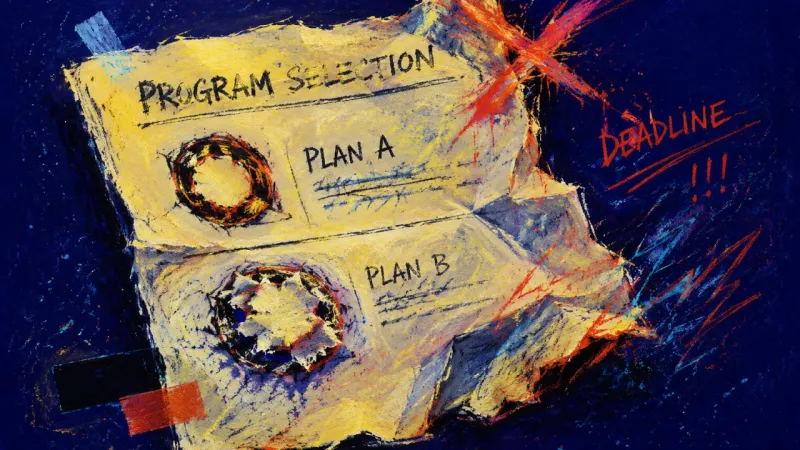
Finding Clarity in the 11:47 p.m. Portal Spiral
Whenever I meet a second-year student with the major declaration portal open past 11 p.m. and three salary tabs telling her to be realistic, I know I am not looking at a lack of ambition. I am looking at major choice paralysis.
Maya (name changed for privacy) joined me from her student apartment near St. George campus in Toronto. She was sitting cross-legged on her duvet with her laptop propped against a pillow, the declaration portal open beside Glassdoor, a Reddit thread, and an Apple Note called “major pros and cons FINAL final.” The screen threw a harsh blue wash across her face; the radiator clicked in the background; yesterday’s iced coffee had gone stale enough that she kept grimacing between sips. Her jaw was locked so tightly that I only noticed it relax when she rubbed it with the heel of her hand.
“I know I need to choose,” she told me, staring at the cursor above the submit button, “but I don’t trust myself to choose well. If I pick the safe option, I might resent it. If I pick the one I want, I might regret it.”
What sat in the room with us was bigger than a form. It was the old practicality-versus-passion split, the safer major versus the one she actually wanted, all of it compressed into a single click. Her anxiety had the sound of a subway brake screaming inside her ribcage: tight chest, dry mouth, clenched jaw, too many tabs masquerading as control.
I nodded. “That makes sense,” I said. “When one campus form starts feeling like a verdict on your whole future, of course your chest locks up. We are not going to force perfect certainty tonight. We are going to make the fog smaller and find some clarity.”

Choosing the Compass: The Decision Cross · Context Edition
I asked her to put both feet on the floor, close every tab except the portal, and take four slow exhales while holding one clean question in mind: what am I actually choosing here? Then I shuffled. I have never cared for theatrical mystique; for me, the ritual is a focusing device, a psychological handoff from panic to pattern recognition. It reminds me of my old trading-floor mornings, when the only way to survive noise was to stop calling it information and start sorting signal from static.
For this reading, I chose the Decision Cross · Context Edition, a Decision Cross tarot spread for choosing a major when the visible dilemma is binary but the real work is not prediction. It is separation. Fear from value. External legibility from genuine fit. Surface logic from the emotional driver underneath. That is how tarot works best in a student decision like this: not by pretending to tell someone the one guaranteed future-proof answer, but by showing why the answer feels impossible in the first place.
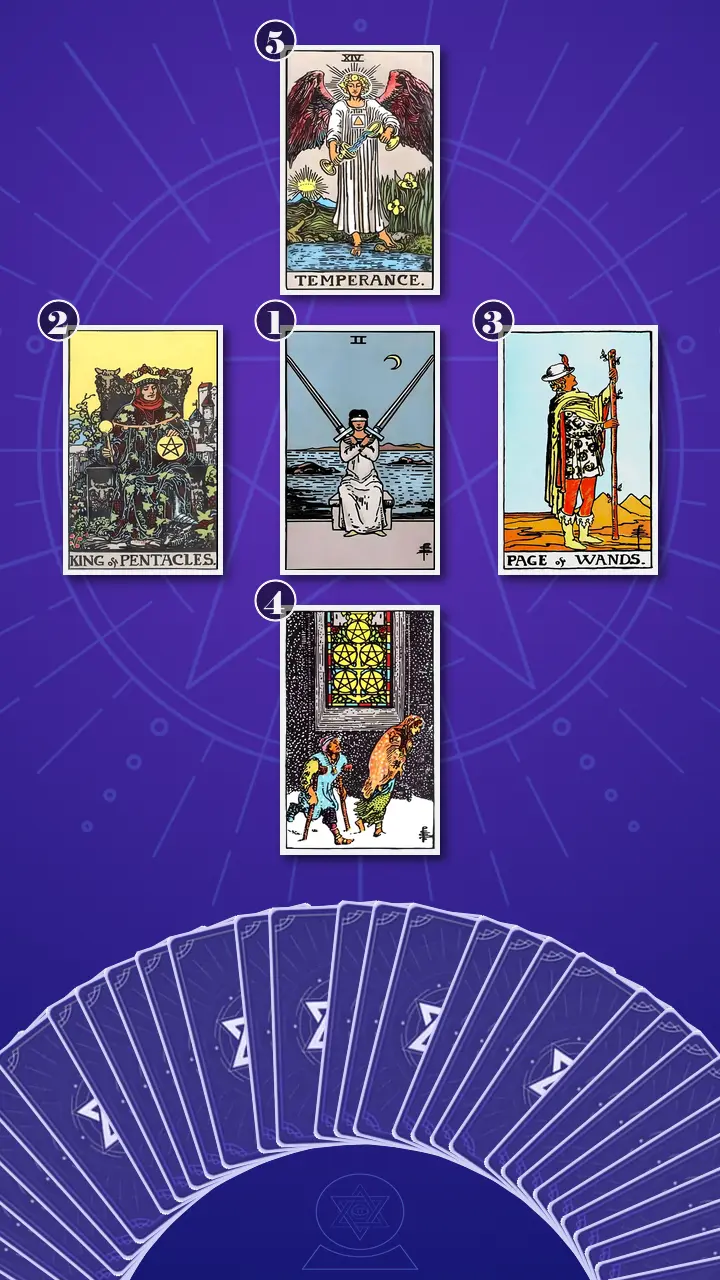
Five cards were enough. The center would show the freeze response around submitting tonight. The lower card would reveal the fear inflating the whole choice. The left and right would compare the safer major and the wanted major in context. The top card would give the integrating lens—the wisest perspective for finding clarity, actionable advice, and next steps without drifting into fantasy.
Reading the Map, Not the Panic
The Center Knot: Two of Swords
I turned the card representing the current freeze response and the specific decision paralysis around submitting the major form tonight. The Two of Swords, upright.
It was the exact browser-tab freeze in card form. The submit button is in view, but instead of choosing, the mind says: one more Reddit thread, one more salary chart, one more course map, one more opinion. As long as the choice stays suspended, no outcome can officially disappoint you. The blindfold maps to acting as if feeling is irrelevant data. The crossed swords over the chest show analysis being used as armor. This was air energy in blockage: too much thought, no movement.
“Research stops being wisdom when it becomes a hiding place,” I told her.
Maya let out a short laugh that landed with more ache than humor. “Okay,” she said, rubbing her forehead, “that is accurate enough to be rude.” Her fingers still hovered near the trackpad, like some part of her wanted to reward being seen by opening another tab.
I asked her what happens in the thirty seconds between seeing the submit button and opening something else. She looked down. “I think if I keep looking,” she said, “I can make it safer.”
The Fear Underneath: Five of Pentacles
I moved to the card revealing the underlying fear about safety and future control that was making the decision feel bigger than it is. The Five of Pentacles, upright.
Under the Two of Swords, this card changed the whole reading. This was not just uncertainty about classes. This was the colder story underneath: one imperfect academic decision could exile her from money, belonging, respect, adulthood. It was the LinkedIn internship post that somehow feels louder after 10 p.m. It was salary data turning into prophecy. It was imagining herself at twenty-six, broke, behind, and having to explain why she had chosen wrong.
This is fear-based earth, not grounded practicality. Practical is not the same thing as fear-based.
I asked her to finish one sentence without editing it: “If I choose wrong, it will prove that I am…”
She went still in a three-step sequence I know well. First, her breath paused. Then her eyes drifted out of focus, as if a private worst-case movie had started replaying. Then the words came out in a quieter voice than anything she had said yet: “Naive. And maybe not someone who can be trusted with her own life.”
I felt an old Wall Street reflex flash through me—the way markets can take one bad quarter and price it as if the whole company is doomed. Fear loves total language. “That,” I said gently, “is why the form feels impossible. You are not only choosing a major. You are trying to prevent exile.”
The Major That Looks Good in a LinkedIn Headline: King of Pentacles
Then I moved to the card clarifying what the safer major represented in this case: the stability, predictability, and external legibility it offers. The King of Pentacles, upright.
This was the major that sounds instantly sensible in an advising office, at a career fair, or in a polished LinkedIn bio. It promises structure, recognizability, a cleaner internship pipeline, and a story other people understand fast. The steadily held coin becomes the need for a choice that looks solid on paper. The heavy throne becomes institutional legibility. In modern life, this is the path easiest to defend out loud.
In balance, the King of Pentacles is healthy grounding. In excess, it becomes overreliance on what sounds adult instead of what fits. I told Maya I did not see this card as a villain. I saw it as a real offering with a real question attached: does this path genuinely steady you, or does it mainly protect you from being questioned?
She pressed her lips together and nodded once. “Relief first,” she said. “Then kind of flat.” The wince came half a second later, small but unmistakable.
The Major That Makes Her Sit Up Straight: Page of Wands
Next came the card clarifying what the wanted major represented here, including the aliveness and curiosity it was asking her to trust. The Page of Wands, upright.
This one changed her face before I finished the sentence. This was the major whose course descriptions she actually wanted to read, the one that made her talk faster, imagine projects, and feel mentally awake before fear rushed in. The sprouting wand spoke of interest that is real even if it is still early. The open horizon showed a path not fully mapped yet. The page’s alert posture was the body-level cue that something meaningful was happening.
“This is the part you keep trying to dismiss because it does not come with a polished five-year plan,” I said. “Not fully mapped is not the same as not viable.”
The energy here was not recklessness. It was underused fire. The kind that makes someone lean in, learn deeply, and build through experience instead of demanding a guarantee in advance. Maya’s shoulders softened. A small smile showed up before she seemed ready to permit it.
“That’s the one I read for fun,” she admitted. “Which sounds embarrassing when I say it out loud.”
“No,” I said. “That sounds like data.”
When Temperance Poured Between Two Cups
The Bridge Card
When I turned the final card—the one showing the integrating decision lens that could move her from panic-based choosing toward an honest, workable next step—the room went strangely still. Even the radiator seemed to pause between clicks. Temperance, upright.
At that moment, Maya was still trapped in the midnight equation I see so often in safe-major-versus-passion-major spirals: if she could make the correct choice, maybe future money, identity, and self-respect would stay intact; if she chose wrong, she imagined future-her filing an appeal. She wanted certainty so badly that she had stopped asking what actually fit.
This is not about gripping the safest coin or freezing behind crossed swords; it is about mixing your cups carefully enough that desire and practicality can belong in the same future.
I let the sentence sit between us for a beat.
Then I added, more softly, “The panic is not proof that one major is wrong. It is what happens when you ask one form to guarantee your whole future.”
She reacted in layers. First, her inhale stopped halfway, and her hand suspended above the keyboard. Then her gaze slipped off the screen and blurred, as if she were replaying every night she had bounced between salary pages, r/UofT threads, and course calendars, calling it responsibility because “I’m scared” felt too exposed. Then the release came: her jaw loosened, her shoulders dropped, and she blinked like the absence of tension had made her briefly lightheaded.
“But if that’s true,” she said, and now there was a flicker of irritation under the relief, “have I just been making this way bigger than it needed to be?”
“You have been trying to protect yourself,” I said. “That is different from being foolish.”
This was the exact moment when my business brain and my tarot brain became the same instrument. I told her that, through my Human Capital Valuation lens, I never price a path only by starting salary, external prestige, or how cleanly it fits in a headline. I look at what compounds. Attention compounds. Skill compounds. Stamina compounds. If a major keeps someone engaged, she studies better, speaks about her work with more conviction, pursues stronger projects, and stays in the game longer. Interest is not decorative. It is part of the asset.
That is why Temperance mattered so much. One foot on land and one in water: practical structure plus emotional truth. The two cups: not purity, but blending. The sunrise path: clarity through adjustment, not one flawless prediction. A major is a path you can shape, not a life sentence you have to predict perfectly. This was the hinge of the entire reading—the move from deadline panic and fear-based comparison to measured self-trust and a support-first decision.
I asked her, “Using this lens, can you remember a moment from last week when it would have changed how you felt?”
She gave me a softer laugh this time. “Yes,” she said. “When I read the course list for the major I wanted and felt excited, and then immediately opened salary tabs like I had to punish myself for it.”
“Exactly,” I told her. “What if the job is not to choose purity, but to build a livable blend?”
From Insight to Action: The Honest + Workable Lens
Once the whole cross was on the table, the story became very clear. The Two of Swords showed how Maya had turned research into emotional armor. The Five of Pentacles showed why: underneath the browser tabs sat a scarcity story saying one wrong choice could cost her safety, belonging, and control. The King of Pentacles showed the appeal of the safer major—not necessarily true fit, but defensibility and external legibility. The Page of Wands showed the wanted major—not fantasy, but real aliveness. Temperance answered the actual question.
That is why this Decision Cross tarot spread for choosing between two majors worked so well. It did not keep comparing options inside the same panic loop. It changed the level from which the comparison was being made.
The blind spot was simple and brutal: she had been treating “defendable” as if it automatically meant “practical,” and treating uncertainty as if it automatically meant danger. The transformation direction was different. Her major did not need to prove her worth forever. It needed to be honest enough to live with and workable enough to build on.
I said it to her plainly: “The question is not ‘Which choice makes me impossible to regret?’ It is ‘Which choice can I support honestly?’”
When I gave her the first exercise, she looked at me and said, “I could absolutely turn this into another spreadsheet.” I smiled. “Then we make the structure smaller than the spiral.”
- The Honest + Workable NoteTonight, before you submit, open a fresh note titled “Honest + Workable.” On the left, write three things you genuinely want from a major. On the right, write three concrete supports that would make that path more workable—such as a minor, certificate, co-op track, budgeting structure, or one campus role.Give it 10 minutes max. If your body starts spiraling, put both feet on the floor and take four slow exhales. No new research tabs.
- The Research Stop LineClose Reddit, salary pages, and LinkedIn for the final decision window. Then say one sentence out loud before you click submit: “I am choosing this path, and I can support it by ___.”If you feel the urge to ask three more friends what they would do, treat that urge as a stop sign, not a task list. Permission is not the same as clarity.
- A Mini Prospectus for Future YouAfter you submit, set one calendar reminder for two weeks from now called “Check how this feels in real life,” and under your chosen major write one line: “My practical support plan is ___.” I use a stripped-down version of my Profile-as-Prospectus method here—not to market yourself, but to state the value of the path and the scaffolding around it.Keep it short enough to fit on a sticky note. If it starts turning into a five-year masterpiece, shrink it back to one next step.

A Week Later: The Quiet Proof
A week later, Maya messaged me. She had chosen the major she actually wanted, paired it with a practical certificate she had been ignoring, and set the two-week reminder exactly as I suggested. “I still woke up the next morning thinking, what if I’m wrong?” she wrote. “But this time I kind of laughed, got ready, and went to class.”
That, to me, is what a real Journey to Clarity looks like. Not a magical disappearance of uncertainty, but the first unmistakable shift from fear-based comparison to steadier self-trust. That is what I want a major decision tarot reading to do: not hand down a verdict, but help someone hear the next honest step more clearly than the panic.
I want to leave you with this: if a campus form has started to feel like a verdict on whether you can be trusted with your own future, no wonder your chest locks up and every open tab starts looking like a rescue plan.
And if I asked you to set down the need for this choice to prove your worth forever, what direction would feel honest enough to support for the next chapter?