From Ten-Tab Panic to a Fair Reply: Deciding on a Study Abroad Offer

The Offer Email You Could Recite in Your Sleep
You’ve re-read the study abroad offer email so many times you could recite the deadline—yet you still haven’t replied, because Decision Paralysis feels safer than choosing wrong.
Alex sat across from me at my café’s corner table, a spot that always smells like toasted hazelnuts and orange peel because that’s what happens when you’ve been pulling espresso on the same street for twenty years. They were 21, Toronto student tired—not the cute kind, the kind where your jaw looks like it’s been clenching through lectures.
“It’s stupid,” they said, phone face-down like it might buzz with a verdict. “I’m not scared of going. I’m scared of choosing wrong.”
I watched their shoulders do that familiar hike—up toward the ears, like the body is trying to hide the neck. A tiny held-breath pause every time the word deadline came up, like their chest didn’t want to be the one to sign anything.
They described the same loop I’ve heard from a hundred smart people at a career crossroads: 9:58 p.m., laptop glow, eyes stinging, offer email reopened “just to look.” Then ten tabs: visas, housing, cost of living, “is it worth it” threads on r/studyabroad, one TikTok montage of someone in a European café that makes it all look effortless. Then the pro/con list in Notion—version four. And somehow, after all that “research,” the reply draft still says only: Hi—
Alex rubbed their palm along the edge of their iced coffee cup, condensation slick under their thumb. “I keep waiting for the moment where it feels obvious. Like my body will just… know.”
“I get it,” I said, gently, because I did. “But we’re not here to force a perfect choice out of your nervous system at 11 p.m. We’re here to make a map. We’re going to look for clarity you can actually use—something you can do next, even if you still feel nervous.”

Choosing the Compass: A Decision Cross Tarot Spread for Stay or Go
I slid a small glass of water toward Alex—part hydration, part permission to slow down—and asked them to take one breath that went all the way into their ribs. Not a mystical ritual. A transition. A way to tell the brain, We’re not doom-scrolling for certainty right now.
“Today,” I said, “we’re using a spread called the Decision Cross.”
If you’re new to tarot, this is one of the most practical ways to use it—especially for a study abroad offer email stay-or-go decision. It’s not about predicting your fate. It’s a framework that holds two options in one container, so you can see the tradeoffs without spiraling into analysis paralysis.
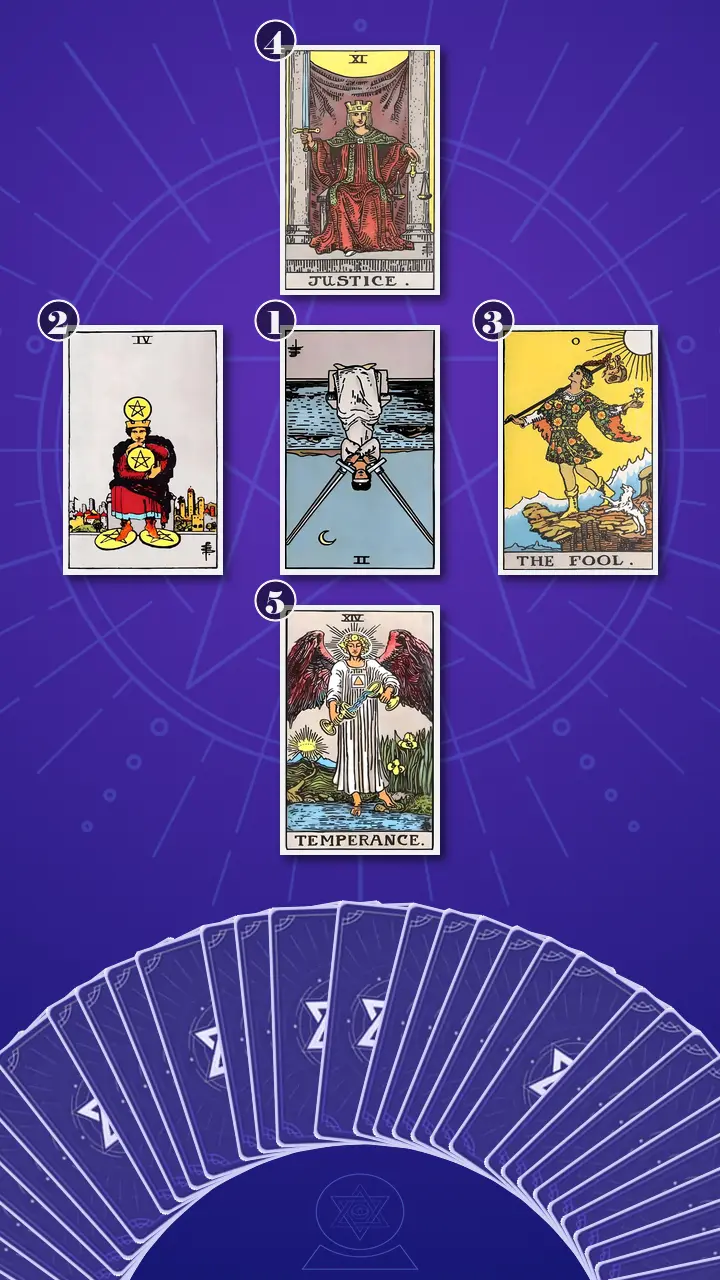
The layout is simple: one card in the center for the present crossroads; one to the left for stay; one to the right for go. Then a card above as the deciding lens—the truth or constraint that cuts through overthinking. And one below as the next step—the smallest concrete action that turns the decision into a process you can live inside this week.
“Think of it like this,” I told Alex as I shuffled. “We’ll name what’s happening, compare what each path actually feels like, then pull a rule of choice and a first move. Not your whole life. Just your next step.”
Reading the Map: The Loop That Looks Like Responsibility
Position 1 — The present crossroads: what indecision looks like right now
“Now we flip the card that represents the present crossroads—the specific way indecision and deadline pressure are showing up right now after the offer email,” I said.
Two of Swords, reversed.
In the classic image, there’s a blindfold and crossed swords held tight across the chest. Reversed, it’s like the blindfold is slipping—not enough to see clearly, but enough to feel the panic of having to look.
And in modern life, this card is brutally specific: You keep the offer ‘open’ the same way you keep ten tabs open: you re-read the email, highlight the deadline, then slide into visa/housing/cost threads because sending a reply feels like cutting off a future. Your body tells on you—tight shoulders, held breath—while your brain calls it “being responsible.”
Alex let out a short laugh that didn’t reach their eyes. “Okay,” they said, voice thin. “That’s… accurate. It’s actually kind of mean.”
That was the unexpected reaction—bitter humor as a shield. I nodded like I’d been expecting it.
“I’m not here to roast you,” I said. “I’m here to name the pattern without shaming it. Because once we can name it, we can change it.”
I tapped the edge of the card. “Two of Swords reversed is avoidance dressed as responsibility. The energy here is blocked Air: too much thinking, not enough landing. You’re trying to buy certainty with research.”
I paused, because I wanted them to hear this cleanly. “You can’t research your way into a feeling of safety. Not when what you’re actually afraid of is what the choice will say about you.”
Alex’s body did a little three-step tell: (1) their breath caught—almost like a freeze; (2) their eyes unfocused, staring past the card as if replaying last night’s Reddit rabbit hole; (3) then a slow exhale, shoulders dropping a centimeter, like their muscles were tired of holding the pose.
“Yeah,” they said quietly. “I refresh Gmail like it’s going to send me… a personality update.”
“Exactly,” I said. “And here’s the question this card asks: What single question are you avoiding because you’re afraid of the answer? Because that’s usually the question that would actually free you.”
Position 2 — Option A (stay): what staying protects, provides, and potentially limits
“Now we look at Option A—staying. What it protects, what it gives you, and what it might quietly cost,” I said.
Four of Pentacles, upright.
This card always makes me think of hands full. A figure clutching one coin to the chest, feet planted on two more, a fourth balanced like a crown. Earth energy—stability, control, conserving resources. Balanced, it’s care. Excess, it’s grip.
Its modern-life translation landed right in Alex’s world: The ‘stay’ version of you imagines the relief of known routines: same campus buildings, same friends, same rent system, same currency, same transit routes. Staying could be a smart resource-protection move—but it can also become a tight grip where security quietly turns into stagnation unless you define what growth-at-home would look like.
Alex’s face softened in a way I didn’t expect. “So staying isn’t… failing,” they said, almost like they were trying the sentence on for size.
“Staying can be a choice—not a freeze,” I replied. “Four of Pentacles validates that money is real. Routine is real. Support is real. If part of you needs the weighted blanket of what you know, that’s not weak. It’s information.”
I let the shadow side be equally real. “But this card also asks: if you’re holding your calendar so tightly there’s no empty square for something new to land—what are you losing without noticing?”
Alex stared down at their hands, which were wrapped around the cup like it was an anchor. They loosened their grip, then re-gripped. Honest self-check happening in real time.
Position 3 — Option B (go): what going abroad opens up, requires, and teaches
“Now we look at Option B—going abroad,” I said. “What it opens, what it asks of you, what it teaches you to become.”
The Fool, upright.
If Four of Pentacles is the body braced, The Fool is the body in motion. A cliff edge, open sky, a small pack. Not recklessness—light preparation and willingness to be new.
The modern-life scenario for Alex was almost painfully precise: The ‘go’ version of you gets a sudden rush picturing a new city—new streets, new classmates, a new identity that isn’t built around being careful. You don’t need a perfect plan; you need light preparation, support, and a willingness to be a beginner. The win condition becomes adaptability, not certainty.
Alex’s mouth twitched into a smile before they could stop it. Their eyes brightened—and then they immediately looked away, like they didn’t trust joy to be evidence.
They gave a nervous little laugh. “Ugh. That’s the part of me I’m trying not to listen to.”
“Of course,” I said. “Because The Fool is the part of you that says, ‘I don’t need a five-year life plan. I need a first day.’ And for someone who’s proud of being responsible, that can feel… suspicious.”
I watched their fingers, now tapping faster against the table. That buzzing-hands energy. Fire trying to start. “A ‘yes’ doesn’t need to be fearless,” I reminded them. “It needs to be supported.”
When Justice Spoke: Turning a Deadline into a Clean Commitment
Position 4 — The deciding lens: what must be acknowledged to decide well
“Now we flip the card that represents the deciding lens,” I said. “The key value, truth, or constraint that should guide the choice and cut through overthinking.”
Before I turned it, the café went quiet in that specific late-afternoon way—espresso machine paused, a spoon stopped clinking, even the street outside felt muted for a second. My hands know when we’re at the core.
Justice, upright.
Scales in one hand. Sword in the other. A posture that doesn’t beg permission. Document energy—deadlines, emails, policies, terms. This card doesn’t care about vibes. It cares about what’s true.
In Alex’s life, Justice said: Instead of asking “Which option makes me happiest forever?”, you build a decision rubric: budget cap, academic fit, mental bandwidth, support system, and what kind of growth you actually want. Then you communicate like you mean it—ask the program for missing facts, set your own decision deadline, and write a reply you can stand behind even if you feel nervous.
I saw Alex swallow. The tightness in their throat had a sound—almost like a click. Their eyes moved to their phone, then back to the card, as if they were finally letting those two realities exist in the same room: desire and constraint.
Here’s the setup I named out loud, because it’s what keeps so many people stuck: Alex was trapped in the moment where they reopen the offer email “just to look,” shoulders climb, and suddenly they’re ten tabs deep—because replying makes it real, and their brain is trying to buy certainty with research.
Not 'I’ll decide when it feels obvious,' but 'I’ll weigh what’s true and choose'—let Justice’s scales set your criteria and its sword turn your reply into a clean commitment.
I let the sentence hang there. In my café, silence can be a tool. Like letting coffee bloom before you pour the rest of the water—if you rush it, you miss what’s actually there.
Alex’s reaction came in a clear chain: (1) their shoulders froze high, like the body braced for impact; (2) their gaze softened and went distant, like they were seeing their own “tomorrow” promises lined up behind each other; (3) then their face changed—less panic, more grounded seriousness. Their eyes got glassy, not with sadness exactly, but with the relief of being understood without being rescued.
“But if I decide like that,” they said, voice sharper for a second—almost angry, almost defensive—“doesn’t that mean I’ve been doing it wrong this whole time?”
I shook my head. “It means you’ve been trying to feel safe. And you used the tools you had: research, opinions, lists. Those tools aren’t bad. They’re just not designed to produce the kind of certainty you’re demanding from them.”
This was where I brought in my own way of thinking—my Knowledge Filtration, the coffee-filter principle that’s become my signature in readings like this.
“When you make coffee,” I told them, “you don’t keep pouring water through more and more grounds hoping the flavor becomes ‘certain.’ You pick the beans that matter, you choose a filter, and you accept that clarity comes from what you leave out.”
“Justice is your filter,” I continued. “It says: we are not absorbing the entire internet. We’re filtering down to what actually changes the decision. Three non-negotiables. One unknown. One question. That’s it.”
Alex blinked hard and inhaled—this time all the way in. Their shoulders dropped for real, like a heavy backpack sliding off. Then they looked at me, still a little dizzy from the relief.
“Okay,” they whispered. “So… I don’t need it to feel obvious. I need it to be fair.”
“Exactly,” I said. “And this is the shift happening right now: from anxious uncertainty and tab-opening avoidance to grounded clarity and calm commitment to one reversible next step. Not perfection. A framework you can respect.”
I leaned in. “Now, with this new lens—think about last week. Was there a moment you could’ve asked one direct question, but you didn’t because you were afraid of what the answer would force you to acknowledge?”
Alex’s eyes flicked down to their phone again. “Funding,” they admitted. “I keep spiraling about money, but I haven’t asked if there’s any additional support or payment plan. I’ve just been… currency-converting myself into despair.”
“That’s your sword,” I said softly. “One clean cut.”
Temperance in a Shared Kitchen: Building a Bridge, Not Jumping a Canyon
Position 5 — Next step: the smallest concrete action that makes it manageable this week
“Now we flip the card for next step,” I said. “The smallest concrete action you can take this week that turns the choice into a manageable process.”
Temperance, upright.
An angel pouring water between two cups. One foot on land, one in water. A path toward sunrise. This is integration, not extremity.
And in Alex’s world, Temperance spoke like a calm kitchen light at 11:21 p.m.: You stop treating the choice like a single dramatic moment and start treating it like a short, steady process. You create a weekly rhythm—one budgeting check, one admin task, one support conversation—so the decision moves from abstract panic into manageable steps. You’re building a bridge between ‘home self’ and ‘abroad self,’ not forcing a personality transplant overnight.
Alex’s whole face softened. Relief, the kind that doesn’t sparkle—it settles.
“I like that,” they said. “A bridge. Not… a canyon jump.”
Then, because real life always shows up, they frowned. “But I genuinely don’t have time. My week is already scheduled down to the hour. I can’t add, like, a whole new decision project.”
I nodded, immediately practical. “Good. That’s actually Temperance too. We’re not adding a new personality. We’re making it small enough to fit.”
I glanced at the espresso bar and thought about my other signature tool—Focus Period Diagnosis. “Also,” I added, “you don’t have to do this at 11:30 p.m. when you’re wired and fragile. When do you tend to make your best calls—after your first coffee? Before your afternoon crash?”
Alex considered. “Late morning. Like 10:30. After class. Before I start spiraling.”
“Perfect,” I said. “We’ll use that.”
The One-Page ‘Justice Check’: Actionable Next Steps for This Week
I pulled the whole cross together for Alex, like turning five separate snapshots into one story.
“Here’s what this spread says,” I told them. “Right now, your mind is jammed—Two of Swords reversed—so you’re coping by keeping everything open: tabs, drafts, options, identities. Staying—Four of Pentacles—offers real protection: money, routines, familiar systems, a version of you that feels competent. Going—The Fool—offers growth through experience: the chance to become someone who learns by living, not just by planning. The key is Justice: stop chasing a feeling of certainty and use a fair decision framework you can stand behind. And Temperance makes it sustainable: small, repeatable actions that bridge home-you and potential-abroad-you.”
“Your cognitive blind spot,” I added gently, “is believing that if you just gather enough information, you’ll finally feel safe enough to choose. But the truth is: the safety you want comes after you decide in a way you respect—and take one clean step.”
I looked Alex in the eye. “Make it fair. Make it real. Make it small enough to do this week.”
- Write a 10-minute “Justice Check” one-pagerOpen a blank Google Doc titled Decision Dossier. In one page, write: (1) the offer deadline, (2) your top 3 values (what you’re protecting by going), (3) your top 3 constraints (money/time/mental bandwidth), and (4) the ONE unknown that blocks you most.Set a timer. When it ends, stop. A filter works because it limits what gets through.
- Send one-question email (the sword, not the spiral)During your best focus window (Alex chose 10:30 a.m.), draft one email to the program with ONE decision-relevant question—e.g., funding options, housing timeline, deferral policy, or course transfer rules. Keep it short. Hit send.If panic spikes, save it as a draft, take one slow breath, then schedule “send” for the next morning. Stopping is allowed—but so is finishing.
- Try a 7-day Temperance rhythm (boring on purpose)For one week: do 2 admin tasks (portal/email), 1 budget check-in (10 minutes), 1 emotional check-in (5 minutes: where is this living in your body?), and 1 connection touchpoint (text someone who studied abroad or ask an advisor one concrete question).If you miss a day, don’t “restart perfectly.” Just resume. Temperance is consistency, not intensity.

A Week Later: Ownership, Not Certainty
Six days later, just after my morning rush, my phone buzzed with a message from Alex.
“I sent the email,” they wrote. “One question. Funding. My hands were shaking, but I did it. Also the Decision Dossier is one page and it’s… weirdly calming.”
I pictured them at a kitchen table with a laptop—not in a cinematic montage, not “effortlessly fulfilled,” just real: a small light on, a checklist open, their breath moving again. Clear but still human. Clear but still a little tender.
They added, almost as an afterthought: “I slept through the night. Woke up and my first thought was still ‘what if I mess this up?’—but it didn’t pull me into tabs. I just… made coffee and looked at my three criteria.”
That’s the quiet proof tarot can give at a major life fork: not a guaranteed outcome, but a steadier self—someone who can respond to a deadline with self-respect instead of panic.
And if tonight you’re feeling that same held-breath pressure as a deadline gets close—because you want the bigger life, but you’re scared that choosing wrong will prove you don’t actually have control over where you’re headed—remember this: you don’t have to wait for the feeling of certainty to arrive.
If you stopped trying to guarantee the perfect outcome and instead chose what’s fair to your future self, what would your next small, reversible step look like this week?
Every reading at AceTarot is a Journey to connect with inner wisdom and empower next step.
Learn more about our Journey to Clarity.