From Wired Urgency to a Repeatable Pace: A Check-Engine Light Burnout Case

The 9:12 p.m. “Reset” That Isn’t Rest
You do the Sunday Scaries “reset,” but it turns into inbox scanning, calendar Tetris, and dread—so Monday starts before Monday even arrives.
Jordan (name changed for privacy) said that to me like she was confessing a small crime. She was 29, a product manager in Toronto, and she looked like someone who could run a meeting with a smile while silently white-knuckling the inside of her own skull.
In her condo living room, the city glow leaked through the blinds in thin stripes. Her “reset” playlist was on—something soft and instrumental that was supposed to mean peace. The laptop was open anyway, Slack on one side, Google Calendar on the other. Cold coffee sat untouched like a prop from a life she meant to have. Every few seconds, her jaw shifted as if she was trying to find a less painful way to hold her own tension.
“I’m not even unhappy,” she told me, eyes flicking to a notification like it was a reflex test. “I’m just tired in a way sleep doesn’t fix.”
I watched her shoulders hover close to her ears, and I felt the familiar moment where the body says what the mouth has learned to downplay. “Your check-engine light isn’t drama,” I said gently. “It’s data. And we can treat it like a diagnostic—no shame, no moral scorecard. Just: what’s the pattern, and what’s one next step that actually changes the system?”
Because underneath everything she’d described, I could hear the engine of it: wanting to feel on top of life and dependable—and the quiet terror that slowing down will prove she’s not enough.
Her exhaustion wasn’t a vague cloud. It was a specific, physical thing: like running a dozen browser tabs in your brain until the laptop fan is screaming, then pretending it’s fine by turning the volume up on a podcast.

Choosing the Compass: The Energy Diagnostic Map (7)
I’m Giulia Canale—Jungian psychologist by training, raised around the Venetian canals, and for years I worked on international cruises where people would find me mid-ocean and say, “I don’t know why, but I need to talk.” You learn something on transoceanic voyages: the body always tells the truth first. The mind usually shows up later with an explanation.
Before we started, I asked Jordan to take one slow inhale and let it travel lower than her collarbones—just enough to mark a transition. Not a ritual for the sake of mystery. A psychological handrail: we are shifting from reacting to observing.
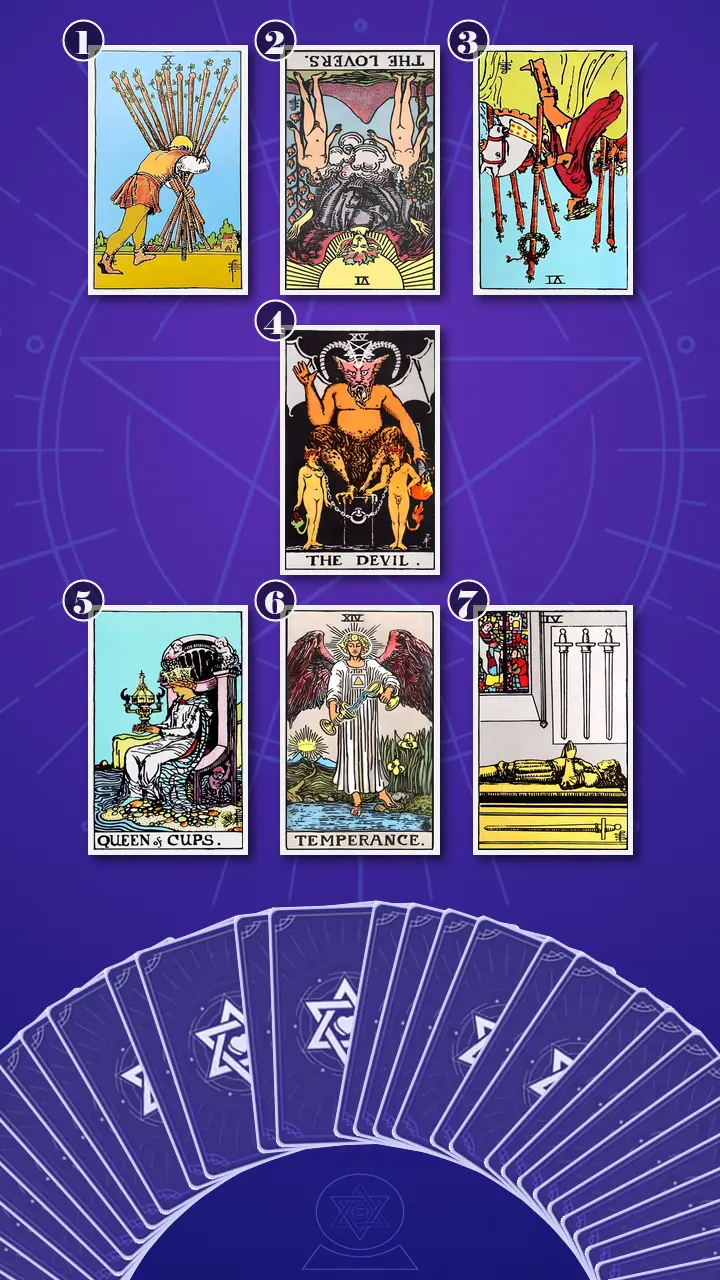
“Today,” I said, “I’m going to use a spread I call Energy Diagnostic Map (7) · Context Edition.”
For you, reading along: this spread works especially well for a burnout ‘check-engine light’ moment because it doesn’t pretend the problem is just one thing. It maps the chain: the surface symptom you can see, the internal tug-of-war you feel, the external pressures that tighten it, the core blockage that keeps it locked, and then—crucially—the repair sequence: resource, transformation, and one grounded next step.
I pointed to the layout as I placed the cards down. “The top row is like warning lights: what’s showing up in your behavior, your inner conflict, and your environment. The center card is the engine block—what’s really driving this. Then the bottom row is the repair plan: what you can access now, the shift that changes your pacing, and one action for the next seven days.”
Jordan nodded, but her fingers kept worrying the edge of her phone, face-down on the table like a sleeping animal.
Reading the Dashboard: The Warning Lights That Look Like “Responsibility”
Position 1 — Surface symptom: what’s most visible right now
“Now we turn over the card that represents your surface symptom: the most visible burnout behavior pattern across life right now,” I said.
Ten of Wands, upright.
In the image, a figure carries a bundled stack of wands so large it blocks his view. The posture is bent—not dramatic, just… inevitably strained.
“This is you doing calendar Tetris like it’s a sport,” I told her, using the plainest language I could. “Sprint planning at work, a friend’s birthday, a family call, groceries, a ‘quick’ workout you keep rescheduling—so you carry everything at once. You can’t see what’s optional anymore, only what’s next. Even small requests land like weights because you’re already at max load.”
The Ten of Wands is Fire energy in excess: output without adequate replenishment. Not laziness. Not lack of discipline. The opposite—too much willpower, deployed too long, with no real off-ramp.
Jordan let out a short laugh that had a sharp edge to it. “That’s… yeah. That’s literally my week. And it’s kind of rude how accurate that is.”
“I’ll take ‘rude’ if it gets us honest,” I said, and I watched her shoulders stay up anyway, as if the body didn’t trust the conversation to hold.
Position 2 — Inner tug-of-war: the conflict that keeps the loop running
“Now we turn over the card that represents your inner tug-of-war: what you want versus what you’re afraid slowing down would prove,” I said.
The Lovers, reversed.
“In real life,” I explained, “this shows up as saying yes because it matches the identity you want to be seen as—reliable, chill, high-performing—not because it fits your capacity. You accept the meeting, agree to the extra deliverable, confirm the last-minute plan… and later you realize your week no longer reflects your actual values.”
I paused. “A fast yes is still a commitment—your body pays for it later.”
Reversed, The Lovers often signals misalignment: choices made from ‘shoulds’ or approval rather than an inner compass. This isn’t about romance here; it’s about integrity with your own limits. The energy is blocked—not absent. She has values. She just doesn’t let them vote when the invite arrives.
Jordan swallowed, and her eyes briefly unfocused, like she’d replayed a recent moment in her head.
“What’s the last ‘yes’ you said fast,” I asked, “where your shoulders tensed the second you hit send?”
“A stakeholder review,” she said immediately. “It’s tomorrow morning. I said I’d ‘tighten the narrative’ tonight. Because… I don’t know. Because that’s what a good PM does.”
“Or what a scared nervous system does,” I offered softly. “We’re going to separate those two.”
Position 3 — External pressure: the context that intensifies it
“Now we turn over the card that represents external pressure: the work/social forces tightening this pattern,” I said.
Six of Wands, reversed.
“This is the visibility pressure,” I told her. “The feeling that you’re only safe if you’re visibly winning—responsive, impressive, ahead.”
I anchored it in the most modern version of the card: “You keep checking for reactions—messages, metrics, stakeholder feedback, social likes—then recalibrate your priorities midstream to chase what looks impressive. Logging off feels risky because what if someone notices your silence? You do extra prep for meetings you could handle fine, because you don’t just want to be competent—you want to be undeniably impressive.”
The energy here is deficiency in internal validation and excess dependence on external cues. Like Slack is a slot machine: every notification is a tiny ‘maybe I’m needed’ hit, training you to keep pulling the lever. And in a metrics-driven team, the algorithm rewards what’s visible, not what’s sustainable.
Jordan’s mouth tightened, then she exhaled through her nose. “LinkedIn is… not helping,” she admitted. “Everyone’s ‘excited to share’ something and I’m like, cool, I’m excited to share I answered 73 messages today.”
“Exactly,” I said. “Your nervous system is being graded by a scoreboard no one officially installed.”
Position 4 — Core blockage: the engine lock
“Now we turn over the card that represents your core blockage: the belief or fear that locks the pattern in place,” I said, and I let my voice slow down. “This is the engine block.”
The Devil, upright.
There’s a reason this card hits people in the body first. The chains in the image are loose. The figures could step away. But they don’t—because the story in their heads says they can’t.
“Here’s the modern translation,” I told Jordan. “You’re not only busy—you’re bound. Even when your calendar has an opening, you fill it, because stillness feels unsafe. Your phone stays within reach in bed ‘just in case.’ Rest isn’t neutral; it feels like a risk to your reputation and worth. You keep producing to avoid the fear that needing recovery means you’re not actually capable.”
She gave me a defensive little laugh—quiet, but immediate. “Ugh. Yep.”
I nodded and used the echo technique I trust when someone is about to slip into self-blame. “Let’s name the invisible contract out loud,” I said, almost like I was reading subtitles from her inner monologue:
“If I don’t reply fast, then… I’m not committed.”
“If I rest, then… I’m falling behind.”
“If I’m not impressive, then… they’ll see I’m not actually that capable.”
“That’s the chain,” I said. “And your body is your lie detector.”
This is where my signature skill—Energy Flow Diagnosis—shows itself. I’m not doing anything medical. I’m reading patterns: mind-body signals as energy information. “Notice your jaw right now,” I said. “Just notice. No fixing.”
Jordan froze for half a second, like she hadn’t realized she was clenching. Then her fingers opened and closed once. Then she let out a small exhale that sounded like defeat and relief at the same time.
“It’s… locked,” she said quietly.
“Mm,” I replied. “In my work, jaw tension is often the body holding a sentence you don’t feel allowed to say. And shoulders up near your ears? That’s a responsibility overload signal. The Devil isn’t saying you’re broken. It’s saying: you’ve been paying a subscription you’re allowed to cancel—availability as proof of worth.”
Jordan stared at the card, and I saw the Severance reference land without me forcing it: the work-self that never fully clocks out, even in bed, even on weekends.
“If rest has to be earned,” I added, “you’ll never feel ‘allowed’ to stop.”
Position 5 — Available resource: what you can access now
“Now we turn over the card that represents your available resource: what you can access now to interrupt the cycle without waiting for perfect conditions,” I said.
Queen of Cups, upright.
Her face changed before she spoke—just a fraction. The smallest softening in her mouth, like the idea of kindness wasn’t a trap.
“This card is emotional attunement,” I explained, “but not in a vague ‘be softer’ way. It’s contained empathy. It’s letting your inner state have voting rights in your calendar.”
I used the dashboard check analogy and gave her a micro-scene: “Picture your finger hovering over ‘Accept’ on a meeting invite. Before the yes goes out, your stomach drops—just slightly. The Queen of Cups is the part of you that notices the drop and treats it as real data, not a character flaw.”
The energy here is balance—Water that can regulate Fire. “You already have this,” I told her. “You notice when you’re snappy, foggy, tight-chested, dreading simple tasks. You’ve just been overriding the signal like it’s an annoying pop-up.”
Jordan rolled her shoulders once, slowly, like she was testing whether they could come down. “I do know,” she admitted. “I just… don’t trust it.”
“Then this week,” I said, “we don’t ask you to trust it perfectly. We ask you to collect evidence.”
When Temperance Started Mixing: A System, Not a Flaw
Position 6 — Key transformation: the shift that changes the system
I let the room get quiet on purpose. Outside her window, a streetcar bell rang faintly—Toronto’s soundscape reminding us the world would keep moving even if she paused.
“Now we turn over the card that represents your key transformation: the central shift that changes the system, not just the symptoms,” I said.
Temperance, upright.
There’s an angel in the image, calmly pouring water between two cups. One foot is on land, one in water. A path leads toward a soft rising sun. Nothing about it is frantic. Nothing about it is performative. It’s regulated.
Setup (what you’ve been stuck inside): I looked at Jordan and named the moment I knew she’d recognize. “You know that moment when it’s 9:41 PM, you’ve told yourself you’ll close the laptop, but your brain keeps whispering ‘just one more thing,’ and you can feel your jaw locked while Slack keeps glowing like it’s still daytime.”
Her eyes widened slightly—then narrowed, like she was both seen and exposed.
Delivery (the line that turns the key):
Not ‘all or nothing’—start mixing your energy like Temperance, one deliberate pour at a time.
I let that sentence sit between us for a beat, like a glass set down on a table.
Reinforcement (the moment it lands in the body): Jordan’s breathing stopped for the tiniest slice of time—an involuntary freeze. Then her gaze drifted off the card and into the middle distance, like her mind was scrubbing back through a week of wired weekdays and collapsed weekends. Her fingers, which had been curled tight near her phone, uncurled slowly. Her shoulders dropped a few millimeters, then a few more. Her eyes got wet—not a sob, not drama—just the nervous system releasing a little pressure it didn’t realize it was holding.
“But if I stop,” she said, voice quieter now, “I feel like everything will pile up and I’ll regret it.”
“Of course,” I replied. “Because your system has been trained to equate rest with danger.”
This was where I fused my own metaphor asset in a way that felt native to me. “Temperance is Venetian wisdom,” I said. “In Venice, water doesn’t behave by willpower. You don’t shame the tide. You build circulation and you use locks. If a canal is blocked, the answer isn’t to yell at the water to move faster. It’s to restore flow.”
“Your energy works the same way,” I continued. “The tight jaw and shoulders are your blockage points—where the ‘invisible contract’ lives in the body. Temperance isn’t telling you to be less ambitious. It’s saying: sustainable isn’t less ambitious. It’s more repeatable. Your burnout pattern won’t change by trying harder. It changes when you build a rhythm where recovery is an input, not a prize.”
I watched the familiar second wave hit—relief, and then the vulnerability that comes with realizing the solution is practical. Not magical. Practical means responsibility. Jordan blinked twice, like she was adjusting to a new brightness.
“Now,” I asked her, exactly when the insight was warm enough to shape into action, “use this new lens and rewind to last week. Was there a moment—one moment—where this would’ve changed how you responded? Where you could’ve poured a little recovery in, on purpose?”
She nodded slowly. “Thursday. Someone wrote, ‘Can we tighten this up?’ and I said yes instantly. I cancelled my workout. I worked until midnight. And it… didn’t even get that much better. I was just panicking.”
“That,” I said softly, “is the before picture. Temperance gives us the after: not perfection—a different operating rhythm.”
And right there, I named the transformation in plain language: “This isn’t just about one decision. It’s a step from wired urgency and guilt-driven overcommitment toward steadier calm and self-trust—through capacity-based boundaries and planned recovery.”
Position 7 — One next step: what to do in the next 7 days
“Now we turn over the card that represents your one next step: a grounded action for the next seven days that supports recovery and sustainable pacing,” I said.
Four of Swords, upright.
“This is deliberate rest,” I explained. “Not avoidance. Not numbing. A protected container.”
I translated it straight into her life: “You schedule one real recovery block—60 to 90 minutes if possible, smaller if needed—with rules: phone in another room, no errands, no ‘life admin,’ no catching up. You’re not collapsing. You’re doing maintenance. Like putting your phone on Low Power Mode before it dies.”
Jordan’s face did that mixed expression I see all the time: relief, immediately followed by resistance. “But I don’t have time,” she said, reflexively.
“That sentence is the burnout loop speaking,” I replied, calm and specific. “Time exists. The question is what you’re protecting: your calendar, or your capacity. Make recovery a calendar event, not a vibe.”
Her shoulders lifted again, then dropped. “Okay,” she said, and it sounded like she meant: I can try.
Make Recovery a Calendar Event, Not a Vibe
I gathered the whole spread into one story for her—so it would feel like clarity, not seven separate tarot meanings.
“Here’s the pattern,” I said. “Your surface life shows Ten of Wands: you carry too much, so everything feels urgent. Under that is The Lovers reversed: your yeses aren’t always values-aligned—they’re identity-aligned (‘reliable,’ ‘easy,’ ‘excellent’). The environment is Six of Wands reversed: visibility pressure, metrics, comparison—your nervous system wants proof you’re still winning. The engine is The Devil: an invisible contract that says worth equals output, so rest feels unsafe. And then the repair sequence begins: Queen of Cups gives you the resource of listening to your body as an instrument panel. Temperance is the system upgrade: mixing output with recovery on purpose. Four of Swords is the concrete container that makes recovery real.”
“Your cognitive blind spot,” I added, “is thinking the only way to be dependable is to be endlessly available. That’s the trap: you try to prove you’re enough by running your battery down to zero—then you have less to give, you make more mistakes from fatigue, and the fear feels confirmed.”
“The transformation direction is the opposite,” I said. “Capacity-based commitments. Recovery as a non-negotiable input. Not all-or-nothing—repeatable rhythm.”
Then I gave her actions—small enough to do inside a real tech-city week, specific enough that she wouldn’t have to ‘motivate’ herself into them. I also wove in my Venetian Aqua Wisdom strategy: think of boundaries like canal locks—simple structures that regulate flow without requiring constant willpower.
- The “Values-Aligned No” (One Sentence + Alternative)Within 24 hours of your next request, send one capacity-based message: “I can’t take this on this week, but I can do X by Friday / or I can revisit next sprint.” If it’s your manager, renegotiate scope or timing instead of refusing outright.Expect discomfort. If anxiety spikes, keep it to one sentence, hit send, then put your phone down for 3 minutes—don’t negotiate with the urge to over-explain.
- The Temperance Blend (Calendar Engineering, Not Self-Improvement)Pick ONE high-output task this week (a PRD section, a stakeholder email, a meeting deck). Immediately schedule a 20–30 minute recovery block right after it on the same day. Title it like a meeting: “Recovery (non-negotiable).”If 30 minutes feels impossible, do 10. If you feel edgy when you stop, name it quietly—“my system is downshifting”—and return to one sensory anchor: feet on the floor, one slow exhale.
- The Protected Rest Container (Four of Swords Rules)Schedule one 60–90 minute block in the next 7 days where your phone is in another room and you do no errands, no life admin, no “catch-up.” Window-stare, stretch, lie down, take tea—anything that’s recovery, not performance.Treat it like canal locks: the structure is what creates flow. If your brain protests, remind it: rest isn’t a reward. It’s maintenance.
Before we ended, I offered one tiny add-on from my Quick Recovery toolkit—again, not medical, just nervous-system-friendly mechanics. “Between meetings,” I said, “try a three-minute reset: drop your shoulders on the exhale, unclench your jaw, and let your eyes look at something far away—out a window if you can. It tells the body, ‘We are not being chased.’ It’s a micro-pour of Temperance.”

A Week Later: Ownership, Not Certainty
Six days later, Jordan sent me a message that was almost aggressively simple: “Did the Temperance Blend. It worked. Also said no (without a novel). Still feel weird about it. But I didn’t spiral.”
She told me she’d paired a high-output deck rewrite with a 25-minute walk right after—scheduled, titled, defended. The first five minutes of the walk felt wrong, like she was skipping class. Then her breath deepened. Her shoulders dropped. And when she came back, she didn’t have to brute-force the next hour.
Her win wasn’t that she became a new person. It was that she created a small lock in the canal—enough structure to let her energy circulate.
She also described a moment that made me smile in that bittersweet way: she woke up after a full night of sleep, and her first thought was still, “What if I’m falling behind?”—but this time she noticed her jaw clench, exhaled once, and thought, “Right. Maintenance.” Then she got up anyway.
When I think back on our session, the journey to clarity wasn’t a dramatic revelation. It was the quiet shift from proving worth through constant output to building a repeatable rhythm where recovery is part of the plan.
When you’re exhausted but still saying yes, it’s not because you love the chaos—it’s because part of you is scared that the minute you slow down, someone will finally see you as ‘not enough,’ and your body holds that fear in your jaw, shoulders, and breath.
If you treated recovery like basic maintenance instead of something you have to earn, what’s one tiny pocket of your week you’d protect first—just to see what changes?