I Kept Rewriting the Renewal Email at Midnight—Until I Asked Two Questions

Finding Clarity in the 11:33 p.m. Glow
If you can feel your jaw clamp before you even open the email—because this doesn’t feel like a contract decision, it feels like a life-direction decision—then you already know the exact kind of pressure Alex (name changed for privacy) walked in carrying.
It was 11:33 p.m. in their Toronto apartment when we started our call. The kind of night where the laptop screen is turned up too bright, and the blue light makes everything feel a little sharper than it needs to be. Their phone was warm from scrolling LinkedIn—another “Thrilled to announce…” post—while the renewal email sat open like an accusation in the background. Alex kept alt-tabbing between a benefits spreadsheet and three freelance job posts, the cursor blinking in the reply window like it was tapping its foot.
“I keep opening it,” they said, voice low, like they didn’t want to wake their own anxiety. “I start drafting. I delete it. Then I do rent math. Then I tell myself I’m being strategic. But it’s… I don’t know. It feels like if I answer wrong, I’m stuck.”
I watched their shoulders sit slightly forward, as if they were bracing for impact. “You want a stable full-time role with predictable income and a clear title,” I reflected, “and you’re scared it’ll cost you your autonomy—and you’ll get trapped in a job that drains you.”
They nodded, once. Tight. “Exactly.”
The feeling in the room—through the screen—wasn’t just worry. It was like trying to keep thirty-seven browser tabs open so you don’t have to choose… until the laptop fan is screaming and you still haven’t moved. A contracted, jaw-locked kind of uncertainty: the body doing the clenching while the mind tries to out-math a fear.
“We’re not going to force certainty tonight,” I told them. “We’re going to map what’s actually happening—so you can get to clarity the practical way. Not a ‘sign from the universe’ way. A ‘here are my values, here are my terms, and here’s my next message’ way.”

Choosing the Compass: How Tarot Works at a Career Crossroads
I’m Laila Hoshino. Most nights, I’m a tour guide at a planetarium in Tokyo, explaining why the same stars look “fixed” even though everything is moving. In my other life—this one—I read tarot the same way I teach astronomy: not as fortune-telling, but as a way to see patterns, trade-offs, and timing when your brain is too loud to sort it out.
I asked Alex to take one slow breath in through the nose and out through the mouth—nothing mystical, just a nervous system handoff. Then I shuffled while they kept their question in mind: Contract renewal email—go full-time or keep freelancing?
“For this,” I said, “we’ll use a spread called Two Paths.”
Here’s why the Two Paths spread works so well for a contract renewal decision when you’re feeling stuck: it’s the smallest structure that still does three essential things. It compares the real energy of both options (full-time versus freelance), it surfaces the hidden bind that makes the choice feel irreversible, and then it gives you a bridge resource and a next step—actual actionable advice you can use to write the email.
I also previewed the map so Alex—and you—wouldn’t feel like we were wandering. “The center card shows the exact behavior loop that’s keeping you stuck. The two side cards show what each path emphasizes. One card beneath shows what’s really gripping you underneath the logic. Then we’ll pull a bridge card to integrate, and a final card for the clearest next move.”
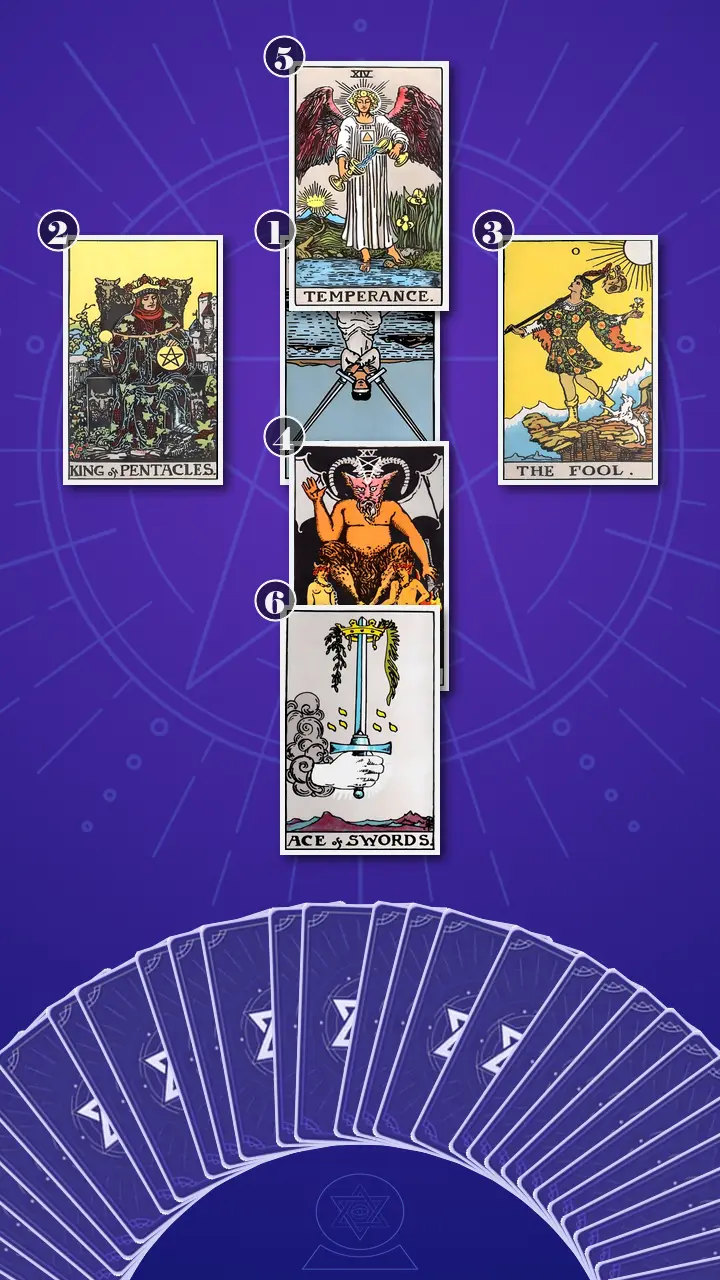
The Fork in the Road: Decision Fatigue, Two Options, and the Hidden Chain
Position 1: The current stuck point — Two of Swords (reversed)
“Now I’m turning over the card that represents the current stuck point: how the decision shows up behaviorally—the email, the delay, the mental loop.”
Two of Swords, reversed.
I didn’t have to reach for abstract symbolism. This card is the loop Alex described. It’s the moment where you open the “Contract Renewal” email for the fourth time, stare at the screen, and feel your jaw lock. You draft three versions of the reply—one confident yes, one careful maybe, one polite no—then close the laptop because every sentence feels like it cancels an entire alternate life. It looks like productivity (tabs, spreadsheets, notes), but it’s actually a way to avoid the one thing that would change the situation: sending a clear message or asking for concrete terms.
In reversed position, the energy here isn’t “balanced.” It’s blocked Air—communication and mental clarity—starting to crack under its own weight. The mind is trying to protect you by keeping the swords crossed over the chest: don’t choose, don’t speak, don’t risk the regret. But the cost is rising every day you stay silent.
I used a tight, cinematic loop, because that’s how this pattern runs: unread badge → draft → delete → spreadsheet math → back to the email. And underneath it, an identity sentence your brain keeps trying to finish: “If I choose X, then I’m a ___ person.”
Alex let out a small laugh—sharp, not amused. “That’s… yeah. That’s brutal. But accurate.”
“It’s not brutal,” I said gently. “It’s protective. But protection has a price.” I paused, then added the line I’ve learned lands best when someone is stuck in perfection-driven decision paralysis: “You don’t need a perfect choice. You need decision-grade information.”
They didn’t nod dramatically. It was subtler: a quiet exhale, their gaze dropping off-screen to the email tab like they could suddenly see the mechanics of their own loop.
Position 2: Full-time path — King of Pentacles (upright)
“Now I’m turning over the card that represents the full-time path: what energy and needs this option would emphasize for you right now.”
King of Pentacles, upright.
This card speaks fluent stability. In real-life terms, it’s the moment you imagine going full-time and feel your nervous system unclench: predictable pay, benefits, a title that doesn’t require explanation, maybe even mentorship and clearer scope. It’s not just money; it’s the sensation of being held by a system.
The King of Pentacles energy is Earth in balance when it’s healthy: steady resources, long-game sustainability, competence recognized. But Earth can get sticky when it becomes a substitute for choice—when comfort quietly turns into “I guess this is just my life now.”
I asked Alex, “What kind of stability actually supports you? Is it pay cadence? Benefits? Predictable hours? Scope that doesn’t constantly expand?”
Alex’s eyes flicked up—like their brain wanted to open a new spreadsheet tab titled “stability definitions.” “Pay cadence and benefits,” they said. “And… not feeling like I’m one slow month away from panic.”
“That’s a real need,” I told them. “Not a weakness. A need.”
Position 3: Freelance path — The Fool (upright)
“Now I’m turning over the card that represents the freelance path: what energy and needs this option would emphasize for you right now.”
The Fool, upright.
The Fool is oxygen. It’s the immediate body-level relief of picturing a Wednesday morning off without asking permission. Choosing projects. Shaping your week. Moving through your life like you own your calendar again.
But this is Fire and openness—beautiful, and also requiring guardrails. The Fool’s freedom can be overabundant if it drifts into constant vigilance: you’re the person who sets rates, maintains a pipeline, saves for slow months, and says no when scope creeps. That’s not a moral statement. That’s simply the operating system of freelance life.
I gave Alex two quick vignettes back-to-back, because the contrast matters: one where a predictable paycheck calms the nervous system; one where a mid-week morning off feels like air returning to the lungs. Then I named the real question hiding in the middle: “When does ‘adult’ turn into a cage, and when does ‘freedom’ turn into constant scrambling?”
Alex’s mouth tightened, then softened. “Both of those feel true,” they said. “That’s the problem.”
“That’s not the problem,” I corrected, kindly. “That’s the data.”
Position 4: The hidden bind — The Devil (upright)
“Now I’m turning over the card that represents the hidden bind: the underlying fear or attachment that makes the choice feel high-stakes and irreversible.”
The Devil, upright.
When The Devil shows up under a career crossroads, I don’t hear “bad news.” I hear: something is pretending to be non-negotiable.
This is the moment when you’re not just deciding full-time vs freelance—you’re trying to escape the shame of choosing “wrong.” Full-time starts to feel like the only respectable option (so you won’t look reckless). Freelance starts to feel like the only way to stay in control (so you won’t feel trapped). Either way, the decision becomes a performance for an imaginary audience, and the email turns into a life sentence in your head.
The Devil’s energy is a blockage created by attachment: “If I pick the wrong thing, it proves I lack control over my life.” And the symbol I always focus on here is the loose chain: the bind is real in your habits and stories, but it’s often less absolute than it feels at 11:30 p.m. with a deadline looming.
I said one of my favorite reframes out loud, slowly, because it loosens the chain without shaming the person in it: “A contract isn’t an identity sentence—it's a set of terms you can renegotiate.”
Alex went still in a way I recognize—the body freeze before a truth sinks in. Their breath paused. Their eyes unfocused for a second, like a mental rewind. Then their shoulders dropped a fraction on the exhale.
“I keep acting like if I ask for what I need,” they admitted, “I’ll look difficult. Like I’m not serious.”
“That’s The Devil’s favorite trick,” I said. “It makes clarity feel like risk and vagueness feel like safety.”
When Temperance Poured Between Two Cups
Position 5: The bridge resource — Temperance (upright)
I let myself slow down before turning this card, the way I slow down when I’m guiding a planetarium audience toward the moment Saturn comes into view. “We’re about to turn over the bridge,” I told Alex. “The card that shows how you stop treating this like a trap.”
Temperance, upright.
Temperance is integration in action. Not “be patient and hope you feel better.” Not “just compromise.” It’s purposeful mixing—like you’re adjusting sliders on a mixing board, not flipping a switch.
In modern life terms, it’s this: instead of asking “Which one forever?”, you start asking “What blend would let me breathe?” You draft a counteroffer like a clean design spec: define scope, define availability, define flexibility, define a review date. You stop trying to pick the perfect identity and start building a structure that protects both your bank account and your autonomy—because the middle path isn’t indecision, it’s design.
And this is where I brought in my signature diagnostic lens—something I call Orbital Resonance. In astronomy, two bodies can share space without crashing when their timing and distance create a stable rhythm. In workplace terms, “resonance” is whether the job’s expectations and your actual energy rhythms can coexist without constant friction.
I asked Alex, “If this role were an orbit, what are the parameters? Meetings per day. Deep work hours. After-hours expectations. Review cycles. Remote days. Those are the gravitational rules. Your anxiety spikes because you’re trying to commit without knowing the orbit.”
They blinked, then leaned closer to the camera. “Wait,” they said. “So it’s not… me being indecisive. It’s me not having the terms.”
That was the opening we needed—the moment their inner monologue could pivot from I don’t need certainty to I need terms.
Here’s the moment I could feel Alex’s mind return to that familiar 11:30 p.m. scene: laptop open to “Contract Renewal,” benefits spreadsheet on one side, freelance gigs on the other—where even one sentence in the reply feels like choosing an entire future.
Stop treating this like an either-or trap; start pouring between the cups until the terms fit your real life.
I let the sentence hang. The room got quiet in that very particular way video calls sometimes do—no typing, no nervous laughter, just the hum of someone thinking with their whole body.
Alex’s reaction came in layers, like a slow meteor shower instead of a single dramatic hit. First: their jaw loosened, and they swallowed as if their throat had been holding something back. Second: their eyes went glossy, not crying—just that “I’ve been bracing for weeks” sheen. Third: they sat back, palms opening on their thighs, and the breath that came out sounded almost surprised.
“But… if it’s a design problem,” they said, voice a little rough, “then I can actually do something. I can ask. I can propose.”
“Yes,” I said. “And you don’t have to decide your whole life to do that.”
I offered them a tiny, time-boxed exercise—because Temperance isn’t a philosophy; it’s a practice. “Let’s do a 10-minute ‘Two Cups Draft,’ and you can stop anytime you feel the spiral start.”
“Open a notes app,” I guided. “Make two headers: STABILITY and AUTONOMY. Under STABILITY, write three specifics you’d genuinely feel in your week—benefits, predictable pay cadence, mentorship, clearer scope. Under AUTONOMY, write three specifics you refuse to lose—two WFH days, no after-hours Slack, defined scope, a review date.”
Alex’s eyes moved as they typed. Their shoulders stayed lower than before. I watched their breathing even out.
“Now circle one item in each column you’d be willing to bring into a conversation,” I said. “Boundary: you’re not deciding your whole life in ten minutes—you’re choosing what information and terms you need next.”
I added the part that always matters when someone’s body leads their spiral: “If you notice jaw tightness or a ‘must get it perfect’ feeling, downshift. Circle just one word per column and close the app.”
Then, because insight has to anchor in real memory to stick, I asked: “Now, with this new lens—terms instead of identity—can you think of a moment last week when you could’ve asked for clarity instead of drafting a fourth version at midnight?”
Alex didn’t answer immediately. Their eyes went to the side, replaying. “Tuesday,” they said finally. “My manager pinged me on Slack: ‘Any thoughts on renewal?’ I froze. I told myself I’d answer after I finished one more comparison. I didn’t ask anything. I just… disappeared into Notion.”
“That’s the exact moment the cups could’ve poured,” I said softly. “That’s the bridge.”
And I named the bigger transformation out loud, so their nervous system could register it as a shift: “This isn’t just about a job choice. It’s the move from anxious uncertainty and perfection-driven decision paralysis to grounded, values-based confidence with clear communication.”
Position 6: The next step — Ace of Swords (upright)
“Now I’m turning over the card that represents the next step: a concrete communication or decision-making move you can take now.”
Ace of Swords, upright.
This is the clean cut through noise. And I mean that in the kindest way: it’s clarity as a single sentence you can stand behind. It’s many drafts becoming one paragraph. Crossed lines becoming one line.
In real-life terms, it’s this: you write one paragraph that states your leaning and three terms you need to make the role workable (money/time/scope/flexibility). You ask two direct questions. You set a decision timeline. Then you hit send—before you feel 100% ready—because clarity isn’t the absence of fear; it’s choosing a clean next step anyway.
I gave Alex a structure that matches this card’s energy exactly, like a “send-ready” template:
One paragraph. Two questions. One timeline.
Alex exhaled again, but this time it wasn’t pained. It was almost… motivated. Their eyes went to the email tab and stayed there, like the message had stopped being a cliff and started being a doorway.
The One-Paragraph Sword Cut: Actionable Next Steps for the Renewal Email
I summarized the story the cards told, so Alex could hold it in one coherent shape.
“You started in Two of Swords reversed: decision fatigue showing up as the email loop—draft, delete, spreadsheet, repeat. Then we saw the real trade-off: King of Pentacles wants stability that actually supports you, and The Fool wants freedom that actually lets you breathe. The Devil underneath is why this feels like a verdict: you’re not afraid of work—you’re afraid the choice will bind your identity. Temperance says you don’t have to choose an extreme; you can design a blend. And Ace of Swords says the way through is clear communication—terms, questions, timeline.”
I named the cognitive blind spot directly, because it’s the lever that changes everything: “Your blind spot is treating the renewal email like it has to lock in your identity and lifestyle—so you keep trying to achieve perfect certainty before you speak. But clarity doesn’t come from more tabs. It comes from decision-grade information and terms you can uphold.”
“So what do I do?” Alex asked—and then, unexpectedly, they winced. “And please don’t say ‘take five minutes.’ I literally don’t have five minutes. My days are back-to-back calls.”
I appreciated the honesty. “Perfect,” I said. “Then we design for the life you actually have. Not the fantasy version where you’re calm and off Slack.”
I offered a micro-tool from my own practice—one of my planetarium-adjacent coping strategies I call Earth-rotation perspective. “Before you write, look out a window for ten seconds. Remind your body: the Earth is rotating either way. Time is moving either way. This email does not need to carry the weight of your entire future tonight.”
Then I gave them practical next steps, small enough to start, specific enough to matter:
- The Two-Questions EmailDuring business hours, draft a 6–8 sentence reply that asks for exactly two clarifications (for example: expected hours/availability and scope/role boundaries). Keep it plain. No over-explaining. Address it to your manager.If you’re rewriting for more than 15 minutes, stop and send the simplest version. If your jaw tightens, take 3 slow breaths, then hit send anyway—unfinished is still clear.
- One Timeline LineAdd one sentence that creates a clean decision window: “Once I have clarity on those, I can confirm by [48 hours / end of week].”This isn’t pressure; it’s structure. It protects you from endless spiraling and protects them from silence.
- The “Two Cups” Terms Blend (Version 1)Write a mini-proposal in bullet points: 1 stability item (benefits or pay cadence), 1 autonomy item (like two WFH days or no after-hours Slack), and 1 review/check-in date (like a 3-month workload and flexibility review if full-time is on the table).If “counteroffer” feels intense, rename it “Version 1 terms.” You’re not negotiating your identity—you’re proposing a workable pilot with success metrics.
Finally, I pulled in one more of my personal tools—because Alex is a designer, and their brain already understands this metaphor. “If it helps,” I said, “use career visualization via elevator movement: picture yourself stepping into an elevator. Full-time isn’t ‘Floor Forever.’ It’s one stop with a button you can press again later—review date, renegotiation, internal move, exit. Freelance isn’t ‘floating in space.’ It’s a route you can give guardrails.”

A Week Later: Ownership, Not Certainty
Six days later, a message from Alex popped up while I was walking through the planetarium lobby before a show, the ceiling lights dimming toward “night.”
“Sent it,” they wrote. “Two questions. One timeline. I didn’t overthink it. They replied fast. I feel… weirdly calm.”
They added a second text: “I still woke up and thought, ‘What if I’m wrong?’ But I didn’t spiral. I just opened my notes and looked at the two cups.”
Clear but vulnerable—like sleeping through the night after weeks of 2 a.m. drafting, and still having that first thought in the morning: what if? Only this time, it didn’t drag them under.
That’s what a real Journey to Clarity looks like in the wild. Not a dramatic personality transformation. A small, clean sentence sent during the day. A body that unclenches just enough to think. A decision that becomes explainable in one paragraph, backed by boundaries you can actually live inside.
When a single “Contract Renewal” email makes your chest tighten, it’s rarely just about the job—it’s the fear that one reply will lock you into a version of your life you can’t undo.
If you let this be less about choosing the “right” identity and more about choosing the terms you can live with, what’s one small boundary or clarification you’d want on the table first?