Midnight Budget Spirals, and the Fair Terms for a 4-day Pay Cut

The 11:47 p.m. Glow
You’re a mid-level PM in London and you can literally feel your shoulders drop only after you log off—then your brain starts doing budget math in bed like it’s a second shift (Sunday Scaries included).
Jordan (name changed for privacy) said it like she was confessing a weird hobby, not describing a survival tactic. Her laugh had that thin edge people get when they’ve been “fine” for too long.
I could picture it because she didn’t even need to paint the scene for me—she just walked us right into it. 11:47 p.m. on a Tuesday in her shared flat in Zone 2: she perched on the edge of her bed with the laptop balanced on her knees, the screen glow making the room feel colder than it actually was, the radiator clicking like it had opinions. Slack was “quiet,” but she reopened it anyway. Then the budgeting tab. Then back to Slack. Her jaw tightening in a rhythm she didn’t notice anymore.
“I’ve got this 4-day week offer,” she said, rubbing the side of her face like she was trying to smooth out the tension. “It’s a pay cut. And I want it. Like… I want that extra day the way you want water when you’re dehydrated. But I’m scared. I’m scared of rent. I’m scared of being seen as… less.”
In her voice, I heard the core contradiction plain as day: wanting sustainable time and recovery, while fearing the loss of income/status—and being judged as less committed.
The exhaustion wasn’t an abstract feeling; it sat on her like a heavy coat she couldn’t take off. Heavy shoulders. Tight jaw. A brain that kept running scenarios like a laptop stuck with twenty tabs open in low power mode.
“Okay,” I told her gently, keeping my voice steady. “We’re not here to force a perfect answer out of you tonight. We’re here to find clarity—something you can actually live inside. Let’s make a map for the fog.”

Choosing the Compass: The Decision Cross Spread
I asked her to take one slow breath—nothing mystical, just a nervous system handrail—and to hold the question in plain language: pay cut for a four-day schedule, or keep the role to avoid burnout? Then I shuffled, slowly, so the pace in the room stopped matching the pace of her workday.
“I’m going to use a spread called the Decision Cross,” I said.
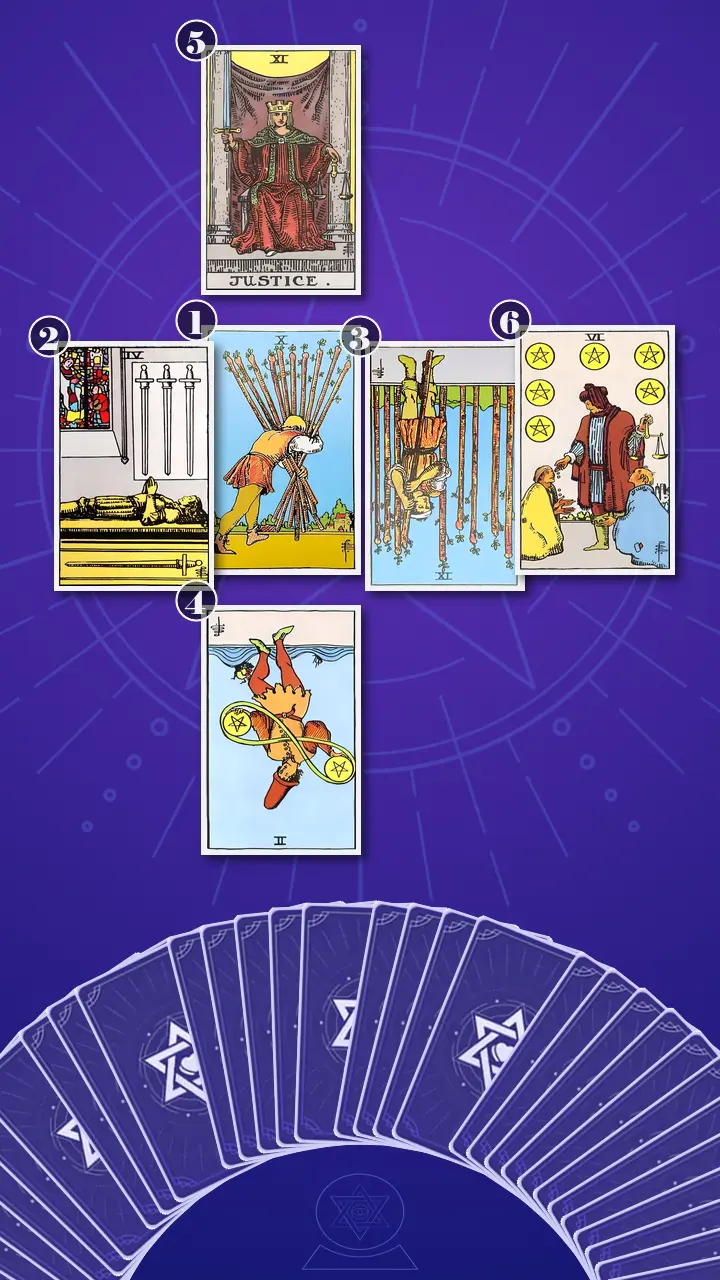
For you reading this: the Decision Cross is one of my favorite tools for a two-option career crossroads, especially when burnout is distorting the lens. It holds the present pressure (why this feels urgent), places the two paths side-by-side (so we stop pretending one choice will magically solve everything), reveals the hidden loop keeping you stuck, then gives you a decision standard and a grounded next step. Minimal structure, maximum honesty.
“Here’s what matters most in this layout,” I added, tapping the space where the cards would land. “The center card shows what’s making this decision feel urgent in real life—not in theory. The left and right cards show what each option actually feels like in your week. And the card above the center? That’s your criterion—the thing you choose by when your brain is done bargaining.”
Reading the Map: What Burnout Has Been Editing Out
Position 1: The current, observable burnout load
“Now I’m turning over the card that represents what is making the decision feel urgent right now.”
Ten of Wands, upright.
I didn’t have to reach for drama. This card is already a whole body posture: someone bent forward, carrying too much, with the load blocking their view.
“This is like,” I said, and I made sure to keep it specific, “it’s 6:20 p.m. and you’re still at your desk doing ‘one last’ deliverable because you’re the fixer. Your Slack is full of small asks, your calendar is stacked, and you can’t even picture what a livable week feels like—only what you have to carry to get to Friday. The decision about the 4-day week feels urgent because you’re already operating past capacity.”
The energy here is excess: too much responsibility, too much grit, too long. Not because you’re incapable—because you’ve been reliable in a system that rewards endurance.
Jordan gave a short, bitter laugh. “That’s… yeah. That’s too accurate. Almost rude.”
“I get it,” I said, and I let that land without defensiveness. “But the rudeness is the point. Ten of Wands doesn’t negotiate with your calendar. It just tells the truth: you’re making a major decision while your capacity is already overdrawn.”
Position 2: Option A — accepting the 4-day week offer
“Now I’m turning over the card that represents the lived reality of accepting the 4-day week offer—not the fantasy version, the real one.”
Four of Swords, upright.
This was the first moment her face changed—like a room getting slightly quieter when someone closes a door.
“The Four of Swords is rest as a container,” I said. “Not leftover time. Not ‘if I earn it.’ It’s a planned pause.”
Then I anchored it where her life actually lives: “You accept the 4-day week and you actually protect the day—phone on Do Not Disturb, no ‘quick check,’ no errands-first trap. By mid-afternoon your nervous system stops buzzing, and you realise your thinking is clearer when you’re not in constant reaction mode. The trade-off isn’t only money—it’s whether you can tolerate rest without translating it into ‘I failed.’”
The energy here is balance returning—but only if the boundary is real. I’ve seen so many people take a four-day schedule and then quietly leak work into the “day off” like a cracked bottle. The card is basically warning: protect it, or it won’t protect you.
I asked, “If you took the 4-day week, what would you protect on that extra day so it doesn’t turn into errands and catch-up work?”
She swallowed. “I’d… want to not be reachable. Even saying that makes me feel edgy.”
“That edge is data,” I said. “Not a moral failing.”
Position 3: Option B — keeping the current role
“Now I’m turning over the card that represents the lived reality of keeping your current role—including what stays unchanged and what it costs in energy.”
Nine of Wands, reversed.
This card always looks like someone bracing. Reversed, it’s the moment your body quietly admits: I can’t brace forever.
“Here’s the modern version,” I said, keeping my words tight like the card’s posture: “You keep the current role as-is. The pay stays, but so does the constant bracing: every new request feels like a hit, you’re defensive before anything even happens, and you’re running on fumes. You tell yourself you can handle it, but your patience, sleep, and relationships keep paying the bill.”
The energy is a deficiency—not of strength, but of resilience. Like a phone that technically turns on, technically runs apps, but the battery percentage is a threat all day.
And this is where I used the split-screen I keep in my own mind for burnout decisions:
Screen One: Wednesday, 4:12 p.m. A new “quick sync” lands. Your stomach drops like you missed a step on the stairs. You accept instantly. You’re half-working, half-resisting. “Tiny question,” someone pings, and your whole body reacts like it’s a threat.
Screen Two: Midnight. Spreadsheet open. Two salary scenarios. Bank app. Rightmove “just to see.” Your eyes sting. Your brain is loud and foggy at the same time.
Constant bracing. Constant juggling. And your jaw—your body’s little lie detector—clenched through both screens.
Jordan nodded once, tight. Then exhaled like she’d been holding it since Monday.
Position 4: The hidden influence keeping you stuck
“Now I’m turning over the card that represents the hidden loop maintaining the choice paralysis.”
Two of Pentacles, reversed.
“Recalculating at midnight feels responsible—until you realise it’s also a nervous system loop,” I said, and I watched her shoulders drop half an inch at being named without shame.
Then I used the scenario exactly where her life gets sticky: “You’re stuck because you’re trying to keep every variable open: salary, savings rate, rent fear, career status, team perception, personal life—so you spin between tabs and never land. The hidden driver isn’t a lack of intelligence; it’s the fear that if you drop one ball, you’ll lose control of stability. The mental load of juggling is part of the burnout.”
The energy here is blockage through over-motion. Movement without progress. Like toggling between apps when you’re anxious: your thumb is busy, but nothing changes.
I asked her, “When you imagine choosing the lighter schedule, what’s the exact fear-script that plays—‘They’ll think I’m ___’?”
She didn’t hesitate. “Replaceable.”
There it was. Not laziness. Not lack of ambition. Fear of losing leverage—fear that rest costs respect.
When Justice Spoke: The Sentence That Changed the Decision
Position 5: The decision criterion (the standard that clarifies the choice)
As I reached for the next card, the room got strangely still—like the pause right before a film cuts from montage to the scene where someone finally tells the truth.
“Now I’m turning over the card that represents what you need to consider most—your criterion.”
Justice, upright.
Her eyes flicked to the scales in the image and stayed there. London noise filtered through the window—distant traffic, someone’s laugh on the street—and somehow it made the quiet between us feel more deliberate.
I grounded it in modern language: “This is the moment you stop asking, ‘Which option makes me look ambitious?’ and start asking, ‘What’s a fair exchange between my labour, my pay, and my health?’ You write a simple decision standard—needs, boundaries, values—and treat it like a policy.”
The energy here is balance—but not the kind that comes from pleasing everyone. The kind that comes from clear standards.
This is also where my own brain does what it always does: it reaches for art. I’m an artist; I think in frames. When I see Justice, I don’t just see “be fair.” I see composition—structure that holds under pressure.
“I want to show you something I use with clients,” I told her. “I call it my Mondrian Grid Method—like the abstract painter who made clean grids with bold lines. When your mind is spinning, you don’t need more thoughts. You need fewer boxes.”
In my notebook, I drew a simple grid: Money, Workload/Scope, Recovery, Respect/Perception. “Justice is asking you to stop treating this like vibes and start treating it like a contract you’re allowed to negotiate.”
The Aha Moment
Setup: It’s that moment at 11:47 p.m. when you’re half-asleep, half-working—Slack on one tab, your budget on the other—trying to prove to yourself that whichever choice you make won’t make you “less.”
Delivery:
You’re not choosing between ‘weak’ and ‘strong’; you’re choosing what’s fair—hold the scales like Justice and let truth, not fear, set the terms.
I let the sentence sit there for a beat. No rush. No extra explanation to protect her from it.
Reinforcement: Jordan’s reaction came in layers—always does when something lands cleanly. First, a tiny freeze: her breath caught and her fingers stopped fidgeting with the ring on her thumb. Then her gaze unfocused, like she was replaying a week in fast-forward: the “quick sync,” the after-hours pings, the spreadsheet, the cancelled plans. Finally, her shoulders softened downward, and her mouth opened on a sound that wasn’t quite a laugh and wasn’t quite a sob—more like relief finding a crack to escape through.
“But if I do that,” she said, and there was a flash of anger under the fear, “doesn’t it mean I’ve been wrong? Like I’ve been… letting them take too much?”
“It means you’ve been surviving inside terms you never got to renegotiate,” I said. “That’s not ‘wrong.’ That’s late-stage capacity. Justice isn’t here to shame you—it’s here to give you a clean line.”
I followed the structure I trust when someone’s nervous system is on the edge. “Set a 10-minute timer and write one ‘Fair Trade’ sentence: ‘Given my workload and my body, fair would look like ____.’ If you feel your chest tighten or your brain start bargaining, pause—hand on jaw/shoulder, one breath—then choose the smallest truthful version of the sentence. You can stop at any time; this is just collecting clarity, not forcing a decision.”
Then I asked, exactly when the insight was still warm: “Now, with this new frame—fairness, not identity—can you think of a moment last week when this would have changed how you felt?”
She blinked hard. “Thursday. Pret. Rent notification. And a coworker asked for a ‘quick thing’ at like 6:40. I said yes before I even read it.”
“That’s the shift,” I said quietly. “This isn’t only about choosing a schedule. It’s moving from fear-driven overcommitment and rumination to values-led calm resolve and sustainable boundaries.”
Position 6: The grounded next step (how the choice becomes livable)
“Now I’m turning over the card that represents the probable direction if you follow Justice—what turns clarity into a structure.”
Six of Pentacles, upright.
Two cards with scales in the same reading is never subtle. It’s the tarot equivalent of an echo in a hallway: terms, terms, terms.
“This is reciprocity,” I said. “Measurable exchange. You don’t silently absorb the cost.”
I brought it into a concrete scene: “You walk into the conversation with a proposal—what you can deliver in four days, what drops, and how you’ll measure success. Think: trial period and a check-in date. Or, if you keep the role, you still redesign the exchange—clear after-hours boundaries, meeting-free blocks, scope clarity—so you’re not paying for ‘stability’ with your entire life.”
The energy here is balance made practical. Fairness you can point to on a calendar. Fairness you can put in writing.
I added the line I always want people to tattoo on the inside of their forehead before any reduced-hours agreement: “If the hours change but the scope doesn’t, you’re just taking a pay cut to do the same job.”
Jordan’s eyes widened in immediate recognition. “That’s exactly what I’m scared of.”
“Good,” I said. “Then we already know what we’re negotiating against.”
From Insight to Action: A Fair-Deal Framework You Can Use This Week
I pulled the whole spread into one simple story for her: Ten of Wands says you’re overloaded, which is why every option feels expensive. Four of Swords shows what the four-day schedule could actually offer—real recovery—if it’s protected. Nine of Wands reversed warns that staying as-is keeps you in constant bracing mode until your resilience cashes out. Two of Pentacles reversed reveals the trap: you’re trying to keep every variable open, and the spinning itself is draining you. Justice says, “Choose by fairness, not by fear.” Six of Pentacles says, “Then put the fairness into terms.”
The cognitive blind spot was clear: Jordan was treating external expectations as fixed, and her own capacity as negotiable. But burnout doesn’t negotiate; it collects interest.
The transformation direction, then, was equally clear: from “I need the most secure-looking option” to “I choose the option I can sustainably live inside, and I negotiate the terms like my energy is a real resource.”
To make that real, I gave her three small, low-friction next steps—practical enough to do even when you’re tired:
- Write your ‘Fair Trade’ sentence (15 minutes)Open Notes on your phone and write one sentence defining what’s fair right now (money + workload + recovery). Example: “Full scope doesn’t fit in four days; if I go to four days, we reduce scope and protect one no-meetings block.”Set a timer for 15 minutes. Write messy. Stop when it goes off—your brain will try to bargain; treat that as noise, not truth.
- Use the “three fixed numbers” rule (10 minutes)At the top of your spreadsheet, write: (1) minimum monthly needs, (2) minimum savings target, (3) maximum weekly work-hours boundary. Don’t run any scenario that breaks those numbers—no exceptions.If you catch yourself tweaking groceries by £20 at midnight, pause and ask: “Am I planning—or am I soothing?” Then close the laptop for five minutes.
- Draft the negotiation message + practice a 2-minute pitchDraft a one-paragraph email: what you can deliver in four days, what would drop, and one term you want (6–8 week trial period with a check-in date, or a meeting-free block, or no after-hours expectation). Then say it out loud once like you’re doing Oscars Speech Training—two minutes, clear, no apologising.Use Six of Pentacles language: “If X stays, then Y goes.” If your voice shakes, it’s not proof you’re wrong—it’s proof you’re doing something new.
I also told her something I’d tell anyone stuck in a burnout decision spiral: “Negotiation isn’t a confession. You don’t owe anyone your private anxiety math. You’re allowed to ask for structure.”

A Week Later: The Quiet Proof
A week later, Jordan messaged me a screenshot—not of a spreadsheet, but of a calendar block titled OFFLINE, protected like it mattered. Under it, one sent email draft to her manager with three bullet points and a proposed 8-week trial. “I felt sick hitting send,” she wrote, “and then I slept. Like, actually slept.”
In the morning, she said her first thought was still, What if I’m making a mistake? But this time, she added, “Then I read my ‘fair’ sentence again and my jaw unclenched.”
That’s the Journey to Clarity I trust most: not certainty, but ownership. Not proving, but choosing. Not endurance, but a fairer deal you can live inside.
And if you’re exhausted enough that even the idea of rest triggers money math and fear about how you’ll be judged, it’s not indecision—it’s your body asking for a fairer deal than “keep proving it.”
If you let “fair” be your compass for one week—not perfect, not impressive—what’s the smallest term or boundary you’d want your work life to respect?
Author Profile